Category: Climate & Energy

Research branch

  • A smooth move or a tough transition? Protecting workers who’ll lose their jobs when the Eraring Power Station closes

    A smooth move or a tough transition? Protecting workers who’ll lose their jobs when the Eraring Power Station closes

    Share

    The Centre for Future Work at The Australia Institute has urged the federal government to take charge of transitioning hundreds of workers into secure employment when the Eraring Power Station shuts down.

    The power station is scheduled to close by August 2027. More than 1000 workers will be directly impacted by the closure.

    This is an important test in Australia’s transition from fossil fuel power to renewables.

    The Centre for Future Work has written a submission to the Net Zero Economy Agency (NZEA) urging it to apply its Energy Industry Jobs Plan to the Eraring closure, to avoid inflicting undue pain on workers currently employed at the power station.

    In the submission, it argues that this important process should not be left solely to the power station owner, Origin Energy, but managed under the Energy Industry Jobs Plan, which was set up for this precise purpose.

    “We hear a lot about how the transition to a clean energy future involves helping workers in the coal and gas industry secure jobs when theirs disappear,” said Charlie Joyce, Researcher, Centre for Future Work at The Australia Institute.

    “To help this process, the government set up the Net Zero Economy Authority, which established an Energy Industry Jobs Plan, designed specifically to support workers who’ll lose their jobs when coal and gas power stations close down.

    “Well, now the nation’s biggest coal-fired power station is closing down. It’s time for this plan to deliver.

    “Origin has made some noise about helping workers with retraining and career counselling, but that’s not enough. This impacts far more than those employed directly by Origin Energy. It requires coordination with industry, unions, and the broader community.

    “The nation will be watching how the Eraring closure unfolds. This is an important test for transitioning workers into good, secure jobs.

    “It would be senseless for the Net Zero Economy Authority not to use its Energy Industry Jobs Plan in this situation.  This is what it was set up to do.”


  • Australia’s Gas Use On The Slide

    Australia’s Gas Use On The Slide

    by Ketan Joshi

    Share

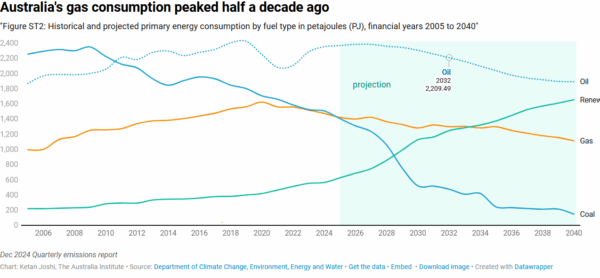
    The Federal Government has released a new report that includes projections of how much gas Australia is set to use over the coming decades. There is no ambiguity in its message: Australia reached peak gas years ago, and it’s all downhill from here:

    “Gas consumption is projected to decline to 2040 as electrification increases across the economy and renewables and storage take an increasing share of electricity generation”, wrote the Department of Climate Change, Energy, Environment and Water (DCCEEW).

    This doesn’t sit well with the Prime Minister’s recent claims that more gas is needed for “firming” renewable energy. Figures from the Australian Energy Market Operator (AEMO)’s 2024 Integrated System Plan (ISP) show just how little gas is likely to be required in Australia’s electricity system.

    In AEMO’s ‘step change’ scenario, there isn’t a single year where gas generates more than its historical peak in the National Electricity Market. In this scenario, more gas was burned in the past 16 years than is burned over the next 25 years.

    In short: while gas might serve occasional use during low wind and sun periods, Australia simply will not end up using large amounts of it.

    It is weird, then, that Australia has a massive pipeline of planned fossil gas extraction projects. Many of them are justified on the grounds that they’re required to help Australia decarbonise its power grids, with more than 1,000 new petajoules coming online by 2027, according to the latest government projects report.

    The chart below compares the above projections of Australia’s domestic gas use to projections of the volume of gas exports, prepared by the separate Department of Resources and Energy (DISER). It makes it pretty clear where all the new gas is going – exports.

    Only looking at new gas production capacity, and only looking at the proportion that has a clear operation date, that is still around 11 times the amount of gas projected to be used in the power sector. In fact, the use of LNG for FY23 was greater just for processing LNG than the entire power sector in Australia:

    This analysis by climate expert Tim Baxter lays it out in even more detail.

    “Again, more than 3,000 petajoules of gas were exported from Western Australia in 2022–23. If the entire transition to clean energy were to stand dead still as if renewables weren’t already going gang-busters — in Western Australia renewable energy generation has increased by an average of 20% each year for the past five years — we would need just 2.5% of that gas to keep the lights on for the state”.

    It is pretty simple: Australia does not need to be expanding its fossil gas production, least of all to run fossil gas power stations. It’s a hollow fossil fuel industry talking point, and the Federal Government should know better than to repeat it.


    You might also like

    Centre For Future Work to evolve into standalone entity

    The Centre for Future Work was established by the Australia Institute in 2016 to conduct and publish progressive economic research on work, employment, and labour markets. Supported by the Australian Union movement, the centre produced cutting edge research and led the national conversation on economic issues facing working people: including the future of jobs, wages

  • Dutton’s nuclear push will cost renewable jobs

    Dutton’s nuclear push will cost renewable jobs

    by Charlie Joyce

    Dutton’s nuclear push will cost renewable jobs

    As Australia’s federal election campaign has finally begun, opposition leader Peter Dutton’s proposal to spend hundreds of billions in public money to build seven nuclear power plants across the country has been carefully scrutinized.

    The technological unfeasibility, staggering cost, and scant detail of the Coalition’s nuclear proposal have brought criticism from federal and state governments, the CSIRO, the Climate Council, the Electrical Trade Union (ETU), the Climate Change Authority, the Australia Institute, and independent energy experts.

    The CSIRO, among others, has refuted the Coalition’s claim that nuclear will be cheaper than renewables; instead, they have shown the energy produced by Australian reactors would cost approximately eight times more than the same amount of energy produced by renewables. If this cost is passed on to consumers, the average household would pay $590 per year more on their power bill. Unsurprisingly, Australia Institute polling has found that fewer than one in twenty Australians (4%) are prepared to pay this nuclear premium.

    The cost alone should be enough to bury this nuclear proposal. But it is also important to recognise how the Coalition’s plan will impact – and fail – workers.

    False promises

    The Coalition has proposed that large nuclear reactors would be built on the sites of five operational or recently decommissioned coal fired power stations: Liddell and Mount Piper in New South Wales, Tarong and Callide in Queensland, and Loy Yang in Victoria. In doing so, the Coalition has promised that nuclear energy would be a source of stable and plentiful work for the communities where coal-fired power plants are phasing down.

    This is a false promise. Six coal fired power stations have already closed in the past decade, with 90% of Australia’s remaining coal-fired power stations set to close in the next decade. These communities are already undergoing structural adjustment, and they need new sources of employment now. But this is not what the Coalition’s plan delivers. The Coalition outlines that the first two nuclear reactors would not come online until the mid-2030s – more than a decade from now – while the remainder would be completed by 2050.

    And energy and technology experts agree that even this timeline is impossible. On average, a nuclear reactor takes 9.4 years just to build in countries with established and capable nuclear industries. Former Australian Chief Scientist Alan Finkel has estimated that it would take until the mid-2040s at the earliest for Australia to build an operational nuclear reactor. Moreover, analysis from the Institute for Energy, Economic & Financial Analysis (IEEFA) has found that, in economies comparable to Australia’s, every single nuclear reactor project experienced multi-year delays and cost blowouts of up to three and a half times over budget. It is hard to see how Australia, which lacks the experienced workforce, training and research base, or regulatory framework, would buck this trend.

    Lost jobs

    While the Coalition’s nuclear plan would not bring jobs to the communities that need them, it might have the real effect of depressing investment in renewables.

    Renewable energy already generates approximately 40% of Australia’s energy and is by far the cheapest form of electricity. Renewable energy industries already account for the employment of tens of thousands of workers, and Jobs and Skills Australia estimates that approximately 240,000 new workers will be required in industries associated with clean energy by 2030.

    But this requires ongoing and expanding investment in renewables, which the Coalition’s nuclear policy is likely to derail. The Clean Energy Council has estimated that by capping renewable energy to 54% of total use (as the Coalition’s modelling has assumed), 29GW of renewable energy generation projects would not be built – squandering an expected 37,700 full-time-equivalent construction jobs and 5,000 ongoing jobs in operations and maintenance. By limiting renewables investment, prolonging fossil fuel usage, and diverting investment towards nuclear energy, the full employment opportunities of the renewable energy transition are lost.

    Scarce and dangerous work

    If the Coalition’s nuclear plan does come to fruition it will hardly create any ongoing jobs for the communities that have undergone structural readjustment. According to analysis from the Nuclear Energy Agency, while the peak period of construction of the average 1GW nuclear power plant can demand up to 3,500 workers, ongoing operations and maintenance will only require about 400 workers – with only a quarter of these being onsite blue-collar jobs that might provide work for the people who will have lost jobs with the closure of coal-fired power stations. Most jobs will be in administration, regulatory compliance, energy, marketing, sales, science and emergency personnel – and many of them are likely to be located away from the nuclear facility itself.

    Disturbingly, any jobs on-site may put the health of workers at risk. Recent analysis of multiple studies of the health impacts of nuclear power plant employment across multiple countries found that workers have a significantly higher risk of mesothelioma and circulatory disease due to exposure to radiation. Nearby residents also exhibit a significantly higher risks of cancer, with children under the age of five at particular risk. And this does not even factor in the risk of sudden plant failure and reactor meltdown on workers and communities – a risk sharpened by the Coalition’s plan for these reactors to be built on geological fault lines with heightened earthquake risk.

    Australian workers have much to gain from the renewable energy transition, including cheaper power, new clean technology industries, and hundreds of thousands of new jobs. The Coalition’s nuclear plan only brings false promises, lost jobs, and – if the plan comes to fruition – few jobs and potentially dangerous work.


    You might also like

  • Commonwealth Budget 2025-2026: Our analysis

    Commonwealth Budget 2025-2026: Our analysis

    by Fiona Macdonald

    Share

    The Centre for Future Work’s research team has analysed the Commonwealth Government’s budget, focusing on key areas for workers, working lives, and labour markets.

    As expected with a Federal election looming, the budget is not a horror one of austerity. However, the 2025-2026 budget is characterised by the absence of any significant initiatives.
    There is very little in this budget that is new, other than some surprise tax cuts, which are welcome given they mostly benefit people on low incomes

    There are continuing investments in some key areas supporting wages growth where it is solely needed and for rebuilding important areas of public good. However, there remains much that needs to be done in the next parliament, whoever is in government.

    “The budget does deliver a welcome tax cut targeted towards those on low incomes” Chief Economist Greg Jericho notes, “but the lack of new spending and initiatives highlights the need for policies from all political parties in the coming election campaign that address inequality and the needs of people who have been most hurt by cost of living rises over the past three years.”

    Read our full budget briefing paper for more information


    Related research

    You might also like

    Dutton’s nuclear push will cost renewable jobs

    by Charlie Joyce

    Dutton’s nuclear push will cost renewable jobs As Australia’s federal election campaign has finally begun, opposition leader Peter Dutton’s proposal to spend hundreds of billions in public money to build seven nuclear power plants across the country has been carefully scrutinized. The technological unfeasibility, staggering cost, and scant detail of the Coalition’s nuclear proposal have

  • Climate crisis escalates cost-of-living pressures

    Climate crisis escalates cost-of-living pressures

    How climate change inaction drove up the cost-of-living
    by Jack Thrower

    Important components of the cost-of-living crisis are a direct result of the climate crisis.

    Failure by policy makers to factor in the impacts of climate change on the cost of living, will limit the government’s ability to address it. Each year we fail to mitigate emissions is another year we bake in cost-of-living pressure in the future.

    Key among these price impacts are the cost of insurance, food and energy. Collectively, food and insurance account for more than a fifth of the consumer price inflation Australia has experienced since 2022.

    Insurance – As the climate has destabilised, the increase in natural disasters has led to an increase in payouts for insurance companies and an increase in premiums for homeowners.

    One in 20 Australian households now pay more than seven weeks of gross income on home insurance. In other words, these households work from New Year’s Day to late February, just to pay their home insurance.

    Increases in insurance premiums have hit certain regional areas particularly hard, where average household incomes are lower than urban areas while premiums are higher.

    The price of insurance in many areas of Australia have already become prohibitively expensive. As continued global heating and more frequent disasters make these problems worse, whole suburbs or towns will become uninsurable.

    Food – Food prices have soared by about 20% since 2020. The planet’s changed weather patterns have impacted food production and, in some areas, permanently affected a region’s ability to grow particular crops. Climate impacts mean that even if Coles and Woolworths stop price gouging, food prices will keep rising.

    Energy – Australia’s energy system is complex. Underinvestment in the transition to renewables and tying ourselves to international pricing mechanisms by exporting fossil fuels has resulted in high local electricity prices for Australian households. Even if we were to decouple ourselves from this, energy prices would continue to be impacted as more climate disasters damage vital public infrastructure.


    Full report


    Factsheet
    Climate crisis escalates cost-of-living pressures

    Share

  • Climate crisis escalates cost-of-living pressures

    Climate crisis escalates cost-of-living pressures

    Share

    A new report has found direct connections between the climate crisis and rising cost-of-living pressures. Failure to lower emissions now will only aggravate the crisis, with each moment of inaction compounding the pressure on households.

    The report identifies three key areas where the climate crisis is directly driving up costs for Australians: insurance, food, and energy.

    These sectors combined have accounted for over a fifth of the consumer price inflation experienced in Australia since 2022.

    Key findings:

    • Insurance premiums have soared due to an increase in natural disasters, with some households now spending over seven weeks of gross income just to cover home insurance
    • Food prices have risen by 20% since 2020, with climate-related disruptions wiping out harvests and making it harder for some regions to grow food
    • Energy costs remain high due to a reliance on fossil fuels, underinvestment in renewables, and fossil fuel exports forcing Australians to compete with the global market for Australia’s resources
    • The impacts of the climate crisis are disproportionately affecting lower-income and regional households, who are already feeling the financial strain more severely

    The report underscores the need for urgent climate action to protect Australian households from these escalating costs. Addressing the root causes of climate change is essential to lowering future risks and alleviating the economic strain that millions of Australians are facing.

    “Insurance costs keep on rising and, while competition across big business sectors is needed, the thing that is driving insurance costs is climate change,” said Richard Dennis, Executive Director at The Australia Institute.

    “The only way to keep insurance costs down is to keep fossil fuel emissions down. The more we heat the climate, the more expensive storms, floods and fires will be and, in turn, the more insurance will cost. It’s time we started to tax the fossil fuel companies to fund the damage that their previous emissions are already causing.”

    As the world’s second-largest fossil fuel exporter and fifth largest producer, Australia’s actions are making a significant contribution to the problem.

    “The increasing frequency and severity of natural disasters driven by climate change have resulted in higher payouts for insurance companies and rising premiums for homeowners,” said Mark Ogge,  Principal Advisor at The Australia Institute.

    “One in 20 Australian households now spend more than seven weeks’ worth of gross income just to pay for home insurance and in many regional areas, where household incomes are lower, the burden is even heavier.

    “As climate change continues to fuel more frequent disasters, entire suburbs or towns could become uninsurable.

    “Food prices have also surged and in some regions growing certain crops is becoming harder and harder, making food insecurity worse, and even without price-gouging by retailers like Coles and Woolworths, prices are expected to keep rising due to the ongoing climate crisis.”

    “Meanwhile, Australia’s energy sector keeps using expensive fossil fuels and there is serious underinvestment in renewable energy solutions which provide far cheaper electricity

    “Exposure to global prices for fossil fuels due to coal and gas exports has driven up local electricity costs and even if Australia moves away from international pricing, the continued risk of climate disasters damaging critical infrastructure will ensure that energy prices remain high for the foreseeable future.”


    Related documents


    Cost-of-living and the Climate Crisis

    Related research

  • An Industrial Strategy for Domestic Manufacturing of Onshore and Offshore Wind Energy Towers and Equipment

    An Industrial Strategy for Domestic Manufacturing of Onshore and Offshore Wind Energy Towers and Equipment

    by Phillip Toner

    Australia could create more than 4300 quality direct jobs by making its own wind towers instead of importing them, according to new research by the Centre for Future Work. At present, all wind towers installed in Australia are imported from overseas with most coming from China.

    The report, by Professor Phil Toner (Honorary Senior Research Fellow in the Department of Political Economy at the University of Sydney) found a domestic wind energy sector would generate:

    ●      4,350 ongoing jobs in wind tower manufacturing, and thousands more in input industries, especially steel

    ●      Output of over 800 towers per year, with cumulative value of up to $15 billion over the next 17 years

    ●      Incremental demand for up to 700,000 tonnes of Australian-made steel per year, creating a foundation for the recapitalization of Australian steel plants with carbon-free technologies

    ●      Avoiding 2.6 million tonnes of CO2 emissions thanks to reduced sea shipping of imported wind towers

    Wind energy manufacturing represents a prime opportunity to apply the new policy tools of the federal government’s Future Made in Australia manufacturing strategy.

    The report makes several recommendations, including:

    • The federal government in co-operation with state governments and industry should commission an engineering and financial study into the optimal location, plant size, plant playout, advanced production equipment and minimum scale of output required to establish competitive tower manufacturing on the east coast of Australia (where onshore and offshore wind farm activity will be intense for decades).
    • State and federal government local content plans for renewable energy generation should prescribe specific proportions of domestic content in private and public procurement of wind energy equipment – harmonised across states to improve efficiency in domestic wind tower manufacturing.
    • A public-private planning authority should be established to strengthen linkages between investments in renewable energy supply and parallel investments in green steel production, using steady demand for wind tower manufacturing (and resulting supply of non-carbon electricity) to validate investments in decarbonised steel production.
    • The Scope 3 emissions embodied in imported towers (both in offshore manufacturing and then shipping of those towers to Australia) should be fully reflected in decisions regarding sourcing.


    Full report

    Share

  • Webinar: Stop passing the buck -Workers’ compensation and ‘gig’ workers

    Webinar: Stop passing the buck -Workers’ compensation and ‘gig’ workers

    by Lisa Heap

    Share

    Workers’ compensation and rehabilitation are amongst the most important legal issues facing the ‘gig’ economy. This reflects the potential vulnerability of these workers and their families, co-workers, and community to harsh and long term consequences from injuries. For a while, it looked like federal industrial policy might ‘solve’ the workers compensation problem by redefining ‘gig’/platform workers as employees.

    However, the policy decision to enshrine minimum rights for a separate ‘employee-like’ category of workers leaves gig workers outside the scope of workers compensation protections.

    In this discussion we will hear from those researching and advising on the reforms necessary to better protect injured gig workers, a worker who has been seriously injured, and those who are organising and advocating for policy and law reform.

    Free Event – Register Now

    Speakers:

    • Michael Kaine – National Secretary Transport Workers’ Union
    • Professor Emeritus David Peetz – Carmichael Centre’s Laurie Carmichael Distinguished Research Fellow.

    When:
    Thursday, July 18, 2024 at 12:30 pm AEST

    Where:
    Zoom


    You might also like

    Dutton’s nuclear push will cost renewable jobs

    by Charlie Joyce

    Dutton’s nuclear push will cost renewable jobs As Australia’s federal election campaign has finally begun, opposition leader Peter Dutton’s proposal to spend hundreds of billions in public money to build seven nuclear power plants across the country has been carefully scrutinized. The technological unfeasibility, staggering cost, and scant detail of the Coalition’s nuclear proposal have

  • “I studied economics to better understand the world and equip me with better tools to serve society”

    “I studied economics to better understand the world and equip me with better tools to serve society”

    Share

    Prof Anis Chowdhury, an Associate of the Centre for Future Work, was recently appointed Emeritus Professor at Western Sydney University, in honour of his decades of influential work in progressive macroeconomics and development economics. Prof Chowdhury’s address on occasion of his installment provides an overview of his evolution as a progressive economist and significant impact on global policy:

    Installment Address, Emeritus Professor Anis Chowdhury, Western Sydney University, June 2024

    Chancellor, Deputy Vice-Chancellor, colleagues, guests, ladies and gentlemen – and of course, graduands.

    Thank-you Deputy Vice-Chancellor for your generous introduction. My sincere thanks to the Board of Trustees for approving me for this prestigious title.

    I recognise the Traditional Custodians of the lands where our campuses are located, and pay my respects to all First Nations Elders past and present.

    I join my voice to all calls to honour their right to self-determination and development, as enshrined in the landmark 2007 UN Declaration on the Rights of Indigenous Peoples.

    Incidentally, at the UN, the first report I provided significant input into, was State of the World’s Indigenous Peoples 2009, and drafted, was Report on the World Social Situation 2010.

    My passion for human rights, equity and justice is the product of my time. I was born in 1954, a year before the leaders of newly-decolonised Africa and Asia met in solidarity in Bandung, Indonesia.

    Indonesia’s founding President Soekarno reminded, “our unhappy world [is] torn and tortured, … because the dogs of war are unchained once again”.

    He called for “Moral Violence … in favour of peace”, to “demonstrate to the minority of the world … that we, the majority, are for peace, not for war”.

    At school in the 1960s, we were constantly inspired by calls against all forms of discrimination, violence and exploitation in favour of peace, humanity and social justice.

    Despite the wave of decolonisation, we remembered Soekarno’s warning: colonialism “was not dead”. Instead, it took “its modern dress … It is a skilful and determined enemy, … appears in many guises… [and] does not give up its loot easily”.

    In solidarity with Franz Fanon’s ‘Wretched of the Earth’, I was a student activist, joining protest movements against the Vietnam War, Indonesia’s invasion of East Timor and India’s annexation of Sikkim; condemning the murders of the likes of Che Guevara and Salvador Allende; demanding the end of apartheid in South Africa; and joining Bangladesh’s liberation war.

    Today, my involvement in these movements would be labelled as “radicalism”; back then, it was the norm.

    I studied economics to better understand the world and equip me with better tools to serve society. My father, a doctor, readily agreed, socio-economic ills are the root cause of many diseases.

    In universities in the 1970s, dissent and debate were encouraged as ways to develop humanist and universalist views; to think big; and to become movers and shakers. We were inspired by world leaders like Gough Whitlam, and Tanzania’s freedom leader Julius Nyerere. Of course, Nelson Mandela stood tall.

    The 1970s were significant.

    • Bangladesh became an independent nation in 1971.
    • In 1972, the Club of Rome warned of the unsustainability of current consumption and production.
    • In 1974, the UN called for a “New International Economic Order” to end economic colonialism.
    • And the people of Vietnam defeated the US superpower in 1975.

    Alas, the 1980s slid us backwards, commodifying everything, including education. Universities turned into mass degree factories, and economics moved from the social science faculty, to business schools.

    Unfortunately, it was not just ‘Gordon Gekko’, but a Nobel Laureate economist, Milton Friedman, who promoted the idea that “greed is good”.

    Then came wars instigated by lies, against the urging of the UN Security Council; and the gleeful murder of half a million children as “collateral damage” justified as “a price worth paying”.

    We started this decade with rich nations stockpiling Covid-19 vaccines and blocking poor countries’ access to drugs, testings and vaccines to protect big pharma profits.

    Now, we’ve descended to the lowest point of our post-war history, with the massacre of over 40,000 Palestinians – mostly women and children – and those in high office openly calling for the total annihilation of a colonised people. The ICC and ICJ are threatened by the leaders of the free world acting like a mafioso cartel.

    How much lower can we descend?

    Has civilization progressed at all?

    We cannot resolve our differences with dialogue; and modern killing machines have replaced sticks and stones where might is right.

    Have I lost hope? NO.

    I look at the bright moments like Bob Hawke’s leadership of the anti-apartheid BDS movement that liberated South Africa and Nelson Mandela.

    Student protests and encampments for Gaza all around the world, including at Western Sydney University, maintain my faith in the power of active citizens.

    Under this “moral violence” for peace, universities are reconnecting with their essential humanity and their duty of care.

    As we celebrate our academic achievements today, we must also remember the students and teachers of Gaza’s razed universities.

    We must not lose sight of the real-world impacts of our academic pursuits. My knowledge of economics was enriched by my social and political activism. When I was in Indonesia to advise on the recovery from the Asian financial crisis and to draft National Human Development Report, I lived outside the gated community to understand the daily struggle of those who lost livelihoods.

    In 1970, Friedman wrote, “the social responsibility of business is to increase its profits”.

    Dear new business graduands, as I congratulate you, I also urge you to purge the world of this obnoxious Friedmanite idea that is destroying our planet and tearing our communities apart.

    Look instead to the “Social Business Model” of Bangladesh’s Nobel Laureate Muhammad Yunus.

    Work on the right side of history; stand up for justice and liberation; spread the “moral violence” for peace; and put people and planet before profit.

    Thank-you.


    You might also like

    Centre For Future Work to evolve into standalone entity

    The Centre for Future Work was established by the Australia Institute in 2016 to conduct and publish progressive economic research on work, employment, and labour markets. Supported by the Australian Union movement, the centre produced cutting edge research and led the national conversation on economic issues facing working people: including the future of jobs, wages

    Dutton’s nuclear push will cost renewable jobs

    by Charlie Joyce

    Dutton’s nuclear push will cost renewable jobs As Australia’s federal election campaign has finally begun, opposition leader Peter Dutton’s proposal to spend hundreds of billions in public money to build seven nuclear power plants across the country has been carefully scrutinized. The technological unfeasibility, staggering cost, and scant detail of the Coalition’s nuclear proposal have

  • The gas industry is laughing at us as they make more money but not more tax

    Originally published in The Guardian on February 29, 2024

    Despite soaring production and revenues the gas industry is not paying more tax

    Australia produces more than six times the amount of gas needed to supply our manufacturing industry, power stations and homes. But more than 80% either heads overseas as LNG exports or is used to convert natural gas into LNG:

    We export much more gas than we used to. In the 2000s we exported around 14m tonnes of LNG a year. Now, due to the opening of the Gladstone LNG terminal, we send 83mt overseas – the second most of any nation.

    But more production and more revenue has not led to more tax, even though the petroleum resources rent tax (PRRT) is in place to supposedly raise revenue from windfall profits such as those generated by the gas industry after the Russian invasion of Ukraine.

    When Australia exported 15.4mt of LNG in 2008-09, the government raised $2.2bn in PRRT. In 2022-23, exports had increased 437% to 83mt but PRRT revenue was up just 7% to $2.4bn.

    Did gas suddenly become unprofitable?

    No, the problem is that the PRRT is open to manipulation that enables companies to use costs to reduce their PRRT liability such that it appears they are never making “super profits”.

    In last year’s budget, the government finally proposed limiting the deductions to the PRRT in any year to 90% of LNG project revenues. Alas that proposal also had a punchline. The government announced the changes would raise an extra $2.4bn in PRRT over the next four years. That was roughly a 30% increase in tax.

    Thirty per cent!

    You would think the gas industry would launch the mother of all campaigns against it. But no. They loved it.

    The day it was announced the gas industry peak body recommended bipartisan support as the changes “would see more revenue collected earlier”. The key word was “earlier”. It won’t raise more tax; it just moves some tax from later to earlier.

    But it won’t even do that.

    In December’s midyear economic and fiscal outlook, the government announced it was revising down its estimate of how much PRRT would be raised over the next four years.

    How much did it reduce its estimate by?

    You guessed it: $2.4bn.

    We need to change the way the PRRT operates, we need to tax our gas more and we need to do it now.


    You might also like

    Australia’s Gas Use On The Slide

    by Ketan Joshi

    The Federal Government has released a new report that includes projections of how much gas Australia is set to use over the coming decades. There is no ambiguity in its message: Australia reached peak gas years ago, and it’s all downhill from here:

    Commonwealth Budget 2025-2026: Our analysis

    by Fiona Macdonald

    The Centre for Future Work’s research team has analysed the Commonwealth Government’s budget, focusing on key areas for workers, working lives, and labour markets. As expected with a Federal election looming, the budget is not a horror one of austerity. However, the 2025-2026 budget is characterised by the absence of any significant initiatives. There is