Author: annamations

  • Log of Extraordinary IR Measures During COVID-19 Shutdowns

    Log of Extraordinary IR Measures During COVID-19 Shutdowns

    by Alison Pennington

    COVID-19 containment measures have suspended large sections of the economy. Governments have committed over $220 billion in income supports to workers and firms. The $130 billion JobKeeper wage subsidy scheme is the most extensive “shock absorber” (with worrying exclusions of many casual and migrant workers). With the scheme now in place, assessment of the government’s COVID-19 measures is now shifting to implementation. This includes effects on the laws and regulations governing wages and how businesses and employees (and their unions) interact to determine the terms and conditions of employment.

    Despite enduring a heightened anti-union agenda, unions (headed up by ACTU) liaised early with government to secure the JobKeeper wage subsidy to prevent mass layoffs. Unions have negotiated with industry to adapt Awards and enterprise agreements (EAs) to new business conditions. The Coalition government has proceeded with significant changes to the Fair Work Act that could hamper efforts to drive an inclusive economic and labour market recovery. What’s more, the Morrison government has indicated it will continue its pre-COVID agenda to further weaken representation rights and minimum labour laws.

    To inform assessment of the impacts of COVID-19 on jobs, wages, and workplace protections, we have summarised major developments within the industrial relations system since March 2020. The log traces revisions to Awards, enterprise agreement-making rules, new instruments formed between unions and industry, major decisions by the Fair Work Commission, and ongoing lobbying efforts by business to weaken minimum labour laws. Links to relevant research from Centre for Future Work released during the crisis, or prior to, are provided. All log entries are reported in the industrial relations publication Workplace Express. Links to other media outlets are provided where relevant.

    If there are any major IR developments that we have not reported here please get in touch at futurework@tai.org.au.

    Thursday 17 September

    • The Fair Work Commission rejects a union application for a $5 per hour “COVID-19 care allowance” for disability workers attending to clients quarantining with COVID-19. While the FWC acknowledged that disability workers were more at risk of having to take paid or unpaid leave to self-isolate, they considered the circumstances in which the allowance would be paid “rare and temporary”, while also presenting an undue cost burden on employers dealing with real or potential COVID outbreaks. The Commission also noted concern that the decision would trigger further litigation, leading to “pressure for a flow-on to other employees and awards” to other sectors with the same circumstances including in hospital care, aged care, home care and crisis accommodation.

    Thursday 3 September

    • New legislation introduced by Morrison government granting more flexibility for parents of young children to vary how they use their 12 months’ unpaid parental leave under the National Employment Standards (NES). The NES entitlement presently requires 12 months unpaid leave to be used in one continuous period (with the employee forfeiting any unused leave if returning to work before 12 months is up). Under the proposed changes, all parents (primary and secondary carers) will be able to access 30 days of flexible unpaid leave of their 12 months’ quota, subject to agreement by their employer about how the leave can be used (e.g. reduced hours, single days, groups of days, or one single block). Primary carers currently eligible under the government’s parental leave scheme will be able to claim the minimum-wage parental leave payment from Services Australia for their 30 days of flexible unpaid parental leave ($753.80 per week). The proposed laws also provide for 12 months of unpaid parental leave for families who have experienced stillbirths, infant deaths and premature births.

    Wednesday 26 July

    • Morrison government introduces JobKeeper V2.0 legislation. The Bill establishes a new two-tiered JobKeeper payment scheme and an additional revenue test that expands access to JobKeeper-enabled exemptions to the Fair Work Act (FW Act) for employers no longer eligible for the wage subsidy. The emergency FW Act measures were introduced in April for businesses receiving JobKeeper, allowing employers to change workers’ hours, duties, days, and location of work, and direct employees to take annual leave. The new Bill allows businesses that fail the existing 30% revenue decline test to apply for FW Act exemptions under a new 10% revenue decline test to determine whether they’re still “distressed”. Employees in businesses that qualify for the revised revenue test for JobKeeper-branded FW Act exemptions can have their hours reduced by up to 40%, with worrying implications for large reductions in employee incomes. The legislation states that employers cannot require staff to work less than two hours a day, and must provide seven days’ written notice before a JobKeeper-enabling direction is given. The Bill adds that employers cannot unreasonably target certain categories of workers for hours reductions, compared with other employees also subject to the directions.
    • The new two-tiered JobKeeper payment replaces the flat $1,500/fortnight rate with $1,200/fortnight for employees who worked full-time prior to the pandemic (in February), and $750/fortnight for employees working less than 20 hours. From January 2021, payments will reduce again to $1,000 and $650, respectively. The scheme will be extended to March 2021.

    Monday 27 July

    • As COVID cases surge in Victoria’s aged care sector, the Fair Work Commission approves an application for two weeks paid pandemic leave for healthcare and social services workers required to self-isolate for coronavirus. The Commission originally adjourned the application on 8 July due to concerns the leave entitlement would cause private aged care providers financial difficulty. The new COVID-era paid leave entitlement expires in three months and applies to full-time and part-time workers, but only casual workers with “regular and systematic shifts”.

    Tuesday 21 July

    • Morrison government reveals JobKeeper wage subsidy payments will be reduced from late-September under a new two-tiered system paying $1,200 for employees who worked full-time prior to the pandemic, and $750 for those working less than 20 hours in February. In January 2021, payments will reduce again to $1,000 and $650, respectively. Employers must continue to meet turnover tests to be eligible for the scheme which will be extended to March 2021.
    • The federal government announces the JobSeeker coronavirus supplement will be reduced from $550 a fortnight to $250 per fortnight, extended only until December 2021. The $300 cut to the supplement coincides with an increase in the income-free threshold for JobSeeker payments from $106 per fortnight to $300 per fortnight. Means-testing and mutual obligations will be reintroduced on 4 August.
    • Cuts to the JobKeeper and JobSeeker programs will reduce government spending by $10 billion per month and reduce the number of employees covered by the wage subsidy by over 2 million by December. Research released by The Australia Institute shows cuts to JobSeeker will plunge 370,000 people into poverty, including 80,000 children.

    Friday 17 July

    • Prime Minister Scott Morrison announces intention to extend JobKeeper exemptions to the Fair Work Act for employers no longer receiving JobKeeper. The COVID-era exemptions were introduced in April for a period of 6 months and allow employers to change workers’ hours, duties, days, and location of work, and direct employees to take annual leave. Extension of JobKeeper FW Act provisions would allow businesses no longer receiving JobKeeper to continue operations with all relevant Awards, enterprise agreements, individual contracts or transitional instruments suspended (though hourly rates of pay under the prevailing pay instruments remain in place).

    Wednesday 8 July

    • In a major decision with concerning public health consequences, the Fair Work Commission adjourns a union application to introduce a paid pandemic leave entitlement for Award-covered healthcare and community services workers required to self-isolate during coronavirus crisis. The Commission contended the COVID-era paid leave provision would undermine financial security of private aged care and NDIS providers.

    Wednesday 1 July

    • Fair Work Commission extends temporary COVID-19 variations made to the fast food, retail, health industry, clerks, hospitality and vehicle maintenance awards in late-March. The flexibility schedules broadly allow employers to deploy workers across classifications, direct employees to take annual leave, and reduce minimum hours requirements. The Clerks Award variation enabling employers to spread out employee working hours without paying penalty rates were opposed by the ASU but the FWC granted the extension until September 27.
    • FWC extends unpaid pandemic leave provisions until further order for health professionals, nurses, aged care, pharmacy and ambulance awards. Other awards granted extensions until defined cut-off dates include fast food, retail, and hair and beauty (July 31), and airline pilots (December).

    Thursday 11 June

    • The Morrison government announces intention to withdraw the regulation introduced in April enabling employers to reduce the period of notice they give employees of proposed changes to EAs from seven days to one. IR Minister Christian Porter stated that the regulation introduced to support employers to rapidly respond to COVID19 disruptions to business was no longer needed.
    • Senate approves Labor proposal to discharge the Ensuring Integrity Bill.

    Tuesday 26 May

    • Morrison announces five working groups of business representatives and unions will be assembled to create a new workplace relations deal by September. The working groups will cover five key areas: award simplification, enterprise agreement making, casual and fixed-term employment, greenfields projects, and compliance and enforcement in areas including wage theft. Morrison also announces withdrawal of the Ensuring Integrity Bill from its second vote in the Senate.

    Wednesday 20 May

    • A full Federal Court rules that a coal miner employed as a casual under six consecutive contracts over almost four years is an employee entitled to leave benefits. The decision exposes employers to annual leave backpay claims for approximately 1.6 million casuals working on a regular, predictable basis.
    • FWC approves AiG application to vary the Fast Food Industry Award covering over 200,000 fast food workers to mitigate impacts of COVID-19 on employees and businesses. The variation approved by the SDA and ACTU (and contested by RAFWUU) allows employers to cut part-time workers’ hours with reduced overtime penalties, amend rosters, and request employees take annual leave which they cannot “unreasonably” refuse.

    Tuesday 19 May

    • Australian Industry Group release post-COVID-19 IR proposals for enterprise agreement-making, limiting Award content, and expanding casual employment. AiG propose to abolish the Better Off Overall Test (that requires employees covered by an EA to not fall below terms and conditions outlined in Awards), replaced by the weaker No Disadvantage Test, and weakening scrutiny of non-union EAs by the FWC, unions and employees. Award content would be drastically reduced under AiG’s proposals to remove annual leave, personal/carer’s leave, redundancy pay and public holiday loadings from Awards. Other Award derogation proposals include the expansion of Individual Flexibility Agreements (a revitalised form of the Australian Workplace Agreement implemented under WorkChoices by John Howard), and annualised salary clauses. Contrary to “fresh” branding, these proposals were developed long-before the pandemic struck. We documented the enterprise bargaining proposals from AiG and other business lobbyists in October 2019.

    Monday 18 May

    • Federal Court rules in favour of Qantas claim that it is not required to pay sick leave, carers’ leave and compassionate leave to the thousands of Qantas workers stood down due to coronavirus. Court considers entitlements forms of income protection that are extinguished when workers are not in receipt of income.

    Thursday 14 May

    • Federal government announces intention to limit the life of enterprise agreements varied using the shortened access period to 12 months. IR Minister Christian Porter said government intends to introduce the regulation through agreement with the Governor-General. On April 16, the government reduced the access period employers are required to consult with employees on changes to EAs from seven days to one.

    Friday 15 May

    • FWC flag that wages paid by distressed companies signed up to Job-Keeper could be frozen as part of the Commission’s Minimum Wage Review decision. The Commission will hand down its decision by June 30.

    Wednesday 13 May

    • The FWC hands down the first published ruling in the JobKeeper dispute jurisdiction, ruling a part-time employee unreasonably refused an employer’s request to use up one day annual leave each week for 16 weeks. The employee argued the wage subsidy was not intended to be used to offset employers’ annual leave obligations, but the case was unsuccessful.

    Friday 1 May

    • Federal government modifies JobKeeper eligibility rules to exclude workers employed by corporations owned by foreign governments. This exclusion applies to all workers including Australian residents.

    Monday 27 April

    • FWC approves joint employer-union application to vary Educational Services (Schools) General Staff Award covering non-teaching staff in non-government schools (bus drivers, maintenance workers, and others). For workers otherwise stood down due to school operations ceasing, the variation allows employers to cut hours by 25%, and redeploy workers across classifications (similar to hospitality and clerks Award variations).

    Friday 24 April

    • Business lobby groups propose changes to the enterprise bargaining system as key economic recovery measure. The proposals to increase employer unilateral power setting terms and conditions of work in EAs were prefaced pre-crisis (documented by Alison Pennington here) and include: removal of Better Off Overall Test, introduction of “whole of life” greenfields agreements, and less scrutiny of non-union EAs.

    Wednesday April 22

    • Government announces intention to reintroduce the Ensuring Integrity (EI) Bill (defeated in the Senate in December 2019). The anti-union Bill would allow the federal court to disqualify union officials, place unions under court administration, and deregister unions altogether. The Bill would also empower the FWC to prohibit union mergers on “public interest” grounds (See Jim Stanford’s submission on EI).

    Monday 20 April

    • Major law firms seek variation to the Legal Services Award mirroring previously agreed changes to the Clerks Award. Changes allow employers to provide workers of 24 hours’ notice of a vote to reduce working hours by 25%, give directives to use annual leave (beyond two weeks), reduce the minimum hours per shift for part-time and casual workers from three hours minimum to two hours, and widen ordinary weekly hours.
    • Australian Tax Office issues updates JobKeeper advice to employers clarifying the “one in, all in” rule. “You cannot choose to nominate only some employees.”

    Sunday 19 April

    • Australian Mines and Metals Association (AMMA) launch second call to abolish all Awards and all enterprise agreements (EAs) for a period of 6 months due to impacts of coronavirus on business activity.

    Thursday 16 April

    • Federal government drastically weaken representation rights under the Fair Work Act, reducing the access period employers are required to consult with employees on changes to EAs from seven days to one. Employer instruments to change hours and pay hitherto were only available to those qualifying for JobKeeper. These FW Act changes are accessible to all employers covered by EAs (including those in no danger of business failure).

    Wednesday 15 April

    • NSW Industrial Relations Commission approves a “splinter Award” covering NSW local government workers (who are ineligible for JobKeeper as state public sector workers) in the first instance of new union-employer Award-making during the pandemic. Covering over 100 councils, the Award requires councils find alternate work for worker redeployment. Those who cannot be redeployed receive a retention allowance of $858.20 per week for a period of 13 weeks. The Award provides a new Special Leave entitlement of four weeks at normal pay to cover any period where no suitable work can be provided (including self-isolation due to contracting COVID-19).

    Tuesday 14 April

    • FWC approves an employer application from Melbourne-based Mason Architectural Joinery to cut redundancy pay – the first redundancy pay entitlement cut by the Commission during the pandemic.
    • The Commission rules against an employer application to reduce the redundancy pay for three manufacturing workers on the same day. Cash flow problems were deemed an insufficient excuse since the company “has both the means to pay the full amount of the redundancy entitlement[s]. . . and the money in the bank to do so”.

    Thursday 9 April

    • Government announces pay freeze for hundreds of thousands of Commonwealth public sector workers. The pay increase deferral is stipulated by determination from April 14 for a period of 12-months. CFW release a report one week later assessing the negative impacts of public sector wage freezes on workers’ incomes and economic recovery post-pandemic.
    • JobKeeper wage subsidy legislation passes Parliament.

    Wednesday 8 April

    • FWC introduce two weeks’ unpaid pandemic leave to Award-covered workers required to self-isolate. The entitlement is available to workers who cannot access other leave entitlements and is inserted into 103 modern Awards, covering around half of all private sector workers (or 4.4 million workers). Awards were selected by the FWC based on a combination of factors including industries most affected by COVID-19, and industries with high proportions of Award-reliant workers and small and medium businesses.
    • In a worrying sign the FWC will permit enterprise bargaining to unravel due to COVID-19, UWU lose their bargaining order application with large food manufacturer Baida after the company refused to continue EA negotiations, proceeding to present the same EA deal to employees previously voted down. The FWC agreed with employer claims that it was too difficult to host negotiations due to virus social distancing requirements.

    Tuesday 7 April

    • Government introduces $130 billion JobKeeper wage subsidy scheme delivering payment of $1,500 per fortnight for a period of 6 months to employees within businesses who have experienced a 30% revenue decline compared to this time last year (less than $1 billion turnover). Registered charities with 15% revenue decline qualify for the scheme. Only Australian citizens (NZ included), employees in full-time or part-time roles, casual roles where an employee has been with the same employer for at least 12 months, and self-employed workers with ABNs are eligible for the subsidy.
    • Morrison government seek substantial changes to standard operation of the Fair Work Act 2009 (FW Act). Government and ACTU reach agreement allowing eligible employers to lawfully change workers’ hours, duties, days and location, and force employees to use annual leave (with two weeks’ “buffer” leave remaining) for period of 6 months. Limited safeguards are introduced with the FWC empowered to adjudicate disputes. No additional funding for the FWC to deal with disputes has been announced. These changes were implemented through entirely new provisions in the FW Act (Parts 6-4C in The Coronavirus Economic Response Package Omnibus (Measures No. 2) Act 2020) that suspend operation of all relevant Awards, enterprise agreements, individual contracts or transitional instruments applicable to employers covered by JobKeeper for a period of six months. The new JobKeeper provisions in the FW Act state:
      • Employers must pay all eligible employees an amount of at least $1,500 per fortnight. Employers are required to pay all wages earned above the JobKeeper threshold to employees who performed work in the period.
      • New employer powers to decrease employee hours, and change duties and location of work. These “JobKeeper enabling directions” allow employers to amend hours of work to “match” the subsidy rate (though hourly rates of pay under the prevailing pay instruments do not change). All directions must be provided in writing, reasonable in the circumstances, delivered with three days’ notice to the employee, and be necessary to the continued employment of the worker.
      • Employers may request that employees agree to alter the days and times that they work, provided the employees’ duties are safe (including with protection from COVID-19), and within the scope of the business’ operations. Employers can also request workers take annual leave, provided they maintain a two-week annual leave balance. Changes to work days and times, and request to use annual leave must be by agreement with employees, but an employee may not “unreasonably refuse”.
    • The Centre for Future Work release early analysis of the pros and cons of JobKeeper, including polling from the Australia Institute showing 81% of respondents support extending the wage subsidy to all casual workers.

    Thursday 2 April

    • The FWC full bench approves the first application by an employer to suspend wage rises payable under the EA due to impacts of COVID-19 on future business revenue. The FWC approve the application from Queensland-based electrical services to withhold a 3% pay rise due to predicted (but not yet realised) revenue decline. The FWC hold powers to change EAs so long as employees remain better off overall than the Award. An additional untested provision allows the FWC to approve EA changes that provide for below-Award conditions in “exceptional circumstances”.
    • Council of Small Business call for suspension of unfair dismissal claims during COVID-19. Joining the Australian Mines and Metals Association, the Council also call on government to suspend all Awards and enterprise agreements for up to six months.

    Tuesday 1 April

    • Restaurant employers apply to vary the restaurants Award with consent of ACTU and UWU. Employers apply for the same hours, leave and location variations made to the Award for clerical and hotels workers on 26 and 24 March.

    Monday 30 March

    • FWC approves UWU ballot for industrial action at RSEA – a manufacturer of personal protective equipment – after the company applied to freeze bargaining for a new agreement till July. The company claimed the industrial action ballot should not be approved due to their “essential business” status and inability to bargain within an unpredictable economic climate.

    Thursday 26 March

    • FWC approves application from Australian Chamber of Commerce and Industry and AiG for a three-month variation to the Clerks Award covering approximately 1.3 million administrative workers. Changes allow employers to reduce minimum hours, allow work across classifications, direct employees to take leave, and provide leave at half pay. The application mirrors amendments made to the hospitality Award on 24 March.
    • NSW parliament passes legislation allowing early access to long service leave entitlements for period of 6 months. Amendments to the Long Services Leave Act 1955 will allows employees to use accrued long-service leave in shorter time periods (such as one day per week), with less notice by agreement with their employer.

    Tuesday 24 March

    • FWC approves joint union–employer application to vary the hospitality Award. The joint Australian Hotels Association and United Workers Union amendment inserts a flexibility schedule expiring in three months. Changes allow employers to deploy workers across classifications, direct employees to take annual leave with 24 hrs notice, and reduce minimum hours requirements – full-time employees entitled to 22.8 to 38 hours per week, part-time employees to 60% of guarantees minimum hours.

    Share

  • Pandemic Shows Australia Needs Domestic Manufacturing

    Pandemic Shows Australia Needs Domestic Manufacturing

    by Jim Stanford

    Disruptions in global supplies of essential medical equipment have served as a wake-up call to Australians that it is always vital for a country to retain the capacity to domestically produce manufactured products that may be crucial to national security and well-being.

    In this commentary, Centre for Future Work Economist Dan Nahum reviews the qualitative reasons why manufacturing retains a special strategic importance to the overall economy, and discusses the potential synergies between the development of sustainable energy resources and a revitalisation of manufacturing.

    Rebooting the Australian Manufacturing Sector in the Era of Coronavirus and Climate Change

    Since the COVID-19 crisis emerged, Australians have been starkly reminded of the importance of being able to manufacture goods domestically. International shortages of, and restrictions on, the export of medical equipment and personal protective equipment have given us all a fright. While thankfully critical shortages have not yet emerged, the crisis has confirmed that being able to domestically produce a full range of essential manufactures is a matter of national wellbeing.

    For many years the conventional economic wisdom was that as a high-wage, resource-rich economy, Australia was unable to competitively manufacture — nor did it need to. Between digging up raw materials and shipping them to Asian trading partners (subsequently paying a premium for reimported manufactures made from those resources) and our pivot to a ‘service economy’, we could somehow sidestep the need to produce what we materially use. Even Treasurer Josh Frydenberg has now conceded that unbalanced strategy is not viable.

    It’s true the extraction of our extraordinary mineral endowment made some Australians wealthy, but in a lopsided way: unbalanced reliance on resource extraction, combined with the long decline of manufacturing, has made Australia far more unequal — indeed, we are now more unequal than most OECD nations. Additionally, this myopic economic focus has put us at the mercy of boom-and-bust cycles in global demand for our resources.

    There are many core reasons why Australia needs a healthy, proportionate manufacturing sector:

    • Australians are buying more manufactured goods over time; and manufacturing output is growing around the world. The absolute decline of manufacturing in Australia is an exception to the experience of other industrialised countries.
    • Manufacturing is the most innovation-intensive sector in the whole economy. No country can be an innovation leader without manufacturing.
    • Manufactured goods account for over two-thirds of world merchandise trade. A country that cannot successfully export manufactures will be shut out of most trade.
    • Production costs in Australia are not expensive relative to other industrial countries (now that the Australian dollar is once again trading in normal range).
    • Even small remote countries (like Korea, Ireland, New Zealand and Israel) are increasing their manufacturing output, and preserving and creating manufacturing jobs. Their experience demonstrates that we cannot blame geographic isolation for our deindustrialisation.
    • Manufacturing anchors hundreds of thousands of other jobs throughout the economy, thanks to its long and complex supply chain. A myriad of supplies and inputs are purchased by manufacturing facilities.

    There’s another key reason to be optimistic about Australian manufacturing — if we create an appropriate policy environment for it. Australia is poised to take advantage of our bountiful renewable energy endowment to reinvigorate manufacturing, on the foundation of plentiful, competitive, and reliable power.

    Read The Centre for Future Work’s report Powering Onwards: Australia’s Opportunity to Reinvigorate Manufacturing through Renewable Energy, which considers the potential and actual connections between renewables and manufacturing in detail.

    The following core policy levers would help to ensure that Australia’s manufacturing sector thrives in decades to come, enhancing our prosperity and our national security:

    Targeted Tax Incentives: No-strings-attached tax cuts for corporations do not stimulate investment, innovation, or employment. Rather, fiscal incentives are more effective when they are linked directly to investment. Examples include accelerated depreciation provisions (allowing companies to write off the cost of new investments faster), investment tax credits, and public co-investments in specific strategic projects.

    Investing Public Funds in Key Industries: International experience confirms that public financial assets can effectively lever greater capital investment in key industries. These include state-owned development banks (as in Japan and Korea) or other forms of sovereign wealth (as in Singapore, the UAE, and Norway). Public investment vehicles have been used successfully — indeed profitably — in numerous applications in Australia (for example, the CEFC to finance sustainable energy projects). The same principles can apply in manufacturing investment. Additionally, industry super funds could play a larger role in financing the development of strategic products and sectors.

    Innovation: Empirical evidence shows successful innovation must be embodied in the hands-on process of ‘learning by doing’. And there is no other sector more directly connected to the innovation process than manufacturing. Government needs to provide tangible, direct support to innovation in manufacturing. We need better systems for linking public innovation activity with commercial applications. And we can emulate successful public equity investments in innovation-intensive businesses in other countries (like the effective methods for financing innovative firms used in Israel, Finland, and Ireland).

    Sector Strategies: Government needs to identify manufacturing sub-sectors with the right criteria for success, and then co-ordinate investment and growth. These sector strategies must engage all relevant sector stakeholders (business, unions, educational institutions, research organisations, state and local governments). Even businesses which compete with each other can benefit when the whole sector succeeds. Criteria for identifying high-potential sectors include innovation, export orientation, productivity, and strong supply chain linkages.

    Networks, Eco-Systems, and Clusters: Successful modern industrial policy relies centrally on connections and collaboration among players from different firms, agencies, and stakeholders. Research shows that spillovers among these diverse sector participants, and the sharing of knowledge between them, are crucial to the development of ‘critical mass’ in any high-tech industry. Often, these networks and clusters are geographically concentrated. Government cannot simply ‘create’ clusters, but it can facilitate their emergence.

    Industrial Infrastructure: Government investments in public capital assets of all kinds will play a crucial role in fostering manufacturing growth. Infrastructure investments help to offset the sustained weakness of private investment, and improve weak macroeconomic conditions. One key focus of infrastructure investment should include facilities and services which support manufacturing: ranging from transportation infrastructure, to utility connections (especially renewable energy), to modern training facilities (to help better integrate TAFE and university training with industry). We should maximise the use of Australian-made manufacturing content in those (and all other) infrastructure projects.

    Connecting Renewable Energy Investment to Manufacturing: Given Australia’s superabundance of renewable resources, Australia should position itself as the world’s renewable energy superpower. Renewable energy is appropriate for most industrial applications, including heavy industry, and now offers lower costs than fossil fuel sources (including gas). To expedite the transition to renewable energy, the manufacturing sector requires stability in energy policy, industrial strategies to take advantage of Australia’s renewable energy endowment, and government partnerships with firms that can benefit from and add value to Australia’s renewable energy endowment.

    Skills and Capacities: Enhancing the future skills and capacities of workers must be a vital component of future sector strategies. Consistent funding for skills training at all levels is essential, as are efforts to more closely link training programs with future workforce needs in strategic sectors. Germany’s apprenticeship system is perhaps the most outstanding international role model in this area.

    Leveraging Procurement: Australian governments are massive purchasers of manufactured goods. An obvious way to support domestic manufacturing is to ensure those expenditures generate the maximum possible boost to domestic industry. This also helps to reduce the final net cost of the program: since the government collects additional revenues through the new work spurred by domestic procurement decisions, offsetting the public expenditure. Other countries regularly utilise domestic content targets in procurement to support domestic producers. Australia can do the same.

    Trade that Goes Both Ways: International trade is essential to the viability of most manufacturing due to the importance of economies of scale in production. Australian trade negotiators need to do far more than mutual tariff reduction to stimulate Australian manufactured exports. And Australian agencies (like Austrade) can be much more proactive in promoting Australia’s exports, through initiatives like expanded credit financing, initiatives to leverage Australian participation in global supply chains, and government support for international marketing.

    A thriving manufacturing sector confers important benefits across the whole economy. Even more importantly, a large and adaptable manufacturing sector offers resilience against periodic crises such as COVID-19. If Australia does not add value through the expansion of our manufacturing sectors, we can anticipate that our relative standard of living will decline, and our vulnerability to future supply disruptions and health crises will only increase. We can and must build a manufacturing sector that is economically and ecologically sustainable, and that adds complexity and resilience to Australia’s economy.

    See the Centre for Future Work’s previous research on the Australian manufacturing sector:

    Manufacturing Still Matters (2016) shows that manufacturing, far from being inherently doomed in Australia, is quite viable. Similar countries manufacture successfully. It provides an agenda of policy recommendations for support of the sector.

    Manufacturing: A Moment of Opportunity (2017) demonstrates that while the Australian public underestimate the size and therefore strategic economic importance of the sector, it enjoys strong popular support. Furthermore, the report identifies some promising signs of future growth in the sector.

    From Consensus to Action: Report from the First National Manufacturing Summit (2018) summarises the key findings of the first National Manufacturing Summit, including areas of strong policy consensus reached among the business, industry peak bodies, trade unions, government departments, academic institutions and vocational training providers and other summit delegates. The report also identifies several priorities for further policy research.

    Advanced Skills for Advanced Manufacturing (2018) argues that Australia’s present vocational education and training system, damaged by years of underfunding and failed policy experimentation, is a weak link in meeting the needs of the industry. High-skilled, high-paid jobs rely on a strong VET sector, and this report identifies twelve key reforms to achieve that.

    Auto Shutdown Another Economic Blow (2016) analyses the causes and impacts of the closure of the Australian car manufacturing industry. It notes that secondary job losses will be several times larger than the direct jobs eliminated at the car plants.

    Penny Wise and Pound Foolish (2016) analyses the impact of the NSW government’s decision to source railroad rolling stock manufacturing work to Korea rather than taking advantage of the opportunity to procure domestically. Governments need to account for the full range of potential costs and benefits of their procurement decisions (job creation, industry development, government revenues, and so on), not simply minimise the up-front purchase cost.


    You might also like

    Post-COVID Manufacturing Renewal Represents Potential $50 Billion Boost to Economy

    New research from the Australia Institute’s Centre for Future Work reveals that Australia ranks last among all OECD countries for manufacturing self-sufficiency. While this indicator confirms the dramatic decline of domestic manufacturing in recent years, it also reveals the enormous potential benefits that would be generated by rebuilding manufacturing back to a size proportional to our national needs: including $180 billion in new sales, $50 billion in additional GDP, and over 400,000 new jobs.

    Centre For Future Work to evolve into standalone entity

    The Centre for Future Work was established by the Australia Institute in 2016 to conduct and publish progressive economic research on work, employment, and labour markets. Supported by the Australian Union movement, the centre produced cutting edge research and led the national conversation on economic issues facing working people: including the future of jobs, wages

  • Working From Home: Opportunities and Risks

    Working From Home: Opportunities and Risks

    by Alison Pennington and Jim Stanford

    With many regular workplaces shut down to ‘flatten the curve’ of COVID-19, millions of Australians are now shifting their work to home. Home work has great potential to cushion the economic blow of the pandemic: allowing many to keep working and earning an income, and many firms and industries to continue at least partial production. But there are also many challenges and risks associated with this major shift in work patterns. Much of the increase in home work will likely become permanent, even after the immediate health emergency passes. That makes it crucial to ‘get home work right’: providing home workers with appropriate support and protections, and preventing abuse and exploitation as home work becomes more common.

    This new Briefing Paper from the Centre for Future Work, written by Alison Pennington and Jim Stanford, surveys the scope of home work, considers its impacts on economic and gender inequality, and proposes several policy recommendations to make home work safer and fairer.

    Main findings of the Briefing Paper include:

    • About 30% of Australian jobs could conceivably be performed from home – but it will take time for workplaces to make necessary organisational and technological adjustments to reach that potential.
    • Occupations which can work from home were already paid about 25% more than occupations which cannot be shifted to remote locations. The shift to home work could therefore exacerbate income inequality; this reinforces the need for comprehensive income protections for those who cannot work from home.
    • The expansion of work-from-home arrangements raises several concerns regarding the conditions of home work, and protecting those who perform it. These include fair compensation for extra expenses associated with home work; applying normal rules regarding working hours and pay; ensuring a safe home work environment (including its social and familial context, with challenges like domestic violence); and protecting the privacy of home workers from undue monitoring and surveillance by employers.

    The paper concludes by urging researchers, unions, regulators and policy-makers to pay top-priority attention to ensuring the safety and fairness of home work – because this shift is clearly here to stay.


    Full report

    Share

  • Webinar: Protecting Jobs and Incomes During the Pandemic

    Webinar: Protecting Jobs and Incomes During the Pandemic

    by Jim Stanford

    Share

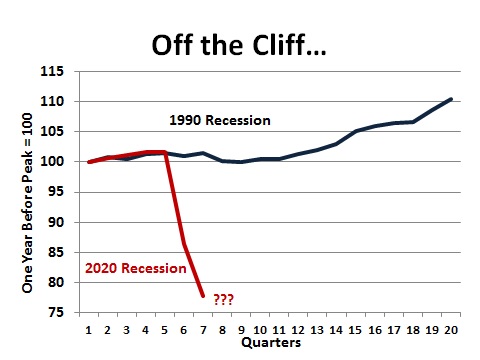
    The COVID-19 pandemic is producing an unprecedented shutdown of large parts of the national and global economies. Our Director Dr. Jim Stanford provided an overview of the coming recession, how it differs from previous downturns, and the best ways for government to respond to protect Australians as much as possible from the economic fall-out.

    Jim titled his presentation “Off the Cliff”, highlighting that the immediate shutdown of so much of Australia’s work and production is producing an economic contraction unlike anything experienced in history.

    Comparing Recessions

    Watch a video recording of the webinar:

    And/or download Jim’s slides below.

    This webinar was part of the Australia Institute’s weekly pandemic webinar series.


    Related documents


    Presentation slides

    You might also like

    Dutton’s nuclear push will cost renewable jobs

    by Charlie Joyce

    Dutton’s nuclear push will cost renewable jobs As Australia’s federal election campaign has finally begun, opposition leader Peter Dutton’s proposal to spend hundreds of billions in public money to build seven nuclear power plants across the country has been carefully scrutinized. The technological unfeasibility, staggering cost, and scant detail of the Coalition’s nuclear proposal have

  • Open Letter From Economists and Policy Experts: Wage Subsidy to Protect Jobs During Pandemic

    Open Letter From Economists and Policy Experts: Wage Subsidy to Protect Jobs During Pandemic

    by Jim Stanford

    Share

    109 Australian economists and policy experts have signed an open letter, initiated by the Centre for Future Work, supporting a government wage subsidy to prevent mass unemployment during the coming economic downturn resulting from the COVID-19 pandemic.

    The letter and the full list of signatories is reprinted below. It has been forwarded to Prime Minister Morrison.

    Public Statement from Economists and Public Policy Experts:

    A Wage Subsidy to Protect Jobs During the Coronavirus Shutdown

    The unprecedented public health measures required to deal with the COVID-19 pandemic are causing a dramatic shutdown of work and production in several key sectors of Australia’s economy. Immediate full or partial closures of activity are occurring in several consumer-facing industries (such as hospitality, retail, airlines, recreation and personal services). But before long, spillover losses will be experienced in other sectors, too: including wholesale trade and logistics, manufacturing, business services, education, and others. Consumer and business confidence has been deeply shocked, and that will magnify the negative economic effects of the pandemic.

    The coming recession will be unprecedented in Australian history – in both its speed and its depth. Without immediate action, we expect that 1-2 million workers, or even more, could lose their jobs in coming weeks. That would drive unemployment to 15% or higher, overwhelm income support programs, and leave hundreds of thousands of businesses unable to function – even after the immediate health danger passes.

    This is a dangerous and dramatic moment in Australia’s economic history. It is imperative that the federal and state governments act immediately and powerfully to protect Australian workers and businesses from the worst of the coming downturn. Important steps have been taken to expand access and benefit levels for income support payments to Australian workers (including casuals, contractors, and gig workers) losing work because of the pandemic. This is a helpful, but on its own inadequate, response. Government must also act forcefully to prevent mass job losses in coming weeks – not just provide support to those who do lose work.

    In this regard, we recommend that the Commonwealth government immediately implement a large-scale wage subsidy scheme, similar to those already enacted in several other industrial countries (including, variously, the UK, Denmark, New Zealand, the Netherlands, South Korea, and Ireland). Under these programs, government directly pays to employers (for a limited period of time) a majority portion of wages (between 70 and 90%) to cover the wages of workers who would otherwise be stood down from their positions. The measure can apply to non-standard workers (including contractors and self-employed). It can also be integrated with measures to support short time working as an alternative to complete redundancy. The wage subsidy is paid to firms experiencing severe losses of revenue and business (beyond a specified threshold). It would cover most of the wage bills for workers who can no longer work for economic reasons, up to a specified ceiling (perhaps the level of full-time median earnings). This program will be expensive – but governments everywhere have recognised that this unprecedented crisis requires them to do everything in their power to protect people, jobs, communities and the economy.

    To date, Australia’s response to the pandemic has been uncertain, inconsistent and inadequate. Immediate, powerful action to keep millions of Australians in their jobs, instead of pushing them into an overloaded and complex Centrelink system, would significantly ease the pandemic’s painful economic effects. It would underpin financial stability for millions of households through the coming terrible weeks or months. And it would preserve the viability of hundreds of thousands of Australian businesses, allowing them to resume work and production as soon as the health restrictions are eased.

    We the undersigned support the proposal for a strong wage subsidy program to keep workers in employment through the coming downturn, and we urge the Commonwealth government to implement such a policy quickly.

    Download full list of signatories below.


    Related documents


    List of signatories

    You might also like

    Dutton’s nuclear push will cost renewable jobs

    by Charlie Joyce

    Dutton’s nuclear push will cost renewable jobs As Australia’s federal election campaign has finally begun, opposition leader Peter Dutton’s proposal to spend hundreds of billions in public money to build seven nuclear power plants across the country has been carefully scrutinized. The technological unfeasibility, staggering cost, and scant detail of the Coalition’s nuclear proposal have

  • The Same Mistake Twice

    The Same Mistake Twice

    The Self-Defeating Consequences of Public Sector Pay Freezes
    by Troy Henderson and Jim Stanford

    New research from the Australia Institute’s Centre for Future Work reveals the consequences of freezing public service pay, both for public sector workers and for the broader economy.

    Governments are devoting unprecedented resources to protecting Australians against the health and economic effects of the pandemic, but a contradictory push to adopt fiscal austerity measures is also becoming apparent. Leaders of governments at all levels — federal, state and local council — have already announced plans to freeze wages and cancel previously agreed pay raises for public servants.


    Full report

    Share

  • Responding to the Economic Emergency

    Originally published in New Matilda on March 21, 2020

    The scale and scope of the economic downturn caused by COVID-19 will be unprecedented in our lifetimes. Mainstream economists have belatedly realised the pandemic will cause an economic downturn, but they are not yet appreciating the size of that downturn, nor the unconventional responses that will be required. Simply calling for government “stimulus” is sadly inadequate, given the complete shut-down of work and production that is occurring in many sectors of the economy. The task is no longer supporting markets with incremental “pump-priming.” What’s needed is a war-like effort, led by government, to mobilise every possible resource to protect Australians’ health and livelihoods. Money is not an object – and this epic effort should not be held back by normal acquiescence to private-sector priorities and decisions.

    That’s the core message of new analysis by Centre for Future Work Director Dr. Jim Stanford, published today by the Australian journal New Matilda.

    Stanford’s article outlines the immediate economic measures needed to both confront the health emergency and prevent households and firms from collapsing:

    • Immediate mobilization of resources to protect health: including more staff at health facilities, quick deployment of off-site and mobile testing capacities, home support for people quarantined or recovering, and quick expansion of equipment and facilities where possible.
    • Income protection for workers: including for casuals, self-employed, gig-workers, and many part-timers who don’t have effective access to sick pay. Incomes must be protected for all workers (regardless of employment status), through mandated special payments (as proposed by the ACTU).
    • Other direct income supplements: similar to the one-time payments distributed in 2009, as well as more targeted aid (like higher Newstart).
    • Debt relief and business assistance: emergency financing will be needed to keep firms viable in many industries (including airlines, other transportation, tourism, and hospitality). Other parts of society also need protection from creditors; foreclosures and evictions should be prohibited, and other personal and credit card debts deferred.

    But Stanford also discusses the longer-run challenge that will face the Australian economy: the pandemic is imposing a shock that is far too powerful and all-encompassing for private market players to autonomously recover from. The economy will need unprecedented and lasting investments by government to repair and expand public infrastructure and services, and directly put Australians back to work:

    “There is enormous need for urgent rebuilding required in our economy and our communities. Repairing and strengthening health care infrastructure comes first, but other priorities, too, are urgent: like sustainable transit, green energy, non-market housing, aged care and early child education. The case for mobilising resources under the leadership of governments and public institutions, and employing millions of Australians to do that work, is compelling. We can repair the damage of this crisis (and better prepare for the next one), deliver valuable services, and create millions of jobs. All we need is the willingness to imagine a different model of organizing and leading economic activity.”

    Please read the full article, We Need Wage Guarantees And Radical Restructure, Not More ‘Stimulus’, published by New Matilda.


    You might also like

    Dutton’s nuclear push will cost renewable jobs

    by Charlie Joyce

    Dutton’s nuclear push will cost renewable jobs As Australia’s federal election campaign has finally begun, opposition leader Peter Dutton’s proposal to spend hundreds of billions in public money to build seven nuclear power plants across the country has been carefully scrutinized. The technological unfeasibility, staggering cost, and scant detail of the Coalition’s nuclear proposal have

    Centre For Future Work to evolve into standalone entity

    The Centre for Future Work was established by the Australia Institute in 2016 to conduct and publish progressive economic research on work, employment, and labour markets. Supported by the Australian Union movement, the centre produced cutting edge research and led the national conversation on economic issues facing working people: including the future of jobs, wages

  • Gender Inequality in Australia’s Labour Market: A Factbook

    Gender Inequality in Australia’s Labour Market: A Factbook

    by Alison Pennington and Jim Stanford

    While women have made some progress in closing the wage gap and other dimensions of gender inequality in Australia, they still face daunting and persistent barriers to their full participation and compensation in Australia’s economy.

    That’s the conclusion from a new factbook on gender economic inequality in Australia, released by the Centre for Future Work to coincide with International Women’s Day on 8 March.

    The factbook compiles evidence on over 60 different statistical indicators of gender inequality in Australia, organised into 18 different subject groupings. It paints a composite picture of how women are blocked from full participation in work and economic activity, experience greater precarity in employment, are paid less for their efforts, and experience other forms of exploitation (including violence and sexual assault in workplaces).

    Some of its more startling findings include:

    • The true wage gap between women and men is much larger than often reported. The commonly-cited gender wage gap of 14% only applies to women working in full-time positions, and excludes bonuses and overtime payments. However, women have less access to full-time jobs, and receive far less bonus and supplementary income than men. The gender gap in total wage income is 32% – more than twice as wide.
    • Women are much more subject to precarious and insecure work arrangements than men. They are far more likely to be employed in part-time, casual, and temporary positions than men. Only 43% of employed Australian women work in a traditional full-time permanent job with normal entitlements (such as paid sick leave, holidays, and superannuation). The rest all experience one or more dimensions of precarity in their jobs. That compares to 57% of men in permanent full-time jobs with entitlements.
    • Women who undertake self-employment are especially vulnerable. The report shows that 47% of self-employed women are in vulnerable business positions: working part-time, and working either without incorporation or without any other employees (or both). That compares to 19.% of self-employed men.
    • Women are now more likely to be members of a union than men, and make up more than half of union members. Women who are in a union earn 29% more per week than women who are not in a union. For part-time workers, the union advantage is even bigger: women union members earn 44% more than non-members

    “The statistical evidence is overwhelming that women are a long way from achieving equality in Australia’s workplaces,” said Alison Pennington, Senior Economist at the Centre for Future Work and co-author of the factbook.

    “These systemic and structural barriers to full participation and fair compensation are holding Australian women back and our economy is weaker for it.

    “Australian women need to be able to work and earn to their full potential. This requires powerful measures to support women workers in all aspects of their lives; from quality affordable childcare to much stronger protections against violence and sexual harassment.”


    Full report

    Share

  • Financialisation and the Productivity Slowdown

    Financialisation and the Productivity Slowdown

    by Anis Chowdhury

    There has been much discussion in recent months about the apparent slowdown in Australian productivity growth. Rather than dredging up the usual wish-list of the business community (more deregulation, more privatisation, and more deunionisation), it’s time to look at the deeper, structural factors behind stagnant productivity. In this commentary, Dr. Anis Chowdhury, Associate of the Centre for Future Work, looks to the perverse role of our overdeveloped financial sector in slowing down productivity-enhancing investment and innovation.

    Financialisation and the Productivity Conundrum

    by Anis Chowdhury

    There has been much angst at the slower or stagnant productivity growth experienced recently in Australia. Ross Gittins, the Sydney Morning Herald’s much respected Economics Editor, summarised some of the discussions reflecting on the causes and remedies of the productivity problem in his recent piece, ‘Productivity problem? Start at the bottom, not the top’ (SMH, 2 March 2020).

    The phenomenon of slow productivity growth is neither unique to Australia nor recent. It has been observed globally over the past few decades, especially in the developed world, as highlighted in recent reports on global economic health (e.g. United Nations, World Economic Situation and Prospects 2020, and the World Bank’s Global Economic Prospects 2020). The trend accelerated since the global financial crisis (GFC) of 2008-2009, as emphasised by Maurice Obstfeld, IMF’s former Chief Economist, at the joint BIS-IMF-OECD conference on weak productivity (10 January 2018).

    The UN report notes that “as firms around the globe have become more reluctant to invest, productivity growth has continued to decelerate.” It attributes much of the slowdown to significantly lower contributions from capital deepening (investment in machinery, technology, etc.). Subdued productivity growth is also proposed as one of the reasons for slow growth of real wages and falling share of labour income in GDP, contributing to rising inequality – although even more rapid productivity growth is no guarantee, of course, of rising wages or greater equality.

    The World Bank report observes that to rekindle productivity growth, a comprehensive approach is necessary for “facilitating investment in physical, intangible, and human capital; encouraging reallocation of resources towards more productive sectors; fostering firm capabilities to reinvigorate technology adoption and innovation; and promoting a growth-friendly macroeconomic and institutional environment.”

    While similar observations can also be found in the OECD and IMF reports, none offer explanations as to why this is happening, that reach beyond orthodox excuses – like  uncertainty due to Brexit and US-China trade tensions. The Bank of International Settlements (BIS), OECD and IMF also included such factors as unconventional monetary policy (very low or negative real interest rates) and financial frictions (e.g. firm-level financial fragilities and tightening credit conditions) as possible causes of weak investment and the productivity slowdown since the GFC.

    Financialisation

    However, one can trace the deeper cause of the long-term declining trend in productivity growth since the 1970s to financialisation: that is, the dominance of finance over the real economy. This is visible globally in the increasing role of financial motives, financial markets, financial actors and financial institutions in the operation of the domestic and international economies.

    Beginning with the collapse of the Bretton Woods system in August 1971, when President Nixon unilaterally withdrew US commitment to gold convertibility of currencies, the process of financialisation gathered pace in the 1980s. This coincided with the neoliberal counter revolution against Keynesian economics, and the coming to power of Margaret Thatcher in the UK and Ronald Reagan in the US. All this ushered in an era of multinational corporation-led globalisation. In turn, this led to rapid growth of international trade, foreign direct investment and capital flows – all mutually reinforcing – and the consolidation of finance’s domination over the real economy.

    Several features of this era of financialisation have direct implications for productivity. They include:

    • Rapid expansion of financial markets, and the proliferation of financial institutions, instruments and services with the de-regulation and liberalisation of the financial system, blurring the distinction between speculative and patient investors;
    • The banking sector becoming more concentrated, less regionalised and more internationalised with the decline of mutual, co-operative and State ownership of banks and financial institutions;
    • Financial intermediation shifting from banks and other institutions to financial markets, thus the axiomatic ‘invisible hand’ of supposedly anonymous, self-regulating financial markets replacing the ‘visible hand’ of relationship banking;
    • Nonfinancial corporations increasingly deriving profitability from their financial as opposed to their productive activities;
    • Financial institutions increasingly becoming owners of equity, and real decision-making power shifting from corporate boardrooms to global financial markets pursuing shareholder value;
    • Managerial remuneration packages increasingly becoming linked to short-term profitability and share price performance rather than to longer-term growth prospects.

    These features, by and large, have adversely affected levels of real capital investment and innovation, due to the inexorable pressure of financial interests for the pursuit of short-term profits and dividends. Shareholders (most of whom are financial institutions) demand from corporations a bigger, faster distribution of profits. The lower retention of profits ratio, and share buybacks to boost share price together imply reduced internal finance for real investment, R&D, and technology upgrading.

    Corporate managers act in the interests of the financial sector as they too profit personally from increasing stock market valuations – often linked to reduction of employment. This has meant chronic job insecurity and underinvestment in on-the-job training. Increased insecurity also discourages workers to invest in their own skill upgrading.

    Thus, the overall effect of financialisation on investment, technology adoption, skill upgrading has been negative, with adverse consequences for productivity and decent jobs.

    Misallocation

    An overgrown financial system also costs the economy on a daily basis by attracting too many talented workers to ultimately unproductive careers in the financial sector. Talented students are disproportionately attracted to finance courses in preference to liberal arts or social sciences; moreover, bright engineering and science graduates are increasingly engaged in the financial sector, where they can earn many times more. Research at BIS shows that when skilled labour works in finance, the financial sector grows more quickly at the expense of the real economy – disproportionately harming R&D intensive industries.

    In his Fred Hirsch Memorial Lecture (15 May 1984), Nobel Laureate James Tobin doubted the value of “throwing more and more of our resources, including the cream of our youth, into financial activities remote from the production of goods and services, into activities that generate high private rewards disproportionate to the social productivity.”

    Rent seeking

    Luigi Zingales titled his 2015 presidential address to the American Finance Association, ‘Does finance benefit society?’. While acknowledging the need for a sophisticated financial sector, he doubted whether the growth of the financial sector in the last forty years has

    been beneficial to society. He argued on the basis of both theory and empirical evidence that a large component of that growth has been pure rent seeking.

    According to Gerry Epstein and Juan Antonio Montecino, the  US financial sector captured rents “through a variety of mechanisms including anticompetitive practices, the marketing of excessively complex and risky products, government subsidies such as financial bailouts, and even fraudulent activities… By overcharging for products and services, financial firms grab a bigger slice of the economic pie at the expense of their customers and taxpayers.”

    Robert Jenkins listed more ‘misdeeds’ of UK banks. These range from mis-selling (e.g. of payment protection insurance, interest rate swaps), manipulation of markets (e.g. precious metals markets, US Treasury Market auction/client sales, energy markets), aiding and abetting tax evasion and money laundering for violent drug cartels, collusion with Greek authorities to mislead EU policy makers on meeting Euro criteria, and more.

    All this sounds too familiar to us in Australia after the Hayne Royal Commission into misconduct in the financial services industry.

    A drag on the real sector

    The power of finance has become a drag on the development of the real sector in a number of ways.

    First, the manner in which the financial sector has grown has not been conducive for

    real investment and savings. Finance has failed to act as an intermediary between savers and investors, and to allocate and monitor funds for real investment.

    Second, the growth of financial markets and speculation have diverted resources into

    what are essentially zero-sum games.

    Third, the rush to financial liberalisation and the failures of the regulatory systems produced more frequent financial crises, with increasing depth and width. An over-abundance of (cash) finance is used primarily to fund a proliferation of short-term, high-risk investments in newly developed financial instruments, such as derivatives — Warren Buffett’s ‘financial weapons of mass destruction’ that blew up the global financial system in 2007–08.

    Thus, real capital formation which increases overall economic output has slowed down, as profit owners, looking for the highest returns in the shortest possible time, reallocate their investments to more profitable financial markets.

    With financial speculators now panicking in the face of the spread of the COVID-19 virus, in the context of inflated and debt-heavy financial valuations, we could be poised for another chapter in this repeating saga.

    Way out

    No amount of corporate tax cuts or suppression of labour rights in the name of structural reform will solve the productivity conundrum. What is really required is the taming of finance.

    Finance can positively contribute to economic progress, but only when the ‘ephor’ is ‘governed’ and ‘directed’ by State regulation to structure accumulation and distribution into socially useful directions.

    The earlier era of financialisation during the late 19th century and early 20th century ended with the Great Depression. John Maynard Keynes wrote in ‘The Grand Slump of 1930’, “there cannot be a real recovery . . . until the ideas of lenders and the ideas of productive borrowers are brought together again . . . .”. He thought, “seldom in modern history has the gap between the two been so wide and so difficult to bridge.”

    Fortunately, the policymakers listened to Keynes and regulated finance to serve the real economy. This produced nearly three decades of the ‘golden age’ of capitalism, ending in the 1970s.

    But the gap between finance and the real economy is now even wider and more difficult to bridge. It will require a lot of political will and courage to confront the very powerful finance capital which has changed the rules of the game to facilitate rent-seeking practices of a self-serving global elite.

    Dr. Anis Chowdhury is an Adjunct Professor at Western Sydney University (School of Social Sciences) and the University of New South Wales (School of Business, ADFA), and an Associate of the Centre for Future Work.


    You might also like

  • Meet the New Boss, Same as the Old Boss

    Originally published in Canadian Dimension on February 11, 2020

    In a new guest commentary for the journal Canadian Dimension, Centre for Future Work Director Jim Stanford argues that existing power relationships in the labour market are being reinforced, more than disrupted, by the process of technological change.

    Stanford highlights seven ways in which the nature of work and employment is demonstrating a fundamental continuity, despite changes in technology and work organisation: ranging from the predominance of wage labour in the economy, to employers’ continuing interest in extracting maximum labour effort for the least possible labour cost.

    “I have started to conclude there is more constancy than change in the world of work. In particular, the central power relationships that shape employment in a capitalist economy are not fundamentally changing: to the contrary, they are being reinforced… As a result, I suspect the future of work will look a lot like its past, at least as it has existed over the past two centuries. Where work is concerned, it is truly a case of ‘back to the future.’”

    Stanford rejects the common assumption that changes in employment relationships (such as the rise of “gig” jobs, and other forms of precarious work) are driven primarily by technology–stressing instead the importance of discrete choices within enterprises and society as a whole about what kinds of technology are developed, and how they are implemented. Improvements in work are certainly possible, but only when workers are able to exert active, organised pressure on employers and governments.

    Please read Stanford’s full commentary, Meet the New Boss, Same as the Old Boss (‘Who’ soundtrack optional!).


    You might also like

    Centre For Future Work to evolve into standalone entity

    The Centre for Future Work was established by the Australia Institute in 2016 to conduct and publish progressive economic research on work, employment, and labour markets. Supported by the Australian Union movement, the centre produced cutting edge research and led the national conversation on economic issues facing working people: including the future of jobs, wages