Author: annamations

  • The Reserve Bank needs to watch that it doesn’t push the economy off a cliff

    Originally published in The Guardian on December 1, 2022

    For most of this year, the warnings and news about inflation have been one of hope for the best but experience the worst. Predictions of future inflation growth have continually been revised upwards and with it has been the suggestion that interest rates need to keep rising.

    But as Labour Market and Fiscal Policy Director, Greg Jericho, notes in his Guardian Australia column, the latest monthly inflation figures out yesterday suggest that maybe the peak could be lower than anticipated.

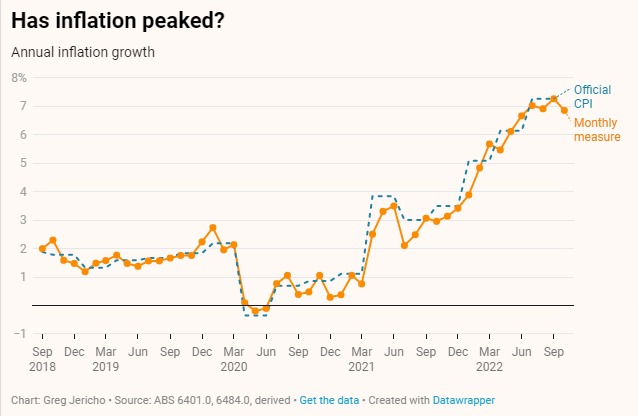
    While the monthly figures can be a little erratic, they do closely align with the quarterly “official” CPI figures and in October the ABS estimates that annual inflation growth fell from 7.3% to 6.9%. Better still this makes 4 months in a row where inflation has remained around 7%, rather than increasing quickly as it has since the middle of last year.

    Combined with the latest Retail Trade figures released this week which showed the dollar amount spent in the shops fell in October, and the volume of spending falling even faster, there are solid signs that the interest rate rises are having an impact.

    This means the Reserve Bank needs to be very cautious as much of the impact of the rate rises from September October and November has yet to flow through into the data. And because the rates of existing mortgages take longer to rise than do rates for new home loans this also means that even were the RBA to halt rate rises, for most mortgage holders rates will still be about to rise over the next few months.

    The IMF, OECD, Treasury and the RBA itself all forecast a sharp slowing of Australia’s economy next year and into 2024. The rationale has been that this is the cost of needing to reduce inflation, but the central bank needs to be very careful that it does not commit overkill. With the economy and consumer spending already slowing, and inflation showing some good signs that growth is no longer increasing at a rapid rate, the RBA should strongly consider not increasing the rate next week in its final board meeting of the year.

    You might also like

    Dutton’s nuclear push will cost renewable jobs

    by Charlie Joyce

    Dutton’s nuclear push will cost renewable jobs As Australia’s federal election campaign has finally begun, opposition leader Peter Dutton’s proposal to spend hundreds of billions in public money to build seven nuclear power plants across the country has been carefully scrutinized. The technological unfeasibility, staggering cost, and scant detail of the Coalition’s nuclear proposal have

  • Rough times ahead for Australia’s economy as oil, gas and coal companies celebrate

    Originally published in The Guardian on November 24, 2022

    The latest economic outlook from the OECD highlights the precarious path for Australia over the next few years.

    As Labour market and Fiscal Policy Director, Greg Jericho, notes in in his Guardian Australia column, the OECD predicts in both 2023 and 2024 Australia’s economy will grow by less than 2%. In the past such weak growth has been associated with recessions. And while a recession is not predicted, unlike for the UK and Germany, the OECD also notes the risks that lie ahead.

    One major problem is that most nations around the world are lifting interest rates to attempt to slow their economies and thus reduce inflation. The OECD notes however that when nations act in concert the impact of higher interest rates on slowing the economy is greater, while the impact on slowing inflation is weaker.

    Given Australia has a higher proportion of mortgage holders with variable rates this increases the risk that higher interest rates will slow our economy more than in other nations, and still have less impact on inflation.

    But one sector of the economy are rejoicing at the current conditions that are causing the rising inflation – energy companies.

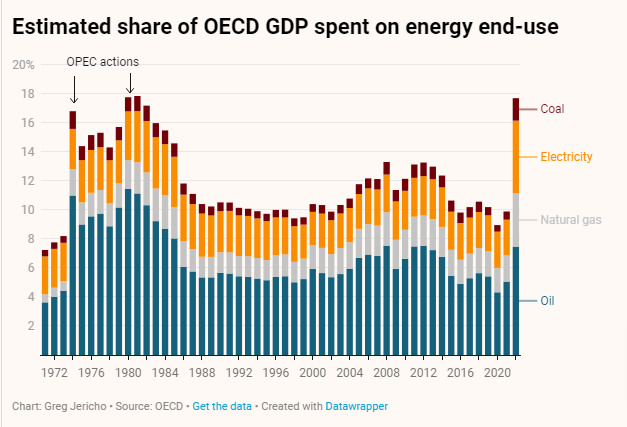
    The OECD notes that the share of GDP being spent on energy by OECD nations is higher now than it was during the OPEC crisis in 1974 and 1980. The evidence again is clear that a windfall profits tax should be levied on coal, oil and gas companies who a reaping massive profits while the cost of living rises sharply for households.


    You might also like

    Australia’s Gas Use On The Slide

    by Ketan Joshi

    The Federal Government has released a new report that includes projections of how much gas Australia is set to use over the coming decades. There is no ambiguity in its message: Australia reached peak gas years ago, and it’s all downhill from here:

    Dutton’s nuclear push will cost renewable jobs

    by Charlie Joyce

    Dutton’s nuclear push will cost renewable jobs As Australia’s federal election campaign has finally begun, opposition leader Peter Dutton’s proposal to spend hundreds of billions in public money to build seven nuclear power plants across the country has been carefully scrutinized. The technological unfeasibility, staggering cost, and scant detail of the Coalition’s nuclear proposal have

  • Theft By Any Other Name: Go Home On Time Day 2022

    Theft By Any Other Name: Go Home On Time Day 2022

    Unsatisfactory Working Hours and Unpaid Overtime
    by Eliza Littleton and Lily Raynes

    This year marks the fourteenth annual Go Home on Time Day (GHOTD), an initiative of the Centre for Future Work at the Australia Institute that shines a spotlight on the maldistribution of working hours and the scale of unpaid overtime worked by Australians.

    Last year’s report focused on working conditions during the pandemic. Since the re-opening of the global economy after pandemic era lockdowns, Australia’s economy and labour market face both new and old challenges. While the unemployment rate is at historic lows, inflation has accelerated, interest rates are rising, and real wages continue to decline. The tighter labour market conditions, combined with strong productivity growth should theoretically place workers in a position to shop around for well-paid secure work. Accordingly, we should be witnessing improvements in working conditions and wages at least keeping up with prices. But this is not what we observe, this myth that a tight labour market will automatically empower workers hides the many diverse realities of working lives in Australia.

    While the labour force participation rate is high, we continue to see growth in non-standard low security employment like labour hire, casual, rolling fixed term, and gig work. While the ‘strong’ labour market conditions may benefit some workers, they are not improving conditions for all, particularly persistently disadvantaged workers like young people, women, first nations workers, and people with disability. Meanwhile, financial dependency on employment remains high as disruptions to global and domestic supply chains cause price hikes for critical products and real wages continue to fall behind, undermining the purchasing power of Australians. This year’s GHOTD focuses on issues Australian workers are experiencing in this economic context.


    Full report

    Share

  • Call Me Maybe (Not)

    Call Me Maybe (Not)

    Working Overtime and A Right To Disconnect in Australia
    by Eliza Littleton and Lily Raynes

    Working beyond scheduled hours has long been a problem for Australian workers. The nature and scale of overtime has more recently been shaped by the rise in flexible working arrangements and the integration of information and communication technology at work. Checking emails on the weekend, taking multiple-time-zone calls out of hours, and teleconferencing from the dining table have all become familiar experiences amongst workers. This both enabled working from home conditions during the pandemic for a large portion of workers, and accelerated patterns of overtime through the blurring of lines between work and home life.

    The survey results presented in this report show that overtime is a prevalent and systemic issue in Australia, primarily driven by working conditions within the control of employers.

    • Seven in ten (71%) workers reported having performed work outside of scheduled working hours. While only 29% of workers indicated that they have not done overtime.
    • Of those who completed overtime, the largest share performed overtime often, as opposed to sometimes, rarely, or never.
      • Almost half (44%) reported often performing overtime to meet employer expectations, and another 31% performed overtime sometimes.
      • Overtime was fairly evenly spread across industries and occupations, suggesting it is not an isolated issue that can be resolved with a targeted solution.
    • The incidence and frequency of overtime are more common among men, young people, those with full-time jobs, and those in goods producing sectors or working as managers.
    • The most common reasons workers perform overtime were having too much work (36%), followed by staff shortages (28%), less interruptions working outside normal hours (26%), and managers’ or supervisors’ expectations (23%).
    • Over a third of workers (38%) reported that overtime was an expectation in their workplaces.

    Overtime doesn’t come without cost: it has significant consequences for workers, their families, and for society more broadly.

    • The most commonly experienced negative consequences of overtime work were physical tiredness (35%), followed by stress and anxiety (32%), and being mentally drained (31%), each affecting around a third of workers.
    • Over a quarter of workers reported that overtime interfered with their personal life and relationships (27%), and 17% responded that it led to disrupted or unfulfilling non-work time.
    • One in five workers identified that working outside scheduled hours negatively affected their relationship with work; 22% reported reduced motivation to work, and 19% experienced poor job satisfaction.

    Australia has enterprise agreements, modern awards, and national employment standards that are intended to set out limitations on working times. However, the prevalence of overtime suggests that Australia’s industrial relations systems are not properly protecting the boundaries between work and non-work time for many workers. In particular, existing laws have done little to prevent the creep of work into private time, aided by technology. This is why workers, employers, unions, and governments around the world have been looking at how to implement a ‘right to disconnect’.

    Our survey found considerable support amongst Australia workers for a right to disconnect.

    • Six in seven (84%) workers expressed support for the Federal Government to nationally legislate a right to disconnect that directs employers to avoid contacting workers outside of work hours, unless in an emergency.
      • Only 8% opposed the idea of a right to disconnect.

    A right to disconnect could take several forms, and be implemented via different avenues in Australia. Based on international examples and the attitudes of workers in Australia, this report finds that implementing the right within the national employment standards would be the most effective.

    • Four in five (80%) workers thought that a right to disconnect would be effective if legislated in national employment standards, making it the avenue viewed as effective by the most workers.

    This report provides strong evidence for the government to pursue a right to disconnect as a way of limiting the creep of work into non-work time.


    Full report

    Share

  • Wages growth improves but real wages fall at a record rate

    Originally published in The Guardian on November 17, 2022

    The latest wages price index figures show that for the first time since 2013 wages grew by more than 3% in the past year.

    This growth is very welcome. It highlights that far from wages driving inflation, wage growth is only now beginning to grow at a pace that would be expected given the low level of unemployment. But as Labour Market and Fiscal Policy Director, Greg Jericho notes in his Guardian Australia column, while the level of wage growth we are seeing remains well below what would have been expected in the past with a 3.5% unemployment rate.

    The strong growth came mostly from the private sector through a combination of new financial year individual contracts and the 5.2% minimum wage increase.

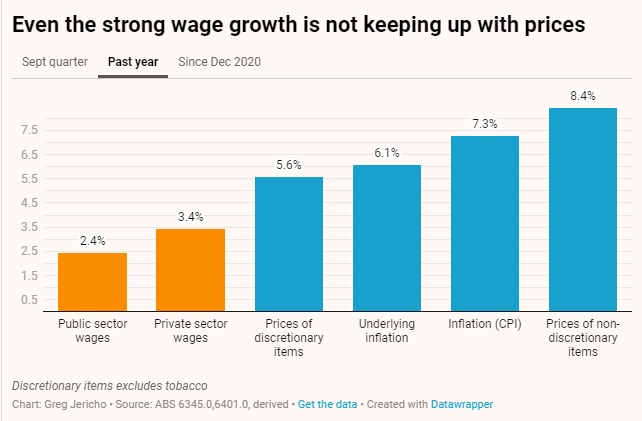
    But even this is not enough to prevent real wages from falling for the 9th straight quarter. For more than 2 years now prices have been rising faster the wages. It has seen real wages fall back to 2011 levels after a 4.6% fall since September 2020.

    The figures show that greater bargaining power is required for workers as they continue to lose out. The fastest wage growth for a decade should not see the biggest fall in real wages on record.

    We know that greater enterprise bargaining producers better wages growth. That business groups are so against the provision in the Fair Work Amendment Bill demonstrates how worried they are about the ability of workers to have increased ability to bargain.

    Profits have been growing faster than inflation, but wages are not.

    The latest wage growth figures are pleasing to see, but they also demonstrate the challenges ahead, and just how greatly workers’ living standards have been hit by price rises that they did nothing to cause.


    You might also like

  • Going Nuclear: The Costs of Mid-Bargaining Termination of Enterprise Agreements

    Going Nuclear: The Costs of Mid-Bargaining Termination of Enterprise Agreements

    by Lily Raynes and Jim Stanford

    New research from the Centre for Future Work quantifies the dramatic risks faced by workers whose employers unilaterally terminate enterprise agreements during the course of renegotiations. This aggressive employer strategy, which became common after a precedent-setting 2015 court decision, would be curtailed by new industrial relations legislation proposed by the Commonwealth government.

    The paper reviews one dramatic example of this termination threat – dubbed the ‘nuclear option’ by labour law experts (because it ‘blows up’ years of collective bargaining embodied in existing enterprise agreements). Earlier this year, Qantas threatened termination of the EA covering its international cabin crew unless they accepted significant contract concessions.

    The new report confirms that losses from termination, if it had gone ahead, would have been enormous for the affected workers:

    • Hourly wage cuts between 25% and 70%.
    • Annual income losses up to $67,000 for the most senior staff.
    • Loss of superannuation contributions and investment income, totalling as much as $130,000 and dramatically reducing retirement incomes.
    • Painful retrenchment of many working conditions issues (including rest periods and accommodation).
    • From the company’s perspective, termination of the EA for just this group of its staff would save $63 million per year, and up to $1 billion over 15 years.

    This threat, backed up by an application for termination lodged with the Fair Work Commission, was sufficient to convince cabin crew staff to accept a new EA containing a two-year wage freeze, real wage cuts, and other compensation and conditions reductions. Staff had earlier voted 97% to reject that agreement. This reversal confirms the termination threat is a very powerful bargaining lever for employers.

    The report recommends reforms to the Fair Work Act to limit employers’ ability to apply for unilateral termination during renegotiations. Current legislation in Parliament (the Secure Jobs, Better Pay Bill) would put new restrictions on employers’ ability to terminate EAs during renegotiation.


    Full report

    Share

  • Collective Bargaining and Wage Growth in Australia

    Collective Bargaining and Wage Growth in Australia

    by Jim Stanford, Fiona Macdonald and Lily Raynes

    The reforms proposed in the Secure Jobs, Better Wages bill represent important but incremental steps in restoring a better balance of bargaining power between workers and employers, and lifting wage growth back toward a normal and healthier pace.

    The measures provided here will not suddenly transform Australia in the image of leading OECD countries, where centralised and coordinated collective bargaining covers most workers, and wage outcomes are much more equal as a result. But they would support a gradual restoration of collective bargaining coverage, consistent with practices in other countries where bargaining still occurs mostly at the enterprise level – but where some broader bargaining and coordination is possible. On that basis, and over several years, this should result in a partial restoration of bargaining coverage lost over the past decade, and a corresponding (but still incomplete) recovery in wage growth.


    Full report


    Factsheet
    Paying for Collective Bargaining

    Share

  • Gas companies are profiting off of human misery – we need a windfall profits tax

    Originally published in The Guardian on November 14, 2022

    Russia’s illegal invasion of Ukraine caused a massive surge in gas and LNG prices that have enabled gas companies around the world, including Australia to make record-level profits.

    But none of these profits have come from either management decisions or productive investments. The price rise has not come from any economic improvements. No, they have come only from an illegal invasion that is causing great human misery.

    Labour market and fiscal policy director Greg Jericho notes research suggests that the gas sector has accrued around $26bn in profits due to price rises affected by the Russian invasion. He argues that all of these profits should be garnered in taxation – a view that echoes that of former Treasurer Secretary Ken Henry.

    This revenue would be enough to cover the cost of rewiring the nation and greatly assist the tradition to renewables.

    But the problem of revenue are much deeper than the need for a windfall profits tax.

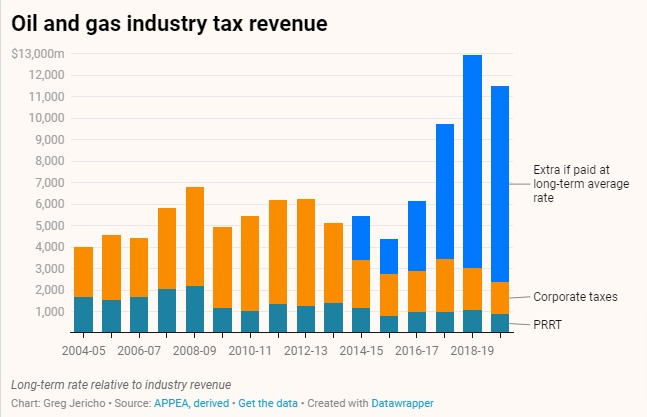
    Jericho’s analysis of industry data reveals that the industry pays much less company tax relative to production than it did in the past.

    Had the industry paid the same level of company tax relative to revenue that is had in the decade prior to the opening of the Gladstone port, in 2019-20 alone, an extra $9.1bn in tax revenue would have been raised.

    Oil and gas are Australia’s resources. Not only are their emissions causing climate change but the profits are largely headed overseas, and more than in the past not flowing through into taxation.

    As Australians demand better and wider government services, and the costs of dealing with climate change grow ever higher, we need to ensure the fossil fuel companies pay their rightful share.


    You might also like

    Australia’s Gas Use On The Slide

    by Ketan Joshi

    The Federal Government has released a new report that includes projections of how much gas Australia is set to use over the coming decades. There is no ambiguity in its message: Australia reached peak gas years ago, and it’s all downhill from here:

  • Multi-Employer Bargaining Necessary for Fixing Wages Crisis

    Originally published in The Conversation on November 14, 2022

    Proposed reforms to Commonwealth industrial relations laws would create more opportunities for collective bargaining to occur on a multi-employer basis, rather than being limited solely to individual workplaces or enterprises. Business groups have attacked this proposal as a dramatic change that would supposedly spark widespread work stoppages and industrial chaos.

    But as our Policy Director Fiona Macdonald argues in this new commentary for The Conversation, multi-employer bargaining is already allowed under various existing provisions of the Fair Work Act. The problem is that those provisions do not work. For example, the low-paid bargaining stream in the Fair Work Act has yet to result in a single multi-employer agreement, due to its stringent conditions and inconsistent application by the Fair Work Commission.

    Dr Macdonald argues that reforming these multi-employer bargaining streams so they can actually work will be an important part of any strategy to revitalise stagnant wages in Australia.

    For more details on the failure of existing multi-employer bargaining streams, and core principles for a stronger bargaining system, please also see the Centre for Future Work’s submission to the Senate inquiry on the Secure Jobs, Better Wages reform package (co-authord by Dr Macdonald, Jim Stanford, and Lily Raynes).


    You might also like

  • IR Reforms To Close Off The ‘Nuclear Option’ Will Protect Wages and Entitlements

    IR Reforms To Close Off The ‘Nuclear Option’ Will Protect Wages and Entitlements

    by Lily Raynes

    Share

    New research from the Centre for Future Work quantifies the dramatic risks faced by workers whose employers unilaterally terminate enterprise agreements during the course of renegotiations. This aggressive employer strategy, which became common after a precedent-setting 2015 court decision, would be curtailed by new industrial relations legislation proposed by the Commonwealth Government.

    The paper reviews one dramatic example of this termination threat – dubbed the ‘nuclear option’ by labour law experts (because it ‘blows up’ years of collective bargaining embodied in existing enterprise agreements). Earlier this year, Qantas threatened termination of the EA covering its international cabin crew unless they accepted significant contract concessions.

    The new report confirms that losses from termination, if it had gone ahead, would have been enormous for the affected workers:

    • Hourly wage cuts between 25% and 70%
    • Annual income losses up to $67,000 for the most senior staff
    • Loss of superannuation contributions and investment income, totalling as much as $130,000 and dramatically reducing retirement incomes
    • Painful retrenchment of many working conditions issues (including rest periods and accommodation)

    From the company’s perspective, termination of the EA for just this group of its staff would save $63 million per year, and up to $1 billion over 15 years.

    This threat, backed up by an application for termination lodged with the Fair Work Commission, was sufficient to convince cabin crew staff to accept a new EA containing a two-year wage freeze, real wage cuts, and other compensation and conditions reductions. Staff had earlier voted 97% to reject that agreement. This reversal confirms the termination threat is a very powerful bargaining lever for employers.

    “The scale of the losses experienced by Qantas staff as a result of termination would have been catastrophic,” said Lily Raynes of the Centre for Future Work, co-author of the report.

    “It would undermine their quality of life for the rest of their careers, and indeed right through their retirement,” Ms Raynes said.

    “The ability to credibly threaten termination, even as workers are trying to negotiate a replacement EA, provides a powerful advantage to employers,” said Jim Stanford, Director of the Centre for Future Work and the other co-author. 

    “It shifts the playing field decisively in employers’ favour and has been a major factor in the rapid erosion of collective agreement coverage over the past decade,” Dr Stanford said.

    “Qantas ruthlessly took advantage of this loophole in labour law to threaten cabin crew staff and impose terms and conditions that are blatantly unfair, given this company’s power and profits,” said Teri O’Toole, Federal Secretary of the Flight Attendants’ Association of Australia (one of the unions representing cabin crew at the airline). 

    “Qantas, and other greedy companies, will keep doing this unless the legislation is changed,” Ms O’Toole said.

    The report recommends reforms to the Fair Work Act to limit employers’ ability to apply for unilateral termination during renegotiations. Current legislation in Parliament (the Secure Jobs, Better Pay Bill) would put new restrictions on employers’ ability to terminate EAs during renegotiation.


    Related research