Tag: Ketan Joshi

  • Australia’s Gas Use On The Slide

    Australia’s Gas Use On The Slide

    by Ketan Joshi

    Share

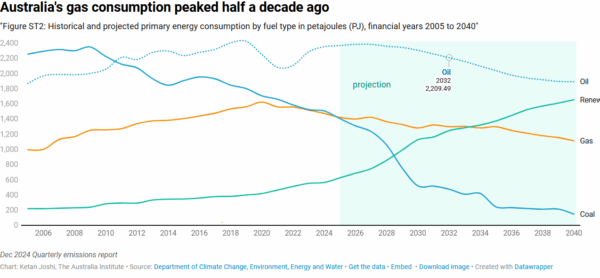
    The Federal Government has released a new report that includes projections of how much gas Australia is set to use over the coming decades. There is no ambiguity in its message: Australia reached peak gas years ago, and it’s all downhill from here:

    “Gas consumption is projected to decline to 2040 as electrification increases across the economy and renewables and storage take an increasing share of electricity generation”, wrote the Department of Climate Change, Energy, Environment and Water (DCCEEW).

    This doesn’t sit well with the Prime Minister’s recent claims that more gas is needed for “firming” renewable energy. Figures from the Australian Energy Market Operator (AEMO)’s 2024 Integrated System Plan (ISP) show just how little gas is likely to be required in Australia’s electricity system.

    In AEMO’s ‘step change’ scenario, there isn’t a single year where gas generates more than its historical peak in the National Electricity Market. In this scenario, more gas was burned in the past 16 years than is burned over the next 25 years.

    In short: while gas might serve occasional use during low wind and sun periods, Australia simply will not end up using large amounts of it.

    It is weird, then, that Australia has a massive pipeline of planned fossil gas extraction projects. Many of them are justified on the grounds that they’re required to help Australia decarbonise its power grids, with more than 1,000 new petajoules coming online by 2027, according to the latest government projects report.

    The chart below compares the above projections of Australia’s domestic gas use to projections of the volume of gas exports, prepared by the separate Department of Resources and Energy (DISER). It makes it pretty clear where all the new gas is going – exports.

    Only looking at new gas production capacity, and only looking at the proportion that has a clear operation date, that is still around 11 times the amount of gas projected to be used in the power sector. In fact, the use of LNG for FY23 was greater just for processing LNG than the entire power sector in Australia:

    This analysis by climate expert Tim Baxter lays it out in even more detail.

    “Again, more than 3,000 petajoules of gas were exported from Western Australia in 2022–23. If the entire transition to clean energy were to stand dead still as if renewables weren’t already going gang-busters — in Western Australia renewable energy generation has increased by an average of 20% each year for the past five years — we would need just 2.5% of that gas to keep the lights on for the state”.

    It is pretty simple: Australia does not need to be expanding its fossil gas production, least of all to run fossil gas power stations. It’s a hollow fossil fuel industry talking point, and the Federal Government should know better than to repeat it.


    You might also like

    Centre For Future Work to evolve into standalone entity

    The Centre for Future Work was established by the Australia Institute in 2016 to conduct and publish progressive economic research on work, employment, and labour markets. Supported by the Australian Union movement, the centre produced cutting edge research and led the national conversation on economic issues facing working people: including the future of jobs, wages

  • The gas industry is laughing at us as they make more money but not more tax

    Originally published in The Guardian on February 29, 2024

    Despite soaring production and revenues the gas industry is not paying more tax

    Australia produces more than six times the amount of gas needed to supply our manufacturing industry, power stations and homes. But more than 80% either heads overseas as LNG exports or is used to convert natural gas into LNG:

    We export much more gas than we used to. In the 2000s we exported around 14m tonnes of LNG a year. Now, due to the opening of the Gladstone LNG terminal, we send 83mt overseas – the second most of any nation.

    But more production and more revenue has not led to more tax, even though the petroleum resources rent tax (PRRT) is in place to supposedly raise revenue from windfall profits such as those generated by the gas industry after the Russian invasion of Ukraine.

    When Australia exported 15.4mt of LNG in 2008-09, the government raised $2.2bn in PRRT. In 2022-23, exports had increased 437% to 83mt but PRRT revenue was up just 7% to $2.4bn.

    Did gas suddenly become unprofitable?

    No, the problem is that the PRRT is open to manipulation that enables companies to use costs to reduce their PRRT liability such that it appears they are never making “super profits”.

    In last year’s budget, the government finally proposed limiting the deductions to the PRRT in any year to 90% of LNG project revenues. Alas that proposal also had a punchline. The government announced the changes would raise an extra $2.4bn in PRRT over the next four years. That was roughly a 30% increase in tax.

    Thirty per cent!

    You would think the gas industry would launch the mother of all campaigns against it. But no. They loved it.

    The day it was announced the gas industry peak body recommended bipartisan support as the changes “would see more revenue collected earlier”. The key word was “earlier”. It won’t raise more tax; it just moves some tax from later to earlier.

    But it won’t even do that.

    In December’s midyear economic and fiscal outlook, the government announced it was revising down its estimate of how much PRRT would be raised over the next four years.

    How much did it reduce its estimate by?

    You guessed it: $2.4bn.

    We need to change the way the PRRT operates, we need to tax our gas more and we need to do it now.


    You might also like

    Australia’s Gas Use On The Slide

    by Ketan Joshi

    The Federal Government has released a new report that includes projections of how much gas Australia is set to use over the coming decades. There is no ambiguity in its message: Australia reached peak gas years ago, and it’s all downhill from here:

    Commonwealth Budget 2025-2026: Our analysis

    by Fiona Macdonald

    The Centre for Future Work’s research team has analysed the Commonwealth Government’s budget, focusing on key areas for workers, working lives, and labour markets. As expected with a Federal election looming, the budget is not a horror one of austerity. However, the 2025-2026 budget is characterised by the absence of any significant initiatives. There is

  • Australia is an energy super power, we need to use that power for good

    Originally published in The Guardian on October 19, 2023

    Australia is already an energy superpower, but our governments have lacked the courage to use that power to reduce greenhouse gas emissions

    As the Australian Government continues to pursue policies notionally designed to reduce our greenhouse gas emissions, a great store has been placed in Australia becoming a “renewable energy superpower”. However as Labour Market and Fiscal Policy Director, Greg Jericho, notes in his Guardian Australia column, Australia already is an energy superpower. But we fail to use that power for good.

    Australia is either the world’s largest or second-largest exporter of metallurgical coal, thermal coal and LNG. And yet we have not sought to use this power to pursue policies that would reduce demand for fossil fuels and transition the world towards renewable energy. Instead, we placate mining companies and give no timeline to end coal and gas use. We continue to approve new coal mines and fail to insert a climate-change trigger into environment protection legislation that determines whether new mines can be approved.

    Given September this year was the hottest September on record, after August this year being the hottest August on record, July this year being the hottest July on record and June this year being the hottest June on record, the time for action that reduces Australia’s and the world’s emissions is urgent and critical.

    Climate change is one area where Australia can legitimately take a leading role in global affairs, our power as an energy producer and supplier of fossil fuels which continue to exacerbate climate change demands we show this leadership.

    For too long Australian governments have cowered before mining companies, now it’s the time to realise we have the minerals they want now and in the future when renewable energy becomes the dominant power and thus we can dictate terms.

    Leadership requires the grasping of power and using it for good.


    You might also like

    Dutton’s nuclear push will cost renewable jobs

    by Charlie Joyce

    Dutton’s nuclear push will cost renewable jobs As Australia’s federal election campaign has finally begun, opposition leader Peter Dutton’s proposal to spend hundreds of billions in public money to build seven nuclear power plants across the country has been carefully scrutinized. The technological unfeasibility, staggering cost, and scant detail of the Coalition’s nuclear proposal have

    Australia’s Gas Use On The Slide

    by Ketan Joshi

    The Federal Government has released a new report that includes projections of how much gas Australia is set to use over the coming decades. There is no ambiguity in its message: Australia reached peak gas years ago, and it’s all downhill from here:

  • Wealth inequality across generations will only fuel voter disenchantment

    Originally published in The Guardian on April 13, 2023

    Millennials are not becoming more conservative as they age – and the rigged housing market is just one reason why

    While income inequality is an often discussed topic, wealth inequality is just as pernicious though often less discussed issue. Worse still the inequality of wealth across generations has lasting impacts for people into retirement.

    Policy director Greg Jericho writes in his Guardian Australia column how economic policies of the past few decades has served to provide those with wealth more of it, while depriving younger people of gaining a foothold that previous generations had.

    The issue is most acute with housing. Housing affability is often debated with some suggesting that because of lower interest rate than in the past owning a home is not as difficult as in the past. But the reality is that the size of the mortgage relative to incomes is so much greater than in the past that even with lower interest rates payments account for much more income than they used to. Whereas for those entering the housing market in the 1980s one incomes was often more than enough, now two incomes is a necessity.

    But what is often forgotten is that while interest rates were higher at times in the 1980s and 1990s those rates fell and with them did the payments all the while incomes rose. As a result those who bought homes in the 1980s and 1990s saw their repayments as a share of income fall to very low levels – levels unheard of now.

    And while the arguments about whether housing is more or less affordable can turn on definitions of affordability, the fact is that for the first time fewer than half of people aged 30-34 own their own home.  That’s not through choice, but through the reality of a housing market that is locking out younger people.

    This in turn sees younger generations have less wealth at  their age than did their parents and grandparents.

    It is little surprise that Millennials are not becoming more conservative in their voting as they age in the same way that did Baby Boomers and Gen Xers. The wealth inequality will have ongoing repercussions for political parties who have in the past taken it as given that older voters will vote for them.


    You might also like

    Dutton’s nuclear push will cost renewable jobs

    by Charlie Joyce

    Dutton’s nuclear push will cost renewable jobs As Australia’s federal election campaign has finally begun, opposition leader Peter Dutton’s proposal to spend hundreds of billions in public money to build seven nuclear power plants across the country has been carefully scrutinized. The technological unfeasibility, staggering cost, and scant detail of the Coalition’s nuclear proposal have

    Australia’s Gas Use On The Slide

    by Ketan Joshi

    The Federal Government has released a new report that includes projections of how much gas Australia is set to use over the coming decades. There is no ambiguity in its message: Australia reached peak gas years ago, and it’s all downhill from here:

  • Rough times ahead for Australia’s economy as oil, gas and coal companies celebrate

    Originally published in The Guardian on November 24, 2022

    The latest economic outlook from the OECD highlights the precarious path for Australia over the next few years.

    As Labour market and Fiscal Policy Director, Greg Jericho, notes in in his Guardian Australia column, the OECD predicts in both 2023 and 2024 Australia’s economy will grow by less than 2%. In the past such weak growth has been associated with recessions. And while a recession is not predicted, unlike for the UK and Germany, the OECD also notes the risks that lie ahead.

    One major problem is that most nations around the world are lifting interest rates to attempt to slow their economies and thus reduce inflation. The OECD notes however that when nations act in concert the impact of higher interest rates on slowing the economy is greater, while the impact on slowing inflation is weaker.

    Given Australia has a higher proportion of mortgage holders with variable rates this increases the risk that higher interest rates will slow our economy more than in other nations, and still have less impact on inflation.

    But one sector of the economy are rejoicing at the current conditions that are causing the rising inflation – energy companies.

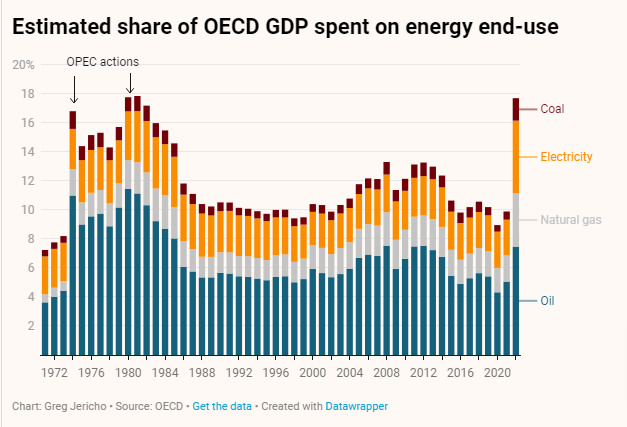
    The OECD notes that the share of GDP being spent on energy by OECD nations is higher now than it was during the OPEC crisis in 1974 and 1980. The evidence again is clear that a windfall profits tax should be levied on coal, oil and gas companies who a reaping massive profits while the cost of living rises sharply for households.


    You might also like

    Australia’s Gas Use On The Slide

    by Ketan Joshi

    The Federal Government has released a new report that includes projections of how much gas Australia is set to use over the coming decades. There is no ambiguity in its message: Australia reached peak gas years ago, and it’s all downhill from here:

    Dutton’s nuclear push will cost renewable jobs

    by Charlie Joyce

    Dutton’s nuclear push will cost renewable jobs As Australia’s federal election campaign has finally begun, opposition leader Peter Dutton’s proposal to spend hundreds of billions in public money to build seven nuclear power plants across the country has been carefully scrutinized. The technological unfeasibility, staggering cost, and scant detail of the Coalition’s nuclear proposal have

  • Gas companies are profiting off of human misery – we need a windfall profits tax

    Originally published in The Guardian on November 14, 2022

    Russia’s illegal invasion of Ukraine caused a massive surge in gas and LNG prices that have enabled gas companies around the world, including Australia to make record-level profits.

    But none of these profits have come from either management decisions or productive investments. The price rise has not come from any economic improvements. No, they have come only from an illegal invasion that is causing great human misery.

    Labour market and fiscal policy director Greg Jericho notes research suggests that the gas sector has accrued around $26bn in profits due to price rises affected by the Russian invasion. He argues that all of these profits should be garnered in taxation – a view that echoes that of former Treasurer Secretary Ken Henry.

    This revenue would be enough to cover the cost of rewiring the nation and greatly assist the tradition to renewables.

    But the problem of revenue are much deeper than the need for a windfall profits tax.

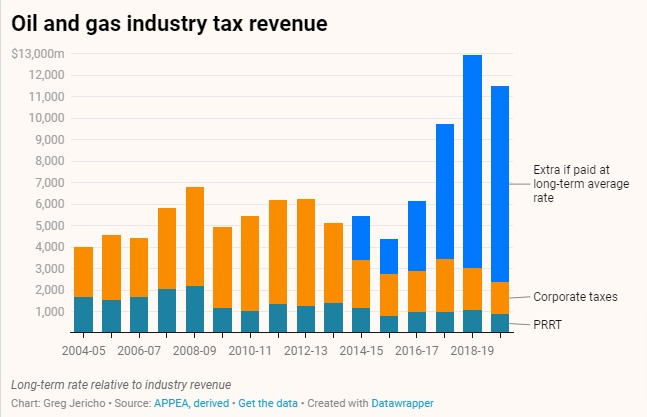
    Jericho’s analysis of industry data reveals that the industry pays much less company tax relative to production than it did in the past.

    Had the industry paid the same level of company tax relative to revenue that is had in the decade prior to the opening of the Gladstone port, in 2019-20 alone, an extra $9.1bn in tax revenue would have been raised.

    Oil and gas are Australia’s resources. Not only are their emissions causing climate change but the profits are largely headed overseas, and more than in the past not flowing through into taxation.

    As Australians demand better and wider government services, and the costs of dealing with climate change grow ever higher, we need to ensure the fossil fuel companies pay their rightful share.


    You might also like

    Australia’s Gas Use On The Slide

    by Ketan Joshi

    The Federal Government has released a new report that includes projections of how much gas Australia is set to use over the coming decades. There is no ambiguity in its message: Australia reached peak gas years ago, and it’s all downhill from here:

  • Expansion of Employer Power to Use Casual Work Hurts Women Most

    Originally published in Michael West Media on March 24, 2021

    As women lead mobilisations against workplace gendered violence, the federal government passed legislation expanding employer power to use insecure, casual labour in its IR bill – laws that will disproportionately impact the pay and security of women’s jobs.

    In this commentary, Senior Economist Alison Pennington explains how new casuals measures and the government’s wider economic policies – including in industrial relations, childcare, welfare, and fiscal spending – significantly undermine the economic security of women, entrench pay inequality, and ultimately, increase their vulnerability to gendered violence.

    This commentary was originally published in Michael West Media.

    Crocodile tears no mask for Coalition’s economic war on women

    Well may Scott Morrison tear up as he relates how his daughters, wife and widowed mother drive his every decision. The facts are that every move of the Coalition government ensures women are poorer, more insecure at work and more vulnerable to violence on the job. The Industrial Relations bill pushed through last week is a final nail in the coffin for women. Alison Pennington reports.

    After a month of anger from women around the country about sexual harassment and the treatment of women in the workplace, federal parliament passed legislation last week that will strike a massive, lasting blow to women’s job quality and pay, entrenching pay inequality and exacerbating women’s economic insecurity.

    The mainstream media has mainly focused on the fact that most of the Industrial Relations bill didn’t pass. But the cornerstone of the legislation – and the primary reason for its inception, pre-pandemic, by business lobbyists – did.

    A new legal definition of casual work will allow employers to call any job a casual one. Jobs can now look and smell like permanent jobs, except that employers can legally engage you as a casual, stripping away your legal entitlements at will.

    So-called “permanency conversion” rights in the legislation are so weak that employers will easily craft employment arrangements to lock in casual jobs long-term.

    Employers will simply vary rosters

    Employers will vary rosters sufficiently to ensure that employees will never reach the benchmarks of six and 12 months of regular schedules that should lead to permanency. In any case, employers will be allowed to refuse offers on “reasonable grounds”. And small businesses, which employ a huge 44% of all private sector employees, are exempted entirely.

    The federal government’s new casual laws will expand the incidence of casual work. Women will disproportionately suffer in a labour market with diminishing opportunities to obtain secure, decent jobs because women are more likely to be in casual roles (filling 54% of all casual positions). And women’s vulnerability to casualisation is growing. Women accounted for 62% of all new casual jobs created in the period from May to November 2020.

    Casual workers are not compensated

    Despite claims from employers that casual workers are compensated for the loss of entitlements and lack of predictability in rosters and tenure, nothing could be further from the truth.

    Casual workers are, on average, paid far less than employees in permanent roles. Median weekly earnings of full-time casuals were 23% lower ($1080 per week) than those in permanent roles ($1400 per week), and 45% lower for casual part-time workers ($390 per week) compared with permanent part-time workers on $720 per week.

    The expansion of the power of employers to use casual work in a jobs market awash with many hungry mouths desperate for paid work means more women in lower-paying, insecure jobs.

    The government’s decision to subject the unemployed to a below-poverty JobSeeker rate means more women reliant on employers to survive. At every move the Liberal National party government is making Australian women poorer, more insecure and more vulnerable to violence on the job.

    Women return to lower quality jobs

    Treasurer Josh Frydenberg celebrates the recent fall in the unemployment rate to 5.8 per cent, claiming the recovery is well under way. But the detailed job quality data tell a very different story for women.

    Women workers are “snapping back” to a world of paid work on inferior terms compared with men – fewer hours, less pay and less security.

    Casual jobs accounted for 64.3% of the total growth in women’s employment from May to November last year.

    Alarmingly, more than half of all the growth in women’s employment over the six-month period was in both low-hours and insecure work, with 52.4% of total growth in employees in part-time casual jobs.

    Traditional full-time permanent jobs with normal entitlements (such as paid sick leave, holidays and superannuation) represented a dismal 10.4% of female employment growth from May through November.

    It’s a crude fact that as women’s casual jobs were booming, business lobbyists were pushing for passage of the IR Bill on the basis that employers “lacked confidence” to hire casuals due to legal “uncertainty”. Australia was simultaneously experiencing the largest and fastest increase in casual employment in its history.

    More fuel for gender pay gap fire

    The consequences of an employment recovery overwhelmingly concentrated in part-time and casual jobs for women is more fuel for the gender pay gap fire.

    The gender pay gap is most often measured by comparing the earnings of men and women in full-time jobs. But women face persistent barriers to workforce participation – including unaffordable childcare, lack of family-friendly work arrangements, and workplace discrimination. Consequently, almost half (45.1%) of all employed women are in part-time work.

    Measuring the gender pay gap using total average earnings data (including both full-time and part-time workers, and bonuses and overtime as well as ordinary time wages) indicates that the gender pay gap is 31% across all jobs – a more dire, but more accurate, measure of the pay gap.

    Ironically, the gender pay gap narrowed in the early stages of pandemic and recession. From late-2019 to May 2020, the gap between male and female total wage incomes declined from 31.4% to 29.6% – down by 1.8 percentage points.

    But this did not represent “progress” in pay equality. The gap only closed because more than 300,000 women in low-paid casual roles lost their jobs, which increased the average earnings of those women who were able to stay connected to the workforce.

    How good’s “snap back”?

    As the economy recovered from May last year, an influx of women’s lower-paying jobs widened the gender pay gap again, just as quickly. How good’s “snap back”?

    Instead of improving the quantity and quality of jobs for women, governments have actively pursued policies that will exacerbate pay inequality this year and into the future.

    In addition to casual work changes pushed through in the IR bill, two other policies create higher barriers to women’s participation in paid work, and suppress their pay once they get on the job.

    The federal government and all states and territories (bar Tasmania and Victoria) have imposed punitive and counterproductive public sector wage freezes and caps on their workforces. This suppression of public sector pay hurts women most because they account for 61.7% of all public sector jobs.

    The failure of government to provide affordable, quality childcare presents another major barrier to women’s paid work opportunities. After dangling free childcare in front of families early in the pandemic, the federal government cut supports and reintroduced fees after just three months.

    The return of full-fee, high-cost childcare prices women out of paid work. More than half of women with young children outside the workforce list childcare costs as a key factor in their decision not to work. A childcare system that lets a small number of profit-driven providers determine access denies families and their children access to critical developmental education and much-needed community bonds as people emerge from pandemic-era isolation.

    Rebuilding women’s economic security requires a very different approach from the bankrupt austerity agenda of government. Women need more and better quality jobs, free childcare, a superannuation system that provides genuine income security and an employment relations system that works to lift the quality, pay and safety of their jobs, not undermine it.

    You might also like

    Dutton’s nuclear push will cost renewable jobs

    by Charlie Joyce

    Dutton’s nuclear push will cost renewable jobs As Australia’s federal election campaign has finally begun, opposition leader Peter Dutton’s proposal to spend hundreds of billions in public money to build seven nuclear power plants across the country has been carefully scrutinized. The technological unfeasibility, staggering cost, and scant detail of the Coalition’s nuclear proposal have

    Australia’s Gas Use On The Slide

    by Ketan Joshi

    The Federal Government has released a new report that includes projections of how much gas Australia is set to use over the coming decades. There is no ambiguity in its message: Australia reached peak gas years ago, and it’s all downhill from here: