Tag: Greg Jericho Chief Economist

  • The Continuing Irrelevance of Minimum Wages to Future Inflation

    The Continuing Irrelevance of Minimum Wages to Future Inflation

    Minimum and award wages should grow by 5 to 9 per cent this year
    by Greg Jericho

    Updated analysis by the by the Centre for Future Work at the Australia Institute reveals that a fair and appropriate increase to the minimum wage, and accompanying increases to award rates, would not have a significant effect on inflation. The analysis examines the correlation between minimum wage increases and inflation going back to 1990, and finds no consistent link between minimum wage increases and inflation. It also reveals that such an increase to award wages could be met with only a small reduction in profit margins.

    The report, authored by Greg Jericho, based on previous work by both he and Jim Stanford finds that an increase to the National Minimum Wage and award wages of between 5.8% and 9.2% in the Fair Work Commission’s Annual Wage Review, due in June, is required to restore the real buying power of low-paid workers to pre-pandemic trends. The report also finds that this would not significantly affect headline inflation.

    Key findings of the report include:

    • Last year’s decision, which lifted the minimum wage and award wages by 3.75 per cent, offset the inflation of the previous year but still left those on Modern Awards with real earnings below what they were in 2020.
    • By June this year, the real value of Modern Award wages will be almost 4 per cent below what they were in September 2020
    • Despite increases in the minimum wage over the past 2 years above inflation, inflation fell by a combined 4.5 percentage points.
    • There has been no significant correlation between rises in the minimum wage and inflation since 1990.
    • Raising wages by 5.8 to 9.2 per cent this year would offset both recent inflation and restore real wages for award-covered workers to the pre-pandemic trend.
    • Even if fully passed on by employers, higher award wages would have no significant impact on economy-wide prices.
    • A 9.2 per cent increase in award wages could be fully offset, with no impact on prices at all, by a 1.8 per cent reduction in corporate profits – still leaving profits far above historical levels

    “Australia’s lowest paid workers have been hardest hit by inflation over the past 3 years. The price rises of necessities always hurt those on low incomes harder than those on average and high incomes. This analysis shows there is no credible economic reason to deny them a decent pay raise above inflation.” Jericho said.

    “It’s vital the Fair Work Commission ensure that the minimum wage not only keeps up with inflation but also returns the value to the real trend of before the pandemic.”


    The Continuing Irrelevance of Minimum Wages to Future Inflation


    Factsheet
    The continuing irrelevance of minimum wages to future inflation

    Share

  • Budget briefing paper 2025-2026

    The Centre for Future Work’s research team has analysed the Commonwealth Government’s budget.

    As expected with a Federal election looming, the budget is not a horror one of austerity. However, the 2025-2026 budget is characterised by the absence of any significant initiatives.  There is very little in this budget that is new other than the surprise tax cuts, which are welcome given they benefit mostly those on low-incomes. There are continuing investments in some key areas supporting wages growth, where it is sorely needed, and rebuilding important areas of public good. However, there remains much that needs to be done in the next parliament.

    This briefing paper reviews some of the main features of the budget, focusing on those aspects targeting and impacting on workers, working lives and labour markets.

    The establishment of a $1 billion Green Iron Investment Fund to provide capital grants to green iron projects is a significant investment. With $500 million of this fund going to the troubled Whyalla steelworks this investment should ensure ongoing integrity in the management of this vital industrial asset. We believe the government should take a significant ongoing stake in the ownership of the Whyalla steelworks. The $2 billion Green Aluminium Production Credit, to incentivise Australian aluminium smelters to switch to renewable electricity before 2036, is a necessary and welcome policy to assist the transition to a low emissions economy. Unfortunately, the credit is not available until 2028-2029.

    New and ongoing support for students in TAFE and in higher education are important cost-of-living measures while also making education and training more inclusive and accessible. There is some new funding for previously announced initiatives that support workers and wages growth and some funding for new wage increases in the female-dominated, and low-paid, aged care and early childhood education and care sectors; demonstrating the government’s commitment to addressing long-standing undervaluation of feminised care occupations. Continuing government support will be needed as the current Fair Work Commission review of awards to address undervaluation progresses.

    Other reforms in ECEC, along with previously announced changes to paid parental leave and carer payments, provide welcome, but belated, support for working parents and carers. It is disappointing to see that the opportunity has been missed to raise Job Seeker and Youth Allowances from their grossly inadequate levels.


    Full report

    Share

  • Chalmers is right, the RBA has smashed the economy

    Chalmers is right, the RBA has smashed the economy

    by Greg Jericho

    In recent weeks the Treasurer Jim Chalmers has been criticised by the opposition and some conservative economists for pointing out that the 13 interest rate increases have slowed Australia’s economy. But the data shows he is right.

    Last year the government announced it was considering removing its statutory power to overrule the Reserve Bank. Thankfully it has now reconsidered that move, and the actions of the RBA over the past year serve to remind everyone that it is far from infallible.

    In its May Statement on Monetary Policy the RBA looked ahead one month and estimated that in June the annual growth of household consumption would be 1.1%. When the national accounts were released last week, the actual growth was revealed to be just 0.5%.

    Now obviously economic forecasting is a bit of a mugs game, but household consumption makes up half of Australia’s economy and accounted for around 45% of all the growth in the economy over the past decade so it is pretty important. It is also the area of the economy most directly affected by interest rate rises. This error of forecasting suggests that the Reserve Bank has rather poorly misread just how greatly households had been impacted by the 13 rate rises that had taken the cash rate from 0.1% in April 2022 to 4.35% in November 2023.

    This error is crucial because the main reason the RBA raises rates is to reduce the ability of households to spend. Because you can’t tell your bank that you don’t really feel like paying your mortgage this month, interest rate rises force households to divert money that would have been spent on goods and services to paying your mortgage.

    The problem is when you are trying to slow down half of the economy so directly, if you overdo it the entire economy begins to fall. This is what happened in the early 1980s and 1990s when interest rates were raised sharply in order to slow inflation.

    And the private sector has already slowed so greatly that the only reason GDP rose in the past year was because of increased government spending.
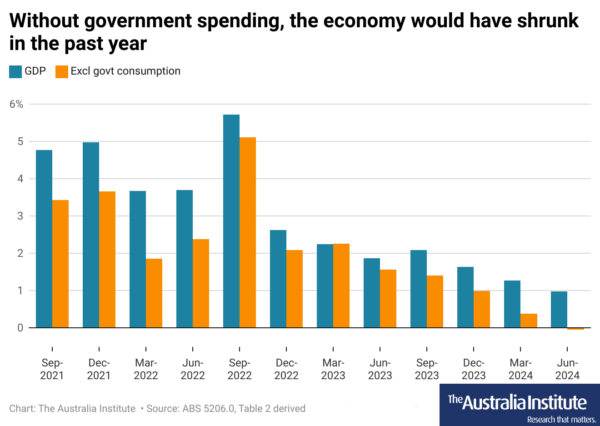
    That is not a sign of a strong economy, nor a sign of one, according to the assistant governor of the RBA, Dr Sarah Hunter, that “is running a little bit hotter than we thought previously”.

    Economies that are running a bit hot are ones in which households are spending a lot more than they were the year before because unemployment is falling and wages are rising well ahead of inflation. Instead we currently have a situation where unemployment has risen from 3.5% in June last year to the current level of 4.2%, household spending grew just 0.5% – well below the long-term average of 3% – and real wages in the past year rose just 0.1%.

    When asked about this discrepancy between reality and the RBA’s belief, the Governor of the Reserve Bank, Michele Bullock told reporters last week that

    …it’s the difference between growth rates and levels.

    She noted that “it’s true that the growth rate of GDP has slowed” but that “part of monetary policy’s job has been to try and slow the growth of the economy because the level of demand for goods and services in the economy is higher than the ability of the economy to supply those goods and services. So there’s still a gap there. So even though it’s slowing, we still have this gap.”

    In effect Bullock was telling people to stop worrying about the fact that household consumption was barely growing or that GDP only grew because of government spending or that GDP per capita has fallen for a record 6 consecutive quarters because the amount of consumption and GDP was too high.

    This could make sense – think of it like a car travelling on a 60km/h road. If it was travelling at 80km/h and slowed to 70km/h even though it was slowing it would still be going too fast.

    In essence this is what Bullock is arguing is happening to demand in the economy – it is slowing but overall there’s still too much of it.

    The only problem is that this is completely wrong.

    Consider the suggestion that the demand for goods and services is higher than the ability of the economy to supply those goods and services. One simple way to look at this is to see if the amount of goods and services bought per person is currently at a level consistent with the growth observed in the decade before the pandemic.

    This is actually not a major test – household consumption, along with most of the economy was rather weak in the 7 or 8 years before 2020. The RBA at the time actually was hoping Australians would spend more than they did, so you would expect in an economy with too much demand that the amount of things we are buying is well above the levels of that particularly weak period.

    But it is not.

    As we can see from the below graph, while household spending did quickly recover after the lockdowns in 2020 and 2021, by the time the RBA began raising interest rates our level of demand for goods and services was only back to the level consistent with the pre-pandemic growth.
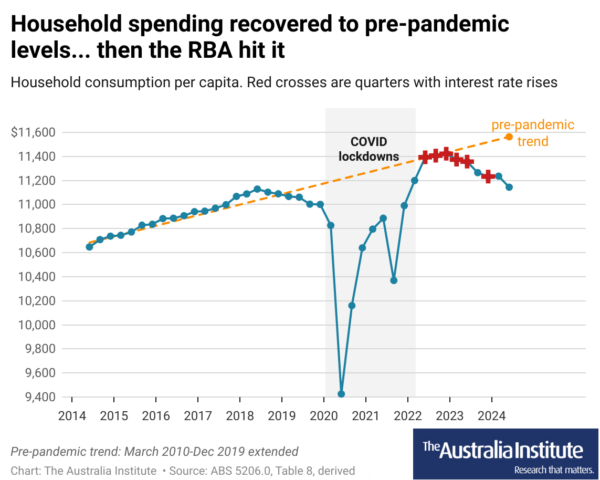
    Now yes you can argue the RBA was right to increase rates at that time – to ensure our spending didn’t keep zooming up in recovery. But by the time of the 10th rate increase in March 2023, household spending per person was already falling and 0.7% below the pre-pandemic trend. When the RBA raised rates for there 12th time in June 2023, the level of demand for goods and services was 1% below the pre-pandemic trend.

    At this point you might think the RBA had done enough. But after pausing for 4 months, the bank inexplicably raised rates for a 13th time in November 2023. At this stage household level of spending was 2.5% below the pre-pandemic trend.

    And because interest rate rises take months to worth through the economy we now find ourselves at a point where the level of household consumption per person is 3.8% lower than would have been expected had households merely kept increasing our consumption in line with the decade before the pandemic.

    In effect Australians are currently consuming almost the same amount of goods and services as they did in June 2018 and yet the head of the RBA would have us believe that is a case of excess demand.

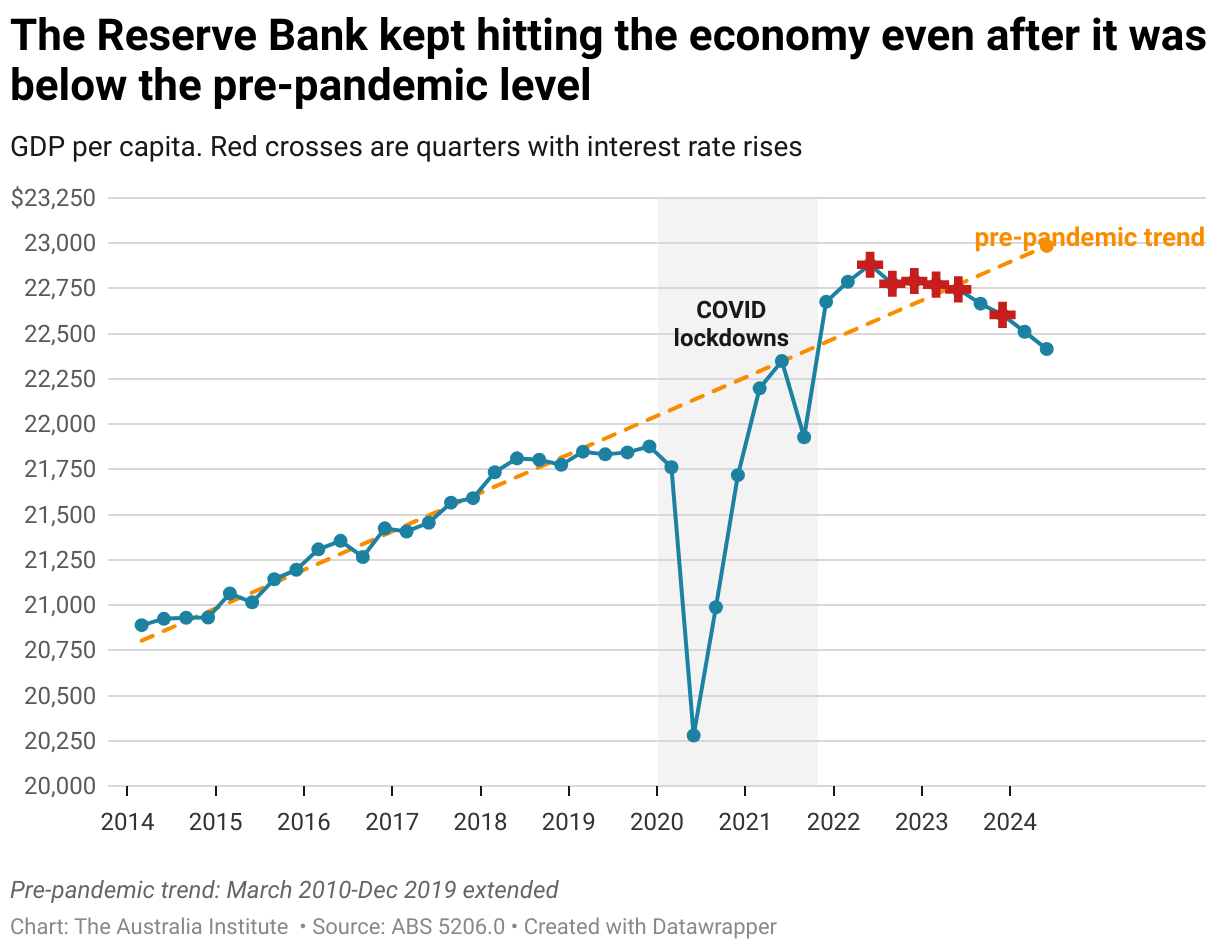
    If we look at the overall economy, the picture is much the same (see the graph at the top of the page). Australia’s level of GDP per capita did recover quickly after the lockdowns and by June 2022 was 1.4% above the pre-pandemic trend level. But the interest rates rises had an immediate impact – reducing GDP per capita in 7 of the next 8 quarters. By June 2023 the level of activity in the economy was already below pre-pandemic expectations, and when the RBA hit Australians with the 13th rate rise in November 2023, the level of GDP per capita was 1.2% below the long-term trend.

    It is now 2.5% below – back at the level it was in June 2021.

    The RBA has got it wrong. They were initially worried that inflation was driven by concerns of strong wage growth rather than supply side issues and corporate profits. They then tried to argue household spending was still growing too strongly. The GDP figures showed that to be woefully mistaken. They then tried to argue that while growth in the economy was slow, there was still too much demand. But again the figures show this to be mistaken.

    The Treasurer Jim Chalmers stated nothing but the facts when he said earlier this month that rate rises were “smashing the economy”. The data supports his assertion, and it is time the RBA admits that their actions have not only slowed the economy but slowed it at a pace that is now harming Australians for no benefit other than the RBA saving face from its previous over-reactions.


    Related research

    You might also like

  • Budget 2024-25: Resists Austerity, Reduces Inflation, Targets Wage Gains

    Budget 2024-25: Resists Austerity, Reduces Inflation, Targets Wage Gains

    Important support to help with cost-of-living challenges, but more needed

    Commonwealth Treasurer Jim Chalmers delivered his 2024-25 budget to Parliament. While it booked a surplus for 2023-24 (the second consecutive surplus), it increased total spending for future years, and forecasts continued small deficits. In the wake of the economic slowdown resulting from RBA interest rate hikes, this new spending is needed and appropriate.

    Targeted cost of living measures will directly reduce inflation in some areas (like energy and rents), while helping working Australians deal with higher prices in others (including reworked State 3 tax cuts, and support for higher wages for ECEC and aged care workers). Unlike previous years, the budget is projecting real wage gains in coming years that are actually likely to materialise — however, the damage from recent real wage cuts will take several years to repair, and further support for strong wage growth will be required, from both fiscal policy and industrial laws. The budget also spelled out initial steps in the government’s Future Made in Australia strategy to build renewable energy and related manufacturing industries; these steps are welcome but need to be expanded, and accompanied by strong and consistent measures to accelerate the phase-out of fossil fuels.

    Our team of researchers at the Centre for Future Work has parsed the budget, focusing on its impacts on work, wages, and labour markets. Please read our full briefing report.


    Full report

    Share

  • The Irrelevance of Minimum Wages to Future Inflation

    The Irrelevance of Minimum Wages to Future Inflation

    Minimum and award wages should grow by 5 to 10 per cent this year
    by Jim Stanford and Greg Jericho

    A significant increase to the minimum wage, and accompanying increases to award rates, would not have a significant effect on inflation, according to new analysis by the Centre for Future Work at the Australia Institute.
    The analysis examines the correlation between minimum wage increases and inflation going back to 1997, and it finds no consistent link between minimum wage increases and inflation.

    The report, co-authored by Greg Jericho (Policy Director) and Jim Stanford (Director), finds that a minimum wage rise of between five and 10 per cent in the Fair Work’s Annual Wage Review, due in June, is needed to restore the real buying power of low-paid workers to pre-pandemic trends, but would not significantly affect headline inflation.

    Key findings of the report include:

    • Last year’s decision, which lifted the minimum wage by 8.65 per cent and other award wages by 5.75 per cent, offset some but not all of the effects of recent inflation on real earnings for low-wage workers.
    • At the same time, inflation fell by 3 full percentage points.
    • There has been no significant correlation between rises in the minimum wage and inflation since 1997.
    • Raising wages by 5 to 10 per cent this year would offset recent inflation and restore the pre-pandemic trend in real wages for award-covered workers.
    • Even if fully passed on by employers, higher award wages would have no significant impact on economy-wide prices.
    • A 10 per cent increase in award wages could be fully offset, with no impact on prices at all, by just a 2 per cent reduction in corporate profits – still leaving profits far above historical levels.

    “Australia’s lowest paid workers have been hardest hit by inflation since Covid. There is a moral imperative to restore quality of life for these Australians and this analysis shows that there is no credible economic reason to deny them,” Jericho said.

    “It’s vital the Fair Work Commission ensure that the minimum wage not only keeps up with inflation, but also grows gradually in real terms – as was the trend before the pandemic.


    Full report


    Factsheet
    Increasing minimum wage would not drive inflation up: new report

    Share

  • The gas industry is laughing at us as they make more money but not more tax

    Originally published in The Guardian on February 29, 2024

    Despite soaring production and revenues the gas industry is not paying more tax

    Australia produces more than six times the amount of gas needed to supply our manufacturing industry, power stations and homes. But more than 80% either heads overseas as LNG exports or is used to convert natural gas into LNG:

    We export much more gas than we used to. In the 2000s we exported around 14m tonnes of LNG a year. Now, due to the opening of the Gladstone LNG terminal, we send 83mt overseas – the second most of any nation.

    But more production and more revenue has not led to more tax, even though the petroleum resources rent tax (PRRT) is in place to supposedly raise revenue from windfall profits such as those generated by the gas industry after the Russian invasion of Ukraine.

    When Australia exported 15.4mt of LNG in 2008-09, the government raised $2.2bn in PRRT. In 2022-23, exports had increased 437% to 83mt but PRRT revenue was up just 7% to $2.4bn.

    Did gas suddenly become unprofitable?

    No, the problem is that the PRRT is open to manipulation that enables companies to use costs to reduce their PRRT liability such that it appears they are never making “super profits”.

    In last year’s budget, the government finally proposed limiting the deductions to the PRRT in any year to 90% of LNG project revenues. Alas that proposal also had a punchline. The government announced the changes would raise an extra $2.4bn in PRRT over the next four years. That was roughly a 30% increase in tax.

    Thirty per cent!

    You would think the gas industry would launch the mother of all campaigns against it. But no. They loved it.

    The day it was announced the gas industry peak body recommended bipartisan support as the changes “would see more revenue collected earlier”. The key word was “earlier”. It won’t raise more tax; it just moves some tax from later to earlier.

    But it won’t even do that.

    In December’s midyear economic and fiscal outlook, the government announced it was revising down its estimate of how much PRRT would be raised over the next four years.

    How much did it reduce its estimate by?

    You guessed it: $2.4bn.

    We need to change the way the PRRT operates, we need to tax our gas more and we need to do it now.


    You might also like

    Australia’s Gas Use On The Slide

    by Ketan Joshi

    The Federal Government has released a new report that includes projections of how much gas Australia is set to use over the coming decades. There is no ambiguity in its message: Australia reached peak gas years ago, and it’s all downhill from here:

    Commonwealth Budget 2025-2026: Our analysis

    by Fiona Macdonald

    The Centre for Future Work’s research team has analysed the Commonwealth Government’s budget, focusing on key areas for workers, working lives, and labour markets. As expected with a Federal election looming, the budget is not a horror one of austerity. However, the 2025-2026 budget is characterised by the absence of any significant initiatives. There is

  • Mid-Term Review of Albanese Government’s Labour Policy Reforms

    Mid-Term Review of Albanese Government’s Labour Policy Reforms

    Reforms will make a significant difference, but further progress needed

    A review of the Albanese government’s labour and industrial relations reforms at the mid-point of its term in office concludes that the government deserves “positive marks” for several measures taken to strengthen collective bargaining and accelerate wage growth.

    That assessment is contained in an article contained in a new special issue of the Journal of Australian Political Economy (JAPE), evaluating the government’s record on a range of issues halfway through its term. The special issue of JAPE was published on 18 December, and was edited by Prof Emeritus Frank Stilwell at the University of Sydney.

    The article reviewing the government’s labour policies was co-authored by several staff at the Centre for Future Work, including Greg Jericho, Charlie Joyce, Fiona Macdonald, David Peetz, and Jim Stanford. It considers the impacts of several government initiatives, including:

    • Successive rounds of reforms to the Fair Work Act (including last year’s Secure Jobs, Better Pay bill, and this year’s Closing Loopholes legislation).
    • Several reforms to address gender inequality in workplaces.
    • A more ambitious approach to raising the national minimum wage.
    • Longer-run proposals for attaining full employment, described in the government’s recent White Paper on Jobs and Opportunities.

    The authors judge that the government’s labour reforms have achieved an “incremental but significant rebalancing of industrial relations.” They pointed to the acceleration of wage growth in Australia in the last year as evidence that workers have won important bargaining power. Wages are now growing at 4% year-over-year, according to the latest WPI data from the ABS — twice as fast as they did on average over the previous decade, which was marked by the slowest sustained wage growth in the postwar era.

    The authors caution, however, that additional reforms are necessary to reverse the erosion of collective bargaining coverage and union membership, and ensure that workers have the bargaining power to improve wages, job security and working conditions.

    “On the whole, the Albanese government has made cautious but useful progress on industrial relations and labour issues during its first year. However, it must be acknowledged that the overall labour relations regime in Australia remains heavily skewed in favour of employers,” the authors concluded.

    Please see the full article, “Labour Policy,” by Greg Jericho, Charlie Joyce, Fiona Macdonald, David Peetz and Jim Stanford, at the link below. Fiona Macdonald also authored a second article in the special issue, dealing with the government’s reforms to care policies. To see the full collection of articles in the special issue, visit the JAPE website.


    Full report

    Share

  • Higher exports prices improve the budget, but the Stage 3 tax cuts remain the wrong tax at the wrong time

    Originally published in The Guardian on December 14, 2023

    As the Budget outlook improves, with most of the benefits of Stage 3 tax cuts going to those earing over $120,000, over 80% of workers will be short-changed

    Yesterday’s mid-year economic and fiscal outlook (MYEFO) provided some pleasing news for the Treasurer, Jim Chalmers. But higher revenue does not mean a stronger economy nor that households are better off.

    While the Treasurer was releasing the latest budget numbers the annual figures for median earnings were released by the Bureau of Statistics.

    These figures showed that the median weekly earnings in August this year were $1,300 – a rise of 4.2% from last year, which was less than the 5.4% increase in inflation.

    That weekly amount translates to $67,600 in annual earnings.

    People earning that amount will get just $565 from the Stage 3 tax cuts (0.8%) while someone on $200,000 – well in the top 10% of earners will get a 4.5% cut worth $9,075.

    The Treasurer told ABC 730 on Wednesday night that the government has not changed its position on Stage 3 and that “We think there is an important role for returning bracket creep where governments can afford to do that.”

    The problem is the Stage 3 cuts are mostly focused at rewarding those on high incomes, who are least affected by bracket creep.

    If the Government was truly worried about using the bonus revenue from higher export prices to assist low and middle-income earners it would care more about those on the median income of $66,700 than those in the top tax bracket and top 10% of income.


    You might also like

    Commonwealth Budget 2025-2026: Our analysis

    by Fiona Macdonald

    The Centre for Future Work’s research team has analysed the Commonwealth Government’s budget, focusing on key areas for workers, working lives, and labour markets. As expected with a Federal election looming, the budget is not a horror one of austerity. However, the 2025-2026 budget is characterised by the absence of any significant initiatives. There is

  • After two years of profit-led inflation, workers deserve the pay rises they are getting

    Originally published in The Guardian on November 16, 2023

    The wage rises for low-paid workers on awards and those working in aged care helped drive the strong wage growth.

    The latest wage growth figures showed that workers’ wages for the past six months have grown faster than inflation. As Labour Market Policy Director, Greg Jericho writes in his Guardian Australia column, this should be celebrated. We need to shed our fear of wage rises. For too long any sign of increasing wage growth has been viewed as something to be stomped on while ever-increasing corporate profits have been cheered.

    Since the start of the pandemic, workers’ purchasing power has crashed, and the only way to recover the lost real wages is through wages increasing faster than inflation.

    The 1.4% growth of private-sector wages in the September quarter was driven largely off the back of the Fair Work Commission’s decision to increase Award wages by 5.75% and the decision to give aged-care workers a 15% pay rise.

    As a result around 40% of those who gained a pay rise in the September quarter received one greater than 4%.

    One other pleasing sign has been the relaxation of public sector wage caps has allowed those workers around the country to get a fairer pay rise, but their increases remain well below that of the private-sector.

    The profit-led inflation since 2021 hurt workers, and it now is only fair that they receive some recompense. After a decade of ever falling wage growth and a pandemic and recover that smashed real wages, it is very good news that workers are finally getting their fair reward.


    You might also like

    Centre For Future Work to evolve into standalone entity

    The Centre for Future Work was established by the Australia Institute in 2016 to conduct and publish progressive economic research on work, employment, and labour markets. Supported by the Australian Union movement, the centre produced cutting edge research and led the national conversation on economic issues facing working people: including the future of jobs, wages

  • The Government needs to act on Stage 3 as the RBA warns about wealthy households spending

    Originally published in The Guardian on November 9, 2023

    The RBA made it clear one group continues to do well, and continue to spend – and they are also the ones who are about to get a massive tax cut.

    The Reserve Bank’s decision to raise interest rates on Tuesday lacked any clear reasoning.

    When compared with other periods such as during the mining boom, when household spending was growing fast and real wages were surging, we can see that the economy at the moment is much weaker. Households are now cutting back on luxuries as their real wages fall.

    But the RBA pointed out that one group of Australians are doing OK – those with high income and wealth. Those with large savings buffers and who are also enjoying the increased wealth from rising house prices are still spending.

    This is also the group who are about to be handed the biggest income tax cut in history. The Reserve Bank has made it clear that allowing Stage 3 to go forward in its current form will only fuel inflation and likely result in higher interest rates for all.

    With a Reserve Bank desperate to use any excused to raise rates and slow the economy even as it already slows, the Government needs to amend the Stage 3 cuts to deliver greater benefit to low-middle income households who have suffered the most from the rising cost of living and interest rates, and less to those who are already doing well and for whom a potential $9,075 tax cut would just put more fuel on the inflation fire.


    You might also like

    Centre For Future Work to evolve into standalone entity

    The Centre for Future Work was established by the Australia Institute in 2016 to conduct and publish progressive economic research on work, employment, and labour markets. Supported by the Australian Union movement, the centre produced cutting edge research and led the national conversation on economic issues facing working people: including the future of jobs, wages