Tag: David Peetz Laurie Carmichael Distinguished Research Fellow

  • Want to lift workers’ productivity? Let’s start with their bosses

    Originally published in The New Daily on August 18, 2025

    Business representatives sit down today with government and others to talk about productivity. Who, according to those business representatives, will need to change the way they do things?

    The elephant in the room is that it is business that has the biggest influence on productivity. Certainly, it has a much bigger impact than workers, who typically get the blame when things go wrong.

    The factor that most shapes how productive workers are, we must remember, is the technology they work with. It is management that is responsible for the decisions about what technology a business introduces, and how. Workers often do not have much of a say.

    It is not workers who make the decisions about how much money is available for investment. It is not workers who make the decision about which particular technologies to buy, install and use. It is not workers who decide how much money should be allocated to the training of workers to use the new technology, or how those workers should be deployed. It is management.

    Sure, there is lots of evidence that, when workers have a say at work, productivity is higher. But managers often don’t give them a chance to have more than a token say, if they have any say at all. Any attempts by governments to legislate that workers decide or influence decisions on those matters are opposed by business bodies in Australia.

    How much effort workers put in to their job also shapes productivity. But lazy workers don’t last long in jobs these days, and most restrictive work practices went out the window in the 1980s. If a business continued to use workers who do not put effort into their job, the finger would very quickly be pointed at the managers who decided to do that and to not have the performance management systems that would overcome that problem.

    Some characteristics of workers do make a difference, but they are often still matters in the hands of management to control.

    Output will be better with an educated and skilled workforce. If people can do more things with their brains, they will be more productive. Yet management decides on the qualifications demanded of successful applicants for jobs. Management decides how much pay to offer to attract qualified workers to apply for and fill skilled vacancies. Management decides on the training provided to workers.

    Management decides on job quality which, studies show, is positively related to performance.

    Management decides on how much a business pursues diversity, equity and inclusion practices, which (despite shenanigans in the US) have also been shown to benefit innovation and firm performance.

    So it’s no surprise that a couple of years ago the Productivity Commission, after looking at OECD evidence, said that the “productivity gains from upskilling managers could be three times higher than for upskilling workers”.

    The problem for Australia is that, overall, the quality of Australian management is not that good. One survey showed that Australia “ranks low in almost all the people management dimensions”.

    The Productivity Commission commented in its 2023 five-yearly review that “managerial capability varies, but generally lags other countries” and observed that “limited management capability may be holding back Australia’s productivity growth”. It added that its consultations had “provided insights into some of the consequences for innovation of poor management capability”.

    The main response by top management seems to be to pay itself more. But a study as far back as 2004 found that the average pay gap between CEO pay and average earnings was “at least three times higher than that required to maximise organisational performance”. Leaders might say they’re tied to performance bonuses, but somehow when profits go down, the formula or the base get changed, and the CEO’s pay packet is saved.

    When that doesn’t increase productivity, it’s blame the unions. But that wears a bit thin when only one in eight workers is unionised these days. Or cut penalty rates, or some other aspect of workers’ pay! But lower wages just reduce the incentive to introduce new technology.

    What the studies do show about the impact of workplace relations on productivity is that it’s not whether a workforce is unionised that matters, it’s the quality of relations between workers and management that counts — and that is very much in the hands of management.

    After all, research shows that workers do want a co-operative relationship with management — which, despite management wishes, is not the same as acquiescing to every management whim. If their union didn’t want co-operation, the workers would quit the union. The trouble is, if management didn’t want genuine co-operation, it will just blame the workers, and up its own pay because it’s dealing with a difficult situation.

    There are no prizes for expecting business to blame others for Australia’s productivity problems. But an honest debate would look at what management can do better.


    You might also like

  • The curious incident of low wages growth

    The curious incident of low wages growth

    Wages and Policy in the 21st Century Report No. 1
    by David Peetz

    A new Carmichael Centre report by David Peetz considers why wages growth has been so low, despite a tight labour market and a brief surge in inflation.

    Asking why has there been no wages explosion, Peetz finds the answer lies in loss of power.

    The report documents how workers have lost power in the past two decades, with almost every change in the economy taking away workers’ bargaining power.

    From 2014 to 2022 most government policies took away workers’ bargaining power. The most recent industrial relations reforms in 2022-2024 shifted the pendulum back some way towards workers. These laws increased workers power and have also boosted wages growth.

    The analysis shows that all workers have had their wages damaged by lack of power. And all workers have been able to recover some ground since the recent industrial relations laws have come into effect.

    • Australian workers can no longer obtain the wage increases that they previously could from wage negotiations. Workers do not contribute to inflation.
    • Changes in power have combined to normalise low wages growth, for both union and non-union workers, even in tight labour markets. Of 16 developments in the labour market and economy over the past 50 years, 14 signalled deterioration in worker power, one an improvement in power for female workers only, and one an improvement only from 2010 until 2023 (lower unemployment).
    • The one countervailing force in recent times has been public policy which, since 2022, has led to some increases in workers’ power. Analysis of 34 policy events showed that the majority of those before 2022 further reduced workers’ bargaining power, while almost all of those since then have increased workers’ power.
    • In March 2014 wages were 53.0% of national income, but by December 2022 they had fallen to just 50.3%, before recovering to 53.5% by September 2024.
    • Wages grew at a little over 2% per year through most of the period from 2013-14.  After September 2022, they grew more quickly, to over 4% per annum throughout 2023-24.
    • The wage gains associated with increased worker power are not just restricted to unionists, but they are likely greater for unionists than non-unionists.


    Full report

    Share

  • Submission to Industrial Relations Victoria Inquiry on Restricting Non-Disclosure Agreements (NDAs) in Workplace Sexual Harassment Cases

    Submission to Industrial Relations Victoria Inquiry on Restricting Non-Disclosure Agreements (NDAs) in Workplace Sexual Harassment Cases

    by Lisa Heap and David Peetz

    It is generally reported that NDAs can benefit victim-survivors by providing anonymity and privacy where that is the victim-survivor’s choice. However, it is also reported that power imbalances between victim-survivors on the one hand and perpetrators and employers/organisation on the other have left workers feeling they had little choice but to sign NDAs.

    NDAs have had the impact of silencing victim-survivors, disguising the actions of perpetrators and covering up the prevalence of sexual harassment and other forms of gender-based violence and harassment within organisations. At times, this has enabled harassers to remain in the same workplace or move within industries and continue to engage in sexual harassment.

    The focus of this submission is on the issues of transparency associated with NDAs and the impact of these agreements on public interest concerns regarding the prevention of sexual harassment and other forms of gender-based violence and harassment at work. We believe that greater transparency regarding the practices associated with settling sexual harassment claims will lead to greater accountability. This accountability should be supported by legislative reforms that mandate minimum conditions such as those set out in this submission.


    Full report

    Share

  • Employee voice and new rights for workplace union delegates

    Employee voice and new rights for workplace union delegates

    Impacts on wages, productivity, cooperation and union training
    by David Peetz

    A workplace delegate is a worker chosen to represent workers who are union members in dealings with management. Delegates are volunteers who perform their union duties on an unpaid basis in addition to their normal job at work. Delegates spend their time undertaking vital tasks for workplace representation.

    Some employers have actively placed barriers in the way of volunteer union delegates and paid officials. One study in the early 2000s found that 23% of delegates found management
    hostile, while 22% of delegates reported that management opposition to their role as a delegate had become more intense over the previous two years. Examples from various case studies, including court and industrial cases, illustrate some of the ways in which that minority of employers from workplaces with delegates expressed their hostility towards unionism and their opposition to delegates, including by placing barriers in the way of workplace union activists and delegates.

    The new regime of workplace delegates’ rights is very likely, overall, to increase the voice of employees, and thereby have positive consequences, over the long run, for pay and conditions, union membership, workplace cooperation, grievance resolution and productivity. However, the effects of new rights for paid union training leave depend very much on union responses, in particular on their subsequent reliance on classroom versus informal training and the ‘follow up’ of classroom education.


    download the report


    Factsheet
    New union rights to boost workplace cooperation

    Share

  • Mid-Term Review of Albanese Government’s Labour Policy Reforms

    Mid-Term Review of Albanese Government’s Labour Policy Reforms

    Reforms will make a significant difference, but further progress needed

    A review of the Albanese government’s labour and industrial relations reforms at the mid-point of its term in office concludes that the government deserves “positive marks” for several measures taken to strengthen collective bargaining and accelerate wage growth.

    That assessment is contained in an article contained in a new special issue of the Journal of Australian Political Economy (JAPE), evaluating the government’s record on a range of issues halfway through its term. The special issue of JAPE was published on 18 December, and was edited by Prof Emeritus Frank Stilwell at the University of Sydney.

    The article reviewing the government’s labour policies was co-authored by several staff at the Centre for Future Work, including Greg Jericho, Charlie Joyce, Fiona Macdonald, David Peetz, and Jim Stanford. It considers the impacts of several government initiatives, including:

    • Successive rounds of reforms to the Fair Work Act (including last year’s Secure Jobs, Better Pay bill, and this year’s Closing Loopholes legislation).
    • Several reforms to address gender inequality in workplaces.
    • A more ambitious approach to raising the national minimum wage.
    • Longer-run proposals for attaining full employment, described in the government’s recent White Paper on Jobs and Opportunities.

    The authors judge that the government’s labour reforms have achieved an “incremental but significant rebalancing of industrial relations.” They pointed to the acceleration of wage growth in Australia in the last year as evidence that workers have won important bargaining power. Wages are now growing at 4% year-over-year, according to the latest WPI data from the ABS — twice as fast as they did on average over the previous decade, which was marked by the slowest sustained wage growth in the postwar era.

    The authors caution, however, that additional reforms are necessary to reverse the erosion of collective bargaining coverage and union membership, and ensure that workers have the bargaining power to improve wages, job security and working conditions.

    “On the whole, the Albanese government has made cautious but useful progress on industrial relations and labour issues during its first year. However, it must be acknowledged that the overall labour relations regime in Australia remains heavily skewed in favour of employers,” the authors concluded.

    Please see the full article, “Labour Policy,” by Greg Jericho, Charlie Joyce, Fiona Macdonald, David Peetz and Jim Stanford, at the link below. Fiona Macdonald also authored a second article in the special issue, dealing with the government’s reforms to care policies. To see the full collection of articles in the special issue, visit the JAPE website.


    Full report

    Share

  • A Better Future for Self-Employment

    A Better Future for Self-Employment

    How is it changing, and how can ‘gig’ work be regulated?
    by David Peetz

    This report considers and challenges two common myths about self-employment.

    The first is that self-employment is inexorably growing. The second is that self-employment cannot, or should not, be regulated in order to protect self-employed workers and improve the conditions of their work.

    This new report from the Carmichael Centre at the Centre for Future Work shows that, in reality, self-employment is not growing inexorably — in fact, in most countries (including Australia) it is declining.

    The much-trumpeted surge in self-employment and ‘freelancing’ is a myth. However, the nature of self-employment is changing: fewer self-employed people are running successful independent businesses, and more are engaged in precarious ‘solo’ activities like short-term contracting and part-time ‘gig’ work.

    The report also shows that some forms of self-employment can be regulated to protect affected workers, provided two simple and important criteria are satisfied: the workers are vulnerable and hence need protection, and a viable mechanism exists that enables their work to be efficiently regulated.

    The report reviews the proposed provisions of the second part of the federal government’s new Closing Loopholes legislation, which would allow for minimum labour standards to be applied to digital platform workers and owner-operators in the transportation sector. The new legislation (to be considered in Parliament in 2024) is an appropriate and effective response to the challenges facing these two groups of ‘gig’ workers.

    Please see the full report, “A Better Future for Self-Employment: How is it changing, and how can ‘gig’ work be regulated?,” by David Peetz, Laurie Carmichael Distinguished Research Fellow at the Centre for Future Work.


    Full report


    Factsheet
    New Report Reveals Changing Face and Future of Self-Employment

    Share

  • Submission to the Senate Education and Employment Legislation Committee Inquiry into the Fair Work Legislation Amendment (Closing Loopholes) Bill 2023

    Submission to the Senate Education and Employment Legislation Committee Inquiry into the Fair Work Legislation Amendment (Closing Loopholes) Bill 2023

    Reforms Would Improve Stability, Wages for Workers in Insecure Jobs
    by Fiona Macdonald, David Peetz and Jim Stanford

    Experts from the Centre for Future Work recently made a submission to the Senate committee studying the “Closing Loopholes” bill, which would make several reforms to the Fair Work Act.

    The submission was prepared by our Policy Director Dr Fiona Macdonald, Carmichael Distinguished Research Fellow Prof Em David Peetz, and Economist and Director Dr Jim Stanford.

    Their submission emphasises:
    • The importance of limiting insecure employment practices (such as casual employment, labour hire, and platform or ‘gig’ work), and providing full protections to workers in those arrangements.
    • The importance of strong and well-resourced mechanisms to ensure the enforcement of these rules, and timely and effective recompense in cases when they are not.
    • The importance of empowering trade unions and their delegates to play their full potential role in enforcing labour standards and ensuring fair compensation and treatment of workers.


    Full report


    Factsheet
    Paying for Collective Bargaining

    Share

  • We need more than a definition change to fix Australia’s culture of permanent ‘casual’ work

    Originally published in The Conversation on July 31, 2023

    The surprising thing about the Albanese government’s announced reforms to “casual” employment is not that they’re happening.

    It’s that employer advocates are getting so excited about them, despite the small number of people they will affect and the small impact they will have.

    That’s not to say the changes aren’t needed. Rather, true reform of the “casual” employment system, of which this is just a first but important step, has a lot further to go to resolve the “casual problem”.

    What is the ‘casual problem’?

    This problem is that most “casual” workers aren’t really casual at all — as shown by analysis that I and colleague Robyn May did, using unpublished data from the Australian Bureau of Statistics (ABS).

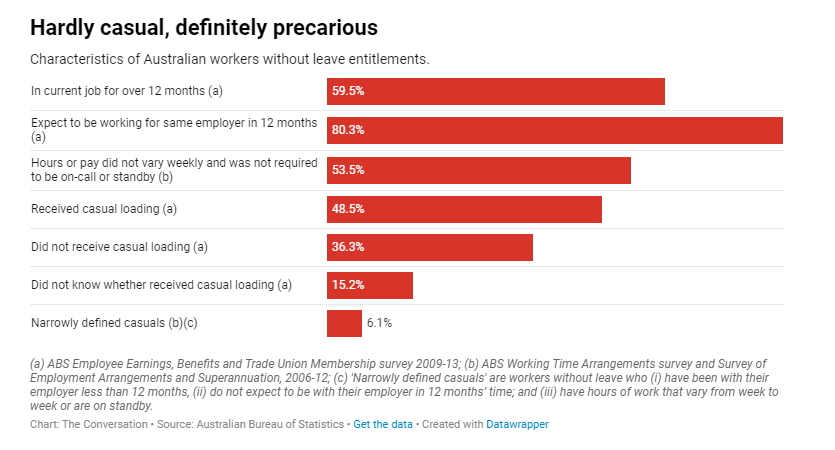
    The premise for hiring them is that the work is intermittent, short-term and unpredictable. But, as you can see from the chart, the last time the ABS collected these data, a majority of “casuals” worked regular hours.

    Almost 60% of “casuals” had been in the job for more than a year. About 80% expected to still be there in a year’s time.

    Only 6% of “casuals” (1.5% of employees) worked varying hours (or were on standby), had been with their employer for a short time, and expected to be there for a short time.

    Even now, some “casuals” have been doing the same “casual” work for over 20 years.

    Permanent ‘casuals’

    All this has led to a class of “permanent casuals” – a nonsense term. They should more accurately be called “permanently insecure”.

    The one thing “casuals” have in common is they’re not entitled to sick leave or annual leave, and they are in a precarious employment situation. Their contract of employment only lasts till the end of their work day.

    That means they have much less power than other workers. So little power, in fact, that barely half of them even get the casual loading they are meant to be paid in compensation for not receiving other entitlements.

    On average, low-paid “casuals” get less pay than equivalent permanent workers, despite the loading.

    Changing legal definitions

    Not many “casuals” have been brave enough to challenge this exploitative relationship. But when they did a few years ago, Australia’s courts agreed permanent casual work was nonsensical.

    To be a “casual worker”, there had to be no promise of ongoing employment. A court would judge this not just by what was in the formal contract of employment but also by what the employer actually did. If they kept hiring you, week after week, on a predictable roster, you weren’t casual.

    In 2018, mine worker Paul Skene challenged his classification as a casual worker, arguing he had done pretty much the same work, with a few changes along the way, for five years.

    The Federal Court agreed he wasn’t a casual employee and should be back-paid annual leave. Another mine worker, Robert Rossato, had a similar victory in 2020.

    Employer organisations were “outraged” by the “billions” in back pay they could be forced to pay for having misclassified ongoing workers as casuals. They lobbied the Morrison government to amend the law, and challenged the rulings in the High Court.

    The Morrison government changed the law in early 2021, to give primacy to the written contract, ignore employer behaviour, and protect employers from back-pay claims.

    Later that year the High Court overturned the Federal Court decisions, ruling it was the written employment contract that mattered. If that was worded a certain way, you couldn’t test whether a worker was “casual” by whether the employer treated them that way afterwards.

    Labor promised to overturn these interpretations, and that’s what this proposal does.

    What will the legislation change?

    The details of the government’s plan is still not clear, but it is likely it will seek to amend the Fair Work Act to revert to something close to the pre-2020 definition of casual work, with a procedural twist.

    It will again be possible to judge whether an employee is “casual” based on employer behaviour. And an employee who repeatedly works a similar roster can, after six months, demand “permanency” – meaning rights to sick leave, annual leave, and better protection against arbitrary sacking.

    The twist: until they demanded “permanency” they won’t be entitled to any leave. So employers will be protected against claims for back pay.

    Theoretically this could affect hundreds of thousands of “casual” workers. In reality, it will likely help far fewer.

    Suppose you’re a “casual” labour hire worker in mining. You can tell what time you’ll start work on the first Friday next June. You go to your employer — the labour hire company — and say: “Make me permanent.” The labour hire company says: “We can’t. You might not have a job tomorrow.”

    And indeed, now that you’ve asked, maybe you won’t have a job. So would you really ask?

    It will depend critically on the protections offered to workers who ask to convert, and how credible they are to workers.

    Most people only expect a few people to make the demand. Workplace relations minister Tony Burke says he believes only a “very small proportion” of “casuals” working regular shifts will do so.

    Part of that reluctance will be fear of the consequences, and part of it will be that many casuals rely on their casual loading. About half of “casuals” are on the award minimum rate, compared with 15% of “permanent” full-time workers. Most cannot afford to “choose” to trade the money for holidays and other entitlements.

    If you’re not getting the casual loading, you’ve got nothing to lose — except your job. If the power imbalance means you don’t get the loading, you won’t fancy your chances.

    So, it will just work for a small number or workers – though it’s likely to be very important to them.

    More needs to be done

    In short, this is a good step but more needs to be done.

    In most other wealthy countries all workers – including temporary workers – are entitled to annual leave. That’s not the case in Australia, because of the “casual” ruse. These laws will not change that.

    There should be universal leave entitlements. Sure, there needs to be a loading where work is unpredictable, and hence so short-term that leave entitlements would not be practical.

    But everyone else should get annual and sick leave, and minimum award wages should be high enough that low-wage workers don’t have to rely on the casual loading to get by.

    The challenge should be about how we transition to that situation.


    You might also like

    “Permanent Casuals,” and Other Oxymorons

    by Jim Stanford

    Recent legal decisions are starting to challenge the right of employers to deploy workers in “casual” positions on an essentially permanent basis. For example, the Federal Court recently ruled that a labour-hire mine driver who worked regular shifts for years was still entitled to annual leave, even though he was supposedly hired as a “casual.” This decision has alarmed business lobbyists who reject any limit on their ability to deploy casual labour, while avoiding traditional entitlements (like sick pay, annual leave, severance rights, and more). For them, a “casual worker” is anyone who they deem to be casual; but that open door obviously violates the intent of Australia’s rules regarding casual loading.

  • Where To Now for Union Campaign? Workplace Express

    Where To Now for Union Campaign? Workplace Express

    The unexpected results of the 2019 Commonwealth election have sparked many commentaries regarding what happened, and why. This article, reprinted with permission from Workplace Express, considers the role of the major #ChangeTheRules campaign mobilised by Australian unions in the lead-up to the election – and ponders the movement’s next steps in the continuing debate over labour market policies and industrial relations. It cites both our Economist Alison Pennington, and our Director Jim Stanford, as well as our previous research on the erosion of collective bargaining in Australia.

    Workplace Express is Australia’s leading labour policy and industrial relations newsletter. Please visit its website to subscribe.

    Where to Now For Unions?: Experts

    Reprinted from Workplace Express, May 27, 2019.

    Future union membership numbers will depend on how effectively unions organise without being able to rely on the political system delivering changes to workplace laws, according to an expert on employment relations.

    In the immediate aftermath of the Morrison Government’s election win, Griffith University’s Professor David Peetz said it was likely that it would be harder to grow union membership under the Coalition than under Labor.

    “In the end, it’s up to unions to organise effectively, they can’t rely on the political system to deliver what they would like, even though it can’t be denied that politics makes a big difference,” he told Workplace Express.

    Whether union membership would fall under three more years with the Coalition in power depended on a range factors, said Peetz, including the government’s ability to pass inhibiting legislation; the movement’s own organising performance; and the effects of underemployment, which both put a brake on union bargaining power and reduced wages growth.

    “Has the focus on political campaigning taken the edge away from workplace organisation, or has it reinforced it?” said Peetz.

    “Will union activists feel so disillusioned by the election result that they give up?

    “Or will they put more effort into workplace action in recognition of the failure of political action?

    “I think these are all things that will become clearer over the next couple of years.”

    Deal ‘protections’ weaker at the margins: Peetz

    Union membership is currently running at less than 15% of the workforce, with unions having a stronghold in the public or government sector thanks to nurses, teachers, public servants and police (see Related Article).

    However, private sector membership remains a weak point, amid a shift away from enterprise bargaining to award coverage.

    Peetz, who is currently a visiting fellow at City University of New York, said the fall in enterprise bargaining coverage was mostly a delayed result of the decline in union density.

    “EB coverage held up for a while because it suited some employers to stick with union bargaining arrangements when unions were weaker,” he said.

    “But eventually a point had to come where those employers would decide to circumvent unions altogether and/or the award simply caught up with what the EB rates were.

    “Of course it means that fewer people are now getting the ‘protection’ of EBAs, but that protection was getting weaker at the margins anyway, and the bigger picture is the decline in the proportion of people getting the ‘protection’ of unions.”

    Peetz said the biggest impact would be felt in non-union workplaces.

    “In unionised workplaces, it’s workers’ own experiences of unions that will determine how well or badly unions go.

    “Unionism is, to use econo-speak, an ‘experience good’.

    “There, unions’ future is very much in their hands.

    “In non-union workplaces, where quite a few employees have no direct experience of unions – or it was so long ago it’s not really relevant – the ideology that comes through the media is more important, and the question of who’s in government and what they say and do, and what employers with government support do, and what the media themselves do, becomes more important.”

    Private sector bargaining ‘out of reach’: Pennington

    Last year, the Centre for Future Work released a report, On the Brink, contending that enterprise bargaining was on the edge of collapse, largely due to its abandonment by the private sector (see Related Article).

    The report, by Centre economist Alison Pennington, said that more than half of the reduction in private sector coverage is due to the termination or expiry of large agreements in the retail sector and the accommodation and food service sector.

    She found that private sector agreements dropped by 46% between December 2013 and June 2018 (from 22,638 to 10,333), while the number of employees under agreements fell by 34% (from 1,950,561 to 1,288,100).

    Last week, Pennington told Workplace Express that new data from the Department of Jobs showed the number of employees covered by enterprise bargaining has shrunk by another 170,000 in the six months to December 2018.

    She did not expect to see any reversal of the trend without reforms to the bargaining systems and freeing unions from restrictive “anti-organising laws”.

    “What it says, for me, is that bargaining rights are out of reach for the vast majority of private sector workers.”

    Nonetheless, Pennington says that private sector union membership is unlikely to fall further than what she believes to be levels already below 10%.

    And on a positive note for unions, she argued the Changes the Rules campaign was successful in terms of recruiting members, with some unions doing “a lot better than others”.

    Union campaign heard: Stanford

    Centre for Future Work director, Professor Jim Stanford, also said the ACTU campaign succeeded in its first aim to “influence the debate” in the lead-up to the election on wage stagnation, work exploitation and job security.

    “Now the question is how do convert that public opinion that workers need fairer treatment into policy reform given the government that’s in power,” said Stanford.

    “That will be challenging, but it’s not impossible because the Coalition has to keep an eye on where people are at.”

    Stanford said the Coalition could not be “deaf” to public opinion on wage stagnation and job security, and the same was true for the FWC, which last year awarded a 3.5% in minimum wages.

    “I think they [the Commission] heard the concerns about wage stagnation and they recognised they had a role to play.

    “I think the public education and organising that the union movement did will still pay dividends, even with a generally hostile government in power.

    “The wage crisis is not going to go away and I think Australians are well aware are that their pay packers are going nowhere relative to consumer prices.

    “That combination of continued wage suppression with an awakened, angry population … is a pretty potent mix.”

    ‘Remain bold,’ Forsyth tells ACTU

    RMIT University’s Professor Anthony Forsyth has argued on his blog that unions can still tap into “deep problems” in the workplace that Labor sought to address.

    These problems included underpayments, “dodgy” labour hire contractors, workers trapped in long-term casual engagement and the widespread use of rolling, fixed-term contracts.

    “We still have the collapse of collective bargaining in the private sector, and employer ‘work-arounds’ to avoid negotiating an enterprise agreement or get out of an existing one,” says Forsyth.

    “We still don’t have the basis for a real living wage.

    “Rather than shrinking back to a ‘small target’ strategy, as is now being contemplated in other policy areas, I reckon the ACTU should remain bold in its reform ambitions.

    “It should make a more substantive case for ‘changing the rules’ with strong underlying research that precisely measures the nature of the current problems (such as the nature and incidence of ‘insecure work’, a concept that business groups constantly debunk in the media).”

    But Forsyth argued that “organising and connecting with workers on the ground in new and innovative ways” are also essential, as shown by United Voice’s ‘Hospo Voice’ initiative and both the Young Workers Centre and Migrant Workers Centre at Victorian Trades Hall Council.

    “As the National Union of Workers and United Voice put it in the context of their current amalgamation proposal: ‘We need to change the rules, but we also need to change the game’.”


    You might also like

    Centre For Future Work to evolve into standalone entity

    The Centre for Future Work was established by the Australia Institute in 2016 to conduct and publish progressive economic research on work, employment, and labour markets. Supported by the Australian Union movement, the centre produced cutting edge research and led the national conversation on economic issues facing working people: including the future of jobs, wages

    IR Bill Will Cut Wages & Accelerate Precarity

    by Alison Pennington in Jacobin

    The Morrison government has proposed sweeping changes to labour laws that will expand unilateral employer power to cut wages and freely deploy casual labour. Together, the Coalition’s proposed changes will accelerate the incidence of insecure work, undermine genuine collective bargaining, and suppress wages growth. Impacts will be felt across the entire workforce – casual and permanent workers alike.

  • Exploring the Decline in the Labour Share of GDP

    Exploring the Decline in the Labour Share of GDP

    The share of total economic output in Australia that is paid to workers (in the form of wages, salaries, and superannuation contributions) has been declining for decades. Workers produce more real output with each hour of labour (thanks to ongoing efficiency improvements and productivity growth), but growth in real wages has been much slower – and recently, real wages haven’t been growing at all. The result is that labour’s slice of the economic pie has been getting smaller. In fact, a recent Centre for Future Work report showed that in early 2017 the labour share of GDP hit its lowest level since the Australian Bureau of Statistics began collecting quarterly GDP data.

    To explore the causes and consequences of this decline in workers’ share of national income, the Centre for Future Work convened a special panel of experts at the Society for Heterodox Economists conference at UNSW in Sydney last December. The papers presented at that panel have been peer-reviewed and just published in the Journal of Australian Political Economy. We are very pleased to co-publish the 4 papers here.

    • In addition to further documenting the long erosion of workers’ share of Australian GDP, the symposium sheds additional light on the trend, including the following aspects:
    • The shifting distribution of income from labour to capital contributes to widening inequality in personal incomes (since financial wealth, and income from that wealth, is so tightly concentrated among the richest Australians).
    • The decline in the labour share in Australia has been among the worst third of all OECD economies; and some countries have experienced stable or even rising labour shares, proving this trend is neither universal nor inevitable.
    • The growing power of finance, and the financialisation of business practices even by non-financial firms, have been key factors in the relative fall of labour compensation.
    • New business models involving the fragmentation of work and the outsourcing of direct employment responsibilities by lead companies (what participating author David Peetz terms “not-there capitalism”) have also contributed to the trend.
    • Australia’s minimum wage once established a strong foundation for a healthy labour share of national income, but its influence has eroded over the last 30 years as minimum wages have failed to keep up with overall wage trends and productivity growth.
    • Despite the erosion of union density and collective bargaining, Australian unions still possess an impressive capacity to mobilise working people to demand a better share of the economic pie (including through the political process).

    The long decline in the labour share is a powerful, telling indicator of the regressive shifts in the power balances of Australian society over the last generation.  These articles help us understand what has happened – and how to achieve a better distribution of income between factors of production in the future.

    Links to the 4 articles, and a rich introduction to the symposium (by Dr. Frances Flanagan of United Voice and Prof. Frank Stilwell of the University of Sydney) are provided below. Please visit the Journal of Australian Political Economy to learn more about the symposium, and to subscribe.

    • Introduction: Frances Flanagan and Frank Stilwell.
    • The Declining Labour Share in Australia: Definition, Measurement, and International Comparisons: Jim Stanford (Director, Centre for Future Work)
    • The Labour Share, Power and Financialisation: David Peetz (Professor of Employment Relations, Griffith University)
    • The Erosion of Minimum Wage Policy in Australia and Labour’s Shrinking Share of Total Income: Margaret McKenzie (Economist, Australian Council of Trade Unions)
    • The Declining Labour Share and the Return of Democratic Class Conflict in Australia: Shaun Wilson (Associate Professor Sociology, Macquarie University)


    Frances Flanagan & Frank Stilwell


    Jim Stanford


    David Peetz


    Margaret McKenzie


    Shaun Wilson

    Share