Tag: Anis Chowdhury

  • RBA Review a Missed Opportunity

    RBA Review a Missed Opportunity

    by Anis Chowdhury

    The Commonwealth Treasury has released the report of a three-person panel charged with reviewing the structure, governance, and effectiveness of the Reserve Bank of Australia (RBA). Treasurer Jim Chalmers accepted in principle all 51 of the panel’s recommendations, ranging from creating a separate board to make decisions on interest rates, to giving the Bank a simpler dual mandate to pursue both price stability and full employment.

    The report represents the most important reconsideration of monetary policy in Australia since the advent of inflation targeting three decades ago. But the “new look” RBA after this review may even do more harm to the economy than in the past. This is because the independent review panel missed the opportunity to question the deeper myths and assumptions regarding the central bank’s infallibility and their ideological bias.

    In this report, Centre for Future Work Associate Dr Anis Chowdhury catalogues the assumptions and failures of conventional inflation targeting policy, and the misleading nature of so-called ‘independent’ central banks. He argues the review panel missed an historic opportunity to reconsider those assumptions, and help craft a more balanced and democratic macroeconomic policy framework.


    Full report

    Share

  • Interest Rate Hikes Will Hurt Workers to Protect Profits

    Interest Rate Hikes Will Hurt Workers to Protect Profits

    by Anis Chowdhury

    The Reserve Bank of Australia has hiked its interest rate 4 times so far this year, for a combined total of 1.75 percentage points. And it has signalled more increases are ahead, as it joins other central banks around the world in rapidly increasing rates to slow spending power, job-creation, and hence inflation.

    In this commentary, Centre for Future Work Associate Dr Anis Chowdhury challenges the wisdom of this strategy. Since current inflation is related more to supply chain disruptions and other global pressures, higher interest rates will do more harm than good – and shift national income even further toward the owners of capital, instead of working Australians.

    Interest Rates Hikes Will Hurt Workers to Protect Profits

    by Dr Anis Chowdhury

    The Reserve Bank’s latest interest rate hike, the fourth in a series and with more to come, will certainly slow economic activity and raise unemployment. It will hurt families, especially of the working class, who played no role in the current bout of inflation.

    Treasurer Jim Chalmers warned Parliament, “Families will now have to make more hard decisions about how to balance the household budget in the face of other pressures like higher grocery prices, and higher car prices and the cost of other essentials”.

    This is bad news, especially since many will also lose their jobs as the economy slows.

    But it didn’t have to be like this – had the RBA and other policy-makers cared to seriously consider what is driving inflation, and been less dogmatic about their inflation target and how to reach it. Many seem to have forgotten the Labor Government’s own successful experience of addressing inflation in the 1980s through social dialogue, reducing price pressures without causing unemployment to rise. Those lessons should be relearned today.

    What is driving current price rises?

    The primary source of current price pressure is not surging demand, soaring wages, or a household spending spree fueled by pent-up demand and one-off pandemic financial supports. Indeed, as RBA Governor Philip Lowe has acknowledged, “The household saving rate remains higher than it was before the pandemic and many households have built up large financial buffers”.

    Even the labour market tightening and skills shortages seen in some sectors are not the result of surging aggregate demand, but rather mostly due to the impacts of the pandemic on labour supply (including via restrictions on the inflow of migrant workers).

    Instead, the primary driver of current inflation is supply bottlenecks and blockages of goods, caused by a perfect storm of global problems: the pandemic, the war in Ukraine, and climate change’s effect on agricultural supply (and hence prices of food).

    Interest rate hikes cannot fix supply bottlenecks; instead, they will exacerbate supply problems, by discouraging investment in new capacity and infrastructure. Interest rate hikes will also impose collateral damages on government finance, in addition to causing job losses and economic hardship for struggling families.

    The Treasurer’s warning to brace for bigger real wage cuts than previously flagged is no comfort for the ordinary workers who already saw their income share in GDP steadily decline during the past four decades – while the share of GDP going to capital owners in profits continued to rise, setting record highs during the pandemic.

    A recent report from the Australia Institute found that rising prices in Australia are actually driving corporations’ profits to record highs amid a cost-of-living crisis for the rest of us. This has been enabled in large part by lack of competition. Big corporations in energy, transportation, supermarkets, and other sectors use their oligopolistic power to raise prices (and profits) far above what would be necessary simply to cover higher input costs.

    A recent study published in the UNSW Law Journal documented widespread price gouging in Australia: “a notorious practice” involving “pricing high-demand essentials at levels significantly higher than what is commonly considered acceptable, reasonable or fair”. During recent crises, including the Black Summer bushfires and then the COVID pandemic, unethical businesses exploited public desperation for basic consumer goods and services, such as hygiene products, staple foods, and utility services, to raise their profit margins.

    Why raise interest rates?

    The RBA knows it cannot fix supply shortages. Yet still it raises the interest rate, calls it a “forward-looking” strategy, and claims it will stem inflationary expectations and higher wage demands. Basically, this is a tactic to scare workers: in essence, saying to workers they must not ask for compensating wage gains or for restoring their share of domestic income, lest the Bank inflict more pain through losing jobs and livelihoods.

    Central bankers around the world sugar-coat this scare tactic by saying, “It’s short-term pain for long-term gain”. That’s easy for them to say, as no central banker ever lost his/her job for such actions, or have tasted this “short-term pain” (which can actually affect a worker and their family for decades via lost work and suppressed incomes).

    This view also ignores the fact that labour’s bargaining power has significantly declined compared to previous inflationary episodes, due to the erosion of collective bargaining and other institutional supports for wages, new technology, out-sourcing and globalisation. All these factors have driven the steady declines in labour income share and real wages. They also mean that fears of a 1970s-style “wage-price spiral” are not credible.

    The interest rate: a blunt tool

    The dogmatic stance of central bankers will cause more damage than it avoids. Even when inflation is rising, higher interest rates are not the right policy tool to tackle the problem for several reasons.

    First, the interest rate only addresses symptoms, not the root causes, of inflation. Inflation is often understood as the overheating of an economy. Like a fever, overheating of an economy can be due to many causes – fever and overheating are just symptoms. Interest rates, like Panadols or Aspirins, may relieve the overheating, but the treatment requires investigations into the root causes and appropriate medications.

    Second, changes in the interest rate affect all sectors – without distinguishing sectors that need expansion and hence credit support, from sectors that are less productive or inefficient and hence should be credit-constrained. Just as taking too many Panadols or Aspirins can have fatal side effects, hiking interest rates too often and too high can kill productive and efficient businesses along with less productive and inefficient ones.

    Third, the overall interest rate does not distinguish between households and businesses. Higher interest rates may encourage households to save, but will dampen business capital spending. Thus, overall economy-wide demand will shrink, discouraging investment in new technology, plant and equipment as well as skill-upgrading. Thus, higher interest rates adversely affect the long-term productive capacity of an economy.

    Fourth, higher interest rates will raise the debt burden for governments, business and households. Global debt burdens have been on the rise since the 2008-2009 global financial crises, and even more dramatically during the COVID crisis. Those debts (especially sovereign government debts) are manageable so long as economic growth remains robust and interest rates low. Current monetary policy, however, will negatively affect both factors: raising rates and slowing growth. That could set the stage for debt problems down the road.

    Monetary tightening will have implications for fiscal policy, too. A slower economy implies less tax revenues and more social security payments. Government is already under pressure to continue pandemic support measures, such as financial assistance for workers without paid sick leave as well as cost-of-living supports. Planned Stage Three tax cuts, if they go ahead, would further undermine Commonwealth government revenues. For state governments, heavily reliant on stamp duties, a collapse of the housing market would devastate their budget bottom-lines.

    Paradoxically, higher interest rates can even feed into higher costs of living, as indebted households’ debt-servicing costs (especially on mortgages) rise. The cost of living would also rise if businesses with market power pass on their own higher interest costs to consumers through still higher prices.

    Policy innovation

    As mentioned earlier, the current inflationary surge is due to supply shortages of key products, such as food and fuel. Therefore, the long-term solution requires expansion of supply and removal of bottlenecks. Perversely, however, higher interest rates force overall demand to shrink down to match aggregate supply. That can slow price increases, but leaves underlying supply constraints for key products unaddressed – hence not addressing the underlying causes of inflation.

    Therefore, policymakers should consider innovative and more appropriate policy tools to respond to current price pressures. The focus of anti-inflationary policy should be changed radically from suppressing domestic demand to enhancing supply and productivity; from restricting credit indiscriminately to easing financing constraints for key and ‘sun-rise’ industries (e.g., renewable energy) while tightening financial conditions for inefficient (e.g., polluting) and speculative activities (e.g., real estate).

    This would mean designing macroeconomic policies to support industrialisation and economic diversification. Instead of reacting to inflationary symptoms with a lone blunt policy tool (the interest rate), policymakers should wield a mix of fiscal and monetary policy levers: using them to unlock supply bottlenecks, enhance productivity, and encourage savings and productive investments (especially to decarbonise the economy).

    Each of these goals needs innovative and customised policy tools, rather than a one-size-fits-all reliance on interest rates to throw cold water over the entire economy.

    Social partnership

    Inflation and responses to it inevitably involve social conflicts over economic distribution. The ‘social dialogue’ approach of Labor Prime Minister Bob Hawke contrasted with the more confrontational approaches of Margaret Thatcher and Ronald Reagan – and their deliberate use of punishing interest rates to inflict long recessions in the 1980s.

    In contrast, social dialogue in Australia not only brought down inflation and unemployment simultaneously in the 1980s, but also enabled difficult reforms – including floating exchange rates and lower import tariffs. That set the stage for sustained economic growth in years to come.

    The new Labor Government needs to earnestly begin rebuilding that model of social partnership to confront not only current inflation challenges, but the more existential threats of climate change and shifts in the global order.

    The government must also not miss the opportunity to review the RBA’s mandate and operations, including better balancing its board with a more representative variety of stakeholders (including workers). The economy does not work in a vacuum, and should not be entrusted to technocrats. Policies and reforms affect real lives and livelihoods. The RBA needs to understand, and hear, the voices and preferences of all Australians, not just financiers and employers.


    You might also like

  • Unemployment Rate Does Not Tell the Whole Story

    Unemployment Rate Does Not Tell the Whole Story

    by Anis Chowdhury

    Three days before the federal election, new ABS data confirmed that Australian wage growth is still stuck at historically weak rate (up just 2.4% year over year to March 2022). One day later, another ABS release showed another small decline in the unemployment rate, which is now below 4%. Most of the decline was due to people leaving the labour market (rather than new jobs being created). But the data is being cited by the current government as a sign that better wage growth is just around the corner.

    In this commentary, CFW Associate Dr Anis Chowdhury explains why a lower unemployment rate, on its own, is not a solution to Australia’s labour market and social challenges.

    Don’t Be Fooled: A Lower Unemployment Rate is Not a Magic Bullet

    Two days before the federal election, comes news that Australia’s unemployment rate had slipped below 4% in March, to 3.9% – the lowest rate in 48 years.

    But this aggregate number hides some hard realities for struggling vulnerable people. For example, the youth unemployment rate increased to 8.8%. About 3 million Australian workers lack basic job security. That includes some 2.4 million workers in casual positions, with no paid leave entitlements. A further 500,000 are on fixed-term contracts. A survey by PwC found that anxiety about the economic future intensified due to the pandemic. Some 56% of Australians now believe few people will have stable, long-term employment in the future (more than two years).

    Meanwhile, the labour force participation rate decreased to 66.3% in March as workers continue to suffer from the pandemic’s scars – including mental health challenges and long COVID’s debilitating health issues. So this apparent labour market tightening is misleading: it is mainly due to this decline in the participation rate, as well as pandemic restrictions on migrant workers (including students and seasonal travellers) which have sharply constrained the size of Australia’s labour force.

    Most telling, Australia’s recent falling unemployment rate is having little effect on wages growth; wages grew 2.4% in the year to March, up only marginally on the 2.3% from the previous reading; and less than half the 5.1% rate of inflation.

    Rising interest rates will now deliver a further blow to the living conditions of ordinary citizens as they struggle to service their debts. With household debt equal to about 120% of annual GDP, Australian households are among the most indebted in the world. As the Reserve Bank is poised to raise interest rates further, Andrew McKellar of the Australian Chamber of Commerce has warned that Australians “have to be very careful”; interest rate hikes are “set to affect Australian businesses nationwide across a number of sectors”.

    So it’s not being alarmist to warn that a recession could be just around the corner: one that would see unemployment rising alongside inflation. The Reserve Bank has little control over the factors (mainly global supply chain disruptions, and rising food and fuel prices) that have led the current cost-of-living inflation. Past history suggests that central banks’ efforts to disinflate the economy produce slower growth, higher unemployment, and often recessions.

    Address the deeper malaises

    No matter who wins the current federal election, the incoming government will have to tackle deeper malaises in the Australian economy. They include stagnating productivity growth and the falling labour income share in GDP.

    Australia’s aggregate labour productivity growth (real output per hour) has stayed mainly in a band between 1.2 and 2.5% per year during the last 50 years; it fell to 0.2% during 2018-2019, but has rebounded since the pandemic (averaging 2% per year from end-2019 through end-2021). Productivity growth is a key source of long term economic and income growth, and as such, is an important determinant of a country’s average living standards. Productivity gains also drive down the cost of goods and services and enhance international competitiveness.

    The impact of productivity growth on standards of living has been undermined, however, by capital’s capture of productivity gains. Real wages have grown much more slowly than real labour productivity (and now, with surging inflation, real wages are falling rapidly). Thus, labour income’s share in Australia steadily declined from the peak of around 58.5% in the mid-1970s to a record low of 46% of GDP at end-2021, as the gap between productivity growth and real wage growth widened.

    Among many factors, wage-suppressing policies and increased job insecurity have contributed to this dismal outcome. More than half of Australian participants in the PwC survey (61%) felt the government should act to protect jobs, with that opinion more acute among 18-34 year-olds (63%) than those over 65 (50%).

    Both the Reserve Bank of Australia and Treasury have made clear, Australia’s low wage growth is a major drag on the economy. But low wage growth was not accidental; the former Coalition Finance Minister, Matthias Cormann, now OECD Secretary-General, described (downward) flexibility in the rate of wage growth as “a deliberate design feature of our economic architecture”.

    Looking after workers is good economic policy

    Coalition leaders attacked Labor leader Albanese’s support for raising the minimum wage, claiming without evidence that a big increase in the minimum wage might force some workplaces to close. The business lobbies also joined the chorus.

    But is this opposition to higher wages grounded in good economics? The available historical evidence, as well as theoretical considerations, say: “no”.

    Robert Bosch, the German industrialist, engineer and inventor, founder of Robert Bosch GmbH (electrical co), introduced 8-hour working days in 1906, free Saturdays in 1910, and other benefits for his workers. He said: “I don’t pay good wages because I have a lot of money; I have a lot of money because I pay good wages.”

    Henry Ford, the American industrialist, the founder of the Ford Motor Company, and developer of the assembly line, doubled the pay of his workers to $5 a day in 1914. In justifying his decision he said: “Of course the higher wage drew a more productive worker.  But that wasn’t the real reason. The fact was, it was no good mass-producing a cheap automobile if there weren’t masses of workers and farmers who could afford to buy it.”

    Both Bosch and Ford realised that better pay and working conditions attract better workers and raise their productivity. They also knew that better pay and working conditions also lead to higher sales and revenues. Therefore, overall profit rises despite a higher labour cost. It is no wonder that both their companies not only survived but also became leading global companies.

    Singapore, which began its industrialisation by initially taking advantage of cheap labour, has used a deliberate high-wage policy since the early 1980s to move toward high value-added activities. It thus maintained its dynamism not by cutting wages and working conditions, but by incentivising companies (in part through higher wages) to upgrade skills and technology, and hence improve productivity.

    In other words, regular upward adjustment of wages can be an effective industry policy tool for accelerating innovation, upgrading, and productivity. Hence, higher wages and better working conditions do not necessarily cause loss of competitiveness in the international market.

    Industry-wide bargaining can boost productivity and real wages

    More than half a century ago two leading Australian academics – WEG Salter and Eric Russel – argued for tying wage increases in any industry to productivity trends across the whole industry, through a system of industry-wide bargaining. By adhering to industry-wide average productivity-based wage increases, they argued, industry bargaining raises relative unit labour costs of firms with below-industry-average productivity, thereby forcing them to improve their productivity or else exit the industry. At the same time, firms with above-industry-average productivity enjoy lower unit labour costs, hence higher profit rates for reinvestment – favouring the growth of more efficient firms. As mentioned earlier, Singapore used this approach to restructure its industry in the 1980s towards higher value-added activities, with great success.

    In contrast, trying to compete on the basis of low wages is a recipe for failure. Low-wage countries typically demonstrate lower productivity; and research by a leading French economist, Edmond Malinvaud, showed that a reduction in wage rates has a depressing effect on capital intensity.

    Salter’s research implies that the availability of a growing pool of low paid workers makes firms complacent with regard to innovation and technological or skill upgrading. Under-paid labour provides a way for inefficient producers and obsolete technologies to survive. Firms become caught in a low-level productivity trap from which they have little incentive to escape – a form of ‘Gresham’s Law,’ whereby bad labour standards drive out good. The discipline imposed on all firms as a result of negotiated industry-wide wage increases forces all of them to innovate and become more efficient.

    Need wide-ranging policy shifts

    Of course, industry-wide bargaining alone cannot solve all the problems of wage inequity or wage stagnation. It must be part of a broader suite of policy measures, to provide all-round support for greater equality and inclusive prosperity.

    For example, the next government should also address the system that produces sky-rocketing executive pay at the expense of workers. The annual CEO pay survey shows a drastic jump of an average of 24% during the pandemic, with annual bonuses soaring by 67% – the highest increase in recent record, while workers are suffering real income losses.

    A lower marginal tax rate is one of the incentives for the executives to pay themselves heftily, but tax cuts are not found to boost growth or employment. Share options for CEOs, which encourage job cuts and discourage re-investment, also must be reined in.

    If anything is making the Australian economy vulnerable, it is the growing economic disparity between self-serving executive compensation and stagnant wages for the rest of the population.


    You might also like

  • Financialisation and the Productivity Slowdown

    Financialisation and the Productivity Slowdown

    by Anis Chowdhury

    There has been much discussion in recent months about the apparent slowdown in Australian productivity growth. Rather than dredging up the usual wish-list of the business community (more deregulation, more privatisation, and more deunionisation), it’s time to look at the deeper, structural factors behind stagnant productivity. In this commentary, Dr. Anis Chowdhury, Associate of the Centre for Future Work, looks to the perverse role of our overdeveloped financial sector in slowing down productivity-enhancing investment and innovation.

    Financialisation and the Productivity Conundrum

    by Anis Chowdhury

    There has been much angst at the slower or stagnant productivity growth experienced recently in Australia. Ross Gittins, the Sydney Morning Herald’s much respected Economics Editor, summarised some of the discussions reflecting on the causes and remedies of the productivity problem in his recent piece, ‘Productivity problem? Start at the bottom, not the top’ (SMH, 2 March 2020).

    The phenomenon of slow productivity growth is neither unique to Australia nor recent. It has been observed globally over the past few decades, especially in the developed world, as highlighted in recent reports on global economic health (e.g. United Nations, World Economic Situation and Prospects 2020, and the World Bank’s Global Economic Prospects 2020). The trend accelerated since the global financial crisis (GFC) of 2008-2009, as emphasised by Maurice Obstfeld, IMF’s former Chief Economist, at the joint BIS-IMF-OECD conference on weak productivity (10 January 2018).

    The UN report notes that “as firms around the globe have become more reluctant to invest, productivity growth has continued to decelerate.” It attributes much of the slowdown to significantly lower contributions from capital deepening (investment in machinery, technology, etc.). Subdued productivity growth is also proposed as one of the reasons for slow growth of real wages and falling share of labour income in GDP, contributing to rising inequality – although even more rapid productivity growth is no guarantee, of course, of rising wages or greater equality.

    The World Bank report observes that to rekindle productivity growth, a comprehensive approach is necessary for “facilitating investment in physical, intangible, and human capital; encouraging reallocation of resources towards more productive sectors; fostering firm capabilities to reinvigorate technology adoption and innovation; and promoting a growth-friendly macroeconomic and institutional environment.”

    While similar observations can also be found in the OECD and IMF reports, none offer explanations as to why this is happening, that reach beyond orthodox excuses – like  uncertainty due to Brexit and US-China trade tensions. The Bank of International Settlements (BIS), OECD and IMF also included such factors as unconventional monetary policy (very low or negative real interest rates) and financial frictions (e.g. firm-level financial fragilities and tightening credit conditions) as possible causes of weak investment and the productivity slowdown since the GFC.

    Financialisation

    However, one can trace the deeper cause of the long-term declining trend in productivity growth since the 1970s to financialisation: that is, the dominance of finance over the real economy. This is visible globally in the increasing role of financial motives, financial markets, financial actors and financial institutions in the operation of the domestic and international economies.

    Beginning with the collapse of the Bretton Woods system in August 1971, when President Nixon unilaterally withdrew US commitment to gold convertibility of currencies, the process of financialisation gathered pace in the 1980s. This coincided with the neoliberal counter revolution against Keynesian economics, and the coming to power of Margaret Thatcher in the UK and Ronald Reagan in the US. All this ushered in an era of multinational corporation-led globalisation. In turn, this led to rapid growth of international trade, foreign direct investment and capital flows – all mutually reinforcing – and the consolidation of finance’s domination over the real economy.

    Several features of this era of financialisation have direct implications for productivity. They include:

    • Rapid expansion of financial markets, and the proliferation of financial institutions, instruments and services with the de-regulation and liberalisation of the financial system, blurring the distinction between speculative and patient investors;
    • The banking sector becoming more concentrated, less regionalised and more internationalised with the decline of mutual, co-operative and State ownership of banks and financial institutions;
    • Financial intermediation shifting from banks and other institutions to financial markets, thus the axiomatic ‘invisible hand’ of supposedly anonymous, self-regulating financial markets replacing the ‘visible hand’ of relationship banking;
    • Nonfinancial corporations increasingly deriving profitability from their financial as opposed to their productive activities;
    • Financial institutions increasingly becoming owners of equity, and real decision-making power shifting from corporate boardrooms to global financial markets pursuing shareholder value;
    • Managerial remuneration packages increasingly becoming linked to short-term profitability and share price performance rather than to longer-term growth prospects.

    These features, by and large, have adversely affected levels of real capital investment and innovation, due to the inexorable pressure of financial interests for the pursuit of short-term profits and dividends. Shareholders (most of whom are financial institutions) demand from corporations a bigger, faster distribution of profits. The lower retention of profits ratio, and share buybacks to boost share price together imply reduced internal finance for real investment, R&D, and technology upgrading.

    Corporate managers act in the interests of the financial sector as they too profit personally from increasing stock market valuations – often linked to reduction of employment. This has meant chronic job insecurity and underinvestment in on-the-job training. Increased insecurity also discourages workers to invest in their own skill upgrading.

    Thus, the overall effect of financialisation on investment, technology adoption, skill upgrading has been negative, with adverse consequences for productivity and decent jobs.

    Misallocation

    An overgrown financial system also costs the economy on a daily basis by attracting too many talented workers to ultimately unproductive careers in the financial sector. Talented students are disproportionately attracted to finance courses in preference to liberal arts or social sciences; moreover, bright engineering and science graduates are increasingly engaged in the financial sector, where they can earn many times more. Research at BIS shows that when skilled labour works in finance, the financial sector grows more quickly at the expense of the real economy – disproportionately harming R&D intensive industries.

    In his Fred Hirsch Memorial Lecture (15 May 1984), Nobel Laureate James Tobin doubted the value of “throwing more and more of our resources, including the cream of our youth, into financial activities remote from the production of goods and services, into activities that generate high private rewards disproportionate to the social productivity.”

    Rent seeking

    Luigi Zingales titled his 2015 presidential address to the American Finance Association, ‘Does finance benefit society?’. While acknowledging the need for a sophisticated financial sector, he doubted whether the growth of the financial sector in the last forty years has

    been beneficial to society. He argued on the basis of both theory and empirical evidence that a large component of that growth has been pure rent seeking.

    According to Gerry Epstein and Juan Antonio Montecino, the  US financial sector captured rents “through a variety of mechanisms including anticompetitive practices, the marketing of excessively complex and risky products, government subsidies such as financial bailouts, and even fraudulent activities… By overcharging for products and services, financial firms grab a bigger slice of the economic pie at the expense of their customers and taxpayers.”

    Robert Jenkins listed more ‘misdeeds’ of UK banks. These range from mis-selling (e.g. of payment protection insurance, interest rate swaps), manipulation of markets (e.g. precious metals markets, US Treasury Market auction/client sales, energy markets), aiding and abetting tax evasion and money laundering for violent drug cartels, collusion with Greek authorities to mislead EU policy makers on meeting Euro criteria, and more.

    All this sounds too familiar to us in Australia after the Hayne Royal Commission into misconduct in the financial services industry.

    A drag on the real sector

    The power of finance has become a drag on the development of the real sector in a number of ways.

    First, the manner in which the financial sector has grown has not been conducive for

    real investment and savings. Finance has failed to act as an intermediary between savers and investors, and to allocate and monitor funds for real investment.

    Second, the growth of financial markets and speculation have diverted resources into

    what are essentially zero-sum games.

    Third, the rush to financial liberalisation and the failures of the regulatory systems produced more frequent financial crises, with increasing depth and width. An over-abundance of (cash) finance is used primarily to fund a proliferation of short-term, high-risk investments in newly developed financial instruments, such as derivatives — Warren Buffett’s ‘financial weapons of mass destruction’ that blew up the global financial system in 2007–08.

    Thus, real capital formation which increases overall economic output has slowed down, as profit owners, looking for the highest returns in the shortest possible time, reallocate their investments to more profitable financial markets.

    With financial speculators now panicking in the face of the spread of the COVID-19 virus, in the context of inflated and debt-heavy financial valuations, we could be poised for another chapter in this repeating saga.

    Way out

    No amount of corporate tax cuts or suppression of labour rights in the name of structural reform will solve the productivity conundrum. What is really required is the taming of finance.

    Finance can positively contribute to economic progress, but only when the ‘ephor’ is ‘governed’ and ‘directed’ by State regulation to structure accumulation and distribution into socially useful directions.

    The earlier era of financialisation during the late 19th century and early 20th century ended with the Great Depression. John Maynard Keynes wrote in ‘The Grand Slump of 1930’, “there cannot be a real recovery . . . until the ideas of lenders and the ideas of productive borrowers are brought together again . . . .”. He thought, “seldom in modern history has the gap between the two been so wide and so difficult to bridge.”

    Fortunately, the policymakers listened to Keynes and regulated finance to serve the real economy. This produced nearly three decades of the ‘golden age’ of capitalism, ending in the 1970s.

    But the gap between finance and the real economy is now even wider and more difficult to bridge. It will require a lot of political will and courage to confront the very powerful finance capital which has changed the rules of the game to facilitate rent-seeking practices of a self-serving global elite.

    Dr. Anis Chowdhury is an Adjunct Professor at Western Sydney University (School of Social Sciences) and the University of New South Wales (School of Business, ADFA), and an Associate of the Centre for Future Work.


    You might also like

  • Industry-Wide Bargaining Good for Efficiency, as Well as Equity

    Industry-Wide Bargaining Good for Efficiency, as Well as Equity

    by Anis Chowdhury

    In this commentary, Centre for Future Work Associate Dr. Anis Chowdhury discusses the economic benefits of industry-wide collective bargaining. In addition to supporting wage growth, industry-wide wage agreements generate significant efficiency benefits, by pressuring lagging firms to improve their innovation and productivity performance. The experience of other countries (such as Germany and Singapore) suggests that this system promotes greater efficiency, as well as equity — although other wealth-sharing policies are also needed.

    Dr. Chowdhury’s full comment is posted below.

    INDUSTRY-WIDE BARGAINING CAN BOOST EFFICIENCY AS WELL AS WAGES

    by Dr. Anis Chowdhury

    In an effort to reverse long-term wage stagnation, the ACTU is calling for an end to current industrial rules which effectively prohibit sector- or industry-wide wage bargaining. Predictably, the business community is opposed. Australian Industry Group chief executive, Innes Willox, said, “The ACTU’s latest proposals would destroy jobs and the competitiveness of Australian businesses…If the ACTU got its way, unions would be able to make unreasonable claims and cripple whole industries and supply chains until employers capitulated.”

    No doubt, the issue will be a hot topic in the upcoming Federal Elections. The Labor Party conference is debating the ACTU’s call. And the Liberal-National Coalition will surely accuse Labor of capitulating to the vested interest of the union movement.

    Mr. Willox’s claim that the sector-wide wage bargaining would destroy jobs and Australia’s competitiveness has no basis. A powerful example is provided by Germany, Europe’s strongest economy. In Germany, wages, hours, and other aspects of working conditions are decided by unions, work councils (organisations complementing unions by representing workers at the firm level in negotiations), and employers’ associations. Collective wage bargaining takes place not at the company or enterprise level but at the industry and regional levels, between unions and employers’ associations. If a company recognises the trade union, all of its workers are effectively covered by the union contract.

    Yet, Germany’s competitiveness did not decline. On the contrary, Germany experiences both strong productivity growth and strong wage growth. Despite ongoing real wage improvements, unit labour costs are stable or even declining – further enhancing Germany’s competitiveness.

    How is this possible? The answer was given by more than half a century ago by two leading Australian academics – WEG Salter and Eric Russel. By de-linking productivity-based wage increases at the enterprise level and adhering to the industry-wide average productivity-based wage increases, an industry bargaining system raises relative unit labour costs of firms with below-industry-average productivity, thereby forcing them to improve their productivity or else exit the industry. At the same time, firms with above-industry-average productivity enjoy lower unit labour costs, hence higher profit rates for reinvestment. Singapore also used this approach to restructure its industry in the 1980s towards higher value-added activities, with great success.

    Trying to compete on the basis of low wages is a recipe for failure. As a matter of fact, low-wage countries typically demonstrate lower productivity; and research by a leading French economist, Edmond Malinvaud, showed that a reduction in the wage rates has a depressing effect on capital intensity. Salter’s research implies that the availability of a growing pool of low paid workers makes firms complacent with regard to innovation and technological or skill upgrading. Other researchers show that under-paid labour provides a way for inefficient producers and obsolete technologies to survive. Firms become caught in a low-level productivity trap from which they have little incentive to escape – a form of Gresham’s Law’ whereby bad labour standards drive out good. The discipline imposed on all firms as a result of negotiated industry-wide wage increases forces all of them to innovate and become more efficient.

    So, sector-wide wage bargaining is good for the economy: favouring efficient firms, stimulating investment, and lifting wages. Of course, industry-wide bargaining alone cannot solve all the problems of wage inequity or wage stagnation. It must be part of a broader suite of policy measures, to provide all-round support for greater equality and inclusive prosperity.

    In particular, we must address the system that produces sky-rocketing executive pays at the expense of workers. A lower marginal tax rate is one of the incentives for the executives to pay themselves heftily, while tax cuts are not found to boost growth or employment. Share options for CEOs, which encourage job cuts and discourage re-investment, also must be reined in. If anything that is making the Australian economy vulnerable, is growing economic disparity between self-serving executive compensation and stagnant wages for the rest of the population.

    Reforms also need to address the macroeconomic policy paradigm, where fiscal policy is focused on creating needless budget surpluses by cutting social services and public infrastructure investment. Meanwhile, monetary policy is focused on a pre-determined inflation target regardless of the economic cycle. All of this stifles economic growth prospects and increases job insecurity – both of which are detrimental for wage recovery.


    You might also like

  • Scare Tactics for Corporate Tax Cuts Do Not Stand Fact Checks

    Scare Tactics for Corporate Tax Cuts Do Not Stand Fact Checks

    by Anis Chowdhury

    Share

    In the wake of the Trump Administration’s success in pushing a major company tax cut through the U.S. Congress, the Australian Treasurer has stepped up his calls for reduced company taxes here. He claims Australia will bypass the growth-inducing benefits of these tax cuts, but Dr. Anis Chowdhury, Associate of the Centre for Future Work, has compiled the economic evidence.  The U.S. experience shows no statistical evidence of any “trickle-down” growth dividend from company tax cuts.

    “Trump tax cuts: Scott Morrison warns business will abandon Australia while we are at the beach” was the Sydney Morning Herald headline, reporting on the Coalition Government’s scare tactics to press through its tax cuts gift for business.  The Treasurer used the opportunity of the Trump tax cuts to issue this “dire” warning. However, his claim does not withstand some basic empirical scrutiny.

    Fact 1: Australia is not a high tax country

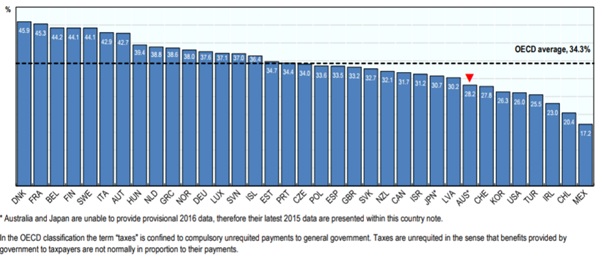
    Our overall tax take is one of the lowest among the 35 OECD countries. If Mr. Morrison was correct, then by now there should have been a tsunami of investment flowing here from 27 OECD countries with higher tax-GDP ratios than that of Australia’s 28.2% in 2016. Australia’s overall tax ratio is well below the OECD average of 34%, and also below neighbouring New Zealand’s tax take of 32.1% of GDP.

    Here are reported tax ratios for 27 OECD countries, 2016.

    OECD Tax Shares
    Source: Revenue Statistics 2017 – Australia; https://www.oecd.org/tax/revenue-statistics-australia.pdf

    Fact 2: Australia’s effective corporate tax is far below its statutory 30% rate

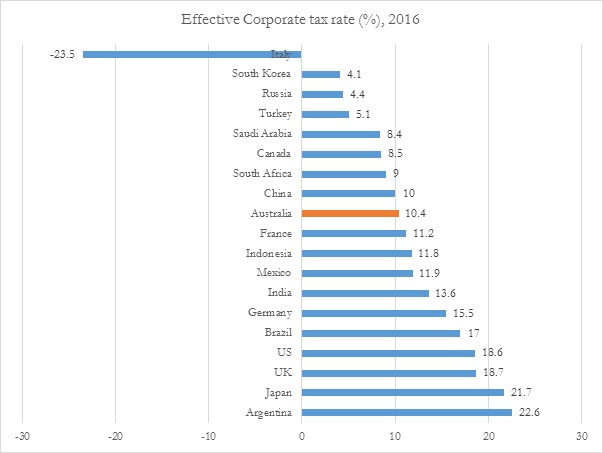
    Australian companies may seem to face a higher statutory corporate tax rate, but once they go through all their deductions and credits they don’t end up paying an unusually high amount compared to companies in other nations. The average effective rate (10.4%) is barely one-third the statutory rate. In fact, more than a third of large companies did not pay any corporate taxes in 2016 according to the recently released ATO data.

    Effective vs Statutory Tax Rates
    Source: National Public Radio, based on US Congressional Budget Office data; https://www.npr.org/2017/08/07/541797699/fact-check-does-the-u-s-have-the-highest-corporate-tax-rate-in-the-world

    Fact 3: Tax is low on companies’ lists of factors influencing investment location decision

    For example, the OECD noted, “it is not always clear that a tax reduction is required (or is able) to attract FDI. Where a higher corporate tax burden is matched by well-developed infrastructure, public services and other host country attributes attractive to business… tax competition from relatively low-tax countries not offering similar advantages may not seriously affect location choice. Indeed, a number of large OECD countries with relatively high effective tax rates are very successful in attracting FDI.”

    This is corroborated by the most recent World Bank survey of enterprises, which found that tax incentives are not high on the list of critical factors affecting inflows of foreign direct investment. The IMF’s recent research also reports that the net impact of corporate tax cuts to incentivise private investment is quite often negative on government revenues.  The pre-tax profitability of Australian businesses has also tended to exceed that in other countries, and this is surely more important in motivating investment flows.

    Fact 4: Rigorous studies of past US tax cuts did not find a positive link between tax cuts and economic or employment growth

    For example, the oft-cited examples of the Reagan or Bush tax cuts do not in fact demonstrate that tax cuts cause growth.  Admitted by President Reagan’s former chief economist, Martin Feldstein, the vast majority of growth during the Reagan era was due to expansionary monetary policy that slashed interest rates massively to help the economy bounce back from a severe recession in 1982.  Increased defence spending and an expanded labour force due to an influx of baby boomers also boosted the economy. In another study with Doug Elmendorf, the former Congressional Budget Office Director, Martin Feldstein found no evidence that the 1981 tax cuts increased employment.

    The 2001 and 2003 Bush tax cuts also failed to spur growth. Between 2001 and 2007 the economy grew at a lacklustre pace—real per-capita income rose by 1.5% annually, compared to 2.3% over the 1950-2001 period. Interestingly, the two sectors that grew most rapidly in this period were housing and finance, which were not affected by the 2001 and 2003 tax cuts.  Moreover, by 2006, prime-age males were working the same hours as in 2000 (before the tax cuts), and women were working less – both facts inconsistent with the view that lower tax rates raise labour supply.

    Fact 5: The most infamous case of tax cuts in the US State of Kansas was a colossal failure

    Governor Sam Brownback promised that a moderate tax cut for individuals and a big tax cut for businesses would be “like a shot of adrenaline into the heart of the Kansas economy.”  Unfortunately, however, despite his 2012 tax cuts, the Kansas economy remained moribund, while neighbouring states surged ahead. In the process, the Kansas state budget was left in tatters. No wonder that the Republican-led state legislature reversed most of Brownback’s tax cuts in the face of poor growth and pressing public spending needs.

    Therefore, if Mr. Morrison is serious about repairing the budget, or stimulating growth and employment, then he should be concentrating on raising more revenues (not less) and investing in the nation – instead of cutting basic services to fund his tax cuts for the rich. He should be looking at the facts, instead of resorting to scare tactics.


    You might also like

    Commonwealth Budget 2025-2026: Our analysis

    by Fiona Macdonald

    The Centre for Future Work’s research team has analysed the Commonwealth Government’s budget, focusing on key areas for workers, working lives, and labour markets. As expected with a Federal election looming, the budget is not a horror one of austerity. However, the 2025-2026 budget is characterised by the absence of any significant initiatives. There is

    Centre For Future Work to evolve into standalone entity

    The Centre for Future Work was established by the Australia Institute in 2016 to conduct and publish progressive economic research on work, employment, and labour markets. Supported by the Australian Union movement, the centre produced cutting edge research and led the national conversation on economic issues facing working people: including the future of jobs, wages

  • Job Growth No Guarantee of Wage Growth

    Originally published in The Sydney Morning Herald on November 17, 2017

    Measured by official employment statistics, Australia’s labour market has improved in recent months: full-time employment has grown, and the official unemployment rate has fallen. But dig a little deeper, and the continuing structural weakness of the job market is more apparent. In particular, labour incomes remain unusually stagnant. In this commentary, Centre for Future Work Associate Dr. Anis Chowdhry reflects on the factors explaining slow wage growth — and what’s required to get wages growing.

    Job Growth No Guarantee of Wage Growth

    by Dr. Anis Chowdhury

    ‘Remarkable’ jobs growth raises hopes for wages” was the headline for a recent Sydney Morning Herald opinion piece by Clancy Yeates. He bases this claim on “some brighter news on the labour market to balance the bad: there is something of a jobs boom under way”. Apparently “more jobs have been created in 2017 in net terms than any year since 2005, with 371,000 new net jobs so far this year”. Clancy Yeates also points to “the lowest number of unemployed people per unfilled position since 2012”.

    This optimism is also shared by the Treasury Secretary John Fraser. In his opening statement at the recent Senate budget estimates hearing on 25 October, he said, “We expect that a period of stronger growth and falling unemployment will lift wages in the next few years.” He further noted, “We do expect that as the cyclical constraints that have weighed on the economy recede wages growth will accelerate.”

    The RBA also holds a similar optimistic view. Philip Lowe, the RBA Governor, in his September statement observed, “Employment growth has been stronger over recent months and has increased in all states. The various forward-looking indicators point to solid growth in employment over the period ahead. … stronger conditions in the labour market should see some lift in wages growth over time.” He had the same positive view in his October statement.

    But can we really be so confident that job growth will eventually lead to wage growth? And even if it does, would it be strong enough to catch up and compensate for the losses incurred from such a long period of wage stagnation?

    Unfortunately, the answer to these questions is a resounding ‘NO’. This so-called remarkable jobs growth will not result in an eventual wage growth sufficient to close the wages gap. This has been confirmed by the latest data showing wages rose by less than expected last quarter; even a significant mandated jump in the minimum wage failed to lift the rate of growth of workers’ pay across the economy. The most broad measure of average earnings growth (derived from GDP statistics) has actually turned negative – the weakest since the mid-1960s.

    The reason for this contradiction is very simple – it is rooted in the different nature of new and old jobs. Jobs, whether part-time or full-time, are now more insecure. Just consider some recent news. The NAB has announced 6,000 job cuts by 2020 even when it announced $6.6 billion profit! Earlier Telstraconfirmed 1,400 job cuts.

    Job insecurity is not just a phenomena in the private sector. Governments – State and Commonwealth – have also joined the new trend. For example, the NSW department of Finance Services and Innovation has notified the union representing the cleaners that employment guarantees in place since 1994 “will not be extended in the new contracts from 2018”.

    The optimists seemed to have decided to ignore what Alan Greenspan, the former chairman of the US Federal Reserve, said in his Congressional hearing two decades ago (on 26 February, 1997). Explaining why “the rate of pay increase still was markedly less than historical relationships with labor market conditions would have predicted”, he said: “Atypical restraint on compensation increases … appears to be mainly the consequence of greater worker insecurity.”

    He clearly elevated job insecurity to major status in the Fed’s policy analysis. Workers have been too worried about keeping their jobs to push for higher wages. And this has been sufficient to hold down inflation without the added restraint of higher interest rates.

    But Greenspan also implied that workers’ fear of losing their jobs was not in itself a sufficient explanation for their failure to push for significant wage increases. The sense of job insecurity has to be rising over time; that is, continually getting worse. Because once the level of insecurity leveled off, and workers become accustomed to their new level of uncertainty, their confidence may revive and the upward pressure on wages would resume. That is particularly true when the unemployment rate is low, as it is today (at least officially).

    However, looking at the length of contracts, Jeff Borland, a leading Australian labour economist, finds no evidence of increased job insecurity in Australia. Others have reported similar findings, while others cite different data to indicate a growth in insecurity. A new ABS survey also showed that while there had been an increase in the number of people with more than one job since 2010-11, those doing multiple jobs as a proportion of the workforce had remained almost completely unchanged at 6%.

    Job insecurity is notoriously difficult to measure. It is not the length of contracts or whether a job is full-time or part-time, that matters. It is the constant threat of losing jobs or pay conditions despite tenure due to constant restructuring that the workers fear. It is the news like that from the ice cream manufacturer Street wanting to terminate its enterprise agreement, or announcements like the one from the NSW department of Finance Services and Innovation, which generate the sense of job insecurity.

    It is this sense of job insecurity and fear of not finding a decent job after losing one (as experienced, for example, when Holden and Toyota recently closed down) which Alan Greenspan had in mind when he calibrated Fed’s monetary policy levers. Thus, there has to be continuous restructuring in the guise of addressing falling or stagnant productivity to keep lid on wages, while the real intent is creating fears among the working class.

    When nearly half the Australian families (41%) feel job security is chief among their concerns, this supposedly remarkable jobs growth won’t generate pressure for wage growth as hoped by the optimists. “Insecure, stressed, and underemployed: The daily reality for millions of Australians”, is how David Taylor summarised the labour market in Australia. This is experienced even as profits are growing at their highest rate in two decades.

    Governments – State and Federal – should worry about rising job insecurity, instead of adding fuel to the fire with their own employment restructuring initiatives. The high level of job insecurity doesn’t just have an effect on wage growth and inflation. Recent research has found that it “cuts to the core of identity and social stability – and can push people towards extremism”. We all have a stake in creating more secure jobs, and fairly rewarding those who perform them.


    You might also like

    Dutton’s nuclear push will cost renewable jobs

    by Charlie Joyce

    Dutton’s nuclear push will cost renewable jobs As Australia’s federal election campaign has finally begun, opposition leader Peter Dutton’s proposal to spend hundreds of billions in public money to build seven nuclear power plants across the country has been carefully scrutinized. The technological unfeasibility, staggering cost, and scant detail of the Coalition’s nuclear proposal have

  • The Paradox of Rising Underemployment and Growing Hours

    The Paradox of Rising Underemployment and Growing Hours

    by Anis Chowdhury

    Share

    Paradoxically, underemployment and number of hours actually worked are both on the rise in Australia.

    Paradoxically, underemployment and number of hours actually worked are both on the rise in Australia.

    Since 1978 from when the ABS started publishing data on the number of hours worked per month, the hours increased continuously. For example, in July 1978 slightly less than a billion hours was worked; the figure was 1.7 billion in June 2017 – a rise of 781.9 million hours worked a month. Compared with June 2008, 151.3 million more hours were worked in June 2017. The recently released Labour Account Australia, Experimental Estimates, July 2017 (by ABS) shows that between 2010/11 and 2015/16, hours actually worked increased by 5.7% from 19.15 billion hours to 20.23 billion hours.

    The rising number of hours worked should be a good news, provided it meant more income. But for the most part during this period real wages either stagnated or fell. Recent ABS data show that quarterly real wage growth stuck below 0.6% for three years, translating into an annual wage growth of just 1.9%, the lowest figure since the late 1990s, and probably the slowest rate of pay rises since the last recession.

    Hence the majority of workers are forced to work more hours in their struggle to maintain a decent living. Labour Account Australia, Experimental Estimates (July 2017) records that a good number of people work more than one job. Interestingly, increasing by 64,100 (9.2%), the growth in secondary jobs outstripped the growth in main jobs which increased by 791,700 (6.8%) over the six years to June 2016.

    It is also not surprising that people are wanting to work more hours, raising the incidence of involuntary underemployment. The most recent ABS estimate, for May 2017, shows 1.129 million Australians working fewer hours than they would like. This translates into an underemployment rate of 9.3%. When added to the current headline unemployment rate of 5.6%, we have a whopping “underutilisation” rate of around 14.9%!

    Labour exploitation is also on the rise as the unpaid overtime work gets longer. The Australia Institute’s 2016 survey (Excessive Hours and Unpaid Overtime: An Update) found that full-time workers were on average performing more than 5.1 hours a week in unpaid overtime. Part-time and casual employees work an average of 3.74 hours unpaid overtime per week. For full-time workers, average unpaid overtime is worth over $10,000 per year – or 13% of actual earnings. For part-time workers, lost income from unpaid overtime exceeds $7500 per year, and represents an even larger share (nearly 25%) of actual earnings. The lost income due to unpaid overtime represents a significant loss to workers and their families.

    Australians are putting in some of the longest hours (more than 50 hours) in the developed world, coming in 9th in a survey of OECD countries. Full-time employees are on average putting in extra 4.28 hours and part-time staff are working an hour over their contracted hours every week. ABS data show that around 30% of employed men and 11% of employed women report usual working 45 hours or more each week.

    Thus, Australian workers are over-worked and underpaid. They are both time and income poor.

    These paradoxes are not statistical quirks. They are the results of heightened job insecurity; but it is deliberate! It is caused by changes in the labour market institutions governing wage and employment conditions, designed to increase the share of profit and strengthen corporate power.

    Alan Greenspan, the former Chairman of the US Federal Reserve, made this very clear in his testimony to the Congress two decades ago (26 February, 1997). He elevated job insecurity to major status in central bank policy when he said, “Certainly other factors have contributed to ‘the softness in compensation growth” despite a low unemployment rate, but ”I would be surprised if they were nearly as important as job insecurity”.

    Workers have been too worried about keeping their jobs to push for higher wages, and this has been sufficient to hold down inflation without the added restraint of higher interest rates. He also acknowledged, “Owing in part to this subdued behavior of unit [labour] costs, profits and rates of return on capital have risen to high levels”.

    Most interestingly, according to Greenspan, widely regarded as the “guru” of present day monetary policy-makers, workers’ fear of losing jobs is not in itself sufficient; the sense of job insecurity has to be rising or getting worse to prevent any push for significant wage increases. This is because, once it levels off, and workers become accustomed to their new level of uncertainty, their confidence may revive and the upward pressure on wages resume, especially when more people find jobs and the unemployment rate drops.

    Right now, millions of Australians are feeling some level of job insecurity because of increased casualisation of employment and insufficient availability of full-time regular jobs. The increase in casual and non-permanent work is putting pressure on people to work harder for longer, and to work more hours unpaid.

    There are many reasons, from automation to slower growth of the economy, for increased job insecurity. But one factor contributed the most – the deregulation of the labour market in the name of increased flexibility. This not only involved moves from centralised to enterprise bargaining and to individual contracts, but also restrictions on union activities – both intended to weaken worker’s bargaining power and strengthen business’s hiring and firing power.

    One can easily blame successive Liberal-National Coalition Governments, starting from John Howard for this. But the Hawke-Keating Labor Government started the process, arguing that it was necessary to respond to changing global economic conditions and to remain competitive. The Hawke-Keating Government argued that linking wage bargaining to the enterprise performance would provide flexibility and hence boost productivity.

    The succeeding Howard-Costello Government increased so-called flexibility by introducing “work choices” (individual contracts) arguing the same. In 2007, Peter Costello said that the greatest risk to Australia’s prosperity is a return to centralised wage fixing: “Nothing could be a bigger threat to the Australian economy at the moment than moving away from decentralised wage fixation and going back to the past.”

    But alas; there has been no sustained boost in productivity growth. Instead, successive labour market reforms have allowed inefficient enterprises to survive. Employers  felt no pressure to upgrade technology, improve management practices or train workers to boost productivity, as both Labor and Coalition Governments, held hostage by the business group threatening to leave Australia for cheaper destinations, vied with each other to make Australia more hospitable – more “competitive” – for businesses by making labour cheaper and regulations looser.

    During 2016, Australia’s labour productivity growth was nil whereas it grew by 1.9% in OECD. Only 4 other OECD countries experienced lower productivity growth than Australia. Using the internationally comparable US Conference Board data, the Productivity Commission reported that Australia’s multi-factor productivity (MFP) growth in 2014 was negative (-0.9%) – and lower than China, India and Korea. MFP reflects the overall efficiency with which labour and capital inputs are used together in the production process. MFP growth in Australia continued to decline since the mid-1990s reaching a negative figure, i.e., declining during 2005-2010.

    The problem is well exemplified by Australia’s auto industry which survived only due to the life-line of government subsidies and some industry protection – recall the Rudd Labor Government’s $6.2 billion over the next 13 years and Abbott Government’s $900 million budget backdown. Despite all the flexibilities afforded by diluting the employment and pay conditions, one of just 13 countries in the world capable of building a car from the ground up, Australia’s 90-year history of assembling and building automobiles is coming to an end with the pulling off of the plug of government assistance.

    Therefore, the only way Australia can now compete internationally is by racing to the bottom; by lowering labour cost – cutting the penalty rates, lowering the minimum wage and diluting working conditions; in short, by underpaying the workers and forcing them to work longer hours. And this only can succeed by ensuring continued rise in job insecurity though underemployment, more spells of unemployment, more volatility in the hours the workers are expected to work and continued weakening of labour’s bargaining power.


    You might also like

    Centre For Future Work to evolve into standalone entity

    The Centre for Future Work was established by the Australia Institute in 2016 to conduct and publish progressive economic research on work, employment, and labour markets. Supported by the Australian Union movement, the centre produced cutting edge research and led the national conversation on economic issues facing working people: including the future of jobs, wages

  • Don’t Pop Champagne Corks Over Longest Growth Streak

    Don’t Pop Champagne Corks Over Longest Growth Streak

    by Anis Chowdhury

    On April 1, Australia will surpass the Netherland’s old record to mark the longest unbroken expansion of real GDP in modern history. While this result permits much chest-thumping on the part of some politicians, we should never assume that there is an automatic correlation between GDP growth and the well-being of people, society, and the environment.

    In this guest commentary, Prof. Anis Chowdhury – a new Associate of the Centre for Future Work, and a distinguished global economist – provides some important perspective on this longest expansion in history.

    Little to Rejoice About in Australia’s Record-Long Expansion

    by Anis Chowdhury

    On April 1, Australia will overtake the Netherlands to lay claim to the title of the longest economic expansion on record, entering our 104th quarter of economic growth, as the nation narrowly avoided slipping into a technical recession.

    With the release of the GDP figure on 1 March, the government expressed a sigh of relief. It showed that Australia’s economy grew by 1.1 per cent in the last quarter, after slipping 0.5 per cent in the three months to December 1.

    Should we rejoice at this?

    It seems, Treasurer Scott Morrison thinks so. As the government is breathing easy, the Treasurer responded by saying “Our growth continues to be above the OECD average and confirms the successful change that is taking place in our economy as we move from the largest resources investment boom in our history to broader-based growth.”

    To be fair, the Treasurer was also cautious and acknowledged that nation’s economic growth “cannot be taken for granted and is not being experienced by all Australians in all parts of the country in the same way”.

    However, with this cautionary note the Treasurer has contradicted himself. If the nation’s growth cannot be guaranteed; if all Australians in all parts of the country are not sharing the benefit of this longest stint of growth, then it is simply not broad-based; nor is it inclusive.

    The nation’s growth still comes largely from mining, agriculture, forestry and fishing, as its manufacturing sector continues to shrink. The share of manufacturing in GDP now stands at around 6 per cent which is less than half what was four decades ago. Despite the longest growth stint, Australia still remains a primary-producing, two-speed economy.

    Australia’s terms of trade — the ratio of the nation’s export prices to its import prices — grew by 9.1 per cent, thanks to strong price rises in coal and iron ore, marking a 15.6 per cent improvement on the December 2015 quarter.

    Thus, Australia’s economic growth continues to be driven by commodity price booms, behind which is the economic expansion in emerging Asian economies, mainly China and India. If these economies sneeze, Australia will catch a cold. Hence, the Treasurer is correct, the “nation’s growth cannot be guaranteed”; it cannot be sustained.

    Even if it is sustained, it is not sustainable in the sense of ensuring social stability and protecting the environment. Australia’s current development trajectory is unlikely to achieve the Agenda 2030, the most ambitious and transformative goals for sustainable development adopted by the nations of the world in September 2015 at the United Nations.

    Let us reflect on some key indicators. First, Australia’s official unemployment rate edges up to 5.9 per cent in February, from 5.7 per cent in January, while underemployment skyrocketed to 1.1 million. The staggering underemployment is more a structural problem than a result of cyclical phenomena. The rise in unemployment and underemployment happened, even when we were told that labour market flexibility would boost employment – the main argument put forward in supporting recent cuts in penalty rates.

    Second, even without the penalty rate cuts, wages growth has been stagnant. The 1.1 per cent GDP growth that technically saved the economy from a recession, was accompanied by falling employee compensations by 0.5 per cent.

    Thus, the 0.9 per cent increase in household consumption, contributing 0.5 per cent to growth, which according to the Treasurer, was a key factor in bolstering the post-mining boom economy, seems to have been debt-driven. No wonder, Australia’s household debt at close to 125 per cent of GDP, is now the third highest in the world. At 187 per cent of household income, the RBA’s worries about household debts are not unfounded.

    Third, the divide between rich and poor is growing in Australia, according to a new national survey, which found more than a quarter of households have experienced a drop in income. At the same time, the socio-economic conditions of indigenous Australians remains shamefully at the Third World level. They don’t live as long as other Australians. Their children are more likely to die as infants. And their health, education and employment outcomes are worse than non-Indigenous people. Despite promising to close this gap on health, education and employment, the 2017 “Closing the Gap” report card finds that we are failing on six out of seven key measures. With less than year until the first wave of “Closing the Gap” deadlines, the road to reducing Indigenous disadvantage appears ever longer.

    Fourth, the latest Australia’s Environment Report 2016 reveals that Australia’s biodiversity is under increased threat and has, overall, continued to decline. It also reveals that pressures on the environment has increased from coalmining and the coal-seam gas industry, habitat fragmentation and degradation, invasive species, litter in our coastal and marine environments, and greater traffic volumes in our capital cities.

    While the quality of growth and overall socio-economic well-being continue to regress, what is the response from government? Regrettably, it is the same mantra: “repair the budget”; “cut welfare expenditure”; “cut wages and employment conditions”; “cut company tax”; “cut environmental regulation”, etc.

    Why these cuts? Because they will help keep our triple A credit rating! In the words of the Treasurer, “We must take the necessary steps to keep expenditure under control structurally, to boost investment, to maintain the AAA credit rating…”

    That is a huge leap of faith in the face of contrary findings world-wide, including Australia, that these sorts of measures do not boost investment; they do not fix the structural problems in the economy; they do not close the societal divide (between the rich and the poor, between indigenous peoples and the rest of Australia); and they do not protect our biodiversity or mitigate pressure on our environment.

    Public policies for structural transformation and environmentally sound, inclusive growth are for the brave hearts, not for the meek who remain hostage to the unaccountable credit rating agencies.


    You might also like

    Centre For Future Work to evolve into standalone entity

    The Centre for Future Work was established by the Australia Institute in 2016 to conduct and publish progressive economic research on work, employment, and labour markets. Supported by the Australian Union movement, the centre produced cutting edge research and led the national conversation on economic issues facing working people: including the future of jobs, wages