Tag: Andrew Stewart

  • The Wages Crisis Revisited

    The Wages Crisis Revisited

    by Andrew Stewart, Jim Stanford and Tess Hardy

    A comprehensive review of Australian wage trends indicates that wage growth is likely to remain stuck at historically weak levels despite the dramatic disruptions experienced by the Australian labour market through the COVID-19 pandemic. The report finds that targeted policies to deliberately lift wages are needed to break free of the low-wage trajectory that has become locked in over the past nine years.

    The report, The Wages Crisis: Revisited, authored by three of Australia’s leading labour policy experts: Professor Andrew Stewart from Adelaide Law School, Dr Jim Stanford from the Centre for Future Work, and Associate Professor Tess Hardy from Melbourne Law School, updates analysis and recommendations from their 2018 edited book, The Wages Crisis in Australia.

    The report shows that annual nominal wage growth recovered after initial lockdowns during the pandemic – but rebounded only to the same slow pace (just above 2% per year) recorded for several years prior to COVID. Unprecedented fluctuations in employment and labour supply, including a significant decline in the official unemployment rate, do not seem to have altered wage growth, which is still tracking at the slowest sustained pace in post-war history.

    The research found little correlation between the lasting slowdown in wage growth after 2013, and changes in supply-and-demand balances in the labour market. Traditional market forces did not cause the wages crisis, and market forces are unlikely to be able to fix it – even with a relatively low unemployment rate.

    Instead, the authors identified nine policy and institutional factors which were more important in explaining the deceleration of wages, including: the erosion of collective bargaining coverage; inadequate minimum wages; pay restraint imposed on public sector workers; and widespread wage theft.

    The problem of restrained compensation in public and human services reaches further than just the pay caps imposed directly on public servants. Wages in publicly funded services (like aged care, the NDIS, and early child education) are also held back by inadequate funding and weak labour standards in those programs. The report makes special mention of the need to improve wages in aged care, in the wake of the recent Royal Commission’s finding that wages in the sector must be improved as a top priority in improving care standards and attracting the new workers the sector needs.

    The authors suggest that nominal wages should grow faster than 4% per year in coming years, to restore healthy relationships with productivity growth, inflation, and national income distribution. But a resuscitation of wage growth will not occur without proactive wage-boosting policies.

    The authors list five broad measures to quickly support wage growth. One is a proposal for a new statutory definition of employment. This would prevent businesses from drafting contracts that present workers as being self-employed, even if in reality they have no business of their own. The authors predict that such arrangements will become far more widespread, including in the growing gig economy, in the wake of two recent decisions by the High Court.


    Full report

    Share

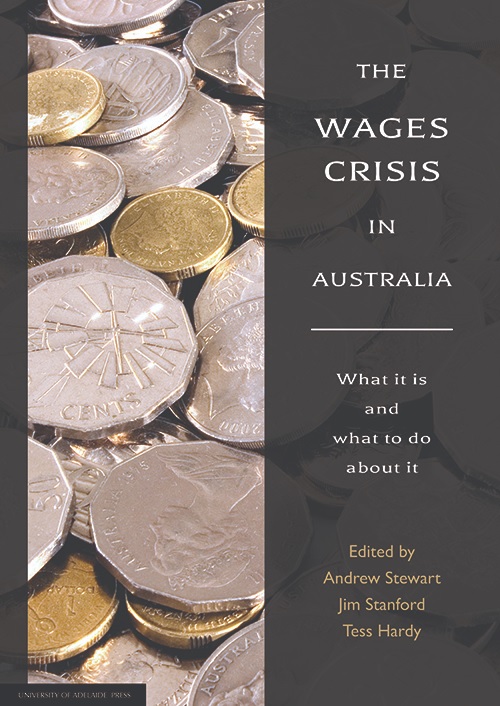
  • New Book: The Wages Crisis in Australia

    New Book: The Wages Crisis in Australia

    by Jim Stanford, Andrew Stewart and Tess Hardy

    Share

    Australian wage growth has decelerated in recent years to the slowest sustained pace since the 1930s. Nominal wages have grown very slowly since 2012; average real wages (after adjusting for inflation) have not grown at all. The resulting slowdown in personal incomes has contributed to weak consumer spending, more precarious household finances, and even larger government deficits.

    Cover

    The wage slowdown has elicited concern from economists and political leaders across the spectrum. Even Dr. Philip Lowe, Governor of the Reserve Bank of Australia, has called it a “crisis,” and suggested that faster wage growth would be beneficial for the economy.

    This new collection of 20 essays by leading labour market experts and commentators in Australia explores the causes, consequences, and potential solutions to this problem.  The book is published by University of Adelaide Press. The book was launched in Melbourne on 29 November, with remarks from Natalie James, former Commonwealth Fair Work Ombudsman and Chair of the Victorian Inquiry Into the On-Demand Workforce.

    Through the links below you may access excerpts from the book, links to participating authors, and supplementary material (including commentary, other readings, and videos). Our hope is that this collection will spark a needed debate in Australia about how to get wages back on track.

    About the Editors:

    Andrew Stewart is the John Bray Professor of Law at the University of Adelaide and a Legal Consultant to the law firm Piper Alderman.

    Tess Hardy is a Senior Lecturer at Melbourne Law School, and Co-Director of the Centre for Employment and Labour Relations Law.

    Jim Stanford is Economist and Director of the Centre for Future Work at the Australia Institute.


    A digital edition of the book is available for free download from University of Adelaide Press. Paperback copies can be ordered for $60 from Federation Press; please submit inquiries to info@federationpress.com.au.


    Related documents


    Natalie James Launch Speech


    Introduction


    Conclusion

    You might also like

  • New Research Symposium on Work in the “Gig Economy”

    New Research Symposium on Work in the “Gig Economy”

    The informal work practices of the so-called “gig” economy are widening existing cracks in Australia’s system of labour regulations, and should be repaired through active measures to strengthen labour standards in digital businesses. That is the conclusion of newly-published research from a special symposium on “Work in the Gig Economy,” organised by the Centre for Future Work.

    The symposium includes contributions from four leading labour market scholars, first presented to a special seminar last year at the conference of the Society of Heterodox Economists in Sydney. The papers have now been published (after a peer-review process) in Economic and Labour Relations Review, an academic journal based at UNSW. The symposium includes research conducted by:

    • Prof. Andrew Stewart of the University of Adelaide
    • Dr. Jim Stanford of the Centre for Future Work at the Australia Institute
    • Prof. Wayne Lewchuk of McMaster University in Canada, and
    • Kate Minter, researcher at Unions NSW.

    The symposium also features an introductory essay by Frances Flanagan, Research Director at the United Voice trade union.

    While the gig economy is often portrayed as an exciting “new” innovation, the work practices embodied in digital platforms are long-standing, and have been utilised by employers for hundreds of years. Jim Stanford’s article describes these historical continuities – including reliance on home work, on-call labour, piece work compensation, and the use of labour intermediaries.  While the digital apps now used to coordinate this work are new, the core features of the precarious employment relationships created in digital businesses are not; regulators should learn from this history in their efforts to develop new tools for protecting labour standards in digital businesses.

    In their article, Prof. Andrew Stewart and Dr. Stanford highlight several broad options for regulatory reform to close the gaps in labour regulation that allow gig businesses to avoid traditional employment standards (like minimum wages). There is clear potential to more forcefully apply existing labour laws to gig businesses, using test cases and other efforts to clarify that workers in gig businesses should indeed be protected by minimum standards.  Clarifying and strengthening the definition of “employee” in existing labour law (so that gig workers are more clearly covered by those laws) would be another promising avenue.  Stewart and Stanford urge regulators to be “ambitious, creative, and eclectic” in their efforts to regulate work in the gig economy, to avoid negative social and economic consequences from the erosion of minimum labour benchmarks.

    Prof. Wayne Lewchuk shows that conventional labour market statistics understate the prevalence of gig work (and other forms of insecure employment), because merely categorising a job as either “permanent” or “temporary” does not capture the more complex forms of insecure work that are increasingly common in the labour market.  Lewchuk also documents the myriad of personal, financial, social, and health consequences of insecure jobs (including gg work).

    Finally, Kate Minter’s contribution to the symposium reviews one specific effort to negotiate the application of minimum labour standards within a digital platform business: namely, a process of negotiation between the odd-job platform Airtasker and the peak trade union body in NSW.  While the resulting agreement (under which Airtasker agreed to recommend minimum award wage rates as the basis for “costing” the jobs advertised on its platform) is not on its own sufficient to ensure minimum standards will be met, it represents a concrete case of how engagement by all stakeholders (including digital businesses, unions, advocates, and regulators) can build momentum for protecting basic standards in the gig economy.

    The final published versions of all articles in the symposium (including the introduction by Frances Flanagan) are available  through the Economic and Labour Relations Review’s website, or through your local library.  Links to pre-publication versions of each article are also provided below.

    • Introduction to the Symposium on Work in the Gig Economy, by Frances Flanagan.
    • The Resurgence of Gig Work: Historical and Theoretical Perspectives, by Jim Stanford:
    • Precarious Jobs: Where are They, and How do They Affect Well-Being?, by Wayne Lewchuk.
    • Regulating Work in the Gig Economy: What are the Options?, by Andrew Stewart and Jim Stanford:
    • Negotiating Labour Standards in the Gig Economy: Airtasker and Unions New South Wales, by Kate Minter:


    Introduction


    The Resurgence of Gig Work: Historical and Theoretical Perspectives


    Precarious Jobs: Where are They, and How do They Affect Well-Being?


    Regulating Work in the Gig Economy: What are the Options?


    Negotiating Labour Standards in the Gig Economy: Airtasker and Unions New South Wales

    Share