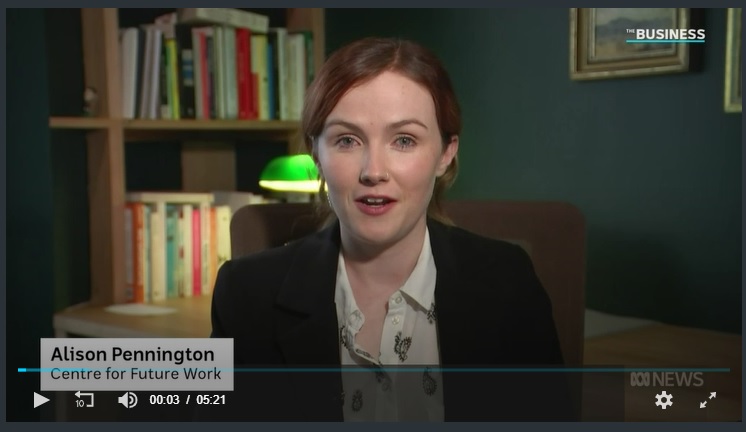
Tag: Alison Pennington

  • Does leave for menstruation and menopause advance women’s rights and gender equality at work?

    Does leave for menstruation and menopause advance women’s rights and gender equality at work?

    by Lisa Heap

    As pressure grows for action to establish new work rights, including additional leave, for those who experience menstruation and menopause, the Centre for Future Work’s Senior Researcher, Lisa Heap, canvases the debate about whether these rights will advance gender equality at work.

    There are growing calls for the establishment of new work rights, including additional leave, for those who experience menstruation and menopause*. These biological processes are normal and are experienced by large numbers of workers. Yet their sometimes debilitating effects have been ignored in the framework of workplace rights historically built around men’s experience of life and work.

    Unions have begun surveying their members on the issue and a growing number of unions are seeking new rights in collective agreements, including additional leave, for menstruation, menopause, and reproductive health concerns. The ACTU, Australia’s peak union body, is likely to discuss a policy on reproductive leave (including leave for menopause and menstruation) at its Congress in June 2024. There is also evidence that organisations are moving to include policies on these issues in their HR handbooks. These calls for new rights reflect increasing public awareness and acceptance that biological processes experienced by women should come out of the shadows and from behind closed bathroom doors.

    However, not everyone agrees that seeking additional leave and other workplace rights because of menstruation or menopause is the right way to go. Leading industrial relations academic Marian Baird, whilst being a strong advocate for new rights, has noted that debate on issues such as menstrual leave ‘can be polarising for organisations and for feminists.’ Concerns include that leave and other rights for menstruation and menopause may result in women being targeted as weak or unable to do the job because they are absent from work or that employers will see them as less reliable or more costly to employ. Thus, undermining women’s position at work. Some scholars argue that focusing on leave, and therefore effectively removing the problem from the workplace, means that the problem is being hidden at work.

    There have been long standing debates between feminist theorists about whether the path to gender equality at work is best served by highlighting the similarities between men and women and treating all workers the same – sometimes referred to a formal equality. Or whether there should be accommodation of differences including acknowledging biological differences and the reproductive role that women play in society and ensuring that work rights reflect this. The difficulty we have in Australia, like in many western democratic countries, is the standard of the ideal worker is male so treating everyone the same, effectively means treating them as men.

    It is difficult to ignore that some workers are struggling with the impacts of menstruation and menopause at work. Supports are needed for these workers. Not everyone’s experience is the same but for some menstruation involves severe bleeding, extreme pain, and lethargy. Shame and stigma for some workers may lead to hiding period pain and carrying on with job. This can have both physical and psychological impacts. The effects of the processes associated with menopause may include losses of concentration, difficulty sleeping, headache, fatigue and mood changes. In both cases work based impacts can include perceptions of poor work performance, a loss of confidence for effected workers and using all personal/carers’ leave trying to ‘manage’ the impact of menstruation and menopause. Some workers may need a move to part-time work or even consider leaving paid work as a way of managing.

    The evidence gathered around the work-based impacts of menstruation and menopause establishes the need for further changes in work rights to accommodate the lived experience of women. To ignore this evidence would in effect reinforce men’s experience of work as the norm and the standard around which work rights are framed. Australian public policy and legal frameworks have developed to accommodate some biological processes experienced by women. For example, there are now universal rights around pregnancy, maternity, and breastfeeding and work. Leave and workplace flexibilities accommodating the effects of menstruation and menopause could be the next step in the evolution of these workplace rights.

    Beyond HR policies there are two main ways of establishing work rights – incorporating these rights in workplace laws or bargaining for their inclusion in enterprise agreements. Incorporating leave and other rights to flexible work arrangements in legislation would provide a universal standard and a whole of society approach. Bargaining offers the opportunity to craft boutique solutions considering the needs of the organisation and those of the workforce. The process of bargaining itself helps to educate and explore the issue thus assisting with ‘normalising’ it at work. However, bargaining for ‘equality rights’ of this kind can take time and often requires work-based champions to get and keep the issue on the bargaining agenda.

    In Australia many universal workplace rights have been achieved first through unions bargaining for these at the industry or organisational level and then by unions fighting to have these included in legislation. The achievement of paid leave for those workers experiencing family violence is the most recently high-profile example of this. The progress to gain menstrual and menopause leave, and other associated rights is likely to involve both bargaining for these rights and lobbying for legislative change.

    Leave for menstruation and menopause will advance women’s rights and gender equality at work however, even when these rights exist that won’t be the end of action to make them a reality. Workers will need to be aware of these rights and feel comfortable and confident to use them without fear that they will be treated less favourably for doing so. Establishing the rights either through legislation or bargaining will set the normative standard. Organisations will then have the obligation to create systems processes and cultures that would ensure that workers can, and do, access these rights once they exist.

    *I use the term woman/en to include those who experience menstruation or menopause but who may not identify as a woman.

    **This article originally appeared in The Point the official newspaper of the Independent Education Union Victoria Tasmania


    You might also like

  • On International Women’s Day: How the Fair Work Commission Can Really Take On the Gender Pay Gap

    Originally published in The Conversation on March 8, 2024

    On occasion of International Women’s Day, the Centre for Future Work’s Senior Researcher Lisa Heap reviews the opportunities to use recent industrial relations reforms to more ambitiously address Australia’s gender pay gap.

    This International Women’s Day, it is time to call on Australia’s workplace umpire, the Fair Work Commission, to finally close the gender pay gap.

    Half a century after the commission’s predecessor granted women “equal pay for equal work” in a landmark case in 1969, the gap remains between 12% and 21%.

    Amendments to the Fair Work Act by the incoming Labor government in 2022 gave it new tools to close the gap by addressing the undervaluation of work in traditionally female-dominated occupations.

    If it uses these tools to their full potential, 2024 will be a landmark year in the genuine achievement of equal pay for equal work.

    What we’ve been doing hasn’t much worked

    Traditionally in Australia, addressing gender-based undervaluation has relied on two approaches.

    The first has been to argue the business case for gender equality – convincing employers they’ll be rewarded for “doing the right thing”.

    The second has been to bring equal pay cases to tribunals.

    Unfortunately, neither approach has been successful. In particular, pushing for equal remuneration through tribunals has been time-consuming and expensive.

    These tribunals, historically working on models of male full-time wage earners, have struggled to understand the undervaluation of work performed predominantly by women.

    The commission’s new tools

    The commission’s act has been rewritten to require it “to promote job security and gender equality.”
    It also has the power to make equal remuneration orders either on its own initiative or on application in order to bring about equal pay for work of equal or comparable value.

    A further new development is the establishment of expert panels to assist in gender-related cases. Advice from gender experts should assist in overcoming historical gender biases in commission decisions.

    Perhaps the most promising tool is the change to the commission’s modern awards objective, which requires it to eliminate gender-based undervaluation of work and provide workplace conditions that facilitate women’s full economic participation each time it reviews an award.

    Among other things, this requirement is likely to result in provisions that ensure part-time work is treated equally to full-time work and ensure a better balance between work and caring responsibilities.

    Amending awards is likely to be particularly important for women given that almost three in five of the workers on awards are women. Men are mainly on negotiated agreements.

    If the commission wanted to, it could hold a wide-ranging inquiry into the many factors that have contributed to gender-based undervaluation of women’s work.

    It could also review entire industries and occupations that are female-dominated, upgrading multiple awards at the same time. This would avoid lengthy and costly reviews of individual awards.

    What’s likely in 2024

    The Fair Work Commission’s resolve to make lasting change will be tested by several matters currently before it.

    The commission is due to issue its final decision in the case lodged by the Australian Nursing and Midwifery Federation, the Health Services Union, and the United Workers Union on the value of the work done by workers in aged care.

    An initial interim decision delivered in 2022 awarded some – but not all – of these workers a 15% increase, finding that work in feminised industries had been historically undervalued and the reason for that undervaluation is likely to be gender-based”.

    Workplace Relations Minister Tony Burke backed the decision, saying it was merely the “first step”.

    Another application, for nurses and midwives outside of aged care, was lodged by the Australian Nursing and Midwifery Federation in February this year.

    The commission has already started the process of grappling with gender-based undervaluation in modern awards, commissioning research that documents the segregation of women and men into different occupations and industries.

    Further research documenting the history of a select group of female-dominated modern awards and identifying the extent to which common elements indicate gender-based undervaluation, is due to be released in April.

    It will feed into the annual wage review due by the middle of the year.

    How to be bold

    Gender-based undervaluation of women’s work won’t be eradicated by incremental adjustments.

    Here are three bold steps the commission could take:

    • grant a minimum interim 12% increase (one estimate of Australia’s national gender pay gap) across the board for female-dominated awards in this year’s annual wage review
    • develop new systems for classifying work and ascribing work value, breaking with the previous standards built around skills and qualifications in male dominated occupations
    • better consider the uneven bargaining power in industries such as nursing where governments fund care work and try to restrain costs.

    The changes to the Fair Work Act that allow multi-employer bargaining are a start, but unlikely alone to correct the undervaluation of women’s work.

    In female-dominated industries where collective bargaining is non-existent or ineffective, the commission should step in and further increase wages.

    The Fair Work Commission has been given the tools. This should be the year it applies them.


    You might also like

  • Enterprise Bargaining System no Longer Fit for Purpose

    Enterprise Bargaining System no Longer Fit for Purpose

    by Alison Pennington

    Share

    The collapse in agreement coverage under Australia’s enterprise bargaining system in Australia in recent years, particularly in the private sector, has focused attention on the need for reforms that will give more workers the effective ability to collectively negotiate better wages and conditions. In the private sector, coverage by a current enterprise agreement has fallen by half since 2013: to below 11% of all workers by March 2021. No wonder wages are lagging so far behind inflation.

    The new Commonwealth government has pledged to find ways to strengthen collective bargaining. In this feature interview with the ABC’s national economics program The Business, Senior Economist Alison Pennington discusses the reasons why the current system is not working, and some of the reforms that will be required to support bargaining and lift wages.

    Alison Pennington on ABC


    You might also like

    IR Bill Will Cut Wages & Accelerate Precarity

    by Alison Pennington in Jacobin

    The Morrison government has proposed sweeping changes to labour laws that will expand unilateral employer power to cut wages and freely deploy casual labour. Together, the Coalition’s proposed changes will accelerate the incidence of insecure work, undermine genuine collective bargaining, and suppress wages growth. Impacts will be felt across the entire workforce – casual and permanent workers alike.

  • Alison Pennington: Budget billions wasted as real wages go backwards

    Originally published in The New Daily on March 30, 2022

    The federal government’s budget would have us believe that the cost of living is a sudden problem because of higher oil prices.

    But the real reason people are feeling the pinch is because their real wages are going backwards.

    The budget forecasts wage growth of 2.75 per cent in 2021-22, below inflation which is forecast to grow by 4.25 per cent. That’s a real wage cut of 1.5 per cent.

    The budget will increase the low-and-middle-income tax offset, but then scrap it at the end of this financial year. The fuel excise will be reduced for six months.

    Complex tax-bracket-shifting schemes are a good way to distract from powerful wage suppression policies. While we’re calculating “how much do I get”, these policies entrench insecure work, cap public sector pay, and stop collective bargaining. These measures hit workers every pay packet, not just at tax time.

    The amount workers get from the tax cuts is nothing compared to normal wage increases. For the 15 years to 2012, private-sector wages grew about 3.5 per cent per year. For someone on $70,000, that’s about $2500 more in one year.

    Distracting the income-strapped

    This budget is about trying to distract the income-strapped with temporary solutions that do nothing to help in the long-run. Alongside time-bound tax cuts are $250 one-off payments to income support recipients – thousands of people who permanently languish below the poverty line.

    The government is also hoping people believe in magical free-market fairies – that lower unemployment will finally unlock wages growth. As though holding a job automatically equips workers with bargaining power.

    The “record funding” fairies were out in full force, too. The Treasurer says “record funding” has been allocated in schools, hospitals, mental health, aged care, women’s safety and disability health. But if you reduce spending to rock-bottom, every marginal increase in spending with population growth can be called “record funding”.

    If it’s not enough funding to meet demand, then it can still be “record funding” for some. Shockingly, public school funding will be cut by $560 million over the next three years. Meanwhile, JobKeeper-subsidy-dripping private schools will get $2.6 billion more over the forward estimates. It’s not a budget without blows.

    Cuts to workers’ pay

    Worse, this budget signals more cuts to workers’ pay. The budget has earmarked reducing legislated minimum redundancy payments for part-time workers. This will disproportionately affect women.

    Women’s chronically low wages and poor job quality receive no attention. Hundreds of thousands of women in underfunded healthcare and social services need government to front up and fund their pay increases. This budget is proof the biggest barrier to Australian women’s progress isn’t glass ceilings, but their own government.

    This government will balls up any opportunity to address structural gender inequality. A new paid parental leave (PPL) scheme will combine the paltry two-week Dad and Partner Pay with the existing 18-week program for a combined 20 weeks. Packaged as empowering “family choice”, it will remove any incentive for fathers to take leave.

    PPL payment at minimum wage will continue to push women into primary caring roles. This is because men earn almost one-third more than women on average. That’s not women’s “choice”.

    Governments have wage-booting tools to deal with the higher cost of living. Across the ditch, New Zealand just increased the minimum wage by 6 per cent, recognising its frontline lowest-paid workers have offered the most in the pandemic, and been hit the hardest.

    Genuine cost-of-living help overlooked

    Along with boosting minimum wages, there are other options for helping workers deal with high inflation. The government could lower the cost of living by ending fee-for-service practices in all the areas they fund – child care, aged care, and disability care. Under the current government, out-of-pocket healthcare costs have increased almost three times more than CPI.

    And there’s not much hope for youth in this budget. Presented with a future of declining living standards, political dysfunction and ecological catastrophe, young people are given just $206 million in mental health funding. They can talk to someone on the phone while the world burns.

    The bottom rungs on the economic-opportunity ladder have been eliminated and youth can’t get up. Tens of thousands of educated capable youth languish in dead-end jobs. Sacrificed by a government that would rather turn unemployment into a misery industry than to create secure, career-building jobs.

    Billions of waste

    The government is wasting billions of dollars paying off their friends in business without conditions to invest in higher wages. Before this Budget, $291 billion in public spending was ploughed into a “business-led recovery” from COVID. On businesses responsibility to reinvest post-war record-high profits, there’s an eery silence.

    And in this budget, we have zero assurances new business subsidies will be invested in the real economy – people, capital, research – rather than more profit-padding.

    On budget eve, Morrison attempted to hat-tip a bygone conservative era. He said “families” will be key to winning the upcoming election. But he never invested in them, instead putting them in a pressure cooker of record-low wage growth and high living costs.

    The government was struck by enormous luck this budget. Extra revenue to play with and they’ve thrown it all away. Hundreds of billions in government spending and no era-defining economic reforms.

    Cos-of-living pressures wouldn’t be as acute if people had almost a decade of normal wages growth. But the truth is, the government has pursued wage suppression over the entire nine years it has been in power.


    You might also like

    Commonwealth Budget 2025-2026: Our analysis

    by Fiona Macdonald

    The Centre for Future Work’s research team has analysed the Commonwealth Government’s budget, focusing on key areas for workers, working lives, and labour markets. As expected with a Federal election looming, the budget is not a horror one of austerity. However, the 2025-2026 budget is characterised by the absence of any significant initiatives. There is

  • Budget Analysis 2022-23

    Budget Analysis 2022-23

    A Budget to Get to the May Election – But No Further

    The Commonwealth Government has tabled its budget for the 2022-23 financial year. As the nation emerges from two years of lockdowns and border closures, with less than two months until a federal election, this budget is focused on getting the government re-elected – rather than addressing the challenges of public health, stagnant wages, and sustainability facing Australia.

    This failure is all the more regrettable given the enormous discretionary fiscal resources which the government has at its disposal: the budget projects $133 billion in extra tax revenues over the next five years, compared to its MYEFO projections just three months ago, thanks to strong economic growth and rising nominal GDP. But instead of ploughing those revenues into reforming human services (like health, aged care, early child education, or disability services), undertaking a genuine policy to revitalise domestic manufacturing, or accelerating the energy transition, the government has prioritised one-time cash handouts to entice voters in the upcoming election.

    In this comprehensive budget overview, the Centre for Future Work’s team of economists unpacks the budget, considers its effects, and suggests alternatives.

    Our report reviews all aspects of the budget’s impacts on work and workers, including: wages, employment forecasts, vocational education and higher education, women workers and caring labour, labour standards enforcement, and manufacturing and energy jobs.

    Please also check out these rapid-response budget commentaries from two of our economists:

    Six graphs that reveal the sugar-hit election strategy,” by Policy Director Greg Jericho in the Guardian Australia.

    Budget billions wasted as real wages go backwards,” by Senior Economist Alison Pennington in The New Daily.


    Full report

    Share

  • Fragmentation & Photo-Ops

    Fragmentation & Photo-Ops

    The Failures of Australian Skills Policy Through COVID
    by Alison Pennington

    Strong vocational education and training (VET) systems are vital to the success of dynamic, innovative economies and inclusive labour markets. Australia’s VET system once provided well-established and dependable education-to-jobs pathways, but a combination of policy vandalism and fiscal mismanagement plunged the VET system into a lasting and multidimensional crisis.

    During the pandemic, the federal government has pursued further VET restructuring through the implementation of several wage and training subsidy programs at the cost of several billion dollars. This has deepened the “contestable market” experiment unleashed in the 2000s, by subsidising further decentralisation of course content, delivery and student recruitment to unaccountable for-profit training providers. Meanwhile, more TAFE institutes have been closed and enrolments have continued to decline.


    Full report

    Share

  • New International Research Exposes Australia’s Missed Wage-boosting Opportunities

    New International Research Exposes Australia’s Missed Wage-boosting Opportunities

    New research on international collective bargaining systems, released today in a special issue of the peer-reviewed journal, Labour and Industry, finds that Australia’s industrial relations system is rapidly losing its ability to support wages in the face of numerous challenges (now including the Omicron outbreak).

    On the heels of new data showing further erosion of Australia’s collective bargaining system, researchers and practitioners from five countries have identified best practices from other countries that could strengthen collective bargaining and lift wages.

    Key findings of the research include:

    • The Ardern government in New Zealand has implemented a new sector-wide bargaining system (called ‘Fair Pay Agreements’) that could be a model for similar changes in Australia. It would enhance workers’ ability to win more stable jobs and higher wages in highly fragmented industries (like security, cleaning or child care).
    • New Zealand-style reforms could also improve the effectiveness of Australia’s pay equity legislation. Recent changes in New Zealand’s pay equity system prove that wider scope for bargaining can address persistent gendered pay discrimination. One recent enterprise agreement in Australia (covering public sector workers in Victoria) has already applied that model here.
    • Nordic and continental European countries have used coordinated sectoral bargaining systems to enhance vocational training and technology adoption. Australia could learn from that experience to better integrate skills programs with secure job pathways.
    • In Germany, a combination of sector-wide bargaining over wages and other core compensation, combined with workplace-level consultations (under that country’s ‘works council’ system), produces employment outcomes that are both flexible and fair.

    The final published versions of all articles in the Special Issue are available through Labour and Industry, or through your local library. Links to the following articles are available free access for 3 months (ends March 2022):

    Introduction, by Alison Pennington and Jim Stanford

    Sector-wide bargaining: problems and prospects in the Australian case, by Tom Roberts

    Rebuilding worker power in Australia through multi-employer bargaining, by Tim Kennedy, Ben Redford, Renee Burns and Anthony Forsyth

    Bargaining for pay equity: an NZ-inspired approach to gender equality in Australia, by Alison Pennington and Megan Wenlock

    International approaches to solving the ‘free rider’ problem in industrial relations, by Jim Stanford

    Collective bargaining’s contribution to employment skills and transitions: lessons from the Nordic countries, by Andrew Scott

    The Ghent system of social insurance: a model for Australia?, by Russell Lansbury

    Industry 4.0 in Germany and Australia: digital choices, human responses, by Andrew Dettmer

    Unions and the evolution of trade and industry policy under the Ardern government, by Bill Rosenberg

    Comment from authors:

    “Australia’s workplace relations system is failing to address rising insecure work, record-low wages growth, and a persistent gender pay gap. Collective bargaining system retrenchment compounds risks in Australia’s uncoordinated, fragmented skills system. We’re failing to facilitate the millions of jobs pathways and transitions our economy needs now, and in the future,” said Alison Pennington, Senior Economist with the Australia Institute’s Centre for Future Work.

    “The pandemic has deepened the structural drivers behind the gender pay gap in low-paid, insecure work. Australia has much to learn from the labour policy settings implemented in neighbouring New Zealand to meaningfully address the gender pay gap, including Fair Pay Agreements and pay equity bargaining.”

    “Australian workers need an effective system of collective bargaining that goes beyond the legal entity that directly employs them. This is a vital mechanism to ensure workers have greater control over the safety of their work, across sectors, industries, franchises, labour hire arrangements, supply chains – or however work is configured,” said Tim Kennedy, Secretary of the United Workers Union.

    “Australia is currently deprived of the skill formation benefits that arise from strong sectoral collective bargaining between social partners observed in Nordic nations. It’s exacerbating serious deficiencies in our skills training arrangements, evident in high rates of misalignment between jobs and skills. Australia can learn much from the Nordic countries’ superior economic and social policy outcomes that arise from well-integrated skills and collective bargaining systems,” said Andrew Scott, Professor of Politics and Policy at Deakin University and Convenor of The Australia Institute’s Nordic Policy Centre.

    Share

  • The great (gendered) resignation is not what you think. It’s worse

    Originally published in Crikey on November 25, 2021

    The great resignation is apparently upon us — workers are walking away from bad jobs. But in Australia, the exodus of women from the workforce says more about structural barriers than worker empowerment.

    Have you heard? The so-called great resignation is afoot. A world where an empowered workforce say “no” to bad bosses and a life dictated by work. In the US, increased job departures have been coined a “revolution in workers’ expectations”.

    Australian workers were squeezed for an average 6.1 hours unpaid overtime per week in 2021 – a substantial increase on 2020.  If only expectations matched reality.

    In Australia, employers crow about shortages in low-paid, “churn and burn” jobs of which they refuse to improve the quality. Meanwhile, 700,000 people are unemployed, and 1.3 million are in jobs, but need more work. Around 1 million more aren’t looking for work, but want to work and are available. The ABS calls them “marginally attached” and “discouraged” workers.

    Women know a thing or two about being discouraged. Far from quitting as an act of righteous agency, they’ve lost their jobs during lockdowns against their will. It’s material. Less “life’s too short to work 24/7”. More “my kids need care immediately”.

    The explosion in caring demands associated with lockdowns fell disproportionately to women – as in 2020, when women’s average hours caring for children and performing household tasks rose faster than for men, reaching 5.1 hours per day (versus 3.1 for men).

    In February 2021, 175,000 women didn’t look for work even though they were available and ready to start within four weeks because they had pressing caring responsibilities.

    Even if women loaded with caring demands wanted to retain their jobs, the odds were stacked against them. They hold the majority of low-hours insecure jobs without protections against sacking. When bosses want to shed jobs to save bottom lines, women cop it worst.

    68% of all jobs lost between May and October were held by women (205,000 jobs). Women’s participation in the job market fell 1.7 percentage points. Nearly all (90%) of women’s jobs lost were part-time.

    Little acknowledged, the latest job vacancies data mirror women’s exodus from paid work. In August, vacancies were highest in healthcare, administration and retail. These are all industries employing 50% or more women. All are in the bottom-half of industries by average weekly earnings.

    The question is, as wallets open, beers flow and economic activity resumes, what’s bringing women back to work? A couple shifts at minimum wage, and higher COVID-19 contagion risks to boot. All to pay for one day of high-cost childcare? Hardly appealing.

    An empowered workforce can walk away from bad jobs. But structural barriers stop women from participating in the first place.

    High-cost childcare is a clear barrier for women workers. Before the pandemic, over half of non-employed women with young children said high-cost childcare was the biggest influence on their decision not to work.

    Australia’s outdated paid parental scheme bakes “primary” and “secondary” carers into family structures – reinforcing the exodus of women from work, and blocking the equal participation of fathers in raising their children.

    The so-called great resignation is gendered. But women shouldn’t have to resign themselves to the revolving door of crap jobs and important caring responsibilities.

    We’ve come a long way since the 1950s when conservative norms dictated women’s labour should be unpaid and confined to the home. Women have better access to the world of paid work now. But their relegation to insecure, low-paid, and junior roles shows we have much further to go.

    And it’s government policies that holds us back.

    Australian women need genuine measures to support them in all aspects of their lives; from free early childhood care and education, better work-family balance policies, pay equity, and more opportunities for decent jobs.

    Only then, can women imagine a world where they are empowered through work.


    You might also like

    Centre For Future Work to evolve into standalone entity

    The Centre for Future Work was established by the Australia Institute in 2016 to conduct and publish progressive economic research on work, employment, and labour markets. Supported by the Australian Union movement, the centre produced cutting edge research and led the national conversation on economic issues facing working people: including the future of jobs, wages

  • International COVID-19 Income Supports: An Update

    International COVID-19 Income Supports: An Update

    by Alison Pennington and Jim Stanford

    The COVID-19 pandemic severely disrupted global labour markets, and exposed long-standing gaps in social protection systems. Governments around the industrialised world injected hundreds of billions of dollars into a range of unprecedented crisis measures: to support individuals who lost work, to subsidise employers to retain workers despite the fall-off in business, and to facilitate workers to stay away from work when required for health reasons. More recently, as the pandemic progressed and vaccination became widespread, governments have begun considering how to transition toward a post-COVID policy stance. 

    In several countries, governments with stronger commitments to public health and safety, and a more inclusive and equitable recovery from COVID-19, have been more cautious and incremental in scaling back government interventions. Some have also made permanent improvements to income security and other policies whose shortcomings became more apparent during the pandemic. In Australia, however, the phase-out of COVID-19 wage subsidies and income supports was accelerated and premature – perhaps more so than any other major industrial country. A new comparison of COVID support policies across numerous industrial countries confirms the economic and public health risks of the rapid elimination of Australia’s COVID programs.

    This briefing paper, prepared by Alison Pennington and Jim Stanford, catalogues a selection of international income support measures introduced in response to the COVID-19 pandemic, and reports on recent changes in those programs as vaccinations roll out and economies have re-opened. This catalogue allows us to make a comparative assessment of the level and coverage of Australia’s provisions, in relation to other jurisdictions.

    After summarising the status of Australia’s Commonwealth-administered COVID-era payments, other countries are surveyed, organised into two groups: those with income support programs still in place, and those whose programs had been eliminated at time of writing. A conclusion summarises the comparison, which confirms that Australia has been an outlier among industrial countries in the speed with which emergency COVID-19 measures were eliminated.


    Full report

    Share

  • Fair Pay Agreements: How Workers in NZ Are Getting Their Share

    Fair Pay Agreements: How Workers in NZ Are Getting Their Share

    by Alison Pennington

    Share

    Across the ditch, the Ardern government in New Zealand is undertaking an ambitious and multi-dimensional effort to address low wages, inequality, and poor job quality. NZ unions have just won the introduction of Fair Pay Agreements, planned for implementation in 2022. FPAs will allow working people to bargain collectively across sectors and start to correct the income and power imbalance between workers and employers.

    The Centre for Future Work hosted a special webinar with Craig Renney, Economist & Director of Policy for the New Zealand Council of Trade Unions. In the recorded webinar, Craig explains key FPA policy details including design & coverage of the system, and how FPAs can lift wages and labour standards, stop the ‘race to the bottom’, and rebuild worker bargaining power in NZ. The webinar is the first in the Centre’s exciting new webinar series exploring key labour market topics related to work, wages, and fairness. Hosted by our Senior Economist Alison Pennington.

    Craig Renney’s presentation slides presented for the webinar are available below.

    The Centre for Future Work has published research on several ambitious progressive labour reforms pursued in New Zealand. For more, please read Workplace Policy Reform in New Zealand: What are the Lessons for Australia?, by Alison Pennington.


    Related documents


    Presentation slides

    Related research

    You might also like

    IR Bill Will Cut Wages & Accelerate Precarity

    by Alison Pennington in Jacobin

    The Morrison government has proposed sweeping changes to labour laws that will expand unilateral employer power to cut wages and freely deploy casual labour. Together, the Coalition’s proposed changes will accelerate the incidence of insecure work, undermine genuine collective bargaining, and suppress wages growth. Impacts will be felt across the entire workforce – casual and permanent workers alike.