Blog

  • Paid Parental Leave for Fathers Advances Parental Equality

    Originally published in Medium on August 26, 2019

    Rising pressure on individuals and families to meet their caring needs is the “human face” of decline in workplace protections and bargaining power that has gathered pace since 2013. Meanwhile, the need for fathers and male spouses to take on more caring and household labour is routinely discussed in the public domain. But how have Australia’s work/care policies worked to support a redistribution of caring and household labour to males and fathers?

    In this commentary, Centre for Future Work Economist Alison Pennington reports on a timely roundtable discussion held with work/care policy experts on Iceland’s “father’s quota” parental leave system, and the future for paid parental leave in Australia – co-hosted with the Nordic Policy Centre.

    Research presented by leading Icelandic academic Dr. Ásdís Aðalbjörg Arnalds on the day shows that paid parental leave for both parents at wage replacement levels is key to building more equal workplaces, families and communities, and a modern dual work/care model.


    You might also like

  • Unemployment and the Newstart Allowance

    Unemployment and the Newstart Allowance

    by Raja Junankar

    Australia’s Newstart benefit hasn’t been increased in real terms in a generation, and pressure is growing on the Commonwealth government to address this inequity and raise the rate. Even RBA Governor Philip Lowe has indicated that better Newstart benefits would stimulate consumer spending and support the economy.

    But the government continues to reject the idea, and instead has fostered lamentable and divisive rhetoric about “dole bludgers” and the supposed lack of “aspiration” among unemployed Australians. Old stereotypes about unemployed people choosing to subsist on poverty-level benefits, instead of looking for work, have been invoked.

    In this paper, Prof. Raja Junankar of UNSW University shows that keeping the Newstart Allowance constant in real terms at a poverty level does not help the unemployed find jobs more rapidly. Despite rock-bottom benefits that have declined notably relative to average wages, long-term unemployment has increased – including among vulnerable groups of workers (like younger and older workers).

    The solution to unemployment is more jobs, not inadequate income benefits.


    Full report

    Share

  • Stuck-in-the-Mud’ Workers Not to Blame for Wage Stagnation

    Stuck-in-the-Mud’ Workers Not to Blame for Wage Stagnation

    by Jim Stanford

    The Commonwealth Treasury raised eyebrows recently with a new research report that seemed to pin the blame for record-weak wage increases on workers’ reluctance to quit their jobs in search of better-paying alternatives. The report was presented to the recent conference of the Economic Society of Australia, and elicited gleeful headlines in conservative newspapers blaming “stubborn” workers for their own poor wage results.

    In this commentary, which originally appeared in 10 Daily, Dr Jim Stanford argues that Treasury has mis-identified the true source of the problem. With so few decent job opportunities available, it’s rational that many workers would choose to stick with their current jobs – despite stagnant wages and poor conditions.

    When in Doubt, Blame the Workers

    Blaming the victim is a long and dishonourable tradition in labour policy debate. Unemployed workers on the dole for months at a time? Clearly they aren’t looking hard enough for work. Low-wage workers stuck in dead-end jobs? Clearly they didn’t invest in their own “human capital.” Young workers facing a never-ending series of gigs? Clearly they don’t have the discipline to stick with a real job.

    A new highwater mark in this lamentable practice was surely set this week with a research paper from the Commonwealth Treasury. The report examined historically weak growth in Australian wages over the last several years. It proposed a novel but far-fetched explanation: workers are failing to leave their existing jobs to seek out better-paying opportunities elsewhere. This stick-in-the-mud attitude explains why wages aren’t growing.

    The formal paper contained all sorts of statistical cautions and academic nuances. But that was lost on the legion of gleeful pundits who seized on its findings, pointing their accusing fingers at complacent, “stubborn” workers for their own low wages. Never mind obvious actions that could directly boost wages: things like raising the minimum wage, restoring collective bargaining (which has all but disappeared from private sector workplaces), or abolishing the Commonwealth government’s own strict 2% limit on wage increases for its own employees.

    No, it’s far easier to ascribe record-low wage growth to some perverse characteristic of the workers themselves. After all, the forces of supply and demand are always working their magic: allocating resources efficiently and ensuring everyone gets paid according to their “productivity.” If that payment isn’t enough to live on – well, that must be your fault, not the market’s.

    In this approach the Treasury follows in the footsteps of other efforts by economic experts to ascribe blame for lousy wages anywhere but on Australia’s labour policies – which for many years have been premised on the assumption that government should stay out of the way, and let private market forces do their thing.

    For example, consider Dr Philip Lowe, Governor of the Reserve Bank of Australia. Even he expresses grave concern about the consequences of weak wage growth, highlighting the dangers to economic growth, consumer finances, and even social stability. But he, too, has ultimately blamed workers for the problem: they are not demanding enough from their bosses, perhaps because they’ve been overly intimidated by fears of job loss arising from about globalisation and robots.

    The Productivity Commission has also weighed in with a robust defense of existing labour market practices; if anything, they say, market forces should be further freed, not reined in. For example, its chair recently proposed eliminating current requirements that enterprise agreements (including those implemented unilaterally by employers, with no union involvement) cannot undercut minimum standards specified in Modern Awards. Will weakening these minimum protections somehow drive wages up? That’s hard to believe – but in any event, if workers really want higher wages, he said, they must acquire the right skills and boost their productivity.

    We should be deeply suspicious of any economic theory that rests on an assumption of collective irrationality by large numbers of people: like Australia’s 12-million-strong workforce. It is true that workers are less likely to voluntarily quit their jobs in recent years – certainly less than the heady 2000s, when many could quit a job one day and get a better paying one the next. Instead, workers are now imbued with a deep sense of insecurity.

    Especially if you’re in the lucky minority who holds a permanent full-time job with normal entitlements (like paid holidays and superannuation), you will naturally be tempted to hang onto it – not because you are unimaginative and lazy, but because you know full well there aren’t many other opportunities out there. Quality jobs are in short supply. And there are almost 3 million underutilised Australians (including unemployed, underemployed, and marginally attached workers) who need and want one. In that context it’s hardly irrational to hold onto your current job. Rather, it’s a predictable response to insecurity.

    Moreover, the insecurity and powerlessness felt by workers is no accident. It’s the deliberate outcome of a generation of labour and social policies predicated precisely on instilling fear and discipline among workers – assuming that will lead to greater obedience and productivity. Newstart has been frozen for a generation; protections against dismissal have been dismantled; steady jobs have been casualised or converted into gigs.

    In that context, there’s little hope of successfully demanding a raise from your boss: more likely, they’ll brand you a troublemaker and not renew your contract. And with strong restrictions on union activity and collective bargaining, there is little institutional possibility for workers to wield collective bargaining power.

    Even if Australia’s workers were to suddenly and collectively develop itchy feet, and abandon their posts en masse in search of greener pastures, wages would still be stuck in the doldrums: there are too many workers chasing too few jobs, and there are no institutional supports (like collective bargaining) to help workers win a better share of the pie.

    But never mind. The high priests of economic policy would still come up with other reason to blame the victims for their own plight – not the system. Perhaps their choice of music. Or their insistence on eating smashed avocado for Sunday brunch. Or their bad planning in being born into families without inherited wealth.

    After six hard years of virtually zero real wage growth, maybe this is a good time to look at what’s wrong with the way Australia’s labour market is working. Instead of blaming the workers who can’t get a raise.


    You might also like

  • Update on Penalty Rates and Job-Creation: Two Years Later

    Update on Penalty Rates and Job-Creation: Two Years Later

    by Jim Stanford

    July 1 marked the implementation of the next stage of reduced penalty rates in the retail and hospitality industries in Australia. It is now two full years since the first reductions were imposed for Sunday and holiday work in several segments of retail and hospitality. Once fully phased in, these reductions will reduce wage payments in the two broad industries by an estimated $1.25 billion per year – at a time when concerns over weak wages and their impacts on the Australian economy are growing.

    Employers argued before the Fair Work Commission that if their Sunday and holiday labour costs were reduced, they would hire more workers, and the Commission cited this logic in accepting employer demands for lower penalties. Now, with two full years of experience since the first reductions, there is growing evidence that the penalty rate reductions have not spurred job creation in retail and hospitality. To the contrary, our new report shows that employment growth in retail and hospitality has been far slower than in other parts of the economy (where penalty rates remained constant) — and job-growth in the two sectors actually slowed by more than half after penalty rates began to fall.

    This briefing paper, authored by Dr Jim Stanford (Director and Economist of the Centre for Future Work) reviews disaggregated employment statistics for 19 Australian industries in the two years after the first penalty rate reductions were imposed on 1 July, 2017.

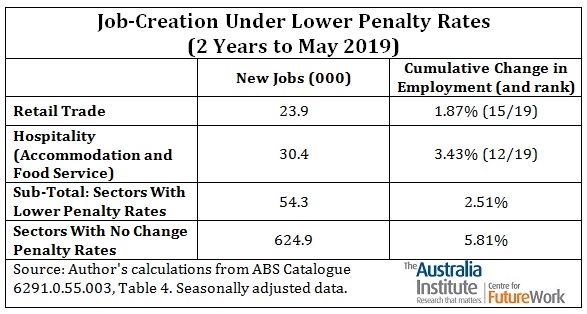
    The retail sector created 24,000 new jobs in the two years since 1 July 2017, and the broad hospitality sector (including accommodation and food & beverage services) created 30,000. In both cases, over 100% of the new jobs were part-time — both sectors actually shed full-time work during this period. The rate of job-creation was less than half as fast during the last two years in both sectors, as it had been in the two years before penalty rate cuts began — even though the pace of job-creation in the broader economy accelerated during the last two years.

    Penalty Rate Chart

    The retail sector ranked 15th out of 19 sectors in job-creation over the past two years; hospitality ranked 12th. Their combined rate of job-creation (up by 2.5% over the two years) was less than half the combined rate of job-creation in the 17 sectors which had no change in penalty rates. 92% of all jobs created in the last two years were created in sectors with constant penalty rates. The two sectors with reduced penalty rates created just 8% of new jobs in this period — even though they accounted for 18% of total employment at the time the penalty rate reductions began.

    It is clear that lower penalty rates have not ignited new hiring in either of these sectors. Instead, job-creation in both sectors has deteriorated well below economy-wide averages in this period. Clearly it takes more than cheapening labour costs to create jobs. Stronger consumer spending (a goal which would be supported by higher wages, not lower wages) is far more important to hiring decisions in these two domestic service industries.


    Full report

    Share

  • Kick-Starting Wage Growth: What the Commonwealth Government Could do NOW

    Kick-Starting Wage Growth: What the Commonwealth Government Could do NOW

    by Jim Stanford

    Australia’s economy continues to endure historically slow growth in wages and salaries, that is undermining household incomes, consumer spending, and economic growth. The Commonwealth government continues to predict an imminent rebound in wages – like in its most recent budget, where it yet again forecast wage growth accelerating quickly to 3.5% per year. But is the government willing to actually do anything to support wages?

    The Centre for Future Work has released new research showing that just 3 specific actions by the Commonwealth government would lead to a significant rise in national wage growth, adding over $10 billion per year to aggregate wage income within three years. That doesn’t single-handedly solve the whole wages crisis, but it would be a big improvement.

    The three measures simulated in the report include:

    1. Reversal of the reductions in penalty rates for Sunday and public holiday work in the retail and hospitality sectors.
    2. Introduction of a “living wage” mandate for Australia’s federal minimum wage, moving it toward a level that would lift full-time full-year workers above standard benchmarks of relative poverty.
    3. Removal of the Commonwealth government’s restrictive cap on wage increases for its own employees, and restoration of normal collective bargaining and traditional rates of wage increase.

    Those three measures alone would boost wages for an estimated 3.3 million Australian workers, by a total of over $10 billion per year once fully implemented.That is equivalent to a 1.25% boost in aggregate national wage income, thus helping to lift overall wage growth in the economy as a whole from current sluggish rates (of 2.3%, according to most recent data) back toward normal historical rates (of 3.5% per year or more).

    The report also considers broader positive benefits from supporting wage growth, including: stronger consumer spending (estimated to rise by $8.5 billion per year), stronger GDP growth (as businesses respond to the increase in purchasing power with expanded output and hiring), stronger government revenues (expected to rise by over $1 billion per year from these measures alone), and a positive spillover onto wage settlements in the rest of the labour market (as employers are pressured keep up with renewed wage growth).


    Full report

    Share

  • Union Organising and Labour Market Rules: Two Sides of the Same Coin

    Union Organising and Labour Market Rules: Two Sides of the Same Coin

    by Jim Stanford

    International evidence is clear that there is a strong, positive correlation between a country’s protection of labour freedoms, and the organising success and economic influence of unions. Improvements in basic labour rights and freedoms tend to be associated with increases in union membership (as a share of total employment). And stronger union membership, in turn, is associated with broader collective bargaining coverage, less poverty among working people, and less inequality.

    Australia has a poor record of protecting basic worker and labour rights and freedoms: including rights to assembly, rights to organise, rights to due process, and rights to strike. According to the World Economic Forum (a generally business-friendly international policy organisation), Australia ranks 5th last among OECD countries in protecting worker rights.

    A new study from the Centre for Future Work documents the correlation between workers’ rights and union organising – and shows they are two sides of the same coin. And that correlation between workers’ rights and the success of unions suggests that unions in Australia will need to continue their campaign to “Change the Rules” of Australia’s labour market (including improving basic rights for workers to organise, bargain collectively, and take industrial action). Winning better legal and regulatory protections for workers seems essential to workers’ ability to build stable, influential unions, and use those unions to improve their lives.

    Australian trade unions are contemplating the after-effects of the Coalition’s surprising victory in the 2019 federal election. The union movement and other social advocates built a successful public campaign to “change the rules” of Australia’s labour market – including lifting the minimum wage (to a living wage level), preserving other labour market protections (like penalty rates), limiting the spread of insecure work, and strengthening collective bargaining freedoms. The Coalition government is not sympathetic to that agenda; and though it barely discussed labour policy issues during the campaign, it may now try to shift labour policies even further in favour of employers.

    However, despite an unreceptive political climate for advocating labour reforms with the present federal government, the evidence presented in this report suggests that the broad campaign for an expansion of both labour market rights and union capacity should continue. The efforts of Australian unions and their allies since 2017 have been effective in strengthening public awareness of labour market injustices, and building support for obvious remedies. They have even led to incremental changes in policies by governments and institutions at all levels (even including, to a modest extent, the Commonwealth government). Most importantly, the international evidence is clear that eventually winning changes in the rules of labour market and industrial relations will be essential, as a complement (not a substitute) for unions’ continuing efforts to expand membership, extend collective bargaining, and lift wages.

    This analysis suggests that Australia faces a dual challenge: improving protection of workers’ basic rights and freedoms, and strengthening workers’ collective ability (given those rights and freedoms) to achieve better economic outcomes (like wage increases and job security). International evidence is also clear that societies in which the benefits of economic growth are shared more broadly across working and middle-income households demonstrate better economic and social outcomes. Rebuilding the labour practices and institutions necessary for more inclusive and stable prosperity will require progress along both of those tracks: greater respect for basic labour rights, and stronger unions and collective bargaining systems.


    Full report

    Share

  • Where To Now for Union Campaign? Workplace Express

    Where To Now for Union Campaign? Workplace Express

    The unexpected results of the 2019 Commonwealth election have sparked many commentaries regarding what happened, and why. This article, reprinted with permission from Workplace Express, considers the role of the major #ChangeTheRules campaign mobilised by Australian unions in the lead-up to the election – and ponders the movement’s next steps in the continuing debate over labour market policies and industrial relations. It cites both our Economist Alison Pennington, and our Director Jim Stanford, as well as our previous research on the erosion of collective bargaining in Australia.

    Workplace Express is Australia’s leading labour policy and industrial relations newsletter. Please visit its website to subscribe.

    Where to Now For Unions?: Experts

    Reprinted from Workplace Express, May 27, 2019.

    Future union membership numbers will depend on how effectively unions organise without being able to rely on the political system delivering changes to workplace laws, according to an expert on employment relations.

    In the immediate aftermath of the Morrison Government’s election win, Griffith University’s Professor David Peetz said it was likely that it would be harder to grow union membership under the Coalition than under Labor.

    “In the end, it’s up to unions to organise effectively, they can’t rely on the political system to deliver what they would like, even though it can’t be denied that politics makes a big difference,” he told Workplace Express.

    Whether union membership would fall under three more years with the Coalition in power depended on a range factors, said Peetz, including the government’s ability to pass inhibiting legislation; the movement’s own organising performance; and the effects of underemployment, which both put a brake on union bargaining power and reduced wages growth.

    “Has the focus on political campaigning taken the edge away from workplace organisation, or has it reinforced it?” said Peetz.

    “Will union activists feel so disillusioned by the election result that they give up?

    “Or will they put more effort into workplace action in recognition of the failure of political action?

    “I think these are all things that will become clearer over the next couple of years.”

    Deal ‘protections’ weaker at the margins: Peetz

    Union membership is currently running at less than 15% of the workforce, with unions having a stronghold in the public or government sector thanks to nurses, teachers, public servants and police (see Related Article).

    However, private sector membership remains a weak point, amid a shift away from enterprise bargaining to award coverage.

    Peetz, who is currently a visiting fellow at City University of New York, said the fall in enterprise bargaining coverage was mostly a delayed result of the decline in union density.

    “EB coverage held up for a while because it suited some employers to stick with union bargaining arrangements when unions were weaker,” he said.

    “But eventually a point had to come where those employers would decide to circumvent unions altogether and/or the award simply caught up with what the EB rates were.

    “Of course it means that fewer people are now getting the ‘protection’ of EBAs, but that protection was getting weaker at the margins anyway, and the bigger picture is the decline in the proportion of people getting the ‘protection’ of unions.”

    Peetz said the biggest impact would be felt in non-union workplaces.

    “In unionised workplaces, it’s workers’ own experiences of unions that will determine how well or badly unions go.

    “Unionism is, to use econo-speak, an ‘experience good’.

    “There, unions’ future is very much in their hands.

    “In non-union workplaces, where quite a few employees have no direct experience of unions – or it was so long ago it’s not really relevant – the ideology that comes through the media is more important, and the question of who’s in government and what they say and do, and what employers with government support do, and what the media themselves do, becomes more important.”

    Private sector bargaining ‘out of reach’: Pennington

    Last year, the Centre for Future Work released a report, On the Brink, contending that enterprise bargaining was on the edge of collapse, largely due to its abandonment by the private sector (see Related Article).

    The report, by Centre economist Alison Pennington, said that more than half of the reduction in private sector coverage is due to the termination or expiry of large agreements in the retail sector and the accommodation and food service sector.

    She found that private sector agreements dropped by 46% between December 2013 and June 2018 (from 22,638 to 10,333), while the number of employees under agreements fell by 34% (from 1,950,561 to 1,288,100).

    Last week, Pennington told Workplace Express that new data from the Department of Jobs showed the number of employees covered by enterprise bargaining has shrunk by another 170,000 in the six months to December 2018.

    She did not expect to see any reversal of the trend without reforms to the bargaining systems and freeing unions from restrictive “anti-organising laws”.

    “What it says, for me, is that bargaining rights are out of reach for the vast majority of private sector workers.”

    Nonetheless, Pennington says that private sector union membership is unlikely to fall further than what she believes to be levels already below 10%.

    And on a positive note for unions, she argued the Changes the Rules campaign was successful in terms of recruiting members, with some unions doing “a lot better than others”.

    Union campaign heard: Stanford

    Centre for Future Work director, Professor Jim Stanford, also said the ACTU campaign succeeded in its first aim to “influence the debate” in the lead-up to the election on wage stagnation, work exploitation and job security.

    “Now the question is how do convert that public opinion that workers need fairer treatment into policy reform given the government that’s in power,” said Stanford.

    “That will be challenging, but it’s not impossible because the Coalition has to keep an eye on where people are at.”

    Stanford said the Coalition could not be “deaf” to public opinion on wage stagnation and job security, and the same was true for the FWC, which last year awarded a 3.5% in minimum wages.

    “I think they [the Commission] heard the concerns about wage stagnation and they recognised they had a role to play.

    “I think the public education and organising that the union movement did will still pay dividends, even with a generally hostile government in power.

    “The wage crisis is not going to go away and I think Australians are well aware are that their pay packers are going nowhere relative to consumer prices.

    “That combination of continued wage suppression with an awakened, angry population … is a pretty potent mix.”

    ‘Remain bold,’ Forsyth tells ACTU

    RMIT University’s Professor Anthony Forsyth has argued on his blog that unions can still tap into “deep problems” in the workplace that Labor sought to address.

    These problems included underpayments, “dodgy” labour hire contractors, workers trapped in long-term casual engagement and the widespread use of rolling, fixed-term contracts.

    “We still have the collapse of collective bargaining in the private sector, and employer ‘work-arounds’ to avoid negotiating an enterprise agreement or get out of an existing one,” says Forsyth.

    “We still don’t have the basis for a real living wage.

    “Rather than shrinking back to a ‘small target’ strategy, as is now being contemplated in other policy areas, I reckon the ACTU should remain bold in its reform ambitions.

    “It should make a more substantive case for ‘changing the rules’ with strong underlying research that precisely measures the nature of the current problems (such as the nature and incidence of ‘insecure work’, a concept that business groups constantly debunk in the media).”

    But Forsyth argued that “organising and connecting with workers on the ground in new and innovative ways” are also essential, as shown by United Voice’s ‘Hospo Voice’ initiative and both the Young Workers Centre and Migrant Workers Centre at Victorian Trades Hall Council.

    “As the National Union of Workers and United Voice put it in the context of their current amalgamation proposal: ‘We need to change the rules, but we also need to change the game’.”


    You might also like

    Centre For Future Work to evolve into standalone entity

    The Centre for Future Work was established by the Australia Institute in 2016 to conduct and publish progressive economic research on work, employment, and labour markets. Supported by the Australian Union movement, the centre produced cutting edge research and led the national conversation on economic issues facing working people: including the future of jobs, wages

    IR Bill Will Cut Wages & Accelerate Precarity

    by Alison Pennington in Jacobin

    The Morrison government has proposed sweeping changes to labour laws that will expand unilateral employer power to cut wages and freely deploy casual labour. Together, the Coalition’s proposed changes will accelerate the incidence of insecure work, undermine genuine collective bargaining, and suppress wages growth. Impacts will be felt across the entire workforce – casual and permanent workers alike.

  • Minimum Wage to Rise 3% for 2019-20

    Minimum Wage to Rise 3% for 2019-20

    by Jim Stanford

    The Fair Work Commission has announced a 3% hike in Australia’s national Minimum Wage, effective July 1, taking it to $19.49 per hour. That increase is lower than the 3.5% increase implemented last year.

    In our judgment, this is inadequate to meet the needs of low-wage workers – and the needs of Australia’s macroeconomy.

    In explaining this year’s smaller boost to wages for the lowest-paid Australians, the FWC argued that recent weak GDP growth (and the risk of Australia’s first recession in 28 years) requires it to be cautious in boosting wages. But that argument is completely backward. The weakest component of GDP growth in the last year has been consumer spending – which actually declined in volume terms in the March quarter. Consumer spending accounts for half of all GDP, and nothing boosts consumer spending more directly than increasing workers’ pay.

    Another argument raised  by the FWC is equally unconvincing: it pointed out that incremental tax cuts promised by the incoming Coalition government will supplement incomes for low- and middle-income workers. But those tax cuts are of no value for the hundreds of thousands of Australian workers who currently pay no income tax (since their wages are too low). And even for middle-income workers, the benefits from those tax cuts are far smaller than the steady improvements in income resulting from healthy ongoing wage increases.

    The Centre for Future Work recently compared the impacts of tax cuts to regular wage gains, and the conclusion is clear: regular annual wage increases are the only way to sustainably improve living standards over time. Please see our research here. Moreover, workers ultimately PAY for those tax cuts in foregone services (which must inevitably be reduced due to fiscal constraints), so the net contribution of tax cuts to living standards is non-existent.

    Many commentators have pointed out that the 3% increase is higher than the current rate of inflation. In fact, inflation is currently running at 0% (in the March quarter), reflecting very weak macroeconomic conditions. Indeed, weak wages are part of the cause for very weak inflation: unit labour costs are the biggest influence on prices. If wage increases are restrained purely because inflation is low, this risks setting off a downward, deflationary cycle in wages and prices. Normal wage increases (in the range of traditional rates of 4% per year or more) are essential to anchor price levels, even in times of macroeconomic weakness.

    So any increase in the minimum wage is higher than current inflation – but that is cold comfort. RBA Governor Dr Philip Lowe has indicated that annual 3.5% wage increases are necessary (when combined with ongoing productivity growth) for the economy to match the RBA’s 2.5% inflation target. In that regard, the FWC should have aimed higher with this year’s increase.

    International and Australian evidence (including from the RBA itself) is clear: minimum wage increases do not “destroy” jobs. Stronger purchasing power is essential to offset other sources of weakness in the macroeconomy, including very poor business investment. In our judgment, the FWC should have increased the minimum wage by twice as much (6%), in order to boost consumer incomes and spending power, and move toward a “Living Wage” for low-income Australians. (See our primer on the Living Wage.)

    Despite those criticisms, this 3% raise for close to 1/4 of Australian employees will provide a crucial boost to wage growth. And it is much better than the under-2% raises for non-Award workers that the private labour market is still delivering. We recently studied the impact of last year’s minimum wage increase on average wage growth. We found it single-handedly explained one-third of all the increase in wages last year.

    The importance of active measures to boost wages has never been clearer. Waiting for “market forces” to reverse recent record weakness in wage growth will not work. Pro-active policies to support wage growth are essential to build more balanced and sustainable economic momentum. And nothing is more important in that policy mix than strong, sustained increases in the minimum wage.


    You might also like

  • Scourge Pricing’: Understanding and Challenging Uber’s Business Model

    Scourge Pricing’: Understanding and Challenging Uber’s Business Model

    by Alison Pennington

    Share

    Centre for Future Work Economist Alison Pennington recently gave a keynote address to hundreds of delegates at the ATIA International Taxi Conference, held this year in Gold Coast, QLD.

    Her presentation discussed the historical, economic, and moral context for the rise of “gig-economy” businesses, such as Uber. She reviewed Uber’s business model, and the company’s recent IPO, in detail, arguing that it depends on underpayment of its drivers – who for all practical purposes are “employees,” even if current labour laws do not always explicitly recognise them as such.

    Growing competition, regulatory and legal problems, and growing resistance to the ultra-precarious and low-wage incomes offered in this type of work suggest that the future success of digital platform businesses like Uber is very much in doubt.

    Pennington also referenced findings of our previous paper estimating the net incomes of Uber-X drivers in 6 Australian cities.

    Please view Alison Pennington’s full presentation below.


    Related documents


    Presentation slides

    You might also like

    The REAL Diary of an Uber Driver

    by Jim Stanford

    ABC recently announced plans for a new 6-part television drama called “Diary of an Uber Driver.”  The Centre for Future Work’s Director Jim Stanford wonders if this drama will truly constitute insightful drama – or whether it will serve to whitewash the labour practices of a controversial, exploitive industry.

    Centre For Future Work to evolve into standalone entity

    The Centre for Future Work was established by the Australia Institute in 2016 to conduct and publish progressive economic research on work, employment, and labour markets. Supported by the Australian Union movement, the centre produced cutting edge research and led the national conversation on economic issues facing working people: including the future of jobs, wages

  • Estimating Wage Trends From Personal Income Tax Data

    Estimating Wage Trends From Personal Income Tax Data

    by Jim Stanford

    New analysis of income tax data confirms a dramatic slowdown in Australian wages in recent years – and the slowdown is worse than previous statistics indicated.

    The research is contained in a new report from the Centre for Future Work at the Australia Institute.  It shows that average nominal wages in Australia grew just 1.7% per year between 2012-13 (when the wage slowdown took hold) and 2016-17 (most recent tax data available). That’s below the average national rate of inflation over that period (1.9%), resulting in a decline in the average real wage.

    While the wage slowdown was experienced across the country, some regions were particularly hard-hit. Real wage losses were especially large in Queensland and Western Australia. Moreover, the impact was disproportionate in regional communities in both states — located in some of the most fiercely contested electorates in the current federal election campaign. This suggests that public anger over falling real wages could be politically pivotal to the result on May 18.

    The new research uses a novel source of data on wages: personal tax returns, summarised in Australian Tax Office reports. The data is produced on a financial-year basis (less frequently than other wage statistics, such as those publishedby the Australian Bureau of Statistics). However, the tax data allow a more precise disaggregation of wage trends by state, community, and electorate.

    The 1.7% estimate of annual national wage growth from 2012-13 through 2016-17 based on the ATO data was a full half-point slower than the 2.2% growth reported for the same period in the ABS’s commonly-cited Wage Price Index (issued quarterly by the Bureau). The WPI series makes adjustments for changes in the composition of employment, in order to create a hypothetical fixed “bundle” of jobs. As a result, the impact of changes in job quality (such as the rise of part-time work, casualisation, and ‘gigs’) is not reflected in the WPI results. In the tax data, in contrast, all of these factors affect the evolution of realised average wages and salaries reported per tax-filer. This is thus a more complete and accurate indicator of the evolution of earnings actually received by Australian workers.

    Analysis of tax data also confirms that while wage growth in all parts of the country fell to historic lows, two states were especially hard-hit: Queensland and Western Australia. In those states, wages grew more slowly than elsewhere, and real income losses were larger. Real wages fell by over 3% in Queensland, and over 5% in WA, during that four-year period.

    Those two states are home to some of the most tightly contested electorates in the current federal election. The tax data allow calculation of wage trends by electorate – a level of detail not possible with other data sources.

    The report estimates wage trends for 17 marginal electorates in the two hard-hit states: including all electorates decided by less than a 5% margin in the 2016 election. Real wages fell in every one of the marginal electorates. In 7 seats (6 of which are currently represented by Liberal or LNP members) the cumulative decline in real wages exceeds 5%.

    “Perhaps it is not a coincidence that some of the tightest contests in the current federal election are precisely in those communities where real wages have declined the most,” said Dr. Jim Stanford, Economist and Director of the Centre for Future Work, and author of the report. “Public anger over cost-of-living issues is clearly understandable, given this hard evidence that real wages in these communities have fallen substantially.”

    “It would be a poetic irony for the whole election to be decided by frustrated voters in these hard-hit marginal electorates, which have been seemingly left behind by economic growth in the rest of the country.”


    Full report

    Share