Category: State: NSW

  • Expansion of Employer Power to Use Casual Work Hurts Women Most

    Originally published in Michael West Media on March 24, 2021

    As women lead mobilisations against workplace gendered violence, the federal government passed legislation expanding employer power to use insecure, casual labour in its IR bill – laws that will disproportionately impact the pay and security of women’s jobs.

    In this commentary, Senior Economist Alison Pennington explains how new casuals measures and the government’s wider economic policies – including in industrial relations, childcare, welfare, and fiscal spending – significantly undermine the economic security of women, entrench pay inequality, and ultimately, increase their vulnerability to gendered violence.

    This commentary was originally published in Michael West Media.

    Crocodile tears no mask for Coalition’s economic war on women

    Well may Scott Morrison tear up as he relates how his daughters, wife and widowed mother drive his every decision. The facts are that every move of the Coalition government ensures women are poorer, more insecure at work and more vulnerable to violence on the job. The Industrial Relations bill pushed through last week is a final nail in the coffin for women. Alison Pennington reports.

    After a month of anger from women around the country about sexual harassment and the treatment of women in the workplace, federal parliament passed legislation last week that will strike a massive, lasting blow to women’s job quality and pay, entrenching pay inequality and exacerbating women’s economic insecurity.

    The mainstream media has mainly focused on the fact that most of the Industrial Relations bill didn’t pass. But the cornerstone of the legislation – and the primary reason for its inception, pre-pandemic, by business lobbyists – did.

    A new legal definition of casual work will allow employers to call any job a casual one. Jobs can now look and smell like permanent jobs, except that employers can legally engage you as a casual, stripping away your legal entitlements at will.

    So-called “permanency conversion” rights in the legislation are so weak that employers will easily craft employment arrangements to lock in casual jobs long-term.

    Employers will simply vary rosters

    Employers will vary rosters sufficiently to ensure that employees will never reach the benchmarks of six and 12 months of regular schedules that should lead to permanency. In any case, employers will be allowed to refuse offers on “reasonable grounds”. And small businesses, which employ a huge 44% of all private sector employees, are exempted entirely.

    The federal government’s new casual laws will expand the incidence of casual work. Women will disproportionately suffer in a labour market with diminishing opportunities to obtain secure, decent jobs because women are more likely to be in casual roles (filling 54% of all casual positions). And women’s vulnerability to casualisation is growing. Women accounted for 62% of all new casual jobs created in the period from May to November 2020.

    Casual workers are not compensated

    Despite claims from employers that casual workers are compensated for the loss of entitlements and lack of predictability in rosters and tenure, nothing could be further from the truth.

    Casual workers are, on average, paid far less than employees in permanent roles. Median weekly earnings of full-time casuals were 23% lower ($1080 per week) than those in permanent roles ($1400 per week), and 45% lower for casual part-time workers ($390 per week) compared with permanent part-time workers on $720 per week.

    The expansion of the power of employers to use casual work in a jobs market awash with many hungry mouths desperate for paid work means more women in lower-paying, insecure jobs.

    The government’s decision to subject the unemployed to a below-poverty JobSeeker rate means more women reliant on employers to survive. At every move the Liberal National party government is making Australian women poorer, more insecure and more vulnerable to violence on the job.

    Women return to lower quality jobs

    Treasurer Josh Frydenberg celebrates the recent fall in the unemployment rate to 5.8 per cent, claiming the recovery is well under way. But the detailed job quality data tell a very different story for women.

    Women workers are “snapping back” to a world of paid work on inferior terms compared with men – fewer hours, less pay and less security.

    Casual jobs accounted for 64.3% of the total growth in women’s employment from May to November last year.

    Alarmingly, more than half of all the growth in women’s employment over the six-month period was in both low-hours and insecure work, with 52.4% of total growth in employees in part-time casual jobs.

    Traditional full-time permanent jobs with normal entitlements (such as paid sick leave, holidays and superannuation) represented a dismal 10.4% of female employment growth from May through November.

    It’s a crude fact that as women’s casual jobs were booming, business lobbyists were pushing for passage of the IR Bill on the basis that employers “lacked confidence” to hire casuals due to legal “uncertainty”. Australia was simultaneously experiencing the largest and fastest increase in casual employment in its history.

    More fuel for gender pay gap fire

    The consequences of an employment recovery overwhelmingly concentrated in part-time and casual jobs for women is more fuel for the gender pay gap fire.

    The gender pay gap is most often measured by comparing the earnings of men and women in full-time jobs. But women face persistent barriers to workforce participation – including unaffordable childcare, lack of family-friendly work arrangements, and workplace discrimination. Consequently, almost half (45.1%) of all employed women are in part-time work.

    Measuring the gender pay gap using total average earnings data (including both full-time and part-time workers, and bonuses and overtime as well as ordinary time wages) indicates that the gender pay gap is 31% across all jobs – a more dire, but more accurate, measure of the pay gap.

    Ironically, the gender pay gap narrowed in the early stages of pandemic and recession. From late-2019 to May 2020, the gap between male and female total wage incomes declined from 31.4% to 29.6% – down by 1.8 percentage points.

    But this did not represent “progress” in pay equality. The gap only closed because more than 300,000 women in low-paid casual roles lost their jobs, which increased the average earnings of those women who were able to stay connected to the workforce.

    How good’s “snap back”?

    As the economy recovered from May last year, an influx of women’s lower-paying jobs widened the gender pay gap again, just as quickly. How good’s “snap back”?

    Instead of improving the quantity and quality of jobs for women, governments have actively pursued policies that will exacerbate pay inequality this year and into the future.

    In addition to casual work changes pushed through in the IR bill, two other policies create higher barriers to women’s participation in paid work, and suppress their pay once they get on the job.

    The federal government and all states and territories (bar Tasmania and Victoria) have imposed punitive and counterproductive public sector wage freezes and caps on their workforces. This suppression of public sector pay hurts women most because they account for 61.7% of all public sector jobs.

    The failure of government to provide affordable, quality childcare presents another major barrier to women’s paid work opportunities. After dangling free childcare in front of families early in the pandemic, the federal government cut supports and reintroduced fees after just three months.

    The return of full-fee, high-cost childcare prices women out of paid work. More than half of women with young children outside the workforce list childcare costs as a key factor in their decision not to work. A childcare system that lets a small number of profit-driven providers determine access denies families and their children access to critical developmental education and much-needed community bonds as people emerge from pandemic-era isolation.

    Rebuilding women’s economic security requires a very different approach from the bankrupt austerity agenda of government. Women need more and better quality jobs, free childcare, a superannuation system that provides genuine income security and an employment relations system that works to lift the quality, pay and safety of their jobs, not undermine it.


    You might also like

    Dutton’s nuclear push will cost renewable jobs

    by Charlie Joyce

    Dutton’s nuclear push will cost renewable jobs As Australia’s federal election campaign has finally begun, opposition leader Peter Dutton’s proposal to spend hundreds of billions in public money to build seven nuclear power plants across the country has been carefully scrutinized. The technological unfeasibility, staggering cost, and scant detail of the Coalition’s nuclear proposal have

    Australia’s Gas Use On The Slide

    by Ketan Joshi

    The Federal Government has released a new report that includes projections of how much gas Australia is set to use over the coming decades. There is no ambiguity in its message: Australia reached peak gas years ago, and it’s all downhill from here:

  • Wrecking superannuation, not protecting women, is the government’s priority

    Originally published in The New Daily on March 20, 2021

    It doesn’t matter what the crisis, when it comes to the Morrison government the message is clear: you’re on your own.

    Women deserve so much more than what Jane Hume is proposing, writes Alison Pennington. Photo: AAP

    It doesn’t matter what the crisis, when it comes to the Morrison government the message is clear: you’re on your own.

    As women across Australia lead historic mobilisations demanding government action on gendered violence week, the federal government encouraged women facing domestic abuse to raid their own superannuation accounts.

    Calling superannuation withdrawal measures of up to $10,000 “an important last resort lifeline” for women experiencing domestic violence, Minister for Superannuation, Financial Services and the Digital Economy Jane Hume later announced the policy would be reviewed following concerns from frontline workers about victim coercion.

    Minister Hume now proposes to strengthen the “integrity” of the scheme with safeguards protecting the free withdrawal of funds. But additional steps for accessing women’s retirement funds do not change the policy’s message: survivors of abuse must fund their own crisis supports. All the while abusers roam free – an addition of intolerable insult to injury.

    Safeguards may stop abusive partners forcing women to raid their retirement savings, but it’s not stopping the federal government. The early-release scheme is entirely consistent with the government’s clear established priorities: dismantling the superannuation system – rain, hail or shine.

    Women marching for economic security and safety are not just ignored by the government. The Coalition’s anti-superannuation crusade to transform the system into an emergency personal bank account actively exploits women’s heightened COVID-era economic vulnerability.

    Women worse off since COVID

    In the initial COVID shutdowns, women experienced greater losses of jobs and hours. Against this backdrop of women’s desperation, the federal government introduced the superannuation early release scheme. Significantly, this was introduced two weeks before the introduction of the Coronavirus Supplement and the JobKeeper wage subsidy.

    Between April and December 2020, 1.5 million women drew down their super, one-quarter of the entire female workforce. $14.9 billion was stripped from women’s already meagre retirement savings. Some 345,000 women completely emptied their accounts. Many more women aged under 20, and also those aged 36-55 (prime working years pre-retirement), withdrew from their superannuation compared to men.

    In 2018, the Coalition announced domestic violence would be added to the list of early release “compassionate grounds”. Frontline domestic violence services voiced concern back then too. Now, pressured by intensifying calls for a proactive government addressing gendered violence, the Coalition suggests “safeguards”.

    The federal government acknowledged heightened gendered violence risks during COVID. But it has still failed to give sufficient funding to the domestic violence sector, lift critical income supports for vulnerable women fleeing abuse, or introduce paid domestic violence leave into minimum labour laws. In fact, $1 million was cut from anti-domestic violence education programs in schools in the 2020 October Budget.

    Early release scheme exacerbates disadvantage

    Women already face systematic disadvantage in the superannuation system and have much lower retirement incomes: they retire with barely half the retirement savings of men. There urgently needs to be targeted reforms to prevent labour market inequalities that reduce women’s career earnings from being baked into the superannuation system as well.

    Abolishing the $450 per month minimum threshold, closing the ‘motherhood gap’ by making super payable for all paid and unpaid care-related absences, and proceeding with the legislated increase in the superannuation guarantee (to 12 per cent) are all important to boosting women’s economic security and safety.

    In the absence of real action on gendered workplace and domestic violence, the government’s superannuation early release scheme for domestic violence victims only exacerbates women’s economic insecurity.

    Women desperate for incomes to survive are more reliant on abusive partners and low-wage casual jobs, more helpless to the threat of ‘handsy’ bosses and colleagues, and below-poverty welfare payments in the future. This latest policy only increases the risks of gendered violence over women’s lifetimes.

    For women experiencing job loss, financial hardship or domestic violence, the message from the federal government is one we are getting sick of hearing: in a crisis, you’re on your own.

    Australian women deserve so much more.


    You might also like

  • The Pandemic is Our Clarion Call to Rebuild Good Jobs

    Originally published in The Age on November 5, 2020

    Victorians emerging from lockdowns now confront Australia’s harsh COVID-era work reality marked by more insecure jobs, mass unemployment, and long-term work at the kitchen table.

    In this commentary, which originally appeared in The Age, Centre for Future Work Senior Economist Alison Pennington discusses what the pandemic reveals about Australia’s high levels of insecure work, new work-from-home risks, and how rebuilding more secure labour markets will be critical to creating more good jobs in our post-COVID recovery.


    You might also like

    Dutton’s nuclear push will cost renewable jobs

    by Charlie Joyce

    Dutton’s nuclear push will cost renewable jobs As Australia’s federal election campaign has finally begun, opposition leader Peter Dutton’s proposal to spend hundreds of billions in public money to build seven nuclear power plants across the country has been carefully scrutinized. The technological unfeasibility, staggering cost, and scant detail of the Coalition’s nuclear proposal have

  • Technology, Standards and Democracy

    Technology, Standards and Democracy

    Submission to Select Committee on the Impact of Technological Change on the Future of Work and Workers in New South Wales
    by Dan Nahum and Jim Stanford

    Workers in most industries and occupations worry about the effects of accelerating technological change on their employment security and prospects. New digital technologies are being applied to an increasingly diverse and complex array of tasks and jobs – including artificial intelligence and machine learning technologies which can exercise judgment and decision-making powers. Some studies suggest that as many as half of all jobs may be highly vulnerable to automation and computerisation in coming decades. The NSW Legislative Council has established a Select Committee to examine the impact of technological and other change on the future of work in NSW. The Centre for Future Work has lodged a submission.

    Concerns about technological unemployment are not new. Workers have long worried what will happen to their jobs when machines can do the work faster, cheaper, or better. But the historical record shows that technology has not produced mass unemployment or impoverishment – although dislocation and adjustment to technological change can be severe for some groups of workers, and some regions. The impacts of technology are always filtered through social and political processes; competing sectors of society naturally endeavour to protect and advance their own respective interests, as technology evolves. Will technology be used to enhance mass living standards and make work more efficient and pleasant? Or will it be used to enrich a small elite, while undermining the economic well-being and political rights of the majority? The answer depends on how technology is implemented, managed, and controlled, and whose interests prevail as the process unfolds.

    Employers tend to implement particular kinds of technology, in specific ways, to enhance their power and profits: not just to boost output, but also to intensify work effort, monitor and discipline workers, and restructure the terms of employment. These negative trends are not inherent outcomes of technology itself. Rather, they are the result of power imbalances in employment relationships, in the context of an economy that is shaped and directed by the profit-maximising actions of private firms.

    In our submission, we discuss several reasons why the impact of technology on both the quantity and quality of future employment is indeterminate, and highly dependent on the policy choices that are made as the process of labour market evolution unfolds.  While some workers will face heightened risk of job loss due to new technology, we nevertheless firmly reject the notion that work in general can somehow ‘disappear’ – even in sectors which seem ripe for the application of labour-saving or labour-replacing technologies. And we reject the implication that workers will somehow be ‘disposable’ in a brave new automated world. The reality is that productive human labour, broadly defined, is still the driving force behind all production and value-add. This is true even in an economy utilising automation and other technology-intensive methods of production. We must be aware of the risks and challenges posed to workers by accelerating technological change, but without resigning ourselves to a dystopic high-tech future in which workers have no power, no agency, and no security. Instead, our response to the challenges posed by technology can be grounded in a complete and balanced assessment of the threats and opportunities associated with new technology.

    The submission is organised as follows:

    • ‘Technology and Work: What changes are at play?’ identifies changes – and continuities – in the world of work in which technology plays a role.
      • This includes a subsection, ‘Electronic Surveillance in the Workplace’ on the incidence of this type of surveillance by employers in – and beyond – the workplace, using results from the Centre for Future Work’s 2018 survey on the incidence and impacts of such surveillance.
    • ‘The Macroeconomic and Social Context for Technological Change’ considers the broader political-economic factors contributing to how we use and regard technology in the workplace. Many of the changes often ascribed to technology are better identified as social or political matters, mediated through or exacerbated by technology.
    • ‘Technology and the Quantity of Work’ discusses technology’s impacts on the quantity of work available. We note that the uptake of technology by employers is in fact surprisingly lower than what many analysts have predicted – further evidence that technology’s effects on the work of work are mediated by social and political factors.
    • ‘The Technology of Production and the Organisation of Work’ further teases apart the distinction between technology as a discrete set of tools, and the social organisation of work, such as precarious employment. There is an interaction and overlap between the two but consideration of the set of challenges under this Select Committee’s Terms of Reference is lent more rigour by identifying the distinctions, too.
    • We present recommendations seeking to support the goal of maximising the benefits of technology, while reducing and ameliorating its social costs.
    • The submission concludes by reiterating that it is not technology specifically, but rather our systems of laws, institutions and social expectations overall that will determine the future of work.

    We are hopeful that this Select Committee can contribute to developing a strategic understanding of, and leading legal framework for, changes in the nature of work and the labour market. These issues have increased in importance in the context of the economic crisis, and the resulting weakness in the labour market, associated with the COVID-19 pandemic.


    Full submission

    Share

  • Unleashing a National Reconstruction Plan Fit for Our Era

    Originally published in Newcastle Herald on June 9, 2020

    Our nation is confronting the most significant economic challenge in nearly a century. Australia’s own experience of long-term, sustained public investment during post-war reconstruction shows direct tools of government planning and investment will be essential to our recovery today. Yet Scott Morrison continues to pretend his hands are tied: “if there’s no business, there’s no jobs, there’s no income, there’s nothing.”

    In this commentary originally published in the Newcastle Herald Centre for Future Work Senior Economist Alison Pennington explains why Australia needs a public spending program proportionate to the nature, speed and depth of this crisis, and outlines some priorities for a public-led post-COVID-19 reconstruction plan.

    Why governments must spend, spend, spend to save the Australian economy

    Our nation faces the most significant economic challenge in nearly a century. GDP will likely contract at least 20 per cent compared to pre-pandemic levels, with millions of jobs already on the scrapheap.

    Unbelievably, a top priority for governments has become freezing or cutting wages, public sector pay freezes and an industrial relations power play to kill the Awards system.

    Recent research on impacts of the NSW government’s proposed public sector wage freeze shows over 1100 jobs will be lost from workers’ lower consumption.

    Cutting wages and dooming working people to poverty is senseless. But governments refuse to learn from our own historical crisis responses in the GFC and the Great Depression.

    We recovered from the GFC better than other countries because government invested in keeping people in jobs (key word here is “invested”).

    Others countries that walked the austerity path were mired for years with lower growth and higher unemployment.

    But stimulus soon ran dry and critical failures of the business-led economy were painfully evident before the pandemic: declining business investment in new capital and innovation; the slowest sustained pace of wages growth since WWII; rising inequality; an explosion in insecure jobs and the labour underutilisation rate.

    It will be impossible for this emaciated economy to “snap back”. We need a powerful public policy response proportionate to the nature, speed and depth of this crisis. Discrete government stimulus programs will not cut it.

    But Scott Morrison continues to pretend his hands are tied: “if there’s no business, there’s no jobs, there’s no income, there’s nothing.” Market ideologues said this for 10 years during the Depression.

    They tried to convince people government was powerless to fix joblessness and protect living standards, heralding a private-sector recovery that never came.

    But there is something called public investment, Prime Minister. It’s what we did on a mass coordinated scale to ensure we didn’t return to the economic and social turmoil of the Depression.

    And it’s this fully-fledged comprehensive national government spending program we need now.

    Government must break the investment gridlock. There are many priorities for a public-led post-COVID-19 reconstruction plan including: repairing and expanding our public healthcare and education systems; a sustained public investment program, for transportation, energy, utilities, and social housing; and building our renewable energy systems and networks.

    We have the most educated generation in our history, and young workers have been disproportionately affected by the decline in hours worked and unemployment in this crisis.

    Let’s expand genuine career pathways before we lose a generation of skills, passion and potential.

    Universities have been decimated by the loss of foreign students and exclusion from the JobKeeper wage subsidy.

    Meanwhile, the disastrously privatised VET system cannot meet the needs of our economy for skilled workers. We need a complete reconstruction of the post-secondary skills system, with government funding injected into pillar institutions in both public universities and TAFE.

    Ensuring public money is targeted to people’s needs demands greater participation across all levels of society.

    We need to open avenues for collective representation – not shut them down. In the rebuild, we need new localised reconstruction and jobs plans, especially for regional communities rebuilding from bushfires, anti-union laws lifted and a new sectoral bargaining system to increase participation and coordination of workers across industries.

    The only actor with sufficient investment power and planning capacity to lead economic reconstruction is government.

    With the private sector wounded, it’s time we got comfortable with invoking direct tools of public investment, tools forced out of favour during a generation of market-worshipping neoliberal policy but which are essential to our recovery today.

    This is a historic crossroads moment.

    Should government refuse to take up the investment mantle they will plunge millions into misery only to endow a smaller layer of business the power to restructure a harsher, more unequal economy.

    In 1942, years before the war ended, our national government formed a National Reconstruction Department to begin planning for post-war rebuilding.

    We can unleash another national reconstruction plan fit for our era. One with a commitment to full employment at its heart, that pulls us through COVID-19 with stronger public services, and paves our way to a sustainable future.


    You might also like

    Dutton’s nuclear push will cost renewable jobs

    by Charlie Joyce

    Dutton’s nuclear push will cost renewable jobs As Australia’s federal election campaign has finally begun, opposition leader Peter Dutton’s proposal to spend hundreds of billions in public money to build seven nuclear power plants across the country has been carefully scrutinized. The technological unfeasibility, staggering cost, and scant detail of the Coalition’s nuclear proposal have

    Centre For Future Work to evolve into standalone entity

    The Centre for Future Work was established by the Australia Institute in 2016 to conduct and publish progressive economic research on work, employment, and labour markets. Supported by the Australian Union movement, the centre produced cutting edge research and led the national conversation on economic issues facing working people: including the future of jobs, wages

  • Webinar: Protecting Jobs and Incomes During the Pandemic

    Webinar: Protecting Jobs and Incomes During the Pandemic

    by Jim Stanford

    Share

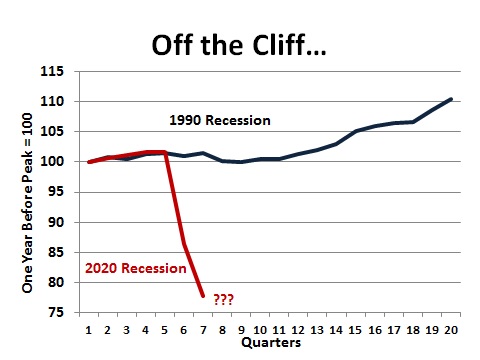
    The COVID-19 pandemic is producing an unprecedented shutdown of large parts of the national and global economies. Our Director Dr. Jim Stanford provided an overview of the coming recession, how it differs from previous downturns, and the best ways for government to respond to protect Australians as much as possible from the economic fall-out.

    Jim titled his presentation “Off the Cliff”, highlighting that the immediate shutdown of so much of Australia’s work and production is producing an economic contraction unlike anything experienced in history.

    Comparing Recessions

    Watch a video recording of the webinar:

    And/or download Jim’s slides below.

    This webinar was part of the Australia Institute’s weekly pandemic webinar series.


    Related documents


    Presentation slides

    You might also like

    Dutton’s nuclear push will cost renewable jobs

    by Charlie Joyce

    Dutton’s nuclear push will cost renewable jobs As Australia’s federal election campaign has finally begun, opposition leader Peter Dutton’s proposal to spend hundreds of billions in public money to build seven nuclear power plants across the country has been carefully scrutinized. The technological unfeasibility, staggering cost, and scant detail of the Coalition’s nuclear proposal have

  • Open Letter From Economists and Policy Experts: Wage Subsidy to Protect Jobs During Pandemic

    Open Letter From Economists and Policy Experts: Wage Subsidy to Protect Jobs During Pandemic

    by Jim Stanford

    Share

    109 Australian economists and policy experts have signed an open letter, initiated by the Centre for Future Work, supporting a government wage subsidy to prevent mass unemployment during the coming economic downturn resulting from the COVID-19 pandemic.

    The letter and the full list of signatories is reprinted below. It has been forwarded to Prime Minister Morrison.

    Public Statement from Economists and Public Policy Experts:

    A Wage Subsidy to Protect Jobs During the Coronavirus Shutdown

    The unprecedented public health measures required to deal with the COVID-19 pandemic are causing a dramatic shutdown of work and production in several key sectors of Australia’s economy. Immediate full or partial closures of activity are occurring in several consumer-facing industries (such as hospitality, retail, airlines, recreation and personal services). But before long, spillover losses will be experienced in other sectors, too: including wholesale trade and logistics, manufacturing, business services, education, and others. Consumer and business confidence has been deeply shocked, and that will magnify the negative economic effects of the pandemic.

    The coming recession will be unprecedented in Australian history – in both its speed and its depth. Without immediate action, we expect that 1-2 million workers, or even more, could lose their jobs in coming weeks. That would drive unemployment to 15% or higher, overwhelm income support programs, and leave hundreds of thousands of businesses unable to function – even after the immediate health danger passes.

    This is a dangerous and dramatic moment in Australia’s economic history. It is imperative that the federal and state governments act immediately and powerfully to protect Australian workers and businesses from the worst of the coming downturn. Important steps have been taken to expand access and benefit levels for income support payments to Australian workers (including casuals, contractors, and gig workers) losing work because of the pandemic. This is a helpful, but on its own inadequate, response. Government must also act forcefully to prevent mass job losses in coming weeks – not just provide support to those who do lose work.

    In this regard, we recommend that the Commonwealth government immediately implement a large-scale wage subsidy scheme, similar to those already enacted in several other industrial countries (including, variously, the UK, Denmark, New Zealand, the Netherlands, South Korea, and Ireland). Under these programs, government directly pays to employers (for a limited period of time) a majority portion of wages (between 70 and 90%) to cover the wages of workers who would otherwise be stood down from their positions. The measure can apply to non-standard workers (including contractors and self-employed). It can also be integrated with measures to support short time working as an alternative to complete redundancy. The wage subsidy is paid to firms experiencing severe losses of revenue and business (beyond a specified threshold). It would cover most of the wage bills for workers who can no longer work for economic reasons, up to a specified ceiling (perhaps the level of full-time median earnings). This program will be expensive – but governments everywhere have recognised that this unprecedented crisis requires them to do everything in their power to protect people, jobs, communities and the economy.

    To date, Australia’s response to the pandemic has been uncertain, inconsistent and inadequate. Immediate, powerful action to keep millions of Australians in their jobs, instead of pushing them into an overloaded and complex Centrelink system, would significantly ease the pandemic’s painful economic effects. It would underpin financial stability for millions of households through the coming terrible weeks or months. And it would preserve the viability of hundreds of thousands of Australian businesses, allowing them to resume work and production as soon as the health restrictions are eased.

    We the undersigned support the proposal for a strong wage subsidy program to keep workers in employment through the coming downturn, and we urge the Commonwealth government to implement such a policy quickly.

    Download full list of signatories below.


    Related documents


    List of signatories

    You might also like

    Dutton’s nuclear push will cost renewable jobs

    by Charlie Joyce

    Dutton’s nuclear push will cost renewable jobs As Australia’s federal election campaign has finally begun, opposition leader Peter Dutton’s proposal to spend hundreds of billions in public money to build seven nuclear power plants across the country has been carefully scrutinized. The technological unfeasibility, staggering cost, and scant detail of the Coalition’s nuclear proposal have

  • Job Opportunity: Research Economist

    Job Opportunity: Research Economist

    Share

    The Centre for Future Work invites applications for an economist to join our research team in labour market research and policy analysis. The position may be at a junior or senior level, and the successful candidate may work from our offices in either Sydney or Canberra.

    The successful candidate will offer:

    • A graduate degree in economics or a closely related discipline.
    • Knowledge of and experience with a wide range of labour issues, preferably including: labour market statistics and trends; characteristics and determinants of employment; industrial relations and collective bargaining; wage determination and inequality; gender, racial, and demographic aspects of labour markets; the impact of technology on employment; macroeconomic policy and labour markets; and others.
    • Demonstrated ability to write to deadline for professional and popular audiences in a credible, succinct, and accessible manner.
    • Strong quantitative skills, including ability to access statistical data, analyse it (including familiarity with statistical tools), and report it in a variety of textual, tabular and graphical formats.
    • Confident communication skills, including ability to speak to public audiences, classrooms, and the media.
    • Ability to work collegially with other members of a research team.
    • Commitment to a progressive vision of work and fairness, including the goals of equality, participation, collective representation and trade unionism.

    Responsibilities of the position will include:

    • Research and completion of several project-length research papers, briefing notes, and shorter commentary articles per year on a range of topics related to labour markets and labour market policy.
    • Ongoing monitoring and analysis of labour market data and information.
    • Helping to maintain relevant websites and databases.
    • Public speaking, presentations, lectures and courses, media interviews, and related communication and educational activities.
    • Minimal office and administrative functions.

    Ability to undertake occasional out-of-town travel (including overnight travel) is essential, as is ability to successfully work in a self-managed and autonomous manner.

    The position will be offered on a one-year term-limited basis, with possibility for renewal. Salary will be commensurate with qualifications and experience.

    Applications are especially invited from women, indigenous persons, other racial and linguistic communities, people with disabilities, and other marginalised communities.

    Please forward applications (including contact information, qualifications, experience, two samples of written work, and names and contact details for two references) in confidence to cfwjob@tai.org.au. Please cite “Economist Job Application” in the subject field of your message; supporting documents should be attached in pdf format. Receipt of applications will be acknowledged by e-mail. Only candidates selected for an interview will then be contacted; no phone calls please.

    Applications must be received by 5:00 pm AEDT on Wednesday 9 October, and interviews will be conducted in Sydney on Wednesday 23 October 2019.

    The Centre for Future Work is an initiative of the Australia Institute, Australia’s leading progressive research institution. Thank you for your interest in the Centre for Future Work.


    You might also like

    Dutton’s nuclear push will cost renewable jobs

    by Charlie Joyce

    Dutton’s nuclear push will cost renewable jobs As Australia’s federal election campaign has finally begun, opposition leader Peter Dutton’s proposal to spend hundreds of billions in public money to build seven nuclear power plants across the country has been carefully scrutinized. The technological unfeasibility, staggering cost, and scant detail of the Coalition’s nuclear proposal have

  • Industry-Wide Bargaining Good for Efficiency, as Well as Equity

    Industry-Wide Bargaining Good for Efficiency, as Well as Equity

    by Anis Chowdhury

    In this commentary, Centre for Future Work Associate Dr. Anis Chowdhury discusses the economic benefits of industry-wide collective bargaining. In addition to supporting wage growth, industry-wide wage agreements generate significant efficiency benefits, by pressuring lagging firms to improve their innovation and productivity performance. The experience of other countries (such as Germany and Singapore) suggests that this system promotes greater efficiency, as well as equity — although other wealth-sharing policies are also needed.

    Dr. Chowdhury’s full comment is posted below.

    INDUSTRY-WIDE BARGAINING CAN BOOST EFFICIENCY AS WELL AS WAGES

    by Dr. Anis Chowdhury

    In an effort to reverse long-term wage stagnation, the ACTU is calling for an end to current industrial rules which effectively prohibit sector- or industry-wide wage bargaining. Predictably, the business community is opposed. Australian Industry Group chief executive, Innes Willox, said, “The ACTU’s latest proposals would destroy jobs and the competitiveness of Australian businesses…If the ACTU got its way, unions would be able to make unreasonable claims and cripple whole industries and supply chains until employers capitulated.”

    No doubt, the issue will be a hot topic in the upcoming Federal Elections. The Labor Party conference is debating the ACTU’s call. And the Liberal-National Coalition will surely accuse Labor of capitulating to the vested interest of the union movement.

    Mr. Willox’s claim that the sector-wide wage bargaining would destroy jobs and Australia’s competitiveness has no basis. A powerful example is provided by Germany, Europe’s strongest economy. In Germany, wages, hours, and other aspects of working conditions are decided by unions, work councils (organisations complementing unions by representing workers at the firm level in negotiations), and employers’ associations. Collective wage bargaining takes place not at the company or enterprise level but at the industry and regional levels, between unions and employers’ associations. If a company recognises the trade union, all of its workers are effectively covered by the union contract.

    Yet, Germany’s competitiveness did not decline. On the contrary, Germany experiences both strong productivity growth and strong wage growth. Despite ongoing real wage improvements, unit labour costs are stable or even declining – further enhancing Germany’s competitiveness.

    How is this possible? The answer was given by more than half a century ago by two leading Australian academics – WEG Salter and Eric Russel. By de-linking productivity-based wage increases at the enterprise level and adhering to the industry-wide average productivity-based wage increases, an industry bargaining system raises relative unit labour costs of firms with below-industry-average productivity, thereby forcing them to improve their productivity or else exit the industry. At the same time, firms with above-industry-average productivity enjoy lower unit labour costs, hence higher profit rates for reinvestment. Singapore also used this approach to restructure its industry in the 1980s towards higher value-added activities, with great success.

    Trying to compete on the basis of low wages is a recipe for failure. As a matter of fact, low-wage countries typically demonstrate lower productivity; and research by a leading French economist, Edmond Malinvaud, showed that a reduction in the wage rates has a depressing effect on capital intensity. Salter’s research implies that the availability of a growing pool of low paid workers makes firms complacent with regard to innovation and technological or skill upgrading. Other researchers show that under-paid labour provides a way for inefficient producers and obsolete technologies to survive. Firms become caught in a low-level productivity trap from which they have little incentive to escape – a form of Gresham’s Law’ whereby bad labour standards drive out good. The discipline imposed on all firms as a result of negotiated industry-wide wage increases forces all of them to innovate and become more efficient.

    So, sector-wide wage bargaining is good for the economy: favouring efficient firms, stimulating investment, and lifting wages. Of course, industry-wide bargaining alone cannot solve all the problems of wage inequity or wage stagnation. It must be part of a broader suite of policy measures, to provide all-round support for greater equality and inclusive prosperity.

    In particular, we must address the system that produces sky-rocketing executive pays at the expense of workers. A lower marginal tax rate is one of the incentives for the executives to pay themselves heftily, while tax cuts are not found to boost growth or employment. Share options for CEOs, which encourage job cuts and discourage re-investment, also must be reined in. If anything that is making the Australian economy vulnerable, is growing economic disparity between self-serving executive compensation and stagnant wages for the rest of the population.

    Reforms also need to address the macroeconomic policy paradigm, where fiscal policy is focused on creating needless budget surpluses by cutting social services and public infrastructure investment. Meanwhile, monetary policy is focused on a pre-determined inflation target regardless of the economic cycle. All of this stifles economic growth prospects and increases job insecurity – both of which are detrimental for wage recovery.


    You might also like

  • Rebuilding the NSW Workers Compensation System

    Rebuilding the NSW Workers Compensation System

    by Ian Watson and Jim Stanford

    Workers compensation benefits in New South Wales were dramatically reduced in 2012 by a newly-elected state government, citing an alleged financial crisis in the system.  Benefit payments (adjusted for inflation) declined 25 percent in just five years – and some cuts are still being imposed on injured workers and their families (including some losing benefits entirely).  But even as injured workers suffered the consequences of these benefit cuts, the financial position of the workers compensation system suddenly transformed from “famine to feast”: the supposedly dire deficit which justified the cutbacks disappeared entirely within one year, and by mid-2013 the fund was already back in surplus.  The system’s total surplus now exceeds $4 billion.

    This report reveals the artificial nature of the supposed crisis which justified the 2012 cuts, and highlights the continuing positive financial trends that are generating ever larger surpluses.  It proposes a five-year timetable for restoring benefits to injured workers in NSW, without increasing average premium levels or incurring funding deficits.

    There is no fiscal or moral justification for injured workers to continue to suffer reduced benefits, while the workers compensation system carries a multi-billion dollar surplus – poised to get even bigger in the years ahead.  Unions NSW commissioned the Centre for Future Work to conduct an independent review of the system’s financial position.  Our full 95-page report, Restoring Dignity and Respect: Rebuilding NSW’s Workers Compensation System, reviews the system’s roller-coaster ride over the past decade, and highlights the artificial and temporary nature of the financial circumstances which were invoked to justify cuts in 2012.  It documents and explains the improvements in injury rates, premium revenue, and financial markets that underpin the continued surplus-generating capacity of the system. 

    The report confirms that ample resources are available to fund a gradual but ambitious repair in benefit entitlements for injured workers in the years ahead, centred around Unions NSW’s 12-point vision for a fair, effective, and sustainable workers compensation system. The report makes 10 core recommendations to the state government and icare directors, including:

    1. Maintain overall effective average premium rates at current level.
    2. Simplify and make more transparent the formulae for calculating premiums for specific employers.
    3. Undertake an independent actuarial review of the cost of reversing specific components of the 2012 policy changes, and otherwise improving benefits (including the twelve reform principles outlined by Unions NSW).
    4. Develop a staged timetable for restoring and enhancing benefits, with liabilities increased by $1 billion annually over the next five years.
    5. Impose a moratorium on the cessation of monthly benefits under Section 39, and restore benefits for injured workers who have been cut off.
    6. Revise capital funding policy to target full funding (100 percent) of adjusted present value liabilities (including a cushion to reflect an 80-percent probability risk margin).
    7. Monitor financial balances of the system, and adjust the timing of benefit improvements accordingly.
    8. Release terms of the contract with EML (now monopoly private provider of core insurance and clams management services to the system), and investigate the potential for in-sourcing its services.
    9. Detailed evaluation of the performance of icare’s investment program to explain fully the recent underperformance of its investment income.
    10. Implement a meaningful tripartite system of consultation and governance.

    Under the five-year timetable, benefits for injured workers would be repaired in several stages, with no increase in average effective premium rates, and still exceeding full funding of obligations (including a $2 billion cushion for risk margin).  There is no fiscal excuse for treating injured workers with the callous disrespect they have endured since 2012.  That legacy cannot be reversed overnight, but it can be reversed with a significant and responsible commitment to rebuild the integrity of the program over the coming years.

    Relative to total labour costs and to NSW’s economy, workers compensation premiums have never been lower: down 60 percent since 2009.  When workplace injuries occur, society has an obligation to provide workers with compensation they can count on.  This report confirms that NSW is fully capable of meeting this responsibility.  It is simply a matter of political and fiscal priority on the part of the state government, to ensure it happens.


    Full report

    Share