Category: Media Releases

  • The Australia Institute’s Centre for Future Work

    Labour mobility is a significant contributor to Pacific Islands’ economies.

    Australia and New Zealand’s temporary labour migration schemes for Pacific workers have expanded into more industries including personal care work in aged care.

    This has led to the loss of skilled health workers from Pacific Island countries, including registered nurses, to lower-skilled personal care jobs overseas.

    Workers who take up temporary migration in Australia and New Zealand are vulnerable to being underpaid and exploited, due to their visa status.

    This report examines the need for reform of labour migration systems and greater consultation with workers.


    Full report


    Factsheet
    Australia dumps its care crisis on the Pacific – new report

    Share

  • Centre For Future Work to evolve into standalone entity

    Centre For Future Work to evolve into standalone entity

    Share

    The Centre for Future Work was established by the Australia Institute in 2016 to conduct and publish progressive economic research on work, employment, and labour markets.

    Supported by the Australian Union movement, the centre produced cutting edge research and led the national conversation on economic issues facing working people: including the future of jobs, wages and income distribution, skills and training, sector and industry policies, globalisation, the role of government, public services, and more.

    The Centre will now evolve to a stand-alone centre sitting outside of the Australia Institute.

    “The Australia Institute and the Centre for Future Work have been such an important and powerful partnership in advocating for and winning ideas that make the world of work better. We look forward to what this next chapter can bring,” said Michele O’Neil, President of the Australian Council of Trade Unions.

    “We are thrilled to have been able to seed this important initiative and build it to where it is able to stand alone. The Australia Institute will continue to work with the Centre for Future Work to amplify good policy solutions for workplace issues,” said Leanne Minshull, co-CEO of The Australia Institute.


  • Australia dumps its care crisis on the Pacific – new report

    Australia dumps its care crisis on the Pacific – new report

    Share

    Skilled health workers from Pacific Island countries are being poached to plug Australia’s shortage of care workers, leaving the health systems in their home countries on the brink of collapse, according to new research.

    A report by the Centre for Future Work at The Australia Institute and Public Services International has also found that when workers get to Australia, many are being deskilled, underpaid and exploited.

    Care workers have been added to the Pacific Australia Labor Mobility (PALM) scheme, traditionally aimed at seasonal agriculture workers like fruit pickers. This has led to skilled health workers – like nurses – quitting their jobs to take up better paid but lower skilled jobs in Australia.

    The report details the harrowing state of the health systems in Fiji, Papua New Guinea, Samoa, the Solomon Islands and Vanuatu. Many health services and hospitals have been decimated, operating at 30-40 percent capacity or below.

    The research reveals that not only are Pacific workers doing lower-skilled care jobs in Australia, they are vulnerable to poor treatment, due to their visa status.

    “Workers have the right to cross borders for a better life for themselves and their families,” said Fiona Macdonald, Director of the Centre for Future Work at The Australia Institute.

    “But the current system is broken. It is rich countries taking from poor countries and giving nothing back. Australia and New Zealand are offloading their own care crises to their Pacific neighbours.

    “Australia has vowed to invest in the health systems of its Pacific neighbours, not destroy them. It should be helping to build better, safer health facilities and train workers, not lure them away.

    “We are taking workers out of a system already at breaking point, giving them jobs which are below their skill level and failing to protect them from exploitation and mistreatment.

    “The recruiting and labour hire systems, including international schemes like PALM, need urgent reform. This should start with meaningful dialogue with the workers themselves.”


    Related research

  • Go Home On Time Day 2025. As full timers disconnect, part timers are doing more unpaid overtime

    Go Home On Time Day 2025. As full timers disconnect, part timers are doing more unpaid overtime

    Share

    New research by the Centre for Future Work at The Australia Institute has revealed a disturbing new twist when it comes to unpaid overtime in Australia.

    The research has been released today to mark Go Home On Time Day 2025, an initiative by the Centre for Future Work, now into its 17th year.

    It is the first full year since Right To Disconnect Laws were introduced in Australia, back in August 2024.

    As full time employees and their bosses come to grips with workers’ right to switch off, the burden is shifting to part time and casual employees.

    Overall, Australians are still doing more than three and a half hours of unpaid overtime each week – the equivalent to four and a half full-time weeks per year.

    The average workers is losing nearly  $8000 a year, which is ripping a staggering $95.8 billion a year out of the pockets of Australian workers.

    Key points:

    • Full-time employees average 3.8 hours of unpaid overtime a week. For every ten hours of paid work, they’re working one for nothing.
    • Despite doing significantly fewer hours overall, part-time employees do 3.7 hours of unpaid overtime a week. For every seven hours of paid work, they’re doing nearly an hour for nothing.
    • Younger people (18-24) do the most unpaid overtime at 4.7 hours a week, equivalent to almost one hour of unpaid work for every five paid hours.
    • Unpaid overtime equates to almost 173 hours per year, per worker, more than 4.5 full-time weeks.
    • If that unpaid overtime was valued at median wage rates, the average worker is losing $7,930 a year or $305 a fortnight.
      • Economy-wide, that equates to almost $95.8 billion of lost income a year, which is more than the government spends on the NDIS and Aged Care combined.

    “Australians have been giving their bosses so many free hours for so many years, we were never going to see the level of unpaid overtime suddenly plummet,” said Fiona Macdonald, Director of the Centre for Future Work at The Australia Institute.

    “The situation for full time workers has stabilised. It’s a good first step. I would say, for them, the right to disconnect is working.

    “But this is the first time we have seen rates of unpaid overtime for part time workers almost as high as full time workers.

    “The right to disconnect is less effective for part time workers and casuals because they are simply not given enough paid hours to do their jobs.

    “Young people who are already on the lowest incomes are bearing the brunt of this trend towards squeezing part timers.

    “However you look at it, Australian workers are being ripped off. The cost of living crisis isn’t over. Now, more than ever, workers should be paid for every single hour they work. ”


  • Want to lift workers’ productivity? Let’s start with their bosses

    Originally published in The New Daily on August 18, 2025

    Business representatives sit down today with government and others to talk about productivity. Who, according to those business representatives, will need to change the way they do things?

    The elephant in the room is that it is business that has the biggest influence on productivity. Certainly, it has a much bigger impact than workers, who typically get the blame when things go wrong.

    The factor that most shapes how productive workers are, we must remember, is the technology they work with. It is management that is responsible for the decisions about what technology a business introduces, and how. Workers often do not have much of a say.

    It is not workers who make the decisions about how much money is available for investment. It is not workers who make the decision about which particular technologies to buy, install and use. It is not workers who decide how much money should be allocated to the training of workers to use the new technology, or how those workers should be deployed. It is management.

    Sure, there is lots of evidence that, when workers have a say at work, productivity is higher. But managers often don’t give them a chance to have more than a token say, if they have any say at all. Any attempts by governments to legislate that workers decide or influence decisions on those matters are opposed by business bodies in Australia.

    How much effort workers put in to their job also shapes productivity. But lazy workers don’t last long in jobs these days, and most restrictive work practices went out the window in the 1980s. If a business continued to use workers who do not put effort into their job, the finger would very quickly be pointed at the managers who decided to do that and to not have the performance management systems that would overcome that problem.

    Some characteristics of workers do make a difference, but they are often still matters in the hands of management to control.

    Output will be better with an educated and skilled workforce. If people can do more things with their brains, they will be more productive. Yet management decides on the qualifications demanded of successful applicants for jobs. Management decides how much pay to offer to attract qualified workers to apply for and fill skilled vacancies. Management decides on the training provided to workers.

    Management decides on job quality which, studies show, is positively related to performance.

    Management decides on how much a business pursues diversity, equity and inclusion practices, which (despite shenanigans in the US) have also been shown to benefit innovation and firm performance.

    So it’s no surprise that a couple of years ago the Productivity Commission, after looking at OECD evidence, said that the “productivity gains from upskilling managers could be three times higher than for upskilling workers”.

    The problem for Australia is that, overall, the quality of Australian management is not that good. One survey showed that Australia “ranks low in almost all the people management dimensions”.

    The Productivity Commission commented in its 2023 five-yearly review that “managerial capability varies, but generally lags other countries” and observed that “limited management capability may be holding back Australia’s productivity growth”. It added that its consultations had “provided insights into some of the consequences for innovation of poor management capability”.

    The main response by top management seems to be to pay itself more. But a study as far back as 2004 found that the average pay gap between CEO pay and average earnings was “at least three times higher than that required to maximise organisational performance”. Leaders might say they’re tied to performance bonuses, but somehow when profits go down, the formula or the base get changed, and the CEO’s pay packet is saved.

    When that doesn’t increase productivity, it’s blame the unions. But that wears a bit thin when only one in eight workers is unionised these days. Or cut penalty rates, or some other aspect of workers’ pay! But lower wages just reduce the incentive to introduce new technology.

    What the studies do show about the impact of workplace relations on productivity is that it’s not whether a workforce is unionised that matters, it’s the quality of relations between workers and management that counts — and that is very much in the hands of management.

    After all, research shows that workers do want a co-operative relationship with management — which, despite management wishes, is not the same as acquiescing to every management whim. If their union didn’t want co-operation, the workers would quit the union. The trouble is, if management didn’t want genuine co-operation, it will just blame the workers, and up its own pay because it’s dealing with a difficult situation.

    There are no prizes for expecting business to blame others for Australia’s productivity problems. But an honest debate would look at what management can do better.


    You might also like

  • Feeling hopeless? You’re not alone. The untold story behind Australia’s plummeting standard of living

    Feeling hopeless? You’re not alone. The untold story behind Australia’s plummeting standard of living

    Share

    A new report on Australia’s standard of living has found that low real wages, underfunded public services and skyrocketing prices have left many families experiencing hardship and hopelessness.

    But the report, Solving the Crisis – Raising Living Standards of Australian Workers, also concludes that there is hope, and suggests a range of reforms to improve our way of life.

    Compiled by the Centre for Future Work at The Australia Institute, the report found that official inflation data does not reflect the pressure families are experiencing as they struggle to afford essentials like food, housing and energy.

    It found the Reserve Bank of Australia’s response to high inflation – repeatedly lifting interest rates – was a case of victim-blaming and acted as a double punishment for working families.

    Among the recommendations in the Solving the Crisis report:

    • Treating housing as a human right
    • Embedding employment targets in the Charter of Budget Honesty
    • Restoring the minimum wage to a minimum of 60% of the median wage
    • Greater investment and fast-tracking of clean, affordable, renewable energy
    • Making fossil fuel mining companies pay their fair share of taxes and royalties
    • Raising all income support payments to the level of the age pension
    • Fixing the broken employment services system
    • Abolishing the capital gains tax discount and negative gearing
    • Better funding of Medicare, public hospitals, early childhood education and care, and public schools

    “Productivity might be the word on everyone’s lips in the lead up to the economic reform roundtable. But weak productivity isn’t the cause of many of the problems facing Australian families today,” said Lisa Heap, Senior Researcher, Centre for Future Work at The Australia Institute.

    “The key to raising living standards is focusing on the experience of workers and their families with a multidimensional approach rather than a narrow concentration on productivity.”

    “There are better, fairer alternatives to managing economic challenges than simply tightening workers’ collective belts,” said Fiona Macdonald, Director, Centre for Future Work at The Australia Institute.

    “By centring workers’ experiences and building a robust evidence base, we have mapped a path to a progressive economic agenda that lifts living standards, reduces inequality, and strengthens democracy.”

    “The inflation crisis was caused by unchecked corporate power and profit-seeking behaviour like price gouging – not the spending of ordinary Australians,” said Greg Jericho, Chief Economist at The Australia Institute.


    Related research

  • A smooth move or a tough transition? Protecting workers who’ll lose their jobs when the Eraring Power Station closes

    A smooth move or a tough transition? Protecting workers who’ll lose their jobs when the Eraring Power Station closes

    Share

    The Centre for Future Work at The Australia Institute has urged the federal government to take charge of transitioning hundreds of workers into secure employment when the Eraring Power Station shuts down.

    The power station is scheduled to close by August 2027. More than 1000 workers will be directly impacted by the closure.

    This is an important test in Australia’s transition from fossil fuel power to renewables.

    The Centre for Future Work has written a submission to the Net Zero Economy Agency (NZEA) urging it to apply its Energy Industry Jobs Plan to the Eraring closure, to avoid inflicting undue pain on workers currently employed at the power station.

    In the submission, it argues that this important process should not be left solely to the power station owner, Origin Energy, but managed under the Energy Industry Jobs Plan, which was set up for this precise purpose.

    “We hear a lot about how the transition to a clean energy future involves helping workers in the coal and gas industry secure jobs when theirs disappear,” said Charlie Joyce, Researcher, Centre for Future Work at The Australia Institute.

    “To help this process, the government set up the Net Zero Economy Authority, which established an Energy Industry Jobs Plan, designed specifically to support workers who’ll lose their jobs when coal and gas power stations close down.

    “Well, now the nation’s biggest coal-fired power station is closing down. It’s time for this plan to deliver.

    “Origin has made some noise about helping workers with retraining and career counselling, but that’s not enough. This impacts far more than those employed directly by Origin Energy. It requires coordination with industry, unions, and the broader community.

    “The nation will be watching how the Eraring closure unfolds. This is an important test for transitioning workers into good, secure jobs.

    “It would be senseless for the Net Zero Economy Authority not to use its Energy Industry Jobs Plan in this situation.  This is what it was set up to do.”


  • Australia does not have a “productivity crisis” – new research

    Australia does not have a “productivity crisis” – new research

    by Jim Stanford

    Share

    New research by The Australia Institute reveals there is little evidence of a “productivity crisis” in Australia, despite claims to the contrary from business leaders and politicians. 

    Like the rest of the world, productivity has been sluggish since the COVID pandemic, but that is largely due to businesses failing to adequately invest in machinery, equipment, technology and skills, at a time when many are recording record profits.

    The research also reveals that disappointing productivity is not the cause of the problems facing Australian households, like falling real wages, high prices, high interest rates and the unaffordability of housing.

    Key findings:

    • If real wages had grown at the same rate of productivity since 2000, average wages would be 18% – or $350 per week – higher.
    • Australian businesses now invest less than half as much in research and development as those in other OECD countries.
    • Higher productivity does not automatically “trickle down” to workers in terms of improved wages or living standards.
    • Productivity benefits are trending toward high-paid executives, shareholders and profits, rather than workers.
    • Business claims that productivity can be improved by wage cuts, tax cuts, deregulation or reduced unionisation are false.
    • The idea that workers should “tighten their belts and make do with less” to improve productivity is a lie.

    “Productivity has become an excuse for big, profitable businesses to do whatever they like,” said Greg Jericho, Chief Economist at The Australia Institute‘s Centre for Future Work.

    “Peter Dutton said he’d tear up the new right-to-disconnect laws, saying they hampered productivity, as if allowing employers to call staff any time of the day or night would somehow make them more efficient. This research dispels that kind of nonsense.

    “Australia’s so-called ‘productivity crisis’ is massively exaggerated. Low productivity is not to blame for the problems facing households today, like soaring interest rates, prices or low wage growth.

    “This research also shows that sluggish productivity is caused by companies investing far less in things like machinery, equipment and research.

    “The benefits of productivity should not go straight to profits, shareholders or fat cat CEOs. They should be shared with workers in the form of wages which grow at a similar rate.

    “That way productivity would deliver its true purpose: to provide economic prosperity and a higher quality of life for everyone.”


    Related research

  • Australia’s Gas Use On The Slide

    Australia’s Gas Use On The Slide

    by Ketan Joshi

    Share

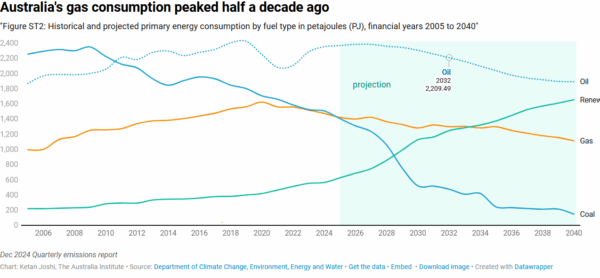
    The Federal Government has released a new report that includes projections of how much gas Australia is set to use over the coming decades. There is no ambiguity in its message: Australia reached peak gas years ago, and it’s all downhill from here:

    “Gas consumption is projected to decline to 2040 as electrification increases across the economy and renewables and storage take an increasing share of electricity generation”, wrote the Department of Climate Change, Energy, Environment and Water (DCCEEW).

    This doesn’t sit well with the Prime Minister’s recent claims that more gas is needed for “firming” renewable energy. Figures from the Australian Energy Market Operator (AEMO)’s 2024 Integrated System Plan (ISP) show just how little gas is likely to be required in Australia’s electricity system.

    In AEMO’s ‘step change’ scenario, there isn’t a single year where gas generates more than its historical peak in the National Electricity Market. In this scenario, more gas was burned in the past 16 years than is burned over the next 25 years.

    In short: while gas might serve occasional use during low wind and sun periods, Australia simply will not end up using large amounts of it.

    It is weird, then, that Australia has a massive pipeline of planned fossil gas extraction projects. Many of them are justified on the grounds that they’re required to help Australia decarbonise its power grids, with more than 1,000 new petajoules coming online by 2027, according to the latest government projects report.

    The chart below compares the above projections of Australia’s domestic gas use to projections of the volume of gas exports, prepared by the separate Department of Resources and Energy (DISER). It makes it pretty clear where all the new gas is going – exports.

    Only looking at new gas production capacity, and only looking at the proportion that has a clear operation date, that is still around 11 times the amount of gas projected to be used in the power sector. In fact, the use of LNG for FY23 was greater just for processing LNG than the entire power sector in Australia:

    This analysis by climate expert Tim Baxter lays it out in even more detail.

    “Again, more than 3,000 petajoules of gas were exported from Western Australia in 2022–23. If the entire transition to clean energy were to stand dead still as if renewables weren’t already going gang-busters — in Western Australia renewable energy generation has increased by an average of 20% each year for the past five years — we would need just 2.5% of that gas to keep the lights on for the state”.

    It is pretty simple: Australia does not need to be expanding its fossil gas production, least of all to run fossil gas power stations. It’s a hollow fossil fuel industry talking point, and the Federal Government should know better than to repeat it.


    You might also like

    Centre For Future Work to evolve into standalone entity

    The Centre for Future Work was established by the Australia Institute in 2016 to conduct and publish progressive economic research on work, employment, and labour markets. Supported by the Australian Union movement, the centre produced cutting edge research and led the national conversation on economic issues facing working people: including the future of jobs, wages

  • Dutton’s nuclear push will cost renewable jobs

    Dutton’s nuclear push will cost renewable jobs

    by Charlie Joyce

    Dutton’s nuclear push will cost renewable jobs

    As Australia’s federal election campaign has finally begun, opposition leader Peter Dutton’s proposal to spend hundreds of billions in public money to build seven nuclear power plants across the country has been carefully scrutinized.

    The technological unfeasibility, staggering cost, and scant detail of the Coalition’s nuclear proposal have brought criticism from federal and state governments, the CSIRO, the Climate Council, the Electrical Trade Union (ETU), the Climate Change Authority, the Australia Institute, and independent energy experts.

    The CSIRO, among others, has refuted the Coalition’s claim that nuclear will be cheaper than renewables; instead, they have shown the energy produced by Australian reactors would cost approximately eight times more than the same amount of energy produced by renewables. If this cost is passed on to consumers, the average household would pay $590 per year more on their power bill. Unsurprisingly, Australia Institute polling has found that fewer than one in twenty Australians (4%) are prepared to pay this nuclear premium.

    The cost alone should be enough to bury this nuclear proposal. But it is also important to recognise how the Coalition’s plan will impact – and fail – workers.

    False promises

    The Coalition has proposed that large nuclear reactors would be built on the sites of five operational or recently decommissioned coal fired power stations: Liddell and Mount Piper in New South Wales, Tarong and Callide in Queensland, and Loy Yang in Victoria. In doing so, the Coalition has promised that nuclear energy would be a source of stable and plentiful work for the communities where coal-fired power plants are phasing down.

    This is a false promise. Six coal fired power stations have already closed in the past decade, with 90% of Australia’s remaining coal-fired power stations set to close in the next decade. These communities are already undergoing structural adjustment, and they need new sources of employment now. But this is not what the Coalition’s plan delivers. The Coalition outlines that the first two nuclear reactors would not come online until the mid-2030s – more than a decade from now – while the remainder would be completed by 2050.

    And energy and technology experts agree that even this timeline is impossible. On average, a nuclear reactor takes 9.4 years just to build in countries with established and capable nuclear industries. Former Australian Chief Scientist Alan Finkel has estimated that it would take until the mid-2040s at the earliest for Australia to build an operational nuclear reactor. Moreover, analysis from the Institute for Energy, Economic & Financial Analysis (IEEFA) has found that, in economies comparable to Australia’s, every single nuclear reactor project experienced multi-year delays and cost blowouts of up to three and a half times over budget. It is hard to see how Australia, which lacks the experienced workforce, training and research base, or regulatory framework, would buck this trend.

    Lost jobs

    While the Coalition’s nuclear plan would not bring jobs to the communities that need them, it might have the real effect of depressing investment in renewables.

    Renewable energy already generates approximately 40% of Australia’s energy and is by far the cheapest form of electricity. Renewable energy industries already account for the employment of tens of thousands of workers, and Jobs and Skills Australia estimates that approximately 240,000 new workers will be required in industries associated with clean energy by 2030.

    But this requires ongoing and expanding investment in renewables, which the Coalition’s nuclear policy is likely to derail. The Clean Energy Council has estimated that by capping renewable energy to 54% of total use (as the Coalition’s modelling has assumed), 29GW of renewable energy generation projects would not be built – squandering an expected 37,700 full-time-equivalent construction jobs and 5,000 ongoing jobs in operations and maintenance. By limiting renewables investment, prolonging fossil fuel usage, and diverting investment towards nuclear energy, the full employment opportunities of the renewable energy transition are lost.

    Scarce and dangerous work

    If the Coalition’s nuclear plan does come to fruition it will hardly create any ongoing jobs for the communities that have undergone structural readjustment. According to analysis from the Nuclear Energy Agency, while the peak period of construction of the average 1GW nuclear power plant can demand up to 3,500 workers, ongoing operations and maintenance will only require about 400 workers – with only a quarter of these being onsite blue-collar jobs that might provide work for the people who will have lost jobs with the closure of coal-fired power stations. Most jobs will be in administration, regulatory compliance, energy, marketing, sales, science and emergency personnel – and many of them are likely to be located away from the nuclear facility itself.

    Disturbingly, any jobs on-site may put the health of workers at risk. Recent analysis of multiple studies of the health impacts of nuclear power plant employment across multiple countries found that workers have a significantly higher risk of mesothelioma and circulatory disease due to exposure to radiation. Nearby residents also exhibit a significantly higher risks of cancer, with children under the age of five at particular risk. And this does not even factor in the risk of sudden plant failure and reactor meltdown on workers and communities – a risk sharpened by the Coalition’s plan for these reactors to be built on geological fault lines with heightened earthquake risk.

    Australian workers have much to gain from the renewable energy transition, including cheaper power, new clean technology industries, and hundreds of thousands of new jobs. The Coalition’s nuclear plan only brings false promises, lost jobs, and – if the plan comes to fruition – few jobs and potentially dangerous work.


    You might also like