Category: Law, Society & Culture

Research branch

  • Submission to the Senate Standing Committee on Education and Employment

    Submission to the Senate Standing Committee on Education and Employment

    by Eliza Littleton

    As tertiary education has become increasingly essential to employment outcomes, financial security, and meeting the demands of the future economy, the importance of affordable or free tertiary education increases. Instead, education is getting more expensive. Tuition fees have increased significantly since their introduction, and debts are growing and taking longer to repay. The context of high inflation and declining real wages HELP indexation and low repayment thresholds are putting an unnecessary financial burden on already disadvantaged Australians. The Government should consider abolishing indexation on educational loans and increasing the threshold for repayments.


    Full submission

    Share

  • Women Earn $1m less than men & $136,000 Less in Super over Working Life

    Women Earn $1m less than men & $136,000 Less in Super over Working Life

    Share

    New research released on International Women’s Day reveals Australian women earn $1.01m less over their working lives than men, based on median income data.

    Women earn $136,000 less in superannuation over their working lives than men, based on median income data. Women earning the median wage will accumulate approximately $393,676 in super, $151,000 below what is considered a ‘comfortable retirement’. The average super balance in Australia in 2023 is $150k.

    Experts say if the gender pay gap was eliminated women would be $3 billion per week better off.

    Despite the gender pay gap narrowing slowly, based on data from the past decade it will only be eradicated by the year 2053 when more than 60% of the current workforce will be retired.

    Key Points:

    • Australian women on a median income will earn $1.01m less over their working lives on average than their male counterparts.
    • Australian women on a median income will earn $136,000 less in superannuation over their working lives than their male counterparts.
      • Women earning the median wage will accumulate approximately $393,676 in super, $151,000 below what is considered a ‘comfortable retirement.
      • The average super balance in Australia in 2023 is $150k.
    • Experts say if the gender pay gap was eliminated women would be $3 billion per week better off.
    • The gender pay gap is narrowing so slowly that it will not fully close for another 30 years until 2053. At that stage 60% of people currently working will have retired.
    • The Gender wage gap in Australia (15.3%) is more than double what it is in New Zealand (6.7%)
    • The gender gap occurs across all occupations and industries:
      • Men have higher average salaries than women in 95% of all occupations, including those where women dominate the workforce. For example, women account for 99% of all midwives, and yet are paid on average 19% less.
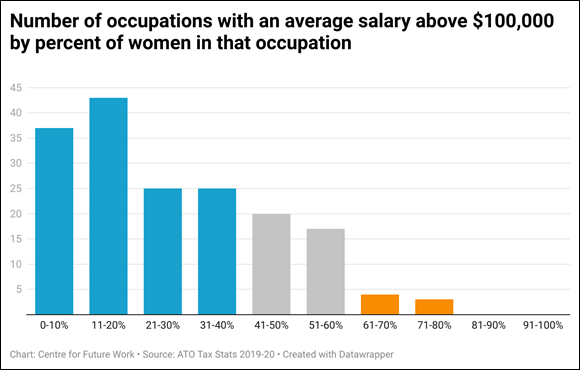
        • 80 occupations in which men make up 80% or more of the workforce have an average salary above $100,000.
        • By contrast zero occupations in which women make up 80% or more of the workforce have an average salary above $100,000.

    “For the average woman in Australia, the gender pay gap will be more than $1.01m over her working life, based on conservative estimates,” said Senior Economist Eliza Littleton from the Australia Institute’s Centre for Future Work.

    “There’s been a noisy political debate about super in Australia for the past week, but this data shows that based on median income data Australian women will earn $136,000 less than their male counter parts over their working life. When you consider that the average super balance in Australia right now is approximately $150,000, that’s a huge disparity.

    “Australian women continue to be paid less than men on average across all industries and occupations, costing us more than $3b across the economy each week.

    “We know that older women are one of the most vulnerable groups when it comes to poverty and homelessness in Australia.

    “Australian women shouldn’t have to wait until the year 2053 for substantive equality. We deserve equity today and our research makes several sensible policy recommendations for the Labor Government to action.”

    Policy recommendations:

    • Greater access to free or more affordable earlier childhood education & care: Australia Institute research shows if Australia had the same labour force participation rates as Nordic countries do, then the economy would be $60 billion, or 3.2% of GDP, larger (Grudnoff and Denniss, 2020).
    • More paid parental leave for both parents: Australia’s PPL scheme is well behind international standards. The OECD average PPL scheme is 60 weeks in total, with 24.6 weeks reserved for mothers, 10.4 weeks for fathers and 25.4 weeks that can be flexibly distributed (OECD, 2022). With a 20-week scheme, Australia unsurprisingly ranks low – 30th out of 38 countries for the duration of paid leave entitlements. Extending leave entitlements and encouraging a more even distribution of childcare would help reduce the career and financial penalty of having children both for all parents, but especially women. Additionally, making it mandatory for superannuation to be paid while a person is taking paid parental leave would help to reduce the gendered super gap.
    • Greater family-friendly work practices: Some workplaces and workers have managed to maintain flexible working arrangements, but this should be standardised, expanded and embedded in employment relations frameworks to make balancing work and care more achievable across the workforce. Breaking down rigid job design in male-dominated jobs could also help with reducing entrenched gendered segregation by industry and occupation.
    • Deliberate policy to lift the wages for industries dominated by women — most urgently in the care sector: Women dominated sectors, especially in the care industry are among the lowest paid work. The 2021 Royal Commission into Aged Care Quality and Safety recommended that gig work, independent contracting and other ‘indirect’ employment arrangements be restricted in the publicly-funded aged care sector. This needs to be agreed to.
    • Address insecure work: Further reforms should include rights to family-friendly working time arrangements and stable work as minimum standards for all employees in the National Employment Standards.
    • Full recommendations in attached report

    Related research

  • The Times They Aren’t A-Changin (enough)

    The Times They Aren’t A-Changin (enough)

    It is past time to value women’s work equally
    by Eliza Littleton and Greg Jericho

    This report examines the barriers to closing the gender gap by reviewing Australia’s position within the industrial countries of the OECD. The report also uses data from the ABS and the ATO to highlight gender disparities across all levels of income, ranges of occupation and ages, as well as disparities regarding who undertakes the greater share of unpaid work.

    One clear concern is gender segregation, where either men or women dominate an occupation or industry. Men have higher average salaries than women in 95% of all occupations, including those where women dominate the workforce. For example, women account for 99% of all midwives, and yet are paid on average 19% less.

    We identify 80 occupations in which men make up 80% or more of the workforce; these occupations have an average salary above $100,000. In contrast, no occupation where women make up that share of the workforce has such a high average salary. This highlights how segregation has reinforced massive differences in pay.

    The report recommends policies to promote greater access to childcare and parental leave for both parents, family-friendly work practices, and the lifting of wages for industries dominated by women – most urgently in the care sector.


    Full report

    Share

  • With interest rates set to rise another 3 times, no wonder consumers are feeling grim

    Originally published in The Guardian on February 16, 2023

    The Reserve Bank now forecasts real household incomes will take longer to recover than they did during the 1990s recession and is also projecting economic growth at historical lows. Australian consumers are right to feel worried about the future.

    Right now Australian consumers have less confidence than they did in April 2020 when the entire world was locked down and the pandemic was raging without any prospect of a vaccine.

    That might suggest that Australians are overly pessimistic, especially given unemployment is at generational lows of 3.5%, but when you look at the statements of the Reserve Bank and its projections for the next 2 years, it is little wonder Australians are worried.

    Last week the RBA not only lifted the cash rate for the 9th straight time, it signalled that there would be a plural number of rises to come. In response, the market now anticipates at least three more rate rises, with a slight chance of 4 more. That would be easily the fastest and largest raising of interest rates since the late 1980s. And Australians are well aware of what occurred after the 1980s rate rises.

    Indeed even the Reserve Bank is anticipating a sharp slowing of the economy. While not suggesting a recession is imminent, in its latest Statement on Monetary Policy the RBA forecast 2 straight years of GDP growth of less than 1.8%. That would equal the record length of less than 2% growth during the 1990s recession. In reality, anytime Australia’s economy has grown by less than 2% for just one year there has been either a recession or near recession conditions such as during the GFC.

    Australians are right to be wary especially as their standard of living has suffered a sharp decline in the past year as incomes fail to keep up with inflation.

    The Reserve Bank of course does need to be concerned about inflation but given the expectations of recessions of slight contractions in the UK, USA and Europe the risk of a recession should be weighed much higher than they currently are.


    You might also like

  • The Reserve Bank is betting that monetary policy is not powerful

    Originally published in The Guardian on February 9, 2023

    The signs are already evident that household consumption is falling despite most mortgage holders yet to feel the full effects of the rate rises. The Reserve Bank however believes more pain is needed.

    On Tuesday the Reserve Bank lifted the cash rate to 3.35%, making for a total increase of 325 basis points since May last year. That rise is the fastest since the rises prior to the 1990s recession. And yet, as policy director Greg Jericho, notes in his Guardian Australia column, the Reserve Bank still think more is needed.

    The Governor’s statement concluded that “the Board expects that further increases in interest rates will be needed over the months ahead”. The use of the plural “increases” was a change from the language used in December. This is despite the bank and most economists acknowledging that inflation peaked in December and that global inflation is now falling.

    The RBA acknowledges that the full impact of the rate rises has yet to flow through, and how remains wedded to the policy that the economy is running too hot, despite wage growth likely still in the low 3% range. Most households have yet to feel the impact of around a third of the total amount of the rate rises thus far. With more rate rises forecast to come, that suggests a further increase of around $400 a month in mortgage repayments on a $500,000 loan even before any more rate rises occur. That would suggest a 45% increase in mortgage repayments since April.

    This drastic raising in rates will serve to slow an already slowing economy. The December quarter retail trade figures showed that retail turnover volume was down for the fourth straight quarter, and forecasts for GDP growth estimate very weak growth for two years.

    That the Reserve Bank continue to hike rates without pause suggests a lack of faith in its biggest weapon to reduce inflation, and also that it can finesse rate rises and economic growth. There is no need to keep hurting households without relief or pause – especially given so much of the rate rises remain yet to be felt.


    You might also like

    Centre For Future Work to evolve into standalone entity

    The Centre for Future Work was established by the Australia Institute in 2016 to conduct and publish progressive economic research on work, employment, and labour markets. Supported by the Australian Union movement, the centre produced cutting edge research and led the national conversation on economic issues facing working people: including the future of jobs, wages

  • A new tool reveals how badly the Stage 3 cuts mismanage the budget

    Originally published in The Guardian on January 12, 2023

    The Stage 3 tax cuts will cost $300bn in their first 9 years. A new tool shows how we can spend the money better

    Just before Christmas last month the Parliamentary Budget Office released a “Build Your Own Budget” tool that reveals the interactions of taxes, spending and economic conditions that go into determining the budget balance.

    While the tool is an invaluable device for economists, its real value as noted by Labour Market and Fiscal Policy Director Greg Jericho, is how it highlights the massive cost of the Stage 3 tax cuts.

    In his Guardian Australian column, Jericho notes that the Stage 3 tax debate has become about all-or-nothing rather than realising the $300bn cost of the tax cuts over 9 years provides an opportunity for the Albanese government to amend the tax cuts and also increase support for benefits and government services.

    The Stage 3 tax cuts are so expensive that the PBO’s budget tool reveals you could raise Jobseeker from its current rate of $668 a fortnight to $1,925 and the budget deficit in 2032-33 would still be lower than it is currently predicted to be with the Stage 3 tax cuts.

    The Stage 3 tax cuts could be amended to reduce the 32.5% tax rate for earnings between $45,000 to $120,000 to 30% and still raise the top tax threshold from $180,000 to $200,000. These still very large tax cuts would cost $120bn less over the first 9 years than would the Stage 3 cuts. That would enable the government to, for example, increase Jobseeker to $1,025 and still have a better budget position than current predicted with the Stage 3 cuts.

    This highlights just how many options are available to the government.

    Budget are about choices, government is about choices. The Albanese government has a massive choice to make – either continue with the Stage 3 tax cuts that massive hit the budget for little reason other than to hand wealthy people a huge tax cut, or it can take this opportunity to create a fairer economy and society.


    You might also like

    Commonwealth Budget 2025-2026: Our analysis

    by Fiona Macdonald

    The Centre for Future Work’s research team has analysed the Commonwealth Government’s budget, focusing on key areas for workers, working lives, and labour markets. As expected with a Federal election looming, the budget is not a horror one of austerity. However, the 2025-2026 budget is characterised by the absence of any significant initiatives. There is

  • Inequality and poverty is a policy choice – and the Stage 3 tax cuts will make both worse

    Originally published in The Guardian on December 15, 2022

    When you reduce the revenue available to fund government services, you inevitably increase inequality

    Much has been made in the debate around the Stage 3 Tax Cut that the cuts themselves massively favour the wealthy and make our income tax system less progressive. But as Policy Director, Greg Jericho, notes in his Guardian Australia column the latest survey of Household Income Distribution reveals that is only the beginning of the problem.

    Taxation works to redistribute the national income, but taxes alone play only a small part. The real work in lowering inequality and raising people out of poverty comes from government benefits and crucially the provision of government services like public health and education.

    The poorest 20% of households have just 4.1% of all private household income in Australia. After taxes, this rises to 4.7%. Once you include government benefits it rises even more to 8.1%. But when you also include the dollar value of public education, health and other government services it rises to 12.1%.

    Without properly funded broad government services, Australia’s society would be much less equal as low t middle income households would be forced to battle the private sector for access to vital services.

    Given the massive cost of the Stage 3 tax cuts, which in their initial year cost $17.7bn – roughly the same as the cost of the PBS, and $6.2bn more than the federal government will spend that year on public schools – the policy threatens to not just make the tax system less fair, it will also significantly affect the ability of the government to provide the necessary services that create a better and fairer society.


    You might also like

    Commonwealth Budget 2025-2026: Our analysis

    by Fiona Macdonald

    The Centre for Future Work’s research team has analysed the Commonwealth Government’s budget, focusing on key areas for workers, working lives, and labour markets. As expected with a Federal election looming, the budget is not a horror one of austerity. However, the 2025-2026 budget is characterised by the absence of any significant initiatives. There is

    Centre For Future Work to evolve into standalone entity

    The Centre for Future Work was established by the Australia Institute in 2016 to conduct and publish progressive economic research on work, employment, and labour markets. Supported by the Australian Union movement, the centre produced cutting edge research and led the national conversation on economic issues facing working people: including the future of jobs, wages

  • Jailing climate protestor Violet Coco shows anti-protest laws have gone too far

    Originally published in The Canberra Times on December 11, 2022

    The anti-protest laws that have swept the country are a threat to us all, even if you’ve never attended a protest in your life. Governments are writing and passing laws which authorise companies to legally cause harm to our community and environment, while jailing individuals seeking to stop such harm through non-violent protest.

    The draconian jail sentence handed down to climate protestor Violet Coco is grossly disproportionate and should ring alarm bells for anyone concerned about living in a free and fair democracy.

    Coco was part of a protest that stopped one lane of traffic on the Sydney Harbour Bridge for 28 minutes and she has been sentenced to jail for 15 months and refused bail. Jail is supposed to be a last resort, but this is a harsh sentence that would usually be reserved for breaching an AVO, or for serious and repeated property and theft offences. For comparison, a Canberra man was recently sentenced to 15 months jail for his role in kidnapping, beating and waterboarding another man over a dispute about missing drugs. Violet Coco was peaceful and didn’t physically harm anyone yet received a similar sentence. Are we really content to be a country that doles out prison sentences for the crime of mildly inconveniencing people?

    No matter if you support or oppose their methods, non-violent protest can be an act of community service. Like the pain signals our brain sends us when we are injured – protest is one way we know there is an injury to our community or to our natural environment that needs to be stopped or repaired.

    Draconian anti-protest laws have now been passed in several states including New South Wales, Victoria and more recently Tasmania. The laws have passed with the support of both the Labor and Liberal parties and are mainly targeted at environmental and climate protestors, though you can bet that governments won’t stop with environmental protestors.

    The purpose of these anti-protest laws is not to protect the community, but to limit the right to protest and to protect business interests above democratic interests. In its submission on Tasmania’s new anti-protest laws, the Australia Institute Tasmania, said: “[The law] continues to preference businesses’ ability to carry out work over the right of people to protest by giving broad powers to police to arrest peaceful protestors and imposing harsh penalties”.

    Tasmania’s laws could see a community member protesting the destruction of old growth forests on a forestry site face a penalty of over $13,000 or two years in prison. Obstructing a business while trespassing risks one year imprisonment. These are similar penalties to those  who trespass while holding a gun, drug another person or perpetrate aggravated assault. Under Tasmania’s new laws, holding a placard will be treated roughly the same as holding a gun.

    We know these laws aren’t passed to protect the interests of the Australian community because while Violet Coco is going to jail for causing a temporary traffic jam, companies that cause real and lasting damage to the environment and the community get away virtually scot free.

    For example, no executive from Rio Tinto went to jail for permanently destroying 46,000 years of world history and heritage in the Juukan Gorge rock shelters.. No coal company executive has ever been jailed for helping to cause climate change, which is turbo-charging the extreme weather events wreaking havoc and billions of dollars in damages upon communities across the country every year. Australia has one of the worst extinction rates for mammals, yet for decades we have chosen to exempt native forest logging from our national environmental laws that are supposed to protect threatened species, something the federal Labor government is now seeking to rectify. Companies are routinely authorised by governments to cause harm to community and to our natural environment while individuals are punished for peacefully protesting to stop such harms.

    Often it is governments that impose harms on the community. Until the Freedom Rides of the 1960s, public pools were still segregated in parts of Australia, prohibiting Aboriginal people from swimming with white people. Homosexuality was a crime in Tasmania until 1997 when years of protest resulted in gay law reforms, and let us not forget equal marriage has only been legal for five years. And former Greens Leader Bob Brown was once shot at during protests against logging at Tasmania’s Farmhouse Creek and he was arrested again this year, fighting the same fight to protect Australia’s forests.

    Whether it be the struggle for basic human rights, like the abolition of slavery, women’s suffrage and the fight for equal marriage, or to struggle to protect our natural world from destruction, like the battle to end whaling in the Southern Ocean, or to stop the destruction of the Amazon rainforest—many just causes are radical until they become inevitable.

    The Franklin River blockade saw around 1500 people arrested and 600 jailed, including Bob Brown who spent 19 days in Risdon Prison. But the day after his release in 1983, he was elected as the first Green in Tasmania’s Parliament. The Franklin River flows freely today thanks to those protestors. Australians owe a debt of gratitude to all those protestors who have been willing to risk jail to stand up for what’s right. But just because protestors are willing to risk jail, does not make harsh jail sentences for protests any less draconian or anti-democratic.

    Some people may not agreewith the methods of climate protestors, but causing a traffic jam is hardly a reason to send someone to jail for more than a year. Especially not when climate change is fuelling extreme weather events that are severely impacting Australians across the country. It is imperative that all of us fight to repeal the anti-democratic laws that have been passed by state governments around the country. Because the reality is that the right to peacefully protest is as fundamental to a healthy democracy as free and fair elections.

    You might also like

    Dutton’s nuclear push will cost renewable jobs

    by Charlie Joyce

    Dutton’s nuclear push will cost renewable jobs As Australia’s federal election campaign has finally begun, opposition leader Peter Dutton’s proposal to spend hundreds of billions in public money to build seven nuclear power plants across the country has been carefully scrutinized. The technological unfeasibility, staggering cost, and scant detail of the Coalition’s nuclear proposal have

    Centre For Future Work to evolve into standalone entity

    The Centre for Future Work was established by the Australia Institute in 2016 to conduct and publish progressive economic research on work, employment, and labour markets. Supported by the Australian Union movement, the centre produced cutting edge research and led the national conversation on economic issues facing working people: including the future of jobs, wages

  • The economy is slowing as the Reserve Bank hits the brake

    Originally published in The Guardian on December 8, 2022

    The build up of savings during the pandemic is over – now we need strong income growth to keep the economy going as the Reserve Bank tries to slow it.

    The September quarter GDP figures reinforced the precarious nature of Australia’s economy.

    The annual GDP growth of 5.6% is extremely strong, but as Fiscal and Labour market policy director, Greg Jericho notes in his Guardian Australia column, the past three quarters have seen a slowing of growth with the economy growing just 0.6% in the September quarter.

    Largely the economy has been supported by household spending, and yet even here we see a slowing as household disposable income fails to keep pace with inflation.

    All of this comes at a period when the Reserve Bank is slamming on the brakes. Since the end of the September quarter the Reserve Bank has raised the cash rate by 75 basis points. And given that the impact of the rate rises in August and September would not be fully realised in the September quarter GDP figures, the economy is likely to keep slowing for some time more.

    The national accounts reveal that much of the inflation in the economy is in areas outside of the influence of the RBA – imports and energy costs – while areas such as house prices that are affected by rate rises have already slowed sharply.

    Given that household saving levels are back where they were prior to the pandemic, this means household spending must come from real growth in incomes. That will be hard to sustain if the economy slows further.

    The rate rises have already slowed the economy and with more rises and more slowing on the way, that makes 2023 a worrying year ahead.


    You might also like

    Centre For Future Work to evolve into standalone entity

    The Centre for Future Work was established by the Australia Institute in 2016 to conduct and publish progressive economic research on work, employment, and labour markets. Supported by the Australian Union movement, the centre produced cutting edge research and led the national conversation on economic issues facing working people: including the future of jobs, wages

  • Gas companies are profiting off of human misery – we need a windfall profits tax

    Originally published in The Guardian on November 14, 2022

    Russia’s illegal invasion of Ukraine caused a massive surge in gas and LNG prices that have enabled gas companies around the world, including Australia to make record-level profits.

    But none of these profits have come from either management decisions or productive investments. The price rise has not come from any economic improvements. No, they have come only from an illegal invasion that is causing great human misery.

    Labour market and fiscal policy director Greg Jericho notes research suggests that the gas sector has accrued around $26bn in profits due to price rises affected by the Russian invasion. He argues that all of these profits should be garnered in taxation – a view that echoes that of former Treasurer Secretary Ken Henry.

    This revenue would be enough to cover the cost of rewiring the nation and greatly assist the tradition to renewables.

    But the problem of revenue are much deeper than the need for a windfall profits tax.

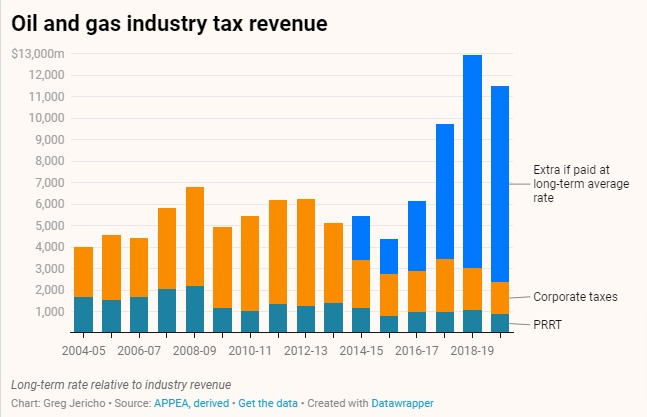
    Jericho’s analysis of industry data reveals that the industry pays much less company tax relative to production than it did in the past.

    Had the industry paid the same level of company tax relative to revenue that is had in the decade prior to the opening of the Gladstone port, in 2019-20 alone, an extra $9.1bn in tax revenue would have been raised.

    Oil and gas are Australia’s resources. Not only are their emissions causing climate change but the profits are largely headed overseas, and more than in the past not flowing through into taxation.

    As Australians demand better and wider government services, and the costs of dealing with climate change grow ever higher, we need to ensure the fossil fuel companies pay their rightful share.


    You might also like

    Australia’s Gas Use On The Slide

    by Ketan Joshi

    The Federal Government has released a new report that includes projections of how much gas Australia is set to use over the coming decades. There is no ambiguity in its message: Australia reached peak gas years ago, and it’s all downhill from here: