Category: Law, Society & Culture

Research branch

  • New Research: Australia’s Skills System Continues to Crumble After COVID

    New Research: Australia’s Skills System Continues to Crumble After COVID

    Share

    Australia’s vocational education and training (VET) system shows growing signs of erosion, fragmentation and dysfunction, according to new research from the Australia Institute’s Centre for Future Work.

    The research reveals a grim picture of a VET system starved of consistent funding or focus, fragmenting into scattered offerings of non-accredited and ‘micro-credential’ courses, mostly provided by private for-profit training companies. Furthermore, several high-profile government announcements during the pandemic designed to address skilled labour shortages have not altered the VET system’s worrying trajectory.

    Key findings:

    • The report recommends a stronger focus on a more pro-active, hands-on approach to workforce training and planning.
    • A new approach to training would support training in comprehensive, quality, accredited qualifications, rather than short-term fragments of training, with revitalised TAFE institutes leading the nation’s skills reconstruction process.
    • The report proposes that a minimum 70% of public VET funding be reallocated through the TAFE system.
    • New supports announced during COVID boosted government VET funding by $1.6 billion in 2019-20 from its five-year low. However deep and long-standing problems with Australia’s VET system have not been resolved – and in some cases, worsened.
    • All VET enrolment growth between 2015-20 has been in non-accredited training, growing by almost 70,000 enrolments, while properly regulated, accredited program enrolments have plunged by over 500,000.
    • Apprenticeship numbers showed a partial rebound in 2020-21 after eight years of marked decline – but Australia still has 173,000 fewer apprentices and trainees in training than it had in 2012, one-third below 2012 levels.
    • Empirical evidence shows rising apprenticeships ‘on the books’ are not being matched by any rise in completions. The number of apprenticeship and traineeship completions collapsed to a new low in the year ending June 2021, with just 77,000 completions – down almost two-thirds from 2013.
    • Government wage subsidies are creating strong incentives for employers to recycle heavily subsidised short-term apprentices. No requirements on employers to ensure apprentices finish programs, offer jobs after completion, and lower 5-10% subsidy rates under the government’s companion program Completing Apprenticeships combine to reinforce apprentice ‘churn’.
    • Three key feminised sectors facing huge shortages of qualified labour (nursing, education, and welfare programs) have all seen continued decline in numbers of apprentices.
    • Three in five (60%) new apprentices in-training over the year to June 2021 were men.
    • In 2021, the proportion of government-subsidised students studying with TAFE fell to less than half of all government-funded VET students (49%) – an historic low. 33% were attending for-profit private providers.
    • TAFE staffing and funding have also eroded further, as federal VET subsidies are diverted in favour of private for-profit providers. Failed market-based policies and TAFE defunding has seen over 8,800 full-time equivalent TAFE positions cut since 2012 across five states and territories.
    • Without renewed investment in TAFE programs, the significant annual economic benefits generated by the stock of TAFE-trained skilled workers in the labour force estimated at $92.5 billion per year will decay

    “Continued decline in enrolments and eight years of declining apprenticeship completions make it very clear: Australia’s domestic skills pipeline is in disarray,” said Alison Pennington, senior economist at the Australia Institute’s Centre for Future Work.

    “Deep failures in VET policy reflect broader failures of Australian economic policy to encourage far-sighted investments of any kind in the economy: physical capital, innovation, or skills.

    “Government COVID-era skills policies throw money at employers taking on apprentices and trainees, but have failed to fix the training system. There is no evidence the skills pipeline has been either protected or replenished under current VET policies.

    “Feminised industries with the most pressing labour shortages continue to see weak participation in accredited programs, traineeships, and apprenticeships. 3 in 5 of the additional apprentices and trainees in training over the year to June 2021 were men.

    “Once again, women’s jobs and demands have been deprioritised in favour of the optics of high-vis photo-ops.

    “Australia must commit to rebuilding the TAFE system’s leading role in reliable vocational education – the national skills policy infrastructure that can restore Australia’s long-term investment vision in its people, skills, and innovative sustainable industries.”


    Related research

  • In next week’s budget watch out for the tax cut that won’t cut your tax

    Originally published in The Guardian on March 24, 2022

    Next Tuesday, Treasurer Josh Frydenberg will deliver the 2022-23 budget. As it is only 2 months from the next federal election, the budget will be even more politically charged than usual.

    And while there will be the usual attempts to suggest better wages growth is just around the corner and those on low-to-middle income earners are benefitting the most, we should watch out for the almost guaranteed spin around tax cuts. 

    The Centre’s Fiscal Policy director, Greg Jericho, notes in his Guardian Australia column that the low-to-middle income tax offset (LMITO) was meant to be discarded when the Stage 2 tax cuts were introduced. However because doing so would have delivered no net benefit to people earning below $90,000 the government extended the offset in the 2020 budget. 

    It extended the offset again last year claiming it was providing tax relief to “10 million low-and-middle income earners” despite it actually doing nothing other than keeping the tax rate of those workers at the same level.

    We can expect the same to occur next week. 

    Budget spin is always a sight to behold, but we are now at the point where income earners are being told they are getting a tax cut that does not actually see them pay any less tax.

    Meanwhile the Stage 3 tax cut that will deliver a cut of up to 4.5% for those earning $200,000 remains in place.

    Spin and imaginary tax cuts for some; truly excessive tax cuts for others.


    You might also like

    Commonwealth Budget 2025-2026: Our analysis

    by Fiona Macdonald

    The Centre for Future Work’s research team has analysed the Commonwealth Government’s budget, focusing on key areas for workers, working lives, and labour markets. As expected with a Federal election looming, the budget is not a horror one of austerity. However, the 2025-2026 budget is characterised by the absence of any significant initiatives. There is

  • Flat wages and booming house prices cause housing affordability to plunge

    Originally published in The Guardian on March 17, 2022

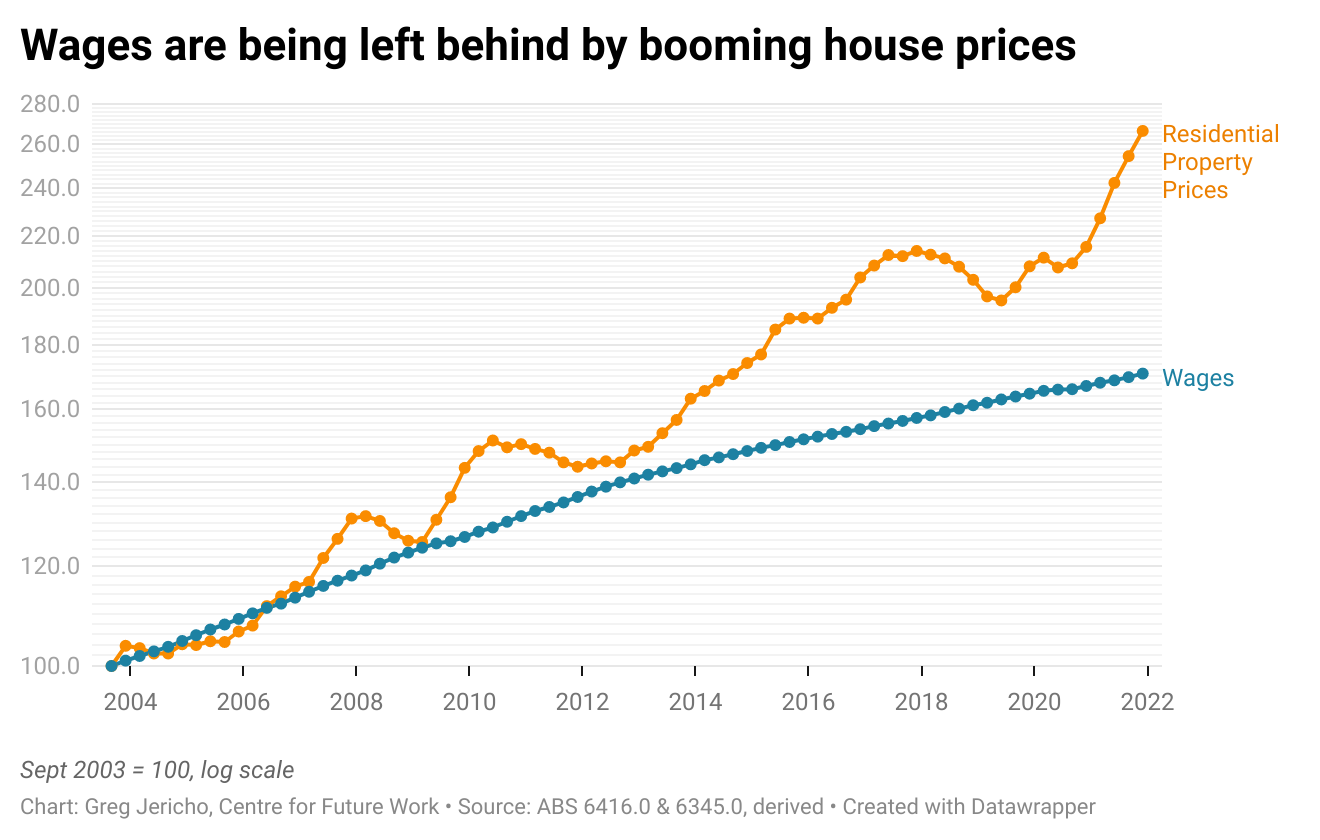
    Since the stimulus measures introduced in 2020 to prop up the housing market during the pandemic, house prices have exploded. In 2021 property prices across Australia’s capital cities rose an astonishing 24%. Combined with the stagnant wages growth of the past 8 years, housing affordability has fallen dramatically.

    A decade ago the medium-priced house in Sydney was equivalent to 5.8 times the annual income of a median household; now it is 10.8 times that income. 

    Greg Jericho examines the issue in his column in Guardian Australia and drills down to look at the affordability of housing across the nation and finds a shocking, yet unsurprising tale – and one that deserves a much greater focus in the coming election campaign than is currently the case 

    https://www.datawrapper.de/_/GmaeJ/


    You might also like

  • International Collective Bargaining Experts Explore Future System Reform

    International Collective Bargaining Experts Explore Future System Reform

    Share

    Multiple negative economic and social consequences have emerged across Anglophone industrial countries from the retrenchment of collective bargaining systems, including slowing wages growth, rising insecure work, inequality, and declining productivity and growth – bringing urgency to proposals for collective bargaining reform.

    On 10 February, Centre for Future Work hosted an exciting timely panel discussion between international collective bargaining experts titled “Beyond the Enterprise: Building Sectoral Collective Bargaining Systems in the Anglophone World”. The panel, delivered for the Association of Industrial Relations Academics of Australia and New Zealand (AIRAANZ) 2022 Conference, explored proposals across Australia, New Zealand, Britain and the US for widening bargaining scope to the multi-employer, industry-wide, or occupational level. Panelists and their presentation links are below:

    • David Madland, Senior Fellow with Center for American Progress and Senior Adviser for the American Worker Project presented on lessons from the US and Britain on strengthening unions and broad-based bargaining proposals. There is a summary of David’s presentation available here.
    • Craig Renney, Director of Policy and Economist with the New Zealand Council of Trade Unions presented on NZ’s ambitious plan to implement sectoral bargaining through Fair Pay Agreements. Craig explained how FPAs can be initiated, bargained and agreed upon. Slides for Craig’s presentation are attached below.
    • Alison Pennington, Senior Economist with Centre for Future Work presented a new sectoral bargaining system design for Australia. The dual-tiered model proposed combines both a revitalised Awards system and multi-employer bargaining. Alison proposed traditional bargaining be re-integrated into Awards, with coverage, scope and minimum wage rates redrawn and refreshed. Her presentation is attached below.
    • Emma Cannen, Nation Research Coordinator with the United Workers Union presented on the bargaining challenges experienced in Australia’s highly fragmented, insecure, feminised care services, and why sector bargaining with stronger regulation and accountability is needed. Emma’s presentation can be viewed below.

    Jim Stanford, Economist and Director at Centre for Future Work chaired the panel.

    The AIRAANZ panel follows release of the 13-article Special Issue Global Lessons for Stronger Collective Bargaining Systems prepared by academic researchers and trade unionists from five countries for the peer-reviewed journal Labour and Industry. The Issue co-edited by Alison Pennington and Jim Stanford adopts a multi-dimensional approach to collective bargaining revitalisation, investigating the role of bargaining in skills and education, unemployment insurance and other social insurance policies, and industry policy – in addition to specific industrial relations matters.

    The final published versions of all articles in the Special Issue are available through Labour and Industry, or through your local library. All commentaries in the Issue freely accessible until end-March 2022.


    Related documents


    Craig Renney’s presentation


    Alison Pennington’s presentation


    Emma Cannen’s presentation

    Related research

    You might also like

  • Digging Deeper Into Australia’s Unemployment Rate

    Originally published in The Guardian on February 10, 2022

    Australia’s unemployment rate is poised to hit its lowest level in a half-century, and this has been heralded by the current government as an economic triumph. But the unemployment rate depends on many factors (including labour supply, hours of work, and others), and does not by itself assure that the economy is maximising its potential.

    In his weekly column for The Guardian Australia, Centre for Future Work Policy Director Greg Jericho unpacks the numbers behind the current unemployment rate, and compares it to the situation in 1974 when unemployment was last below 4%.

    The column considers several factors contributing to the current unemployment rate, including:

    • The flattening of labour supply due to border closures during the pandemic.
    • Lower female labour force participation (especially in full-time work).
    • The general growth in part-time work, including for men.

    Please see Greg’s full column, “Australia’s 4% unemployment in isolation hides what’s really going on in the labour market,” in The Guardian Australia.


    You might also like

    Centre For Future Work to evolve into standalone entity

    The Centre for Future Work was established by the Australia Institute in 2016 to conduct and publish progressive economic research on work, employment, and labour markets. Supported by the Australian Union movement, the centre produced cutting edge research and led the national conversation on economic issues facing working people: including the future of jobs, wages

  • CPI Numbers Don’t Tell the Whole Story

    Originally published in The Guardian on February 3, 2022

    With the rise in inflation as Australia’s economy struggles with re-opening and supply chain problems, each release of the Consumer Price Index (CPI) generates headlines and political debate. But the CPI doesn’t necessarily provide a full reading of price pressures: depending on who you are, and what you buy. In this column published in the Guardian Australia, Greg Jericho (new policy director for the Centre for Future Work) dissects several measurement issues related to this most-watched economic statistic.

    Jericho shows that inflation measurements can very widely for different types of household. Those with limited incomes (including government benefit recipients), who spend more of their income on ‘non-discretionary’ items, face an especially large threat to their real living standards as inflation picks up.

    See Greg’s full column, “With inflation on the rise, Australia’s cost of living will dominate the election debate,” in the Guardian Australia.


    You might also like

  • Snatching Defeat from the Jaws of Victory: Labour Market Implications of Australia’s Failed COVID Strategy

    Snatching Defeat from the Jaws of Victory: Labour Market Implications of Australia’s Failed COVID Strategy

    by Jim Stanford

    Share

    As COVID and recession gripped the world, through 2020 and most of 2021 Australia recorded one of the best outcomes: lower infection, fewer deaths, and a faster, stronger economic recovery. That seeming victory has been squandered, however by the appalling and infuriating events of recent weeks. Purportedly in the name of ‘protecting the economy’, key political leaders (led by the Commonwealth and NSW governments) threw the doors open to the virus at exactly the wrong time: just as the super-infectious Omicron variant was taking hold.

    The resulting surge in infections has been among the worst in the industrialised world (worse than the U.S. now, as shown in the following graph from Our World in Data). The implications of this massive outbreak for work, workers, production, and the economy have been as predictable as they are devastating. One-third or more of workers in the most-affected regions cannot attend work: because they contracted COVID, were exposed to it, or must care for others (like children barred from child care and soon, possibly, schools).

    Our Centre for Future Work team has been active in highlighting the risks of ‘letting it rip’, analysing the failures of isolation and income support programs, and reminding everyone that keeping workers healthy must be the first priority in keeping the economy healthy. Here is a selection of our recent interventions:

    New COVID Cases per Million (7-day rolling)

    • Our Director Jim Stanford reminded policy-makers in this commentary in The Conversation that human labour is the critical input to production at all stages of value-added and supply chains, and if policy-makers acknowledged the centrality of work to the economy they would not have made such destructive choices. The article was reposted by the ABC, the Sydney Morning Herald, and other platforms, and viewed over a half-million times.
    • Senior Economist Alison Pennington has exposed the flaws in government isolation and testing systems. For example, she highlighted the perverse incentives created by the NSW government’s punitive $1000 fine for failing to register a positive RAT test — never mind the governments’ failures to make tests available, and support workers (with necessary income benefits) to isolate. Her analysis was shared thousands of times, and featured in multiple news coverage (including News.com, The New Daily, and Yahoo Finance) of the flawed NSW policy.
    • Alison further detailed the flaws in changes to the Commonwealth government’s isolating support payments, in this commentary in The New Daily. By punitively excluding hundreds of thousands from isolation benefits, the policy will accelerate contagion and make supply chain problems even worse down the road.
    • Our experts have been featured in numerous other reports on the supply chain problems arising from the Omicron surge, including these reports on Channel 10, Today, The Age, ABC Online, and The Guardian.
    • Our Economist Dan Nahum linked the surge in Omicron contagion to the spread of insecure work arrangements in Australian workplaces. And the Centre’s previous work on how COVID has accentuated the dominance of casual and insecure work in Australia’s labour market shows that without urgent action to improve job quality, the labour market will be even more vulnerable to the inevitable future disruptions from this continuing crisis.

    Our team of experts will continue monitoring the dangerous labour market developments arising from Omicron, and flawed government responses to it. Please watch our site and follow our Twitter feed for regular updates.


    You might also like

    Centre For Future Work to evolve into standalone entity

    The Centre for Future Work was established by the Australia Institute in 2016 to conduct and publish progressive economic research on work, employment, and labour markets. Supported by the Australian Union movement, the centre produced cutting edge research and led the national conversation on economic issues facing working people: including the future of jobs, wages

  • Healthy humans drive the economy: we’re now witnessing one of the worst public policy failures in Australia’s history

    Originally published in The Conversation on January 12, 2022

    Australians are getting a stark reminder about how value is actually created in an economy, and how supply chains truly work.

    Ask chief executives where value comes from and they will credit their own smart decisions that inflate shareholder wealth. Ask logistics experts how supply chains work and they will wax eloquent about ports, terminals and trucks. Politicians, meanwhile, highlight nebulous intangibles like “investor confidence” – enhanced, presumably, by their own steady hands on the tiller.

    The reality of value-added production and supply is much more human than all of this. It is people who are the driving force behind production, distribution and supply.

    Labour – human beings getting out of bed and going to work, using their brains and brawn to produce actual goods and services – is the only thing that adds value to the “free gifts” we harvest from nature. It’s the only thing that puts food on supermarket shelves, cares for sick people and teaches our children.

    Even the technology used to enhance workers’ productivity – or sometimes even replace them – is ultimately the culmination of other human beings doing their jobs. The glorious complexity of the whole economy boils down to human beings, using raw materials extracted and tools built by other human beings, working to produce goods and services.

    A narrow, distorted economic lens

    The economy doesn’t work if people can’t work. So the first economic priority during a pandemic must be to keep people healthy enough to keep working, producing, delivering and buying.

    That some political and business leaders have, from the outset of COVID-19, consistently downplayed the economic costs of mass illness, reflects a narrow, distorted economic lens. We’re now seeing the result – one of the worst public policy failures in Australia’s history.

    The Omicron variant is tearing through Australia’s workforce, from health care and child care, to agriculture and manufacturing, to transportation and logistics, to emergency services.

    The result is an unprecedented, and preventable, economic catastrophe. This catastrophe was visited upon us by leaders – NSW Premier Dom Perrotet and Prime Minister Scott Morrison in particular – on the grounds they were protecting the economy. Like a Mafia kingpin extorting money, this is the kind of “protection” that can kill you.

    NSW Premier Dominic Perrottet’s decision to relax COVID-19 restrictions in December has turned into both a health and economic disaster. Bianca De Marchi/AAP

    Effect as bad as lockdowns

    On a typical day in normal times, between 3% and 4% of employed Australians miss work due to their own illness. Multiple reports from NSW indicate up to half of workers are now absent due to COVID: because they contracted it, were exposed to it, or must care for someone (like children barred from child care) because of it. With infections still spreading, this will get worse in the days ahead.

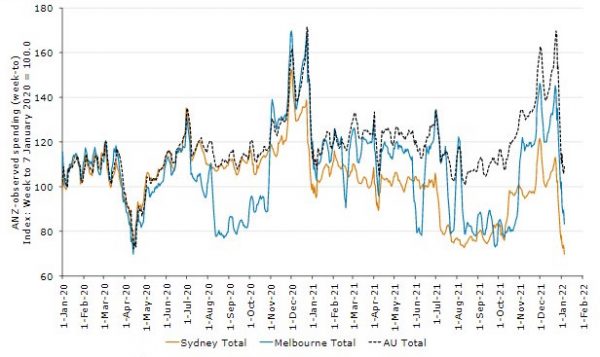
    Staffing shortages have left hospitals in chaos, supermarket shelves empty, supply chains paralysed. ANZ Bank data, for example, shows economic activity in Sydney has fallen to a level lower than the worst lockdowns.

    Spending in Sydney and Melbourne now near lockdown conditions

    ANZ Research

    If relaxing health restrictions in December (as Omicron was already spreading) was motivated by a desire to boost the economy, this is an own-goal for the history books.

    Relaxing isolation rules

    Now the response to Omicron ravaging labour supply is to relax isolation requirements for workers who have contracted, or been exposed to, COVID-19.

    The first step was to shift the goalposts on “test, trace, isolate and quarantine” arrangements by redefining “close contact”.

    On December 29 the Prime Minister said it was important to move to a new definition “that enables Australia to keep moving, for people to get on with their lives”. The next day National Cabinet approved a definition such that only individuals having spent at least four hours indoors with a COVID-infected person needed to isolate.

    Australians certainly want supply chains to keep moving. That won’t happen by simply pretending someone with three hours and 59 minutes of face-to-face indoor contact with Omicron is safe. Putting asymptomatic but exposed and potentially infected people back to work will only accelerate the spread.

    The second step has been to reduce the isolation period for those who do pass this tougher “close contact” test. At its December 30 meeting National Cabinet agreed to a standard isolation period of seven days (ten days in South Australia), down from 14 days.

    For “critical workers” in essential services including food logistics, the NSW and Queensland governments have gone even further, allowing employers to call them back to work so long as they are asymptomatic.

    Snatching defeat from the jaws of victory

    This follows a US precedent, despite scientific evidence indicating contagion commonly lasts longer than 5 days.

    Employers will use this change to pressure exposed and even sick workers to return to work, risking their own health, colleagues, customers, and inevitably spreading the virus further.

    Copying US COVID protocols only guarantees US-style infection rates. In fact, since 5 January, Australia’s seven-day rolling average infections per million now exceed that of the US.

    Our Wold in Data, CC BY

    From one of the best COVID responses in the world to one of the worst, Australia has snatched defeat from the jaws of victory.

    It’s not too late to limit the carnage

    The idea that health considerations had to be balanced with economic interests was always a false dichotomy. A healthy economy requires healthy workers and healthy consumers.

    The Omicron surge has created an economic emergency that will be difficult to endure.

    But it’s not too late to limit further avoidable contagion. Infection prevention practices (including masks, capacity limits, prohibitions on group indoor activities, PPE and distancing in workplaces, and free and accessible rapid tests) must be restored and enforced.

    Income supports for workers who stay home must be restored. Staffing strategies need to emphasise steady, secure jobs, rather than outsourcing and gig arrangements which have facilitated contagion.

    Above all, our policy makers need to remember the economy is composed of human beings, and refocus their attention on keeping people healthy. Protecting people is the only thing that can protect the economy.


    You might also like

    Centre For Future Work to evolve into standalone entity

    The Centre for Future Work was established by the Australia Institute in 2016 to conduct and publish progressive economic research on work, employment, and labour markets. Supported by the Australian Union movement, the centre produced cutting edge research and led the national conversation on economic issues facing working people: including the future of jobs, wages

  • Victorian Rate Cap Policy Costs Economy Over 7,000 jobs and $890 million to GDP

    Victorian Rate Cap Policy Costs Economy Over 7,000 jobs and $890 million to GDP

    Share

    The Victorian State Government’s policy to cap the rates of local government has cost the Victorian economy 7,425 direct and indirect jobs in 2021-22, and has reduced GDP by up to $890 million in 2021-22, according to new research from the Australia Institute’s Centre for Future Work.

    Key Findings

    • The Victorian Government’s rate caps have reduced employment in Victoria (counting both direct local government jobs, and indirect private sector positions) by up to 7425 jobs in 2021-22. They have also reduced GDP by up to $890 million in 2021-22. The costs of suppressed local government revenues, and corresponding austerity in the delivery of local government services, will continue to grow with each passing year if the policy is maintained.
    • Rates on property are the largest single source of revenue to local governments in Victoria. Of total Victorian local government revenue in 2019-20 ($11.7 billion), rates accounted for $5.6 billion or almost half. Since 2016-17, the Victorian state government has capped the amounts local governments can collect from their ratepayers.
    • The rate cap policy, imposed by the Victorian state government on local governments, interferes with the mission of service delivery and expanded, secure employment.
    • The local government sector in Victoria employs about 50,000 people in a wide range of services and occupations, including road planning and maintenance, home and aged care, waste disposal, libraries, childcare, school crossing supervision, maternal and child health, the State Emergency Service, and environmental management.
    • The rate cap policy becomes more restrictive as the overall economy slows rather than less restrictive, since the rate cap is tied to inflation indexes which tend to slow when the economy is weak.
    • The rate caps act as a brake on recovery and growth by embedding a dynamic of self-fulfilling fiscal restraint and austerity.
    • Victoria’s rate cap policy has inhibited a normal trend of expanding and improving local government services in line with population growth, rising living standards, and economic expansion.

    “Rate caps are an arbitrary policy which ties growth in overall rates revenue to price indexes which have nothing to do with demand for services or democratic accountability,” said Dan Nahum, economist at the Australia Institute’s Centre for Future Work.

    “It’s not even the case that ratepayers necessarily save any money as a result of the rate cap. There has been a shift to other forms of revenue-raising that are less progressive and socially equitable.

    “Rates bills are calculated based on relative property valuations – so even if local governments are collecting less from rates overall than they would in the absence of the cap, if your property value has gone up relative to others in your community, then your rates payments do as well.

    “There is no evidence that rate caps makes local councils ‘more efficient’. Instead, it simply takes money out of much-needed council services and robs local communities of employment opportunities.

    “Far from protecting ratepayers and residents, rate caps hurt them. Rate caps compromise service delivery, negatively impact employment and wages amongst residents employed in the local government sector, result in higher fees collected through other revenue tools, and reduce local government expenditures flowing back into the private sector.

    “There is simply no good economic reason for rate caps. By abolishing the rate caps policy, the Victorian Government could create jobs and stimulate the economy post-COVID.”


    Related research

  • The great (gendered) resignation is not what you think. It’s worse

    Originally published in Crikey on November 25, 2021

    The great resignation is apparently upon us — workers are walking away from bad jobs. But in Australia, the exodus of women from the workforce says more about structural barriers than worker empowerment.

    Have you heard? The so-called great resignation is afoot. A world where an empowered workforce say “no” to bad bosses and a life dictated by work. In the US, increased job departures have been coined a “revolution in workers’ expectations”.

    Australian workers were squeezed for an average 6.1 hours unpaid overtime per week in 2021 – a substantial increase on 2020.  If only expectations matched reality.

    In Australia, employers crow about shortages in low-paid, “churn and burn” jobs of which they refuse to improve the quality. Meanwhile, 700,000 people are unemployed, and 1.3 million are in jobs, but need more work. Around 1 million more aren’t looking for work, but want to work and are available. The ABS calls them “marginally attached” and “discouraged” workers.

    Women know a thing or two about being discouraged. Far from quitting as an act of righteous agency, they’ve lost their jobs during lockdowns against their will. It’s material. Less “life’s too short to work 24/7”. More “my kids need care immediately”.

    The explosion in caring demands associated with lockdowns fell disproportionately to women – as in 2020, when women’s average hours caring for children and performing household tasks rose faster than for men, reaching 5.1 hours per day (versus 3.1 for men).

    In February 2021, 175,000 women didn’t look for work even though they were available and ready to start within four weeks because they had pressing caring responsibilities.

    Even if women loaded with caring demands wanted to retain their jobs, the odds were stacked against them. They hold the majority of low-hours insecure jobs without protections against sacking. When bosses want to shed jobs to save bottom lines, women cop it worst.

    68% of all jobs lost between May and October were held by women (205,000 jobs). Women’s participation in the job market fell 1.7 percentage points. Nearly all (90%) of women’s jobs lost were part-time.

    Little acknowledged, the latest job vacancies data mirror women’s exodus from paid work. In August, vacancies were highest in healthcare, administration and retail. These are all industries employing 50% or more women. All are in the bottom-half of industries by average weekly earnings.

    The question is, as wallets open, beers flow and economic activity resumes, what’s bringing women back to work? A couple shifts at minimum wage, and higher COVID-19 contagion risks to boot. All to pay for one day of high-cost childcare? Hardly appealing.

    An empowered workforce can walk away from bad jobs. But structural barriers stop women from participating in the first place.

    High-cost childcare is a clear barrier for women workers. Before the pandemic, over half of non-employed women with young children said high-cost childcare was the biggest influence on their decision not to work.

    Australia’s outdated paid parental scheme bakes “primary” and “secondary” carers into family structures – reinforcing the exodus of women from work, and blocking the equal participation of fathers in raising their children.

    The so-called great resignation is gendered. But women shouldn’t have to resign themselves to the revolving door of crap jobs and important caring responsibilities.

    We’ve come a long way since the 1950s when conservative norms dictated women’s labour should be unpaid and confined to the home. Women have better access to the world of paid work now. But their relegation to insecure, low-paid, and junior roles shows we have much further to go.

    And it’s government policies that holds us back.

    Australian women need genuine measures to support them in all aspects of their lives; from free early childhood care and education, better work-family balance policies, pay equity, and more opportunities for decent jobs.

    Only then, can women imagine a world where they are empowered through work.


    You might also like

    Centre For Future Work to evolve into standalone entity

    The Centre for Future Work was established by the Australia Institute in 2016 to conduct and publish progressive economic research on work, employment, and labour markets. Supported by the Australian Union movement, the centre produced cutting edge research and led the national conversation on economic issues facing working people: including the future of jobs, wages