Category: Economics

Research branch

  • Wages Crisis Has Obvious Solutions

    Wages Crisis Has Obvious Solutions

    by Jim Stanford

    Mainstream economists and conservative political leaders profess “surprise” at the historically slow pace of wage growth in Australia’s labour market. They claim that wages will start growing faster soon, in response to the normal “laws of supply and demand.”  This view ignores the importance of institutional and regulatory factors in determining wages and income distribution.  In fact, given the systematic efforts in recent decades to weaken wage-setting institutions (including minimum wages, the awards system, and collective bargaining), it is no surprise at all that wages have slowed to a crawl.  And the solutions to the problem are equally obvious: rebuild the power of those institutions, to support workers in winning a better share of the economic pie they produce.

    This recent commentary, by Centre for Future Work Director Jim Stanford, appears in the March 2018 issue of Australian Options magazine, and is reprinted with permission.

    Wage Crisis Has Obvious Solutions

    By Jim Stanford

    When the head of the central bank declares wages are too low, and urges workers to demand more money, you know you have a problem.

    After all, central bankers are traditionally the “party poopers” of the economy: they are the ones who march in and take away the punch bowl, as soon as the party gets rolling.  Yet here was Governor Philip Lowe, Governor of the Reserve Bank of Australia, urging party-goers to turn up the volume.  It’s like he was pouring bottles of straight tequila into the punchbowl, instead of taking it away – desperately trying to turn a boring flop into a wild shindig.

    Mr. Lowe made his surprising call at a conference last year on Australia’s economic outlook at Australian National University.  He said weak wage growth was holding back national purchasing power and economic growth, and contributing to too-low inflation (which has languished below his bank’s official 2.5 percent target for several years running).

    But while his acknowledgement of the consequences of wage stagnation was refreshing, his diagnosis of the causes was incomplete and unconvincing.  In fact, Governor Lowe almost seemed to blame the victims of wage stagnation – namely, Australia’s workers – for the problem.  They were unduly worried about losing their jobs to robots or imports, he suggested; they should feel more “confident” in asking for higher wages.  He has clearly not experienced the reality of Australia’s dog-eat-dog labour market in recent years, or felt the desperation that drives workers, especially young workers, to accept any job on offer.

    (Incidentally, the RBA’s own enterprise agreement signed last year will raise base wages by just 2 percent per year over the next 3 years … below the bank’s own inflation target!)

    While mainstream economists and policy-makers belatedly recognise the economic and social damage resulting from weak wages (even Treasurer Scott Morrison frets about the negative effect of slow wage growth on his budget balance), they’ve been distinctly reticent to connect the dots about the causes of the problem – and its obvious solutions.  Lowe, Morrison, and their colleagues pretend wages will pick up automatically as the economy grows and the labour market tightens.  But with official unemployment only a tick above 5 percent (still the RBA /Treasury estimate of “full employment,” according to their discredited but still operational NAIRU model), yet wages still decelerating, this faith in a market solution is increasingly far-fetched.

    Measuring the Slowdown

    The stagnation of Australian wages is visible by many indicators.  The most common “headline” source is the ABS’s quarterly Wage Price Index, which reports an index of wages calculated from a representative sample of jobs (the methodology is similar to the Consumer Price Index).  The WPI therefore measures changes in average hourly compensation holding constant the bundle of jobs which make up the overall labour market.

    However, one important factor in weak wages has been the changing composition of work.  In particular, the growth of part-time, casual, and irregular jobs has undermined the overall level (and stability) of labour incomes.  These changes are not captured in the WPI.  Similarly, changes in average hours worked per week (due to growing part-time work) are also excluded from the WPI.  So the WPI data understates the true extent of the wage slowdown.

    Other ways of measuring the wage slowdown show an even bigger drop-off in wage growth.  These include average weekly earnings, the pay increases specified in enterprise agreements, and estimates of average labour compensation generated through GDP statistics.  Trends in all these indicators are summarised in the accompanying table.  Whatever measure is chosen, it is clear that there has been a dramatic slowdown in wage growth – especially visible since 2013.
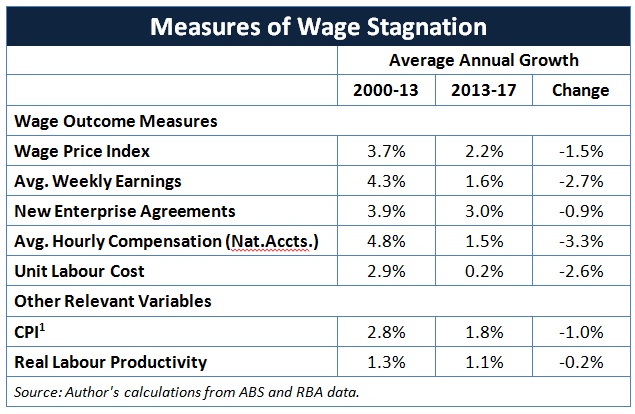
    Annual wage growth fluctuated around 4 to 5 percent during the first decade of the century.  Wage growth fell sharply but temporarily during the GFC – but then quickly regained pre-crisis norms from 2011 through 2013.  After 2013, however, wage growth has decelerated dramatically: to 2 percent or even lower.  In fact, by the broadest measure of labour compensation (wages, salaries, and superannuation contributions paid per hour of work), there has been virtually no nominal wage growth in the past year.  Consumer prices, meanwhile, continue to grow at around 2 percent per year (and even faster, if escalating housing prices are taken into account).  Real earnings, therefore, are flat or falling.

    What is “Normal” Wage Growth?

    Any shortfall in wage growth below the pace of consumer price increases (corresponding to a decline in the real purchasing power of workers’ incomes) is a clear sign of labour market dysfunction.  But even flat real wages (ie. nominal wages that just keep pace with inflation) are problematic.  After all, wages are supposed to reflect ongoing growth in real labour productivity (or at least that’s what the economics textbooks tell us).  So wages should actually consistently grow faster than consumer price inflation, to fairly reflect the enhanced real output of each hour of labour.

    Therefore, a “normal” benchmark for wage growth might be the sum of long-run consumer price inflation (the RBA’s 2.5 percent target) plus average productivity growth (running around 1.5 percent per year over the past three decades).  That suggests a “normal” benchmark for annual nominal wage growth should be 4 percent per year.  Australian wage growth in the pre-GFC period generally fit that definition of “normal.”  But since 2013 wages shifted to a significantly lower trajectory.

    Joining the Dots

    Contrary to the assumptions of free-market economics, there is no guarantee that wages will automatically grow in line with labour productivity, as a result of automatic market mechanisms.  Power is always a key factor in income distribution.  And labour markets never “clear,” so that labour supply (the number of workers) equals labour demand (the number of jobs).  In fact, inflation-targeting policy deliberately aims to maintain a certain level of unemployment (5 percent is the target in Australia) to suppress wage demands and protect profits.

    The systematic and structural disempowerment of workers and their unions over the neoliberal era is therefore the most relevant factor in the deceleration of wage growth, and the erosion of labour’s share of total GDP.  Some obvious indicators of that dramatic shift in economic and political power include:

    • A steady erosion in the real “bite” of minimum wages, which have fallen from 60 percent of median wages in 1990 to around 45 percent today.
    • The collapse of trade union membership in the face of legal restrictions, harassment, and full-protection for “free riders.” Today just 9 percent of private sector workers, and less than 5 percent of young workers, are union members.
    • A corresponding collapse in collective industrial action.  Adjusted for the size of the workforce, the frequency of strikes and other industrial disputes has declined by 97 percent from the 1970s to the present decade.
    • The relegation of industry awards to a baseline “safety net,” instead of a system for supporting ongoing progress in wages and working conditions.
    • The generally pro-business shifts in economic policy, including tax cuts, deregulation, privatisation, and globalisation, which have also shifted economic power in favour of employers and hence indirectly suppressed wage growth.

    To begin to rebuild wage growth, restore labour’s share of GDP, and achieve greater equality in labour incomes will require a comprehensive, multidimensional effort to restore the power of all these wage-supporting institutions.  The ACTU is tackling this challenge with gusto, with its ambitious “Change the Rules” campaign.  The goal is to propose a consistent, holistic vision for repairing the institutions that support workers and their wages – and then building a strong grass roots campaign to push politicians of all stripes to adopt that vision.

    On the other hand, if we follow the advice of Scott Morrison and Philip Lowe, and simply wait for supply and demand forces to rescue wages from their current doldrums, we are going to be waiting a very long time.


    You might also like

    Centre For Future Work to evolve into standalone entity

    The Centre for Future Work was established by the Australia Institute in 2016 to conduct and publish progressive economic research on work, employment, and labour markets. Supported by the Australian Union movement, the centre produced cutting edge research and led the national conversation on economic issues facing working people: including the future of jobs, wages

  • Inquiry into the BCA Commitment to the Senate

    Inquiry into the BCA Commitment to the Senate

    by Jim Stanford, Bill Browne and David Richardson

    The present submission questions the Business Council of Australia’s (BCA) Commitment to increasing investment, employment and wages in the event that the outstanding tax cuts are legislated. We looked specifically at the 10 corporate CEOs who made the commitment on behalf of their companies and found some half of those paid no tax. One wonders what their commitment could possibly mean.

    We then examine the logic of the tax cuts, issues to do with dividend imputation, problems with the theory, and problems in the modelling exercises as well as the evidence from cross-country data and the evidence from Australia’s own history. Much of this has been covered in earlier Australia Institute papers but there is a new treatment of the modelling problems. However, we were able to add a new section that examines the early indicators following the Trump tax cuts.

    Many of the same arguments were used by the US promoters of corporate tax cuts as were used in the Australian context. The main difference of course was that the US does not have the complications of dividend imputation. Nevertheless the early indicators are that very little is going to the workers with the bulk of the gains being spent in unproductive activities such as share buybacks and mergers and acquisitions.


    Full report

    Share

  • The Difference Between Trade and ‘Free Trade’

    Originally published in The Guardian on March 19, 2018

    U.S. President Donald Trump’s recent trade policies (including tariffs on steel and aluminium that could affect Australian exports) have raised fears of a worldwide slide into protectionism and trade conflict.  Trump’s approach has been widely and legitimately criticised.  But his argument that many U.S. workers have been hurt by the operation of current free trade agreements is legitimate; conventional economic claims that free trade benefits everyone who participates in it, have been discredited by the reality of large trade imbalances, deindustrialization, and displacement.

    Can progressives respond to the real harm being done by current trade rules, without endorsing Trump-like actions – which will almost certainly hurt U.S. workers more than they will help?  Centre for Future Work Director Jim Stanford has proposed several key principles to guide a progressive vision of international trade: one that would capture the potential benefits of greater trade in goods and services, while managing the downsides (instead of denying that there are any downsides).

    Dr. Stanford’s commentary was recently published in the Australian Guardian.  The column generated follow-up coverage and commentary in Australia and internationally.  For example, here is an interview with Phillip Adams on ABC Radio National’s Late Night Live.

    Here is an edited version of Dr. Stanford’s commentary:

    Progressives Alternatives to So-Called Free Trade Deals

    U.S. President Donald Trump’s bellicose policies, including new tariffs on steel and aluminium, have raised fears of a worldwide slide into protectionism and trade conflict.  Trump’s unilateral and xenophobic approach to trade policy is reprehensible and dangerous from any perspective.  But many progressives feel conflicted about Trump’s actions.  After all, he is challenging business-friendly trade deals (including the TPP and NAFTA) which labour, social and environmental advocates opposed for years.  And while his policies will clearly make life worse for working and poor people in the U.S., he is nevertheless speaking to their actual experience: unlike free trade defenders, who continue to pretend that the tide of globalisation has lifted all boats.

    But many progressives feel conflicted about Trump’s actions.  After all, he is challenging business-friendly trade deals (including the TPP and NAFTA) which labour, social and environmental advocates opposed for years.  And while his policies will clearly make life worse for working and poor people in the U.S., he is nevertheless speaking to their actual experience: unlike free trade defenders, who continue to pretend that the tide of globalisation has lifted all boats.

    Given Trump’s domination of the debate, progressives need to work quickly to distinguish our critique of globalisation from his.  In particular, we must flesh out a vision of trade policy reforms that would genuinely help those harmed by globalisation, while rejecting the nationalism and racism that underlies Trump’s appeal.

    Established policy elites still ridicule Trump’s belief that trade deals have contributed to the misery and inequality afflicting working class communities in America (and, for that matter, Australia).  For them, globalisation must produce winners but no losers.  And they trot out theoretical economic models (premised on assumptions of full employment and costless adjustment) to buttress their case.  They concede the gains from trade may not have been evenly shared.  But they deny that globalisation has anything to do with the erosion of living standards experienced in so many once-prosperous working communities.

    This patronising denial is precisely what got Trump elected in the first place.  It’s not that depressed industrial towns in Pennsylvania, Ohio, and Wisconsin (the states that put Trump over the top) didn’t “share in the benefits” of free trade.  It’s that their economic viability was destroyed by it.

    Acknowledging that globalisation produces losers as well as winners, allows us to imagine policies to moderate the downsides of trade – and purposefully share the upsides.  The next step is to make a crucial distinction between trade and ‘free trade.’  The former is the pragmatic day-to-day flow of goods and services between countries.  The latter is the set of specific, lopsided rules embodied in the plethora of trade and investment agreements enacted over the last generation.

    These ‘free trade’ rules often have very little to do with actual trade: describing tariff elimination, for example, usually takes up just a tiny part of the text of each trade deal.  The rest is devoted to a raft of provisions securing and protecting the rights of private companies to do business anywhere they want, on predictable and favourable terms.

    Proof of the dissonance between trade and ‘free trade’ is provided by Australia’s lacklustre trade performance over the last two decades.  Exports of actual goods and services constitute a smaller share of total GDP today, than at the turn of the century.  Sure, the volume of resource exports has surged – not surprisingly, since that’s what our trading partners wanted.  But resource prices have been shaky, and meanwhile our other value-added exports flagged badly. If the goal of all the free trade agreements signed since then (a dozen) was to boost Australia’s exports, they failed miserably.  But of course, that wasn’t the goal: the deals were actually intended to cement a business-friendly policy environment, even in sectors that have nothing to do with international trade.

    Progressives can endorse mutually beneficial international trade, and even international flows of direct investment, without accepting the lopsided, business-dominated vision of ‘free trade’ agreements.  In fact, a progressive approach to managing globalisation would actually boost real trade more effectively: by supporting purchasing power on all sides, and avoiding the contractionary race-to-the-bottom unleashed by current free trade rules.

    Here are several key principles central to a more hopeful and inclusive vision of globalisation:

    Preserve the power to regulate:  Free trade deals assume government intervention in markets (regulating prices, service standards, investment, and more) is inherently illegitimate and wasteful; they establish “ratchet” rules to limit regulation and public ownership, and lock-in deregulation over time.  The failure of market competition in so many areas – in Australia’s case, including electricity, vocational education, and employment services – reaffirms that trade deals must not inhibit governments from regulating businesses, no matter where they are owned.

    Eliminate investment preferences:  ‘Free trade’ deals proffer all kinds of preferences and rights for businesses and investors that have no necessary connection at all to actual trade.  Chief among these are the unique quasi-judicial rights and powers granted to corporations (such as investor-state dispute settlement panels); these are an affront to democracy.  Progressive trade policy would abolish these preferences, and subject corporations and their owners to the same laws and processes the rest of us face.  Similarly, progressive trade deals would aim to relax monopoly patent rights (for drug companies and others), rather than strengthening them.

    Manage capital and currencies:  Foreign direct investments in real businesses that produce actual goods and services can certainly benefit host communities, but only so long as those operations are subject to normal public interest and regulatory oversight.  Retaining the capacity to regulate foreign investment is essential to capturing maximum benefits from foreign investment.  On the other hand, volatile, speculative flows of financial capital and foreign exchange have less upside, and more downside.  In particular, rules should prevent the common practice of suppressing exchange rates to gain artificial advantage in international competition.

    Social clauses that mean something:  Most ‘free trade’ deals, the TPP included, feature token language about protecting labour and environmental standards.  These provisions are window-dressing: responding to fears that global competition will spark a downward spiral in social standards.  Typically these clauses simply commit signatories to follow their own laws – with no requirement that those laws are decent to start with.  Progressive trade deals would have safeguards that are enforceable, including requiring participating jurisdictions to respect universal standards or lose preferential trade rights.  Where trade partners have different standards (such as, for example, levying varying degrees of carbon pricing), border adjustments must be permitted so that trade competition does not undermine environmental and social progress.

    Balanced adjustment:  Trade and investment flows never automatically settle at a balanced position – even if a “level playing field” in labour and environmental standards was actually achieved.  That’s because competition always has uneven effects, producing both winners and losers.  Countries that experience loss of employment and production through global competition (a possibility denied by free trade theory, but commonplace in practice) must be supported with measures to safeguard domestic employment, facilitate adjustment, and boost exports.  Chronic surplus countries (like China and Germany) must recycle excess earnings into expanding their own imports, thus bearing a fair share of adjustment – rather than forcing deficit countries to do all the heavy lifting.

    Active, inclusive domestic policies:  Opposition to trade liberalisation is relatively mild in the highly trade-exposed social-democratic countries of Europe: like the Nordic countries, Germany, and Netherlands.  Their extensive networks of social protections provide average workers with reasonable confidence they won’t be economically tossed aside for any reason: whether trade competition, or some other disruption.  That’s why a key component of progressive trade policy must be a general commitment to social protection, inclusion, and job-creation. A general context of security and equity better facilitates adjustments of any kind, in response to any source of change.  Indeed, collecting healthy taxes from successful industries, and reinvesting them in priorities like infrastructure, training, and communities, is precisely how to harvest the much-trumpeted gains from trade – and pro-actively share them throughout society.  That’s much more feasible than hoping those benefits will somehow trickle down of their own accord.

    Claims by policy elites that international trade is the engine of all progress are vastly overblown.  Our well-being mostly depends on what we do with our skills, energies and innovation right here at home.  But real international trade and investment, properly managed, can certainly make a contribution to prosperity.  And progressives can advance a vision of a more balanced, inclusive globalisation that has nothing in common with Donald Trump.


    You might also like

  • From Consensus to Action: Report from the First National Manufacturing Summit

    From Consensus to Action: Report from the First National Manufacturing Summit

    by Tom Barnes

    The first National Manufacturing Summit was held at Australian Parliament House, Canberra, in June 2017, organised by the Centre for Future Work and the Australia Institute. The event was attended by over 100 delegates from the full range of stakeholders concerned with the future of Australia’s manufacturing sector: including businesses, industry peak bodies, trade unions, government departments, academic institutions and vocational training providers, and other civic organisations.

    This report, prepared by Dr. Tom Barnes from Australian Catholic University, summarises the key findings of the day, including areas of strong consensus among the stakeholders represented, as well as priorities for further policy research.

    We release the report as we proceed with planning for the Second National Manufacturing Summit, which will also be held at Parliament House on Tuesday, 26 June 2018.  This year’s Summit is hosted by the Welding Technology Institute of Australia, and co-sponsored by the Centre for Future Work and several other organisations.  It will focus on two key issues that could constrain the industry’s recent encouraging recovery: secure supply of affordable, sustainable energy, and badly-needed improvements to vocational training and apprenticeships in manufacturing.


    Full report

    Share

  • Subsidising Billionaires: Simulating the Net Incomes of UberX Drivers in Australia

    Subsidising Billionaires: Simulating the Net Incomes of UberX Drivers in Australia

    by Jim Stanford

    Uber’s rapid growth in point-to-point transportation services has become the most potent symbol of the growth of the so-called “gig economy”: where people perform work on an irregular, on-demand basis, paid by the task, and without the stability or security of traditional paid employment. The expansion of this model has raised concerns regarding the erosion of labour standards and entitlements (including minimum wages, paid leave, and superannuation). This report simulates the net hourly incomes received by UberX drivers in six Australian cities, and finds that they almost certainly earn much less than would be required under relevant minimum wage standards.

    The report considers gross revenues generated by a typical urban fare (traveling 10 km, and taking 22 minutes to complete), according to UberX’s published rate schedule. After deducting Uber’s various fees, net taxes, and the costs of providing and maintaining the vehicle, the driver is left with an average of just $8.29 from that fare (barely one-third of the gross revenue they collect).  Accounting for unpaid time spent waiting for the next fare and collecting the passenger from their pick-up point, this translates into a net hourly wage (before personal income tax) of $14.62 per hour.  This is well below the national statutory minimum wage, and less than half the level of the weighted-average minimum wage (including casual loading and penalty rates for evening and weekend work) that would apply to waged employees under Australia’s Passenger Vehicle Transportation Award.  The underpayment of UberX drivers in Australia constitutes a subsidy paid by them to the company amounting to hundreds of millions of dollars per year; and this underpayment of drivers (in Australia and elsewhere) has been essential to the dramatic expansion of Uber’s market value (most recently estimated at almost $50 billion U.S.).

    These findings confirm that the use of digital platforms to organise and compensate irregular work, and the ability of businesses (including large global firms like Uber) to classify their workers as independent businesses in their own right, are undermining the effectiveness of traditional labour market protections (such as the minimum wage, superannuation entitlements, paid leave, and others).  The report calls on Australian lawmakers and regulators to urgently address the gaps in existing labour laws, to ensure that traditional labour protections are available to workers in the “gig economy.”


    Full report

    Share

  • The future of transportation work: Technology, work organization, and the quality of jobs

    The future of transportation work: Technology, work organization, and the quality of jobs

    by Jim Stanford and Matt Grudnoff

    Workers in all parts of the economy are confronting twin threats from accelerating changes in technology and automation, and the ongoing shift toward more precarious and irregular forms of work — including “gigs” on digital platforms.  The transportation sector is widely acknowledged to be one of the most susceptible to both of these trends.  The Centre for Future Work has published a major new research report on these trends, and how sector stakeholders can best prepare for the coming changes.

    The report was commissioned by TWUSUPER (the main industry superannuation fund in Australia’s transportation sector).  It describes the current size and economic importance of the transportation industry, and provides a detailed profile of its existing workforce.  In then considers twin drivers of change buffeting the industry: changes in technology, and changes in work organisation and employment relationships.  The report stresses the importance of distinguishing between these factors, lest observers accept a misplaced sense of “technological determinism” regarding the evolution of work and jobs.  The report concludes that the erosion of job quality and stability associated with the growth of non-standard work poses a greater challenge to quality transportation jobs, than the much-hyped advent of driverless vehicles and other technological breakthroughs.

    The report concludes with several key recommendations for transportation stakeholders to assist in preparing for these changes, and managing them so as to maximise their benefits and minimise their costs.  These include:

    1. Facilitating Mobility: There will be significant new work associated with the advent of new transportation technologies. An obvious response is to assist existing workers to fill new positions by providing notice, support, and access to training and adjustment programs. Financial support from employers and governments will be necessary. Training and adjustment programs need to take account of the advanced age of many transportation workers, and tailor offerings to fit needs of older workers with less formal qualifications.
    2. Establishing Benchmarks for Skills and Qualifications: New technology-intensive jobs will require a wide-ranging suite of new skills – including design, programming, operation, data management, and more. Specific requirements and qualifications for those skills must be formalized and regulated. Sector stakeholders should work closely with existing bodies (such as Australian Industry Standards, TAFEs, and others) to specify and catalogue requirements for new jobs. Transferable certifications will assist workers and employers to identify and acquire needed skill sets, and develop a ready supply of qualified, flexible workers. Strengthening high-quality apprenticeships is also critical.
    3. Facilitating Decent Retirement: The advanced age of many transportation workers is an advantage in a time of transition. Downsizing or restructuring can be managed in part by facilitating exit by workers not interested or able to undertake retraining and adjustment. Bridging benefits and early retirement incentives, with government support, ease the transition, and avoid involuntary job losses that would otherwise occur.
    4. Negotiating Technological Change: Adaptation is more successful when all parties have a genuine say in how it is implemented and managed. Transportation stakeholders must commit to information sharing, consultation, and negotiation over technological change. Workers and their unions should be notified of plans for new technologies. Discussions should occur regarding timing, scope, and effects of new investments. Opportunities should be provided for early input from workers regarding how change will be managed; collective bargaining should include the terms of technology and its application.
    5. Building Consensus: Sector needs a multi-partite, sector-wide approach to analysing challenges and developing inclusive sector-wide responses. Undertake social dialogue among industry participants to maximise benefits of change, reduce costs – and share both costs and benefits fairly. Multi-partite forums (engaging business, workers and their unions, government, regulators, training institutions, financial institutions, and others) will help build relationships among stakeholders, identify future needs, and imagine and implement initiatives to facilitate necessary investments and adjustments.
    6. Protecting Standards and Benefits: Changes in work organisation and employment relationships are changing transportation jobs and challenging traditional standards of security, entitlements, and compensation. The use of non-standard employment forms (like contractors and labour hire) imposes unsustainable consequences on workers who are denied stable, decent opportunity. Traditional standards and entitlements should apply to all transportation workers, including in non-standard, independent, or “gig” situations. Regulatory benchmarks and corporate accountability should apply across the supply chain.


    Summary Report


    Full report

    Share

  • The Future of Work Is What We Make It

    The Future of Work Is What We Make It

    by Jim Stanford

    In October the Senate of Australia launched an important new inquiry into the Future of Work and the Future of Workers.  The terms of reference for the inquiry include:

    1. “The future earnings, job security, employment status and working patterns of Australians;
    2. The different impact of that change on Australians, particularly on regional Australians, depending on their demographic and geographic characteristics;
    3. The wider effects of that change on inequality, the economy, government and society;
    4. The adequacy of Australia’s laws, including industrial relations laws and regulations, policies and institutions to prepare Australians for that change;
    5. International efforts to address that change.”

    Given the close correspondence between this mandate, and the research focus of the Centre for Future Work, we were very glad to make a submission to this inquiry.

    Our full 35-page submission is available here. It synthesizes much of our previous research on wages, job quality, the effects of automation, precarious work, the “gig” economy, and other dimensions of the future of work.  As we state in our introduction to the submission,

    “Australians have expressed growing concern about their future ability, and that of their children and grandchildren, to support themselves and their families through paid work.  After all, for the vast majority of society, paid work is the dominant method to earn income to pay for the necessities of life.  A few are able to live off the proceeds of their financial wealth, business investments, or other capital assets; but most of us have to work for a living.  So the availability, stability, and earning potential of paid work is a crucial determinant of individual and collective well-being.  There is no more important factor in the economic and social success of any society, than being able to provide its members with decent, secure employment.”

    One important but under-reported issue tackled by our submission is the negative impact of now-ubiquitous electronic surveillance and discipline systems in Australian workplaces. We argue that this practice has contributed to the severe stagnation of wages in Australia’s economy in recent years, by altering the trade-off in staffing strategy between offering positive inducements for performance (“carrots,” such as higher wages and greater job security), versus reliance on negative sanctions (“sticks,” including discipline and discharge).  Unconstrained electronic surveillance reduces the cost of the “stick,” hence reducing the compulsion on employers to reward good performance with rising wages.

    Among the recommendations contained in our submission, therefore, we suggest that the use of electronic monitoring and surveillance should be limited through stronger privacy rights.  The power of employers to discharge workers solely on the basis of electronic ratings should also be curtailed — ensuring instead that normal progressive discipline procedures are followed in any discharge.


    Full report

    Share

  • Historical Data on the Decline in Australian Industrial Disputes

    Historical Data on the Decline in Australian Industrial Disputes

    by Jim Stanford

    The Fair Work Commission’s ruling to pre-emptively block industrial action (including restrictions on overtime and a one-day work stoppage) by Sydney-area train workers has brought renewed attention to the legal and administrative barriers which limit collective action by Australian workers. 

    The Sydney trains experience is a high-profile example of a much larger trend.  Across the national economy, work stoppages have become extremely rare – and the extraordinary discretionary ability of industrial authorities to restrict or prevent industrial action is an important reason why.

    The Centre for Future Work has compiled a database of historical work stoppage data, going back to 1950, including the incidence of work stoppages and the numbers of work days lost as a result (both in absolute terms and relative to the size of the employed workforce).

    The main findings of this historical review include:

    • The relative frequency of industrial action (measured by days lost in disputes per 1000 workers employed) declined 97 percent from the 1970s to the present decade.
    • There were only 106 disputes across Australia during the first nine months of 2017. The low number of stoppages last year may set a record low for the postwar era (final year-end statistics will be released in March).
    • There is a close statistical relationship between the near-disappearance of strike activity and the deceleration of wage growth, which has also fallen to the lowest rates in the postwar era. Over the postwar period, every decline in the frequency of work stoppages of about 60 lost days per 1000 was associated with a one percentage point deceleration in wage increases.
    • Strike activity in Australia is very low compared to other industrial countries.


    Full report

    Share

  • Scare Tactics for Corporate Tax Cuts Do Not Stand Fact Checks

    Scare Tactics for Corporate Tax Cuts Do Not Stand Fact Checks

    by Anis Chowdhury

    Share

    In the wake of the Trump Administration’s success in pushing a major company tax cut through the U.S. Congress, the Australian Treasurer has stepped up his calls for reduced company taxes here. He claims Australia will bypass the growth-inducing benefits of these tax cuts, but Dr. Anis Chowdhury, Associate of the Centre for Future Work, has compiled the economic evidence.  The U.S. experience shows no statistical evidence of any “trickle-down” growth dividend from company tax cuts.

    “Trump tax cuts: Scott Morrison warns business will abandon Australia while we are at the beach” was the Sydney Morning Herald headline, reporting on the Coalition Government’s scare tactics to press through its tax cuts gift for business.  The Treasurer used the opportunity of the Trump tax cuts to issue this “dire” warning. However, his claim does not withstand some basic empirical scrutiny.

    Fact 1: Australia is not a high tax country

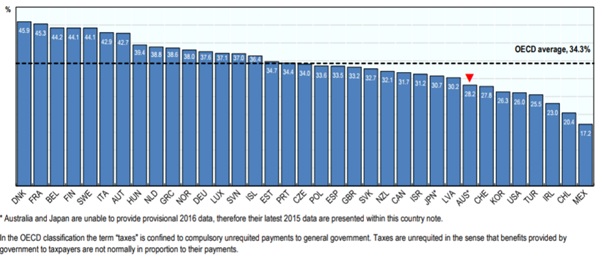
    Our overall tax take is one of the lowest among the 35 OECD countries. If Mr. Morrison was correct, then by now there should have been a tsunami of investment flowing here from 27 OECD countries with higher tax-GDP ratios than that of Australia’s 28.2% in 2016. Australia’s overall tax ratio is well below the OECD average of 34%, and also below neighbouring New Zealand’s tax take of 32.1% of GDP.

    Here are reported tax ratios for 27 OECD countries, 2016.

    OECD Tax Shares
    Source: Revenue Statistics 2017 – Australia; https://www.oecd.org/tax/revenue-statistics-australia.pdf

    Fact 2: Australia’s effective corporate tax is far below its statutory 30% rate

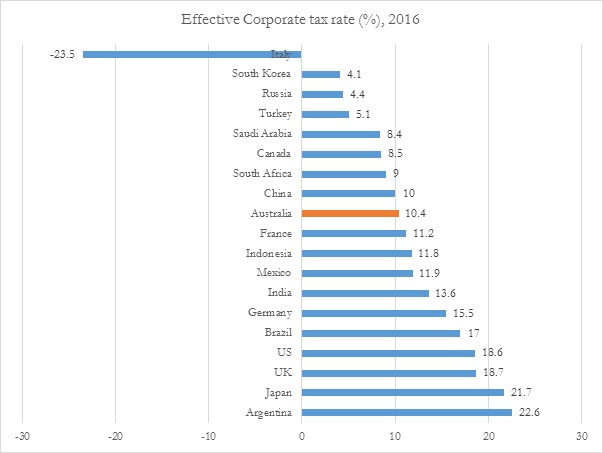
    Australian companies may seem to face a higher statutory corporate tax rate, but once they go through all their deductions and credits they don’t end up paying an unusually high amount compared to companies in other nations. The average effective rate (10.4%) is barely one-third the statutory rate. In fact, more than a third of large companies did not pay any corporate taxes in 2016 according to the recently released ATO data.

    Effective vs Statutory Tax Rates
    Source: National Public Radio, based on US Congressional Budget Office data; https://www.npr.org/2017/08/07/541797699/fact-check-does-the-u-s-have-the-highest-corporate-tax-rate-in-the-world

    Fact 3: Tax is low on companies’ lists of factors influencing investment location decision

    For example, the OECD noted, “it is not always clear that a tax reduction is required (or is able) to attract FDI. Where a higher corporate tax burden is matched by well-developed infrastructure, public services and other host country attributes attractive to business… tax competition from relatively low-tax countries not offering similar advantages may not seriously affect location choice. Indeed, a number of large OECD countries with relatively high effective tax rates are very successful in attracting FDI.”

    This is corroborated by the most recent World Bank survey of enterprises, which found that tax incentives are not high on the list of critical factors affecting inflows of foreign direct investment. The IMF’s recent research also reports that the net impact of corporate tax cuts to incentivise private investment is quite often negative on government revenues.  The pre-tax profitability of Australian businesses has also tended to exceed that in other countries, and this is surely more important in motivating investment flows.

    Fact 4: Rigorous studies of past US tax cuts did not find a positive link between tax cuts and economic or employment growth

    For example, the oft-cited examples of the Reagan or Bush tax cuts do not in fact demonstrate that tax cuts cause growth.  Admitted by President Reagan’s former chief economist, Martin Feldstein, the vast majority of growth during the Reagan era was due to expansionary monetary policy that slashed interest rates massively to help the economy bounce back from a severe recession in 1982.  Increased defence spending and an expanded labour force due to an influx of baby boomers also boosted the economy. In another study with Doug Elmendorf, the former Congressional Budget Office Director, Martin Feldstein found no evidence that the 1981 tax cuts increased employment.

    The 2001 and 2003 Bush tax cuts also failed to spur growth. Between 2001 and 2007 the economy grew at a lacklustre pace—real per-capita income rose by 1.5% annually, compared to 2.3% over the 1950-2001 period. Interestingly, the two sectors that grew most rapidly in this period were housing and finance, which were not affected by the 2001 and 2003 tax cuts.  Moreover, by 2006, prime-age males were working the same hours as in 2000 (before the tax cuts), and women were working less – both facts inconsistent with the view that lower tax rates raise labour supply.

    Fact 5: The most infamous case of tax cuts in the US State of Kansas was a colossal failure

    Governor Sam Brownback promised that a moderate tax cut for individuals and a big tax cut for businesses would be “like a shot of adrenaline into the heart of the Kansas economy.”  Unfortunately, however, despite his 2012 tax cuts, the Kansas economy remained moribund, while neighbouring states surged ahead. In the process, the Kansas state budget was left in tatters. No wonder that the Republican-led state legislature reversed most of Brownback’s tax cuts in the face of poor growth and pressing public spending needs.

    Therefore, if Mr. Morrison is serious about repairing the budget, or stimulating growth and employment, then he should be concentrating on raising more revenues (not less) and investing in the nation – instead of cutting basic services to fund his tax cuts for the rich. He should be looking at the facts, instead of resorting to scare tactics.


    You might also like

    Commonwealth Budget 2025-2026: Our analysis

    by Fiona Macdonald

    The Centre for Future Work’s research team has analysed the Commonwealth Government’s budget, focusing on key areas for workers, working lives, and labour markets. As expected with a Federal election looming, the budget is not a horror one of austerity. However, the 2025-2026 budget is characterised by the absence of any significant initiatives. There is

    Centre For Future Work to evolve into standalone entity

    The Centre for Future Work was established by the Australia Institute in 2016 to conduct and publish progressive economic research on work, employment, and labour markets. Supported by the Australian Union movement, the centre produced cutting edge research and led the national conversation on economic issues facing working people: including the future of jobs, wages

  • NSW Workers’ Compensation System has Ample Resources to Maintain Benefits

    NSW Workers’ Compensation System has Ample Resources to Maintain Benefits

    by Jim Stanford

    The workers’ compensation system in NSW has been dramatically scaled back and restructured since the current state government came to office in 2011.  Real benefit payouts have been cut by 30 percent, with the resulting “savings” passed on to employers in lower premiums (down 40 percent over the past decade).  Yet injured workers continue to bear the real cost of these changes, with benefit cuts (and further premium cuts) still occurring.  Over 4000 workers will have their monthly benefits cancelled entirely later this month.

    The changes were all justified by a supposed fiscal “emergency” that existed in 2011, but that deficit was exaggerated and mostly the result of temporary factors connected to the Global Financial Crisis.  Now the system boats a large and growing accumulated surplus.  Annual financial reports released by the NSW workers insurance scheme last week confirm that the system has ample financial reserves with which to fund the maintenance and improvement of benefits for injured workers.

    See our full 4-page fact sheet on the financial condition of the NSW Workers’ Compensation system for more details on the size of the accumulated surplus, other “hidden” financial cushions, and the extent of the benefit cuts that have been endured by injured workers in the state.


    Full report

    Share