Category: Economics

Research branch

  • Webinar: Changes to the SCHADS Award and Next Steps to Improve Job Quality in Human Services

    Webinar: Changes to the SCHADS Award and Next Steps to Improve Job Quality in Human Services

    Share

    The Fair Work Commission recently announced important changes to the SCHADS Award (which sets minimum standards for workers in home care, disability services, community agencies, and other vital services) as part of its award review process. This culminates several years of research and advocacy by unions representing workers in these sectors, aimed at improving job quality and stability in these vital but undervalued positions. The Centre for Future Work provided expert testimony to the Commission as part of its review.

    We recently hosted a special webinar to discuss the Commission’s changes, their significance, and what comes next in the struggle to improve and properly value work in human services.

    The webinar featured two representatives from the Australian Services Union, which was centrally involved in the campaign for these changes: Emeline Gaske, Assistant National Secretary for the ASU, and Michael Robson, National Industrial Coordinator. They reviewed the economic and policy context for the review, the specific changes that have been announced, how they will be implemented, and the next steps in lifting the quality of work in these vital sectors. The conversation was chaired by our Policy Director for Industrial and Social issues, Dr. Fiona Macdonald.


    You might also like

  • Real wages plummet and will take years to recover

    Originally published in The Guardian on May 19, 2022

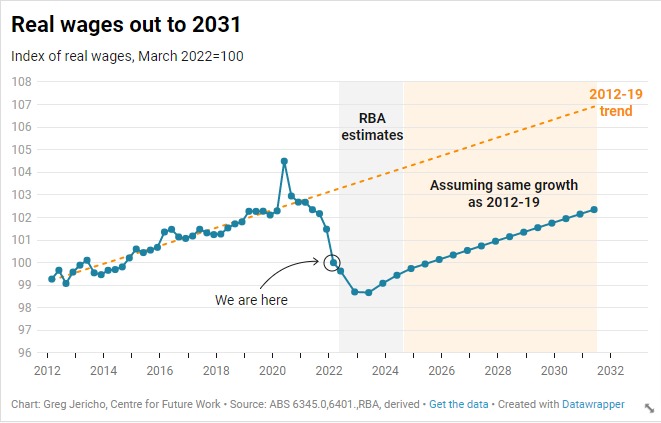
    The release of the March Wage Price Index confirms what a horror year it has been for workers. While inflation in the past 12 months rose 5.1%, wages grew just 2.4%. Even worse, in the past year the price of non-discretionary items rose 6.6%, meaning for those on low wages, who spend more of their incomes on essential items, real wages would have fallen even more than the 2.6% average fall.

    Labour market policy director, Greg Jericho notes in his Guardian Australia column that the fall in real wages has been the worst since the introduction of the GST and in the first 3 months of this year real wages fell 1.5%.

    So steep has been the fall that real wages are now back essentially to where they were at the time of the September 2013 election.

    The fall highlights that talk about Australia having recovered from the pandemic ignores the most basic aspect of the economy – the living standards of workers from their wages.

    The fall is such that even with the RBA’s estimates of solid wage growth recovery over the next two years, should Australia return to pre-pandemic trend real wages growth, it would take till 2031 to recover workers purchasing power back to the levels of 2020.

    That would we a lost decade of living standards.


    You might also like

  • Real wages are shrinking, these figures put it beyond doubt

    Originally published in The Conversation on May 18, 2022

    Every three months the Bureau of Statistics releases the lesser-known cousin of the consumer price index. It’s called the Wage Price Index (WPI) and it records changes in the overall level of wages, in the same way the price index records changes in the overall level of consumer prices.

    Read the full article Real wages are shrinking, these figures put it beyond doubt on The Conversation.


    You might also like

    Denying Wages Crisis Won’t Make It Go Away

    by Jim Stanford

    As the great novelist Isaac Asimov wrote, “The easiest way to solve a problem is to deny it exists.” Business leaders and sympathetic commentators have adopted that advice with gusto, during current public debates over the unprecedented weakness of Australian wages.

  • One in Five Worked with COVID Symptoms; Sick Leave Entitlements Must Be Strengthened

    One in Five Worked with COVID Symptoms; Sick Leave Entitlements Must Be Strengthened

    Share

    Almost one in five Australians (and a higher proportion of young workers) acknowledge working with potential COVID symptoms over the course of the pandemic, according to new opinion research released today by the Australia Institute’s Centre for Future Work.

    The research confirms the public health dangers of Australia’s patchwork system of sick leave and related entitlements, as new ABS data released today indicates 32% of Australian households had one or more members exhibiting COVID symptoms in April.

    Key Findings:

    • More than one in three (37%) employed Australians have no access to statutory paid sick leave entitlements (including workers hired under casual employment arrangements, and self-employed workers). Another 12% had access only to pro-rated part-time entitlements.
    • When the pandemic hit Australia, therefore, barely half (51%) of employed workers could count on regular full-time income if they had to stay home from work.
    • Almost one in five respondents (19%), and a higher proportion of young workers (29%), acknowledged working with potential COVID symptoms at some point during the pandemic. This highlights the public health dangers of Australia’s patchwork system of sick leave and related entitlements.
    • Polling results also confirm that a significant proportion of workers (17%) also attended work after exposure to someone possibly infected with COVID.
    • Given inadequate sick pay entitlements and the surprising share of workers attending work in violation of public health advice, perhaps it is not surprising that 18% of workers did not feel safe attending their normal workplaces during the pandemic.
    • Australia’s sick pay entitlements are clearly inadequate to allow workers to stay home from work when health advice requires it. The expansion of non-standard and insecure forms of work (including part-time work, casual jobs, contractor positions, and ‘gigs’) has heightened concern that many workers do not have the effective ability to stay home from work for health reasons.
    • Government should expand sick pay entitlements to cover all workers, and also implement strategies to limit and reduce the incidence of insecure work: including by constraining employers’ use of ‘permanent casual’ arrangements, sham contracting, and on-demand gigs, none of which provide normal and healthy paid leave entitlements.
    • Unfortunately, the current Federal Government has done the opposite by reinforcing the shift toward insecure working arrangements – including through its 2021 amendments to the Fair Work Act, which cemented and expanded employers’ rights to hire workers on a casual basis (with no sick pay) in virtually any job they wish.

    “Our research shows that too many workers are not following public health guidelines and isolation instructions, to the detriment of their own health, and the health of their colleagues and the broader community,” said Dr Jim Stanford, economist and director of the Australia Institute’s Centre for Future Work.

    “Millions of workers have either used up all the paid sick leave they are entitled to, or do not receive sick pay entitlements in the first place. There is no doubt this has contributed to the epidemic of people attending work with possible COVID symptoms.

    “With incomplete sick leave coverage, workers face a devil’s choice: between staying home to protect themselves, their colleagues and the public; or going to work regardless simply to make ends meet.

    “The policy implications of this analysis are clear. The government needs to expand sick pay entitlements to cover all workers, including those in casual employment and self-employed situations.”


    Related research

  • Working With COVID: Insecure Jobs, Sick Pay, and Public Health

    Working With COVID: Insecure Jobs, Sick Pay, and Public Health

    by Dan Nahum and Jim Stanford

    Almost one in five Australians (and a higher proportion of young workers) acknowledge working with potential COVID symptoms over the course of the pandemic, according to new opinion research published by the Centre for Future Work.

    The research confirms the public health dangers of Australia’s existing patchwork system of sick leave and related entitlements.

    The main findings of the report, based on a poll of 1000 Australians, include:

    • More than one in three (37%) employed Australians have no access to statutory paid sick leave entitlements (including workers hired under casual employment arrangements, and self-employed workers). Another 12% had access only to pro-rated part-time entitlements.
    • When the pandemic hit Australia, barely half (51%) of employed workers could count on regular full-time income if they had to stay home from work.
    • Almost one in five respondents (19%), and a higher proportion of young workers (29%), acknowledged working with potential COVID symptoms at some point during the pandemic. This confirms the public health dangers of Australia’s patchwork system of sick leave and related entitlements.
    • Polling results also confirm that a significant proportion of workers (17%) also attended work after exposure to someone possibly infected with COVID.
    • Given inadequate sick pay entitlements and the surprising share of workers attending work in violation of public health advice, it is not surprising that 18% of workers did not feel safe attending their normal workplaces during the pandemic.

    This research indicates that Australia’s sick pay entitlements are clearly inadequate to protect workers’ health and safety at work and allow them to stay home from work when health advice requires it. The expansion of non-standard and insecure forms of work (including part-time work, casual jobs, contractor positions, and ‘gigs’) has heightened concern that many workers do not have the effective ability to stay home from work for health reasons.

    Government should expand sick pay entitlements to cover all workers, and also implement strategies to limit and reduce the incidence of insecure work: including by constraining employers’ use of ‘permanent casual’ arrangements, sham contracting, and on-demand gigs, none of which provide normal and healthy paid leave entitlements.

    Unfortunately, the current federal Government has done the opposite by reinforcing this shift toward insecure working arrangements – including through its 2021 amendments to the Fair Work Act, which cemented and expanded employers’ rights to hire workers on a casual basis (with no sick pay) in virtually any job they wish.


    Full report

    Share

  • Submission to the Productivity Commission Study on Aged Care Employment

    Submission to the Productivity Commission Study on Aged Care Employment

    by Fiona Macdonald

    In 2021 the Royal Commission into Aged Care Quality and Safety recommended that gig work, independent contracting and other ‘indirect’ employment arrangements be restricted in the publicly-funded aged care sector.

    The Royal Commission found that, to develop the ‘well led, skilled, career-based, stable and engaged workforce’ required to provide high quality aged care, service providers should be directly employing aged care workers as employees.

    Rather than adopting this recommendation, the Federal Government referred the matter to a Productivity Commission inquiry.

    The Centre for Future Work made a submission to the Productivity Commission’s inquiry into Aged Care Employment, in which we argue there is ample evidence to show there are unacceptable risks and consequences for both care workers and people receiving care, where workers are engaged as independent contractors, including as gig workers.

    Restricting gig work and other indirect employment arrangements in aged care will also remove one form of unfair competition between aged care services providers. It will stop platforms, labour hire firms and others making profits in the publicly-funded care sector while avoiding the normal costs, risks and responsibilities of employing workers and providing care to the elderly.


    Full submission

    Share

  • To really address housing affordability we need to think differently

    Originally published in The Guardian on May 16, 2022

    The current election campaign has seen the two major parties put forward housing policies, both of which to varying degrees are aimed at the demand side of the equation.

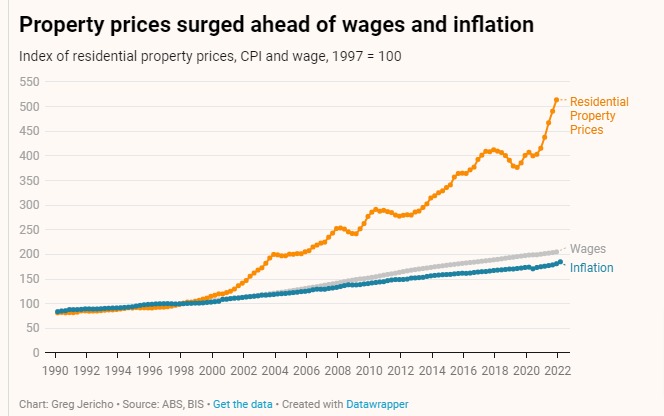
    The problem is that for many decades, housing policies have overwhelmingly been geared toward increasing demand within the private-sector housing market. This has only served to pump prices and make it harder for first-home buyers to enter the market, and also increasing the age that people are buying their first home.

    Policy Director, Greg Jericho, writes in a column for Guardian Australia, that we need to instead focus on the supply side – increasing the stock of housing – and we also need to be bold enough to look outside the typical private-sector model.

    The Australia Institute’s Nordic Policy Centre has proposed a number of measures that have been pursued in Norway, Sweden and Finland that show the solution to housing affordability is not about creating tax distortions that benefit homeowners or which serve only to transfer money from low-income people to the wealthy, but instead treats housing as a need rather than just a wealth-building asset.

    After decades of failure, the solution to housing affordability needs to be something other than more policies designed to lift housing prices.


    You might also like

    Centre For Future Work to evolve into standalone entity

    The Centre for Future Work was established by the Australia Institute in 2016 to conduct and publish progressive economic research on work, employment, and labour markets. Supported by the Australian Union movement, the centre produced cutting edge research and led the national conversation on economic issues facing working people: including the future of jobs, wages

  • Real wages should rise – anything else means declining living standards

    Originally published in The Guardian on May 12, 2022

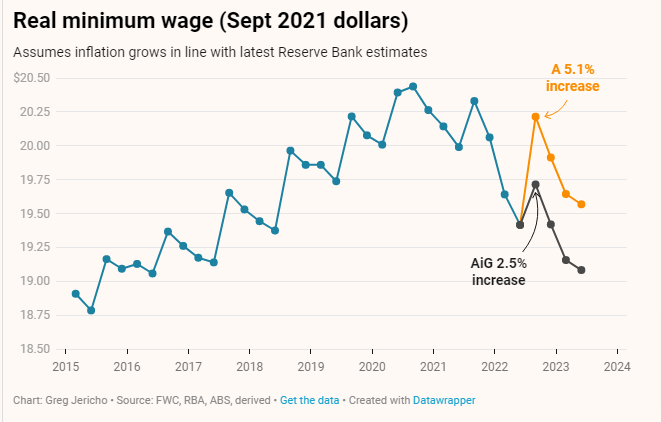
    This week the election campaign has turned to discussion about the increase to the minimum wage, with suggestions that an increase either in line with the curent rate of inflation of 5.1% or marginally above it (such as the ACTU’s proposal of a 5.5% increase) would bring about a return to 1970s style wage sprials.

    Labour market policy director, Greg Jericho, in his column in Guardian Australia, however notes that wages should grow faster than inflation, and so long as real wages are not outpacing productivity growth then such rises are not exerting any inflationary pressure. He also shows that given the recent estimates for inflation by the Reserve Bank, a 5.1% increase would not be enough to prevent the minimum wage falling in real terms over the next financial year.

    The problem is not that wages have been fuelling inflation, but that for the past 20 years real wages have risen slower than productivity.

    We need to change the debate from a reflex that assumes low wages is the ideal to realising that given workers are the economy they should be rewarded fairly for their efforts and improvements in productivity.

    You cannot say the economy is healthy if real wages are falling, and most certainly not if the lowest paid in Australia are seeing their living standards decline.


    You might also like

  • The Wages Crisis Revisited

    The Wages Crisis Revisited

    by Andrew Stewart, Jim Stanford and Tess Hardy

    A comprehensive review of Australian wage trends indicates that wage growth is likely to remain stuck at historically weak levels despite the dramatic disruptions experienced by the Australian labour market through the COVID-19 pandemic. The report finds that targeted policies to deliberately lift wages are needed to break free of the low-wage trajectory that has become locked in over the past nine years.

    The report, The Wages Crisis: Revisited, authored by three of Australia’s leading labour policy experts: Professor Andrew Stewart from Adelaide Law School, Dr Jim Stanford from the Centre for Future Work, and Associate Professor Tess Hardy from Melbourne Law School, updates analysis and recommendations from their 2018 edited book, The Wages Crisis in Australia.

    The report shows that annual nominal wage growth recovered after initial lockdowns during the pandemic – but rebounded only to the same slow pace (just above 2% per year) recorded for several years prior to COVID. Unprecedented fluctuations in employment and labour supply, including a significant decline in the official unemployment rate, do not seem to have altered wage growth, which is still tracking at the slowest sustained pace in post-war history.

    The research found little correlation between the lasting slowdown in wage growth after 2013, and changes in supply-and-demand balances in the labour market. Traditional market forces did not cause the wages crisis, and market forces are unlikely to be able to fix it – even with a relatively low unemployment rate.

    Instead, the authors identified nine policy and institutional factors which were more important in explaining the deceleration of wages, including: the erosion of collective bargaining coverage; inadequate minimum wages; pay restraint imposed on public sector workers; and widespread wage theft.

    The problem of restrained compensation in public and human services reaches further than just the pay caps imposed directly on public servants. Wages in publicly funded services (like aged care, the NDIS, and early child education) are also held back by inadequate funding and weak labour standards in those programs. The report makes special mention of the need to improve wages in aged care, in the wake of the recent Royal Commission’s finding that wages in the sector must be improved as a top priority in improving care standards and attracting the new workers the sector needs.

    The authors suggest that nominal wages should grow faster than 4% per year in coming years, to restore healthy relationships with productivity growth, inflation, and national income distribution. But a resuscitation of wage growth will not occur without proactive wage-boosting policies.

    The authors list five broad measures to quickly support wage growth. One is a proposal for a new statutory definition of employment. This would prevent businesses from drafting contracts that present workers as being self-employed, even if in reality they have no business of their own. The authors predict that such arrangements will become far more widespread, including in the growing gig economy, in the wake of two recent decisions by the High Court.


    Full report

    Share

  • Wages Will Continue to Lag Without Targeted Wage-Boosting Measures: New Report

    Wages Will Continue to Lag Without Targeted Wage-Boosting Measures: New Report

    Share

    A comprehensive review of Australian wage trends indicates that wage growth is likely to remain stuck at historically weak levels despite the dramatic disruptions experienced by the Australian labour market through the COVID-19 pandemic. The report finds that targeted policies to deliberately lift wages are needed to break free of the low-wage trajectory that has become locked in over the past nine years.

    The report, The Wages Crisis: Revisited, authored by three of Australia’s leading labour policy experts: Professor Andrew Stewart from Adelaide Law School, Dr Jim Stanford from the Centre for Future Work, and Associate Professor Tess Hardy from Melbourne Law School, updates analysis and recommendations from their 2018 edited book, The Wages Crisis in Australia.

    The report shows that annual nominal wage growth recovered after initial lockdowns during the pandemic – but rebounded only to the same slow pace (just above 2% per year) recorded for several years prior to COVID. Unprecedented fluctuations in employment and labour supply, including a significant decline in the official unemployment rate, do not seem to have altered wage growth, which is still tracking at the slowest sustained pace in post-war history.

    “It is striking that despite so much turmoil in our labour market during and after the pandemic, wage growth is still stuck at historically weak rates,” noted Professor Andrew Stewart.

    The research found little correlation between the lasting slowdown in wage growth after 2013, and changes in supply-and-demand balances in the labour market.

    “Traditional market forces did not cause the wages crisis, and market forces are unlikely to be able to fix it – even with a relatively low unemployment rate,” said Dr Jim Stanford.

    Instead, the authors identified nine policy and institutional factors which were more important in explaining the deceleration of wages, including: the erosion of collective bargaining coverage; inadequate minimum wages; pay restraint imposed on public sector workers; and widespread wage theft.

    The problem of restrained compensation in public and human services reaches further than just the pay caps imposed directly on public servants. Wages in publicly funded services (like aged care, the NDIS, and early child education) are also held back by inadequate funding and weak labour standards in those programs.

    The report makes special mention of the need to improve wages in aged care, in the wake of the recent Royal Commission’s finding that wages in the sector must be improved as a top priority in improving care standards and attracting the new workers the sector needs.

    “A combination of underfunding, outsourcing, and precarious employment has suppressed wages for some of the most important jobs in our economy,” commented Associate Professor Tess Hardy. “The Aged Care Royal Commission identified this problem, and directed government to solve it, but so far the government has done nothing to improve wages.”

    The authors suggest that nominal wages should grow faster than 4% per year in coming years, to restore healthy relationships with productivity growth, inflation, and national income distribution. But a resuscitation of wage growth will not occur without proactive wage-boosting policies.

    The authors list five broad measures to quickly support wage growth. One is a proposal for a new statutory definition of employment. This would prevent businesses from drafting contracts that present workers as being self-employed, even if in reality they have no business of their own. The authors predict that such arrangements will become far more widespread, including in the growing gig economy, in the wake of two recent decisions by the High Court.

    “The High Court has said that employment status has to be determined by what your contract says, not what you actually do. That opens the door to much wider use of contractor models, even when the actual conditions of work clearly indicate an employment-like relationship”, said Prof Stewart. “Without urgent action to prevent minimum wage laws being avoided in that way, the negative impacts on wages will steadily become much worse.”


    Related research