Category: Economics

Research branch

  • Australia at risk of exclusion from renewable manufacturing boom

    Australia at risk of exclusion from renewable manufacturing boom

    Share

    Australia risks being left out of lucrative new markets for renewable energy-related manufacturing unless government provides an urgent, domestic response to match powerful incentives introduced by the U.S and several other industrial nations.

    The finding is published in a new report released today by the Australia Institute’s Centre for Future Work, as part of the 4th National Manufacturing Summit, being held in Canberra.

    Key points:

    • There is an overseas manufacturing boom in the productions of batteries, electric vehicles, renewable energy generation and transmission equipment, and other renewable energy products.
    • This boom is being driven by incentives provided by the Biden Administration’s Inflation Reduction Act, and similar supports in the EU, China, Japan, Korea, and Canada.
    • Meanwhile, Australia is considering its response, but no clear strategy has been announced.
    • The report estimates the proportional investment required to match the American IRA in the Australian context at between $83 to $138 billion over 10 years in fiscal supports and incentives to match U.S. benchmarks.
    • Several qualitative best practices should also be included in the Australian response to the IRA to generate maximum economic, social, and environmental impact: these include strong labour and environmental standards attached to subsidised projects, public equity participation, and parallel investments in training for workers to fill the new jobs.

    “The extraordinary response by industry to the U.S. measures confirms that these policies are having an outsized effect on the volume and location of sustainable manufacturing investment,” said Dr. Jim Stanford, Director of the Centre for Future Work and co-author of the report.

    “It also confirms that Australia must move quickly with its response to this new industrial landscape, or risk losing its chance to leverage our renewable energy resources into lasting, diversified industrial growth.”

    Charlie Joyce, a research fellow at the Centre and co-author of the report, noted: “The global race for clean technology manufacturing is well underway, and Australia is barely on the track.”

    “Australia has many advantages when compared to other competitors in this market, including an unmatched endowment of renewable energy sources and ample deposits of critical minerals.

    “However, the painful legacy of decades of policy neglect for domestic manufacturing has left our industrial base in poor shape to seize the opportunities opening up ahead of us.”

    “If we don’t support domestic manufacturing to quickly enhance its production, skills, and technological capabilities, all that will happen is we will replace one set of unprocessed minerals: coal, oil and gas; with another: raw lithium and related critical minerals.”

    “Without action, most of the spin-off benefits of the renewable energy revolution for industry, technology, value-added and diversification will pass us by,” said Mr. Joyce.

    The report estimates the proportional investment required to match the American IRA in the Australian context at between $83 to $138 billion over 10 years in fiscal supports and incentives to match U.S. benchmarks.

    “That is a big fiscal ask by any standards, but not out of reach for Australia,” said Dr. Stanford. “But the common claim that Australia cannot afford to undertake proportionately equivalent measures is not convincing.”

    “Our federal budget is in much better shape than the U.S. And the government has committed to other, less pressing priorities which are just as expensive – such as nuclear submarines, Stage 3 tax cuts, and ongoing fossil fuel subsidies.”

    Please see the full report, Manufacturing the Energy Revolution: Australia’s Position in the Global Race for Sustainable Manufacturing, by Charlie Joyce and Jim Stanford.

    The paper is being released at the 4th National Manufacturing Summit, being held at Old Parliament House in Canberra from 8.30am to 4.30 pm on Thursday, August 3, co-sponsored by Weld Australia, the Centre for Future Work, and several industry bodies.


    Related research

  • Manufacturing the Energy Revolution

    Manufacturing the Energy Revolution

    Australia’s Position in the Global Race for Sustainable Manufacturing
    by Charlie Joyce and Jim Stanford

    Australia needs to respond quickly to powerful new incentives for sustainable manufacturing now on offer in the U.S. and several other industrial countries, or risk being cut out of lucrative new markets for manufactured products linked to renewable energy systems.

    That is the finding of a major new report from the Centre for Future Work. The report catalogues new incentives for production of batteries, electric vehicles, renewable energy generation and transmission equipment, and other renewable energy products provided under the Biden Administration’s Inflation Reduction Act and parallel public programs.

    Many other industrial countries, including the EU, China, Japan, Korea, and Canada have already implemented major new incentives to support the expansion of the manufactured products and technologies that will be required for those systems.

    Australia is considering its response, but with no clear announced strategy yet.

    The report provides evidence that the U.S. incentives and content requirements are sparking an unprecedented expansion in manufacturing investment in the U.S. and other industrial countries.

    This response confirms that active climate industrial policies are having an outsized effect on the volume and location of sustainable manufacturing investment. It also confirms that Australia must move quickly to respond to this new industrial landscape, or risk losing its chance to leverage our renewable energy resources into lasting, diversified industrial growth.

    The report notes that Australia has many advantages in the global race for sustainable manufacturing – including an unmatched endowment of renewable energy sources and ample deposits of critical minerals. However, the painful legacy of decades of policy neglect for domestic manufacturing has left Australia’s industrial base in poor shape to seize the opportunities being opened up by the global energy transition.

    The report estimates the proportional fiscal effort that would be required to match the American IRA in the Australian context. The government would need to commit $83 to $138 billion over 10 years in fiscal supports and incentives to match U.S. benchmarks.

    The report also catalogues several qualitative best practices that should be incorporated in the Australian response to the IRA, to generate maximum economic, social and environmental impact: including strong labour and environmental standards attached to subsidized projects, public equity participation, and parallel investments in training for workers to fill the new jobs.

    The paper was released at the 4th National Manufacturing Summit, being held at Old Parliament House in Canberra from 830am to 430 pm on Thursday, August 3, co-sponsored by Weld Australia, the Centre for Future Work, and several industry bodies.


    Full report

    Share

  • We need more than a definition change to fix Australia’s culture of permanent ‘casual’ work

    Originally published in The Conversation on July 31, 2023

    The surprising thing about the Albanese government’s announced reforms to “casual” employment is not that they’re happening.

    It’s that employer advocates are getting so excited about them, despite the small number of people they will affect and the small impact they will have.

    That’s not to say the changes aren’t needed. Rather, true reform of the “casual” employment system, of which this is just a first but important step, has a lot further to go to resolve the “casual problem”.

    What is the ‘casual problem’?

    This problem is that most “casual” workers aren’t really casual at all — as shown by analysis that I and colleague Robyn May did, using unpublished data from the Australian Bureau of Statistics (ABS).

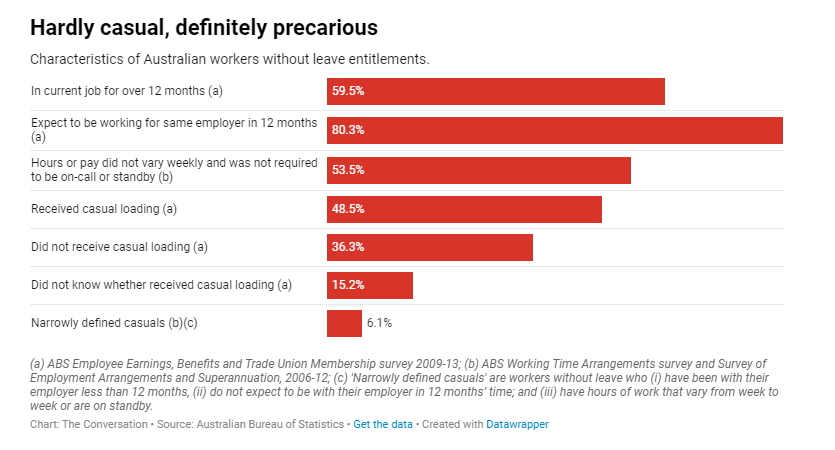
    The premise for hiring them is that the work is intermittent, short-term and unpredictable. But, as you can see from the chart, the last time the ABS collected these data, a majority of “casuals” worked regular hours.

    Almost 60% of “casuals” had been in the job for more than a year. About 80% expected to still be there in a year’s time.

    Only 6% of “casuals” (1.5% of employees) worked varying hours (or were on standby), had been with their employer for a short time, and expected to be there for a short time.

    Even now, some “casuals” have been doing the same “casual” work for over 20 years.

    Permanent ‘casuals’

    All this has led to a class of “permanent casuals” – a nonsense term. They should more accurately be called “permanently insecure”.

    The one thing “casuals” have in common is they’re not entitled to sick leave or annual leave, and they are in a precarious employment situation. Their contract of employment only lasts till the end of their work day.

    That means they have much less power than other workers. So little power, in fact, that barely half of them even get the casual loading they are meant to be paid in compensation for not receiving other entitlements.

    On average, low-paid “casuals” get less pay than equivalent permanent workers, despite the loading.

    Changing legal definitions

    Not many “casuals” have been brave enough to challenge this exploitative relationship. But when they did a few years ago, Australia’s courts agreed permanent casual work was nonsensical.

    To be a “casual worker”, there had to be no promise of ongoing employment. A court would judge this not just by what was in the formal contract of employment but also by what the employer actually did. If they kept hiring you, week after week, on a predictable roster, you weren’t casual.

    In 2018, mine worker Paul Skene challenged his classification as a casual worker, arguing he had done pretty much the same work, with a few changes along the way, for five years.

    The Federal Court agreed he wasn’t a casual employee and should be back-paid annual leave. Another mine worker, Robert Rossato, had a similar victory in 2020.

    Employer organisations were “outraged” by the “billions” in back pay they could be forced to pay for having misclassified ongoing workers as casuals. They lobbied the Morrison government to amend the law, and challenged the rulings in the High Court.

    The Morrison government changed the law in early 2021, to give primacy to the written contract, ignore employer behaviour, and protect employers from back-pay claims.

    Later that year the High Court overturned the Federal Court decisions, ruling it was the written employment contract that mattered. If that was worded a certain way, you couldn’t test whether a worker was “casual” by whether the employer treated them that way afterwards.

    Labor promised to overturn these interpretations, and that’s what this proposal does.

    What will the legislation change?

    The details of the government’s plan is still not clear, but it is likely it will seek to amend the Fair Work Act to revert to something close to the pre-2020 definition of casual work, with a procedural twist.

    It will again be possible to judge whether an employee is “casual” based on employer behaviour. And an employee who repeatedly works a similar roster can, after six months, demand “permanency” – meaning rights to sick leave, annual leave, and better protection against arbitrary sacking.

    The twist: until they demanded “permanency” they won’t be entitled to any leave. So employers will be protected against claims for back pay.

    Theoretically this could affect hundreds of thousands of “casual” workers. In reality, it will likely help far fewer.

    Suppose you’re a “casual” labour hire worker in mining. You can tell what time you’ll start work on the first Friday next June. You go to your employer — the labour hire company — and say: “Make me permanent.” The labour hire company says: “We can’t. You might not have a job tomorrow.”

    And indeed, now that you’ve asked, maybe you won’t have a job. So would you really ask?

    It will depend critically on the protections offered to workers who ask to convert, and how credible they are to workers.

    Most people only expect a few people to make the demand. Workplace relations minister Tony Burke says he believes only a “very small proportion” of “casuals” working regular shifts will do so.

    Part of that reluctance will be fear of the consequences, and part of it will be that many casuals rely on their casual loading. About half of “casuals” are on the award minimum rate, compared with 15% of “permanent” full-time workers. Most cannot afford to “choose” to trade the money for holidays and other entitlements.

    If you’re not getting the casual loading, you’ve got nothing to lose — except your job. If the power imbalance means you don’t get the loading, you won’t fancy your chances.

    So, it will just work for a small number or workers – though it’s likely to be very important to them.

    More needs to be done

    In short, this is a good step but more needs to be done.

    In most other wealthy countries all workers – including temporary workers – are entitled to annual leave. That’s not the case in Australia, because of the “casual” ruse. These laws will not change that.

    There should be universal leave entitlements. Sure, there needs to be a loading where work is unpredictable, and hence so short-term that leave entitlements would not be practical.

    But everyone else should get annual and sick leave, and minimum award wages should be high enough that low-wage workers don’t have to rely on the casual loading to get by.

    The challenge should be about how we transition to that situation.


    You might also like

    “Permanent Casuals,” and Other Oxymorons

    by Jim Stanford

    Recent legal decisions are starting to challenge the right of employers to deploy workers in “casual” positions on an essentially permanent basis. For example, the Federal Court recently ruled that a labour-hire mine driver who worked regular shifts for years was still entitled to annual leave, even though he was supposedly hired as a “casual.” This decision has alarmed business lobbyists who reject any limit on their ability to deploy casual labour, while avoiding traditional entitlements (like sick pay, annual leave, severance rights, and more). For them, a “casual worker” is anyone who they deem to be casual; but that open door obviously violates the intent of Australia’s rules regarding casual loading.

  • Inflation is falling so let’s make sure we don’t let unemployment rise

    Originally published in The Guardian on July 27, 2023

    Inflation is coming down fast so we should now shift our attention to making sure unemployment does not rise

    The latest quarterly CPI figures showed that inflation is falling dramatically and in line with that of other major economies such as the USA and Canada. This, Chief Economist, Greg Jericho writes means we have a prime opportunity to lock in the current level of low unemployment.

    Through the past year of the Reserve Bank raising interest rates, the main justification has been that the economy needs to be slowed in order to bring down demand pressures on inflation.

    What the latest figures reinforce however is that the major pressures have come from the supply side. Australia’s inflation is essentially following the same path as other nations. This is because inflation is slowing largely due to reduced world prices of commodities rather than any response to increasing interest rates.

    Indeed the largest driver of inflation in the June quarter was rental prices, which will have been in part due to investors raising their prices to deal with higher mortgage payments.

    In the past year, unemployment has remained at 3.5% while inflation has gone from 6.7% up to 8.4% and now down to 5.4% (using the monthly measures). The belief that we needed to raise unemployment to 4.5% in order to stop inflation from accelerating is a cruel approach that treats inflation in the wrong way.

    Fortunately, in spite of the RBA’s best efforts, unemployment has not yet risen. This presents Australia with a genuine chance to lock in historically low unemployment as the norm.

    Rather than pursuing higher unemployment in order to reduce inflation the RBA and the government should be pursuing policies that keep unemployment low while also reducing inflationary pressure. This can mean a price cap on essential items such as rents and energy, introducing windfall-profits taxes, and increased public housing investment to reduce housing price surges.

    Interest rates are not the only way to tackle inflation and in an environment where profits are been driven by supply-side issues and profits they are one of the worst ways.

    Full employment needs to be the target, not a mythical “non-accelerating inflation rate of unemployment” that largely justifies higher unemployment and more ho0usyheold living in poverty.


    Related research

    You might also like

  • Hollywood actors showing that unity is strength

    Originally published in The Guardian on July 20, 2023

    When workers are united, and able to collectively bargain, they can win good outcomes

    The Screen Actor’s Guild-American Federation of Television and Radio Artists strike launched last week against Hollywood studios has brought large attention because of the celebrities involved. But as Chief Economist, Greg Jericho, notes in his Guardian Australia column, there are lessons for Australian workers as well.

    For the past 40 years there have been consistent efforts in Australia and other English speaking countries to reduce to power and role of unions in industrial relations. And while we are often told that there are reasons such as a need for greater flexibility to ensure increased productivity, the reality is there has been no evidence that any of the changes to IR laws have produced anything like the productivity that was promised.

    The past decade has seen as much “flexibility” and reduced power for unions as any business group could (and did) desire, and yet productivity levels have plummeted.

    The problem, as the SAG-AFTRA strike makes clear, the reason governments and business groups have agitated against unions and the ability to conduct industrial action is not because of concerns about productivity, but because unions garner better wages for their members and faster wage growth.

    The past decade shows that as the number of days lost to industrial action have fallen, so too has wage growth.

    The Hollywood strike might notionally be about payment for film and productions on streaming services and concerns about AI, but as SAG-AFTRA president Fran Drescher made clear, it is truly about workers demanding respect, and to be honoured for their contribution.

    Australian workers should learn from the strike and see that unity and union membership delivers benefits – and we know this is true, because employers will do anything they can to prevents it happening.


    You might also like

    Centre For Future Work to evolve into standalone entity

    The Centre for Future Work was established by the Australia Institute in 2016 to conduct and publish progressive economic research on work, employment, and labour markets. Supported by the Australian Union movement, the centre produced cutting edge research and led the national conversation on economic issues facing working people: including the future of jobs, wages

  • The key legislation changes that will help workers get a better deal

    Originally published in The New Daily on July 14, 2023

    In recent years, workers have been held back from demanding better working conditions and pay by a lack of bargaining power.

    However, with recent changes to industrial relations laws, and with unemployment at record low levels, some workers are now in a better position to bargain for better pay and conditions.

    Slow wages growth, low bargaining coverage and high levels of insecure work are good indicators of how workplace power imbalances have stifled prospects for many employees.

    Over the last decade Australia’s wage growth has been at its weakest since the middle of the last century, coverage of workers by enterprise agreements has rapidly eroded, and over a third of workers are now in insecure casual, labour hire or fixed-term jobs.

    Bargaining hobbled

    Despite low unemployment – meaning there are fewer workers available to fill vacancies – employees have not been able to bargain for higher pay and the real value of wages has been declining.

    Industrial relations reforms passed by parliament in late 2022 are designed to restore some balance to the workplace.

    The changes don’t mean there is a massive shift of power to workers but, with the removal of some barriers to bargaining, there should be greater opportunity for employees to gain improvements at work.

    At the present time, the labour market is tight and employers are competing to find and retain workers so they may be prepared to offer higher wages and other benefits.

    Already, unions representing early childhood education and care workers have applied to use a new multi-employer bargaining option – which came into force last month – to seek a pay increase for these low-paid workers.

    While it will be some time before we see any outcomes, there is early evidence that other bargaining reforms are getting workplace bargaining moving after years of decline. Certainly some employers may now be more ready to negotiate enterprise agreements to avoid being roped into multi-employer agreements.

    Other non-bargaining reforms introduced as part of the 2022 Secure Jobs, Better Pay package attracted much less attention than bargaining changes during last year’s debates over the new laws.

    However, these other changes are not insignificant for working conditions.

    The right to flexible work

    More than half of all employees now have new rights to request flexible work, including employees who are parents of children of school age or younger, carers and workers aged 55 or over, those with a disability or people experiencing or supporting someone experiencing family violence.

    Before the flexibility changes, which came into effect in June, some limited flexible work rights already existed. However, now there is much greater onus on employers to show there are reasonable business grounds if they wish to refuse employees’ requests for flexible work.

    While this is no guarantee that all employees can access the flexibility they need, it has potential to be a game-changer in some workplaces through pushing employers to find ways to organise work for greater employee-friendly flexibility.

    Research shows that Australians are some of the most stressed and overworked of all workers worldwide. We know we need better-work life balance.

    Post-pandemic, there is widespread experience of more flexible work arrangements and greater recognition of the benefits of flexible work.

    There is some impetus to lock in more employee-friendly flexibility, and workers are having some success in achieving these changes through collective bargaining.

    Working lives are longer than ever, including as the retirement age has just been increased to 67 years.

    Along with pay increases that stop the decline in the value of wages, bargaining for better work-life balance will continue to be important.


    You might also like

  • If the unemployment rises to 4.5% who is likely to lose their job?

    Originally published in The Guardian on July 13, 2023

    The RBA is currently targeting a 4.5% unemployment rate, and that is going to hurt young, low skilled and low paid workers,

    The next 12 months ahead look to be a time of rising wages, and rising unemployment. The Reserve Bank is trying to raise unemployment in order to prevent rising wages. It’s target of 4.5% will see around 130,000 to 150,000 more people unemployed than is currently the case.

    Labour market policy director, Greg Jericho, in his Guardian Australia column, examines which workers are likely to be the ones who will lose their jobs.

    In a bitterly ironic point, he notes that these are the same workers whom Deputy Governor of the Reserve Bank Michele Bullock recently boasted were the ones who had gained the most from the strong employment growth of the past 18 months:

    people on lower incomes and with less education who have benefited the most from the strong labour market conditions

    More worrying is that the Reserve Bank’s own estimates suggest that the rises in unemployment over the next year will see Australia breach the “sahm Rule” of recession, in which the unemployment rate rises more than 05%pts in a year. Oddly however the RBA’s correspondence on the issue revealed in an FOI disclosure has them suggesting that for Australia the recession trigger is a 0.75% rise.

    Either way, history suggests that when unemployment rises in a year by the amount the RBA is estimating it usually keeps rising.

    The RBA’s own estimates show just how close to a recession the economy is set to go in the next year. It already looks likely to hit workers with low skills and low paid jobs, and if the RBA gets it wrong, it will quickly hit many more of society.


    You might also like

    Dutton’s nuclear push will cost renewable jobs

    by Charlie Joyce

    Dutton’s nuclear push will cost renewable jobs As Australia’s federal election campaign has finally begun, opposition leader Peter Dutton’s proposal to spend hundreds of billions in public money to build seven nuclear power plants across the country has been carefully scrutinized. The technological unfeasibility, staggering cost, and scant detail of the Coalition’s nuclear proposal have

  • Public Attitudes on Issues in Higher Education

    Public Attitudes on Issues in Higher Education

    Corporatised Model for Australian Universities is Eroding Public Trust, Education Quality
    by Eliza Littleton

    Stronger public universities are vital to the success of dynamic, innovative economies, and more inclusive labour markets. But decades of fiscal restraint and corporatization have eroded the democratic governance and equitable delivery of public higher education in Australia. There are widespread concerns among both university staff and the broader Australian community regarding many higher education issues: including funding, governance, the insecurity of work in universities, the quality of education, and the affordability of attending university.

    This report, by Senior Economist Eliza Littleton, combines data from the Department of Education, the OECD, and original survey data from a national poll conducted by the Centre for Future Work to draw attention to key challenges facing public universities today. The Federal Government’s new ‘Universities Accord’ creates an important opportunity to address these challenges and put higher education back on a better path.


    Full report

    Share

  • Australian and Global Union Leader Sharan Burrow to Deliver Second Annual Carmichael Lecture

    Australian and Global Union Leader Sharan Burrow to Deliver Second Annual Carmichael Lecture

    Share

    Former Australian Council of Trade Unions president Sharan Burrow will deliver the second annual Carmichael Lecture on August 16.

    Ms Burrow, who was ACTU president for a decade from 2000, was also general secretary of the International Trade Union Confederation between 2010 and 2022.

    She will speak on the topic ‘Global Worker Solidarity for a Peaceful, Sustainable World’. Ms Burrow will also answer audience questions, facilitated by newly elected ACTU Assistant Secretary Joseph Mitchell.

    “Sharan Burrow has been an inspiring voice for economic, social and environmental justice for many years, in Australia and around the world,” said Dr Jim Stanford, Director of the Centre for Future Work at the Australia Institute, home of the Carmichael Centre.

    “At a time of global polycrisis, as we face profound economic, geopolitical and ecological uncertainty, we are honoured that Sharan is able to share her experiences and her advice about how trade unionists can unite to build a better world,” Dr Stanford said.

    The Laurie Carmichael Lecture is an annual keynote address co-sponsored by the Carmichael Centre, which is an initiative of the Australia Institute’s Centre for Future Work, and RMIT University.

    The lecture is named in honour of Laurie Carmichael, the legendary manufacturing trade union leader who passed away in 2018 at the age of 93. Last year, the inaugural Laurie Carmichael Lecture featured Nobel Prize-winning economist Joseph E. Stiglitz.

    Event details:

    Date: Wednesday, 16 August 2023

    Time:

    • 5.30pm Doors open (event registration)

    • 6.00pm Event starts

    • 7.15pm Event concludes

    Venue: RMIT Building 80, Level 2, Lecture Theatre 7, 445 Swanston Street Melbourne, VIC 3000

    Attendance at the lecture is free, but advance registration is essential.


  • Bolstered by a biased tax system, house prices keep rising

    Originally published in The Guardian on June 15, 2023

    As interest rates rise, the gains from negative gearing increase.

    Despite rising interest rates, the latest figures from the Bureau of Statistics show that Australia’s house prices rebounded in the March quarter of this year. Policy director Greg Jericho writes in his Guardian Australia column that since the beginning of the pandemic property prices around Australia have risen 26% while at the same time average household disposable income has increased just 8%.

    This disparity has massive consequences for affordability. Had for example the median property price in Sydney risen in line with household incomes since June 2020, instead of being $1.15m it would be $954,000 – a $196,000 difference.

    Underlying the strength of the market even in the face of rising interest rates is the fact that Australia’s tax system is biased towards property investors.

    The most recent taxation statistics covering 2020-21 showed for the first time the number of investors recording property net profits was greater than those recording a loss. Such a situation only occurred because of the record low interest rates at the time. We know that the past 12 months will have seen a large spike in the number of people negative gearing their properties and thus not surprisingly housing remains an attractive investment not in spite of rising interest rates, but because of rising interest rates.


    You might also like

    Centre For Future Work to evolve into standalone entity

    The Centre for Future Work was established by the Australia Institute in 2016 to conduct and publish progressive economic research on work, employment, and labour markets. Supported by the Australian Union movement, the centre produced cutting edge research and led the national conversation on economic issues facing working people: including the future of jobs, wages