Category: Democracy & Accountability

Research branch

  • The Reserve Bank needs to wait before raising rates again

    Originally published in The Guardian on January 19, 2023

    Home loans have fallen sharply in the past year, and the rate rises are clearly having a major impact. As such the Reserve Bank needs to wait before raising them again.

    In 8 months the Reserve Bank raised the cash rate from 0.1% to 3.1% in an effort to slow inflation growth which has been increasing around the world. But while many things in the economy remain affected by the pandemic and its ructions, the impact of interest rate rises remains the same.

    As policy director, Greg Jericho notes in his column in Guardian Australia, the latest lending data reveals that home loan numbers have fallen by 25% over the past year. The cost of repaying an average new mortgage in Sydney or $750,000 has increased by more than third and as a result fewer people are taking out loans and house prices are falling.

    This fall in the price of the item most directly affected by interest rates however is not reflected in the official CPI figures. Rather than measure house prices, the CPI measures the cost of “new dwelling purchases by owner-occupiers”. This is actually the cost of building a new home. In the year to September 2022 (the most recent CPI figures) this item accounted for a quarter of the total growth of inflation. And yet while “new dwelling purchases” rose by 21% the price of dwellings across Australia rose by just 1%.

    This means that inflation is not truly reflecting the impact of interest rates. Rising interest rates do slow the economy, they do reduce the level of money available to mortgage holders to spend on other item and thus reduce demand. That the official CPI figures are not fully showing this does not mean the Reserve Bank needs to keep raising rates.

    The Reserve Bank has already raised rates at a historically fast pace. They have slammed on the brakes as hard as they have at any time in the past 30 years. Given economists around the world are predicting a slowdown in the global economy and here in Australia, the RBA needs to pause its rate rises and not keep hitting the brakes on an already slowing economy.


    You might also like

    Centre For Future Work to evolve into standalone entity

    The Centre for Future Work was established by the Australia Institute in 2016 to conduct and publish progressive economic research on work, employment, and labour markets. Supported by the Australian Union movement, the centre produced cutting edge research and led the national conversation on economic issues facing working people: including the future of jobs, wages

  • A new tool reveals how badly the Stage 3 cuts mismanage the budget

    Originally published in The Guardian on January 12, 2023

    The Stage 3 tax cuts will cost $300bn in their first 9 years. A new tool shows how we can spend the money better

    Just before Christmas last month the Parliamentary Budget Office released a “Build Your Own Budget” tool that reveals the interactions of taxes, spending and economic conditions that go into determining the budget balance.

    While the tool is an invaluable device for economists, its real value as noted by Labour Market and Fiscal Policy Director Greg Jericho, is how it highlights the massive cost of the Stage 3 tax cuts.

    In his Guardian Australian column, Jericho notes that the Stage 3 tax debate has become about all-or-nothing rather than realising the $300bn cost of the tax cuts over 9 years provides an opportunity for the Albanese government to amend the tax cuts and also increase support for benefits and government services.

    The Stage 3 tax cuts are so expensive that the PBO’s budget tool reveals you could raise Jobseeker from its current rate of $668 a fortnight to $1,925 and the budget deficit in 2032-33 would still be lower than it is currently predicted to be with the Stage 3 tax cuts.

    The Stage 3 tax cuts could be amended to reduce the 32.5% tax rate for earnings between $45,000 to $120,000 to 30% and still raise the top tax threshold from $180,000 to $200,000. These still very large tax cuts would cost $120bn less over the first 9 years than would the Stage 3 cuts. That would enable the government to, for example, increase Jobseeker to $1,025 and still have a better budget position than current predicted with the Stage 3 cuts.

    This highlights just how many options are available to the government.

    Budget are about choices, government is about choices. The Albanese government has a massive choice to make – either continue with the Stage 3 tax cuts that massive hit the budget for little reason other than to hand wealthy people a huge tax cut, or it can take this opportunity to create a fairer economy and society.


    You might also like

    Commonwealth Budget 2025-2026: Our analysis

    by Fiona Macdonald

    The Centre for Future Work’s research team has analysed the Commonwealth Government’s budget, focusing on key areas for workers, working lives, and labour markets. As expected with a Federal election looming, the budget is not a horror one of austerity. However, the 2025-2026 budget is characterised by the absence of any significant initiatives. There is

  • Inequality and poverty is a policy choice – and the Stage 3 tax cuts will make both worse

    Originally published in The Guardian on December 15, 2022

    When you reduce the revenue available to fund government services, you inevitably increase inequality

    Much has been made in the debate around the Stage 3 Tax Cut that the cuts themselves massively favour the wealthy and make our income tax system less progressive. But as Policy Director, Greg Jericho, notes in his Guardian Australia column the latest survey of Household Income Distribution reveals that is only the beginning of the problem.

    Taxation works to redistribute the national income, but taxes alone play only a small part. The real work in lowering inequality and raising people out of poverty comes from government benefits and crucially the provision of government services like public health and education.

    The poorest 20% of households have just 4.1% of all private household income in Australia. After taxes, this rises to 4.7%. Once you include government benefits it rises even more to 8.1%. But when you also include the dollar value of public education, health and other government services it rises to 12.1%.

    Without properly funded broad government services, Australia’s society would be much less equal as low t middle income households would be forced to battle the private sector for access to vital services.

    Given the massive cost of the Stage 3 tax cuts, which in their initial year cost $17.7bn – roughly the same as the cost of the PBS, and $6.2bn more than the federal government will spend that year on public schools – the policy threatens to not just make the tax system less fair, it will also significantly affect the ability of the government to provide the necessary services that create a better and fairer society.


    You might also like

    Commonwealth Budget 2025-2026: Our analysis

    by Fiona Macdonald

    The Centre for Future Work’s research team has analysed the Commonwealth Government’s budget, focusing on key areas for workers, working lives, and labour markets. As expected with a Federal election looming, the budget is not a horror one of austerity. However, the 2025-2026 budget is characterised by the absence of any significant initiatives. There is

    Centre For Future Work to evolve into standalone entity

    The Centre for Future Work was established by the Australia Institute in 2016 to conduct and publish progressive economic research on work, employment, and labour markets. Supported by the Australian Union movement, the centre produced cutting edge research and led the national conversation on economic issues facing working people: including the future of jobs, wages

  • Jailing climate protestor Violet Coco shows anti-protest laws have gone too far

    Originally published in The Canberra Times on December 11, 2022

    The anti-protest laws that have swept the country are a threat to us all, even if you’ve never attended a protest in your life. Governments are writing and passing laws which authorise companies to legally cause harm to our community and environment, while jailing individuals seeking to stop such harm through non-violent protest.

    The draconian jail sentence handed down to climate protestor Violet Coco is grossly disproportionate and should ring alarm bells for anyone concerned about living in a free and fair democracy.

    Coco was part of a protest that stopped one lane of traffic on the Sydney Harbour Bridge for 28 minutes and she has been sentenced to jail for 15 months and refused bail. Jail is supposed to be a last resort, but this is a harsh sentence that would usually be reserved for breaching an AVO, or for serious and repeated property and theft offences. For comparison, a Canberra man was recently sentenced to 15 months jail for his role in kidnapping, beating and waterboarding another man over a dispute about missing drugs. Violet Coco was peaceful and didn’t physically harm anyone yet received a similar sentence. Are we really content to be a country that doles out prison sentences for the crime of mildly inconveniencing people?

    No matter if you support or oppose their methods, non-violent protest can be an act of community service. Like the pain signals our brain sends us when we are injured – protest is one way we know there is an injury to our community or to our natural environment that needs to be stopped or repaired.

    Draconian anti-protest laws have now been passed in several states including New South Wales, Victoria and more recently Tasmania. The laws have passed with the support of both the Labor and Liberal parties and are mainly targeted at environmental and climate protestors, though you can bet that governments won’t stop with environmental protestors.

    The purpose of these anti-protest laws is not to protect the community, but to limit the right to protest and to protect business interests above democratic interests. In its submission on Tasmania’s new anti-protest laws, the Australia Institute Tasmania, said: “[The law] continues to preference businesses’ ability to carry out work over the right of people to protest by giving broad powers to police to arrest peaceful protestors and imposing harsh penalties”.

    Tasmania’s laws could see a community member protesting the destruction of old growth forests on a forestry site face a penalty of over $13,000 or two years in prison. Obstructing a business while trespassing risks one year imprisonment. These are similar penalties to those  who trespass while holding a gun, drug another person or perpetrate aggravated assault. Under Tasmania’s new laws, holding a placard will be treated roughly the same as holding a gun.

    We know these laws aren’t passed to protect the interests of the Australian community because while Violet Coco is going to jail for causing a temporary traffic jam, companies that cause real and lasting damage to the environment and the community get away virtually scot free.

    For example, no executive from Rio Tinto went to jail for permanently destroying 46,000 years of world history and heritage in the Juukan Gorge rock shelters.. No coal company executive has ever been jailed for helping to cause climate change, which is turbo-charging the extreme weather events wreaking havoc and billions of dollars in damages upon communities across the country every year. Australia has one of the worst extinction rates for mammals, yet for decades we have chosen to exempt native forest logging from our national environmental laws that are supposed to protect threatened species, something the federal Labor government is now seeking to rectify. Companies are routinely authorised by governments to cause harm to community and to our natural environment while individuals are punished for peacefully protesting to stop such harms.

    Often it is governments that impose harms on the community. Until the Freedom Rides of the 1960s, public pools were still segregated in parts of Australia, prohibiting Aboriginal people from swimming with white people. Homosexuality was a crime in Tasmania until 1997 when years of protest resulted in gay law reforms, and let us not forget equal marriage has only been legal for five years. And former Greens Leader Bob Brown was once shot at during protests against logging at Tasmania’s Farmhouse Creek and he was arrested again this year, fighting the same fight to protect Australia’s forests.

    Whether it be the struggle for basic human rights, like the abolition of slavery, women’s suffrage and the fight for equal marriage, or to struggle to protect our natural world from destruction, like the battle to end whaling in the Southern Ocean, or to stop the destruction of the Amazon rainforest—many just causes are radical until they become inevitable.

    The Franklin River blockade saw around 1500 people arrested and 600 jailed, including Bob Brown who spent 19 days in Risdon Prison. But the day after his release in 1983, he was elected as the first Green in Tasmania’s Parliament. The Franklin River flows freely today thanks to those protestors. Australians owe a debt of gratitude to all those protestors who have been willing to risk jail to stand up for what’s right. But just because protestors are willing to risk jail, does not make harsh jail sentences for protests any less draconian or anti-democratic.

    Some people may not agreewith the methods of climate protestors, but causing a traffic jam is hardly a reason to send someone to jail for more than a year. Especially not when climate change is fuelling extreme weather events that are severely impacting Australians across the country. It is imperative that all of us fight to repeal the anti-democratic laws that have been passed by state governments around the country. Because the reality is that the right to peacefully protest is as fundamental to a healthy democracy as free and fair elections.


    You might also like

    Dutton’s nuclear push will cost renewable jobs

    by Charlie Joyce

    Dutton’s nuclear push will cost renewable jobs As Australia’s federal election campaign has finally begun, opposition leader Peter Dutton’s proposal to spend hundreds of billions in public money to build seven nuclear power plants across the country has been carefully scrutinized. The technological unfeasibility, staggering cost, and scant detail of the Coalition’s nuclear proposal have

    Centre For Future Work to evolve into standalone entity

    The Centre for Future Work was established by the Australia Institute in 2016 to conduct and publish progressive economic research on work, employment, and labour markets. Supported by the Australian Union movement, the centre produced cutting edge research and led the national conversation on economic issues facing working people: including the future of jobs, wages

  • The economy is slowing as the Reserve Bank hits the brake

    Originally published in The Guardian on December 8, 2022

    The build up of savings during the pandemic is over – now we need strong income growth to keep the economy going as the Reserve Bank tries to slow it.

    The September quarter GDP figures reinforced the precarious nature of Australia’s economy.

    The annual GDP growth of 5.6% is extremely strong, but as Fiscal and Labour market policy director, Greg Jericho notes in his Guardian Australia column, the past three quarters have seen a slowing of growth with the economy growing just 0.6% in the September quarter.

    Largely the economy has been supported by household spending, and yet even here we see a slowing as household disposable income fails to keep pace with inflation.

    All of this comes at a period when the Reserve Bank is slamming on the brakes. Since the end of the September quarter the Reserve Bank has raised the cash rate by 75 basis points. And given that the impact of the rate rises in August and September would not be fully realised in the September quarter GDP figures, the economy is likely to keep slowing for some time more.

    The national accounts reveal that much of the inflation in the economy is in areas outside of the influence of the RBA – imports and energy costs – while areas such as house prices that are affected by rate rises have already slowed sharply.

    Given that household saving levels are back where they were prior to the pandemic, this means household spending must come from real growth in incomes. That will be hard to sustain if the economy slows further.

    The rate rises have already slowed the economy and with more rises and more slowing on the way, that makes 2023 a worrying year ahead.


    You might also like

    Centre For Future Work to evolve into standalone entity

    The Centre for Future Work was established by the Australia Institute in 2016 to conduct and publish progressive economic research on work, employment, and labour markets. Supported by the Australian Union movement, the centre produced cutting edge research and led the national conversation on economic issues facing working people: including the future of jobs, wages

  • The Reserve Bank needs to watch that it doesn’t push the economy off a cliff

    Originally published in The Guardian on December 1, 2022

    For most of this year, the warnings and news about inflation have been one of hope for the best but experience the worst. Predictions of future inflation growth have continually been revised upwards and with it has been the suggestion that interest rates need to keep rising.

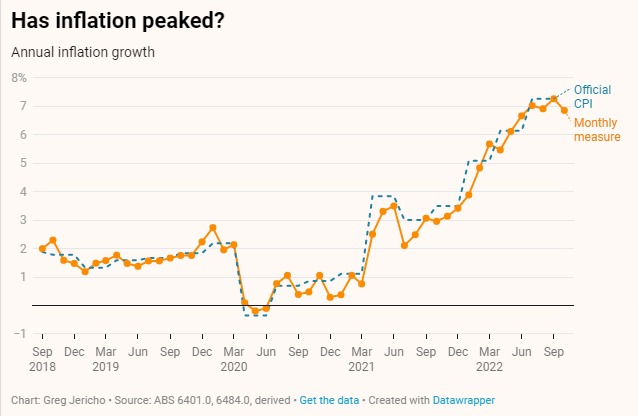
    But as Labour Market and Fiscal Policy Director, Greg Jericho, notes in his Guardian Australia column, the latest monthly inflation figures out yesterday suggest that maybe the peak could be lower than anticipated.

    While the monthly figures can be a little erratic, they do closely align with the quarterly “official” CPI figures and in October the ABS estimates that annual inflation growth fell from 7.3% to 6.9%. Better still this makes 4 months in a row where inflation has remained around 7%, rather than increasing quickly as it has since the middle of last year.

    Combined with the latest Retail Trade figures released this week which showed the dollar amount spent in the shops fell in October, and the volume of spending falling even faster, there are solid signs that the interest rate rises are having an impact.

    This means the Reserve Bank needs to be very cautious as much of the impact of the rate rises from September October and November has yet to flow through into the data. And because the rates of existing mortgages take longer to rise than do rates for new home loans this also means that even were the RBA to halt rate rises, for most mortgage holders rates will still be about to rise over the next few months.

    The IMF, OECD, Treasury and the RBA itself all forecast a sharp slowing of Australia’s economy next year and into 2024. The rationale has been that this is the cost of needing to reduce inflation, but the central bank needs to be very careful that it does not commit overkill. With the economy and consumer spending already slowing, and inflation showing some good signs that growth is no longer increasing at a rapid rate, the RBA should strongly consider not increasing the rate next week in its final board meeting of the year.


    You might also like

    Dutton’s nuclear push will cost renewable jobs

    by Charlie Joyce

    Dutton’s nuclear push will cost renewable jobs As Australia’s federal election campaign has finally begun, opposition leader Peter Dutton’s proposal to spend hundreds of billions in public money to build seven nuclear power plants across the country has been carefully scrutinized. The technological unfeasibility, staggering cost, and scant detail of the Coalition’s nuclear proposal have

  • Wages growth improves but real wages fall at a record rate

    Originally published in The Guardian on November 17, 2022

    The latest wages price index figures show that for the first time since 2013 wages grew by more than 3% in the past year.

    This growth is very welcome. It highlights that far from wages driving inflation, wage growth is only now beginning to grow at a pace that would be expected given the low level of unemployment. But as Labour Market and Fiscal Policy Director, Greg Jericho notes in his Guardian Australia column, while the level of wage growth we are seeing remains well below what would have been expected in the past with a 3.5% unemployment rate.

    The strong growth came mostly from the private sector through a combination of new financial year individual contracts and the 5.2% minimum wage increase.

    But even this is not enough to prevent real wages from falling for the 9th straight quarter. For more than 2 years now prices have been rising faster the wages. It has seen real wages fall back to 2011 levels after a 4.6% fall since September 2020.

    The figures show that greater bargaining power is required for workers as they continue to lose out. The fastest wage growth for a decade should not see the biggest fall in real wages on record.

    We know that greater enterprise bargaining producers better wages growth. That business groups are so against the provision in the Fair Work Amendment Bill demonstrates how worried they are about the ability of workers to have increased ability to bargain.

    Profits have been growing faster than inflation, but wages are not.

    The latest wage growth figures are pleasing to see, but they also demonstrate the challenges ahead, and just how greatly workers’ living standards have been hit by price rises that they did nothing to cause.


    You might also like

  • Multi-Employer Bargaining Necessary for Fixing Wages Crisis

    Originally published in The Conversation on November 14, 2022

    Proposed reforms to Commonwealth industrial relations laws would create more opportunities for collective bargaining to occur on a multi-employer basis, rather than being limited solely to individual workplaces or enterprises. Business groups have attacked this proposal as a dramatic change that would supposedly spark widespread work stoppages and industrial chaos.

    But as our Policy Director Fiona Macdonald argues in this new commentary for The Conversation, multi-employer bargaining is already allowed under various existing provisions of the Fair Work Act. The problem is that those provisions do not work. For example, the low-paid bargaining stream in the Fair Work Act has yet to result in a single multi-employer agreement, due to its stringent conditions and inconsistent application by the Fair Work Commission.

    Dr Macdonald argues that reforming these multi-employer bargaining streams so they can actually work will be an important part of any strategy to revitalise stagnant wages in Australia.

    For more details on the failure of existing multi-employer bargaining streams, and core principles for a stronger bargaining system, please also see the Centre for Future Work’s submission to the Senate inquiry on the Secure Jobs, Better Wages reform package (co-authord by Dr Macdonald, Jim Stanford, and Lily Raynes).


    You might also like

  • With household incomes set to fall, we need to think about what matters in the economy

    Originally published in The Guardian on November 10, 2022

    The current tightening of monetary policy is undoubtedly having an impact. While it may take some time for the slowing of inflation to flow through to the official CPI figures – especially given the level of inflation that is being imported – the economy is set to slow drastically.

    As Labor Market and Fiscal Policy Director Greg Jericho notes in his Guardian Australia column the Reserve Bank in last week’s Statement on Monetary Policy, has forecast GDP growth to slow to levels normally associated with recessions – even if the RBA is not actually forecasting a recession.

    However, in one area the RBA is not hedging at all – that of real household disposable income. This measure, which essentially examines the living standards of the average household, is forecast to decline at a pace as bad as any experienced in the past 60 years.

    While a fall in household incomes was always expected given the abnormal level of stimulus that occurred during the pandemic, the fall is predicted to be much greater than just going back to where we were. The Reserve Bank predict incomes will fall well below the pre-pandemic trend level.

    That such a drastic fall has received little coverage highlights that the orthodox commentary and debate around the economy largely focuses on aspects that minimise workers and households in place of corporations and the “broader” economy of GDP.

    The cost of taming inflation is too often discussed in terms of whether it will send the economy into a recession, without examining if that measure misses the real-life experience of most people.

    If the RBA forecast comes true, inflation will have been brought back to the RBA target, GDP will have kept growing, but household living standards will have plunged.


    You might also like

  • Would further interest rate rises do more harm than good?

    Originally published in The Guardian on November 3, 2022

    In the past 7 months, the Reserve Bank has increased the cash rate by 275 basis points. That is as fast as any time since the RBA became independent. Given the pace of inflation growth, the rises are not wholly without cause, but as policy director, Greg Jericho notes in his Guardian Australia column the main drivers of inflation are now easing, and wages are yet to take off. In that case, should the RBA continue to raise rates given it will only slow the economy further?

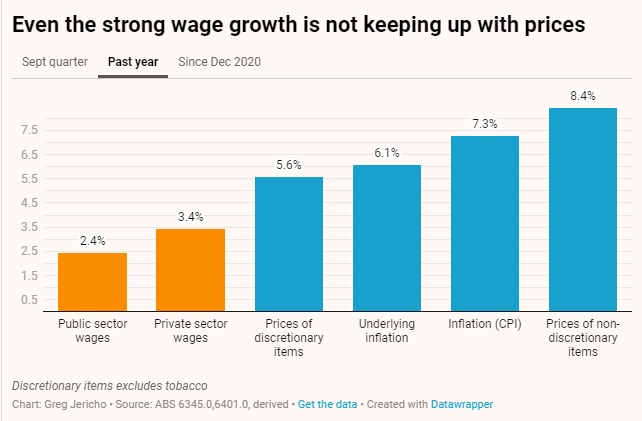
    Over the past year, the main driver of inflation has been house prices accounting for a quarter of the 7.3% rise in the CPI. And yet we know that house price growth is now either slowing dramatically or even falling in some areas. The RBA has also noted that commodity prices are falling and supply-side issues are being dealt with and that these aspects, which are not influenced by interest rates, will reduce inflation next year.

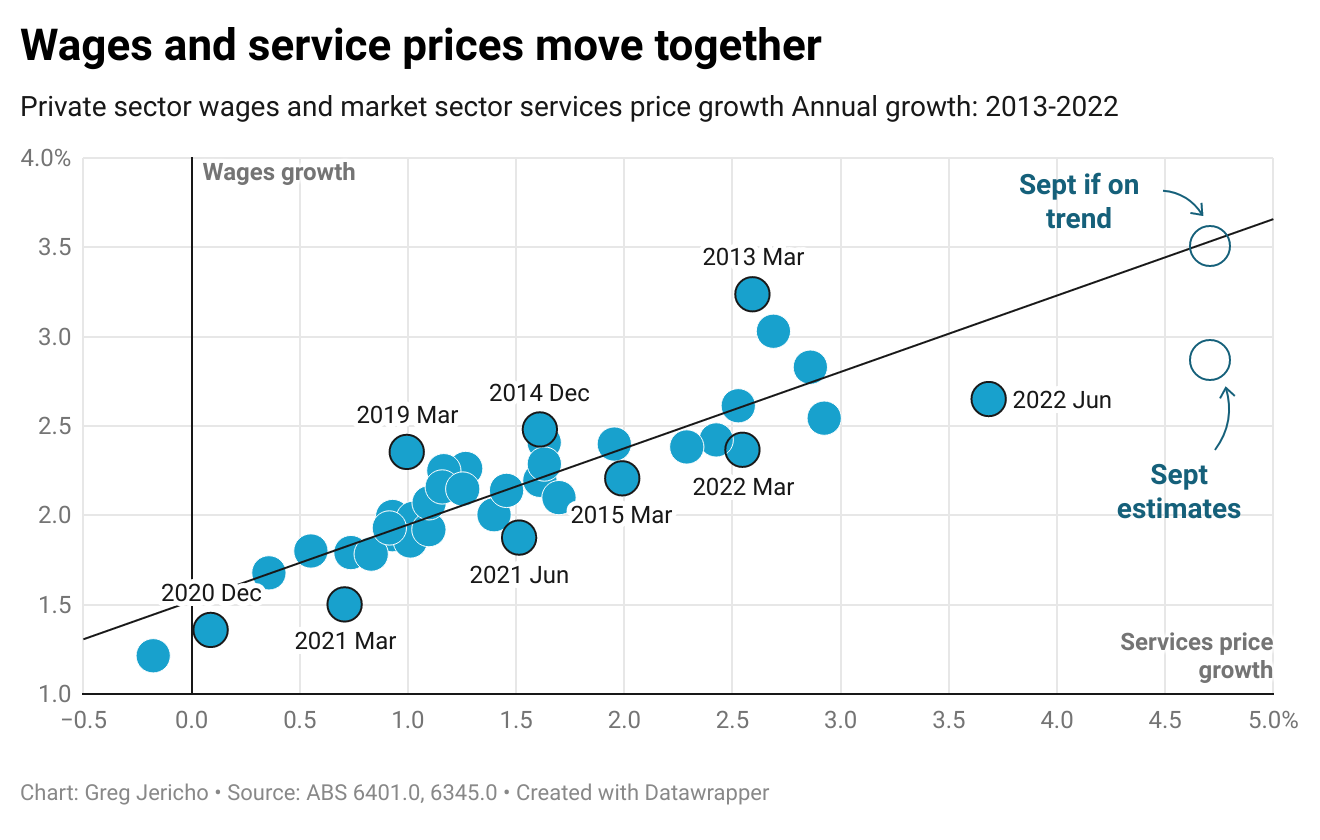
    At the same time, the Reserve Bank continues to sound warnings of a wage-price spiral despite any evidence of such a thing occurring. Indeed the latest CPI figures show that overwhelmingly inflation is driven by the price rises of goods rather than services. This is important because service prices and wages are strongly linked.

    More rate rises will certainly continue to reduce demand in the economy as the cost of servicing a mortgage rises. But to what end? The main factors driving inflation are easing, wages have not risen above 3% yet, let alone to a rate anywhere near inflation.

    Even if wages were to rise in line with the historical link with service prices, in September they would have risen 3.5% – a level very much consistent with inflation growth of between 2% and 3%. And yet we know that wages are unlikely to rise that fast. The most recent estimates have it closer to 2.8%.

    The great risk now is that further rate rises will only hurt the economy for little gain and see wages growth stunted before they even get to a level that would see real wages rising.


    You might also like

    Centre For Future Work to evolve into standalone entity

    The Centre for Future Work was established by the Australia Institute in 2016 to conduct and publish progressive economic research on work, employment, and labour markets. Supported by the Australian Union movement, the centre produced cutting edge research and led the national conversation on economic issues facing working people: including the future of jobs, wages