Category: Democracy & Accountability

Research branch

  • Insecure work is a feature of our labour market. New laws can change that.

    Insecure work is a feature of our labour market. New laws can change that.

    by Chris Wright

    Chris Wright is Associate Professor in the Discipline of Work and Organisational Studies at the University of Sydney, and a member of the Centre for Future Work’s Advisory Committee. This commentary is based on his submission to the Senate Education and Employment Legislation Committee’s inquiry into the Fair Work Legislation Amendment (Closing Loopholes) Bill 2023, and originally appeared in the Sydney Morning Herald.

    *   *   *   *   *

    The Senate has started reviewing the Australian Government’s Closing Loopholes Bill. If passed, this legislation will allow minimum standards to be set for contract workers, provide stronger penalties against employers who commit wage theft and deter employers from outsourcing to circumvent enterprise bargaining.

    These measures will strengthen protections for workers who often face barriers to job security and career development.

    Australia’s current system of workplace laws was adopted at a time when enterprise bargaining and awards covered a larger share of the workforce than today. Enterprise bargaining and awards encourage employers to invest in their workers through “standard” employment arrangements underpinned by permanent contracts, decent wages and training.

    These arrangements promoting workforce investment benefit both workers and employers. Workers gain job and economic security and career progression opportunities. Employers gain loyal and satisfied workers who contribute to productivity and innovation. As the architects of the current system of workplace laws envisaged, workforce investment thus provides the basis for high-productivity business strategies, which help to make the Australian economy more internationally competitive.

    Recently, however, more businesses have opted for a different course. These businesses have tried to compete not through high-productivity strategies but instead by undercutting or evading workplace laws and by engaging workers via “non-standard” arrangements such as casual contracts or via gig economy platforms.

    The rising incidence of wage theft in which employers pay workers below their legal entitlements is evidence of this undercutting. The growing numbers of workers hired through labour hire arrangements, which some businesses have used to avoid their enterprise bargaining obligations, is evidence of evasion. So too is the emergence of gig platforms exempt from workplace laws.

    Wage theft, gig platforms and use of labour hire as an evasion tactic have become features of Australia’s modern labour market. None of these features existed when the foundations of the current system of workplace laws were first laid in the 1990s.

    As the nature of work and the labour market evolves, workplace laws must adapt in response. The Closing Loopholes Bill recognises this by allowing workers on casual contracts to convert more easily to permanent contracts, increasing protections for gig and labour hire workers and introducing new measures against employers who undercut wage laws.

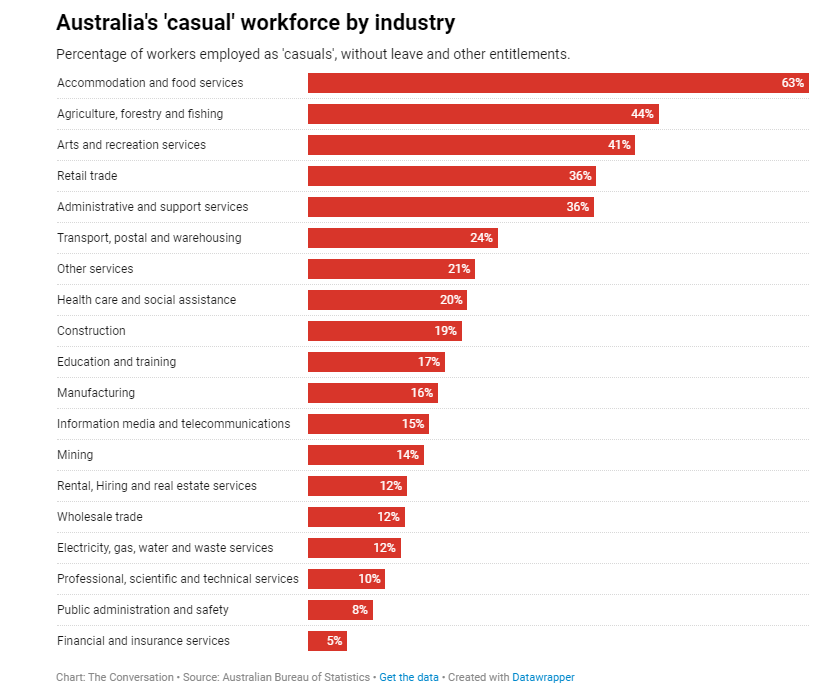
    While non-standard workers have flexibility, they have little job and economic security under current laws. For instance, casual workers receive a higher hourly pay rate as compensation for this insecurity but are concentrated in the lowest-paid industries. Like their counterparts in the gig economy, casual workers are less likely to receive training than permanent workers.

    The proposed change to give casuals who work regular hours the right to convert to permanent employment will probably improve their access to good quality jobs and career development opportunities.

    Business groups have criticised the Closing Loopholes Bill for its supposedly negative impacts on productivity and innovation. They have not offered evidence supporting these claims. To the contrary, research evidence suggests that measures promoting standard employment are more likely to encourage businesses to compete through high-productivity and innovation-enhancing strategies rather than by undercutting or evading.

    Winston Churchill once said that without effective workplace laws, “the good employer is undercut by the bad and the bad by the worst… Where those conditions prevail you have not a condition of progress, but a condition of progressive degeneration”.

    Workers in Australia are increasingly missing out on legal protections under current laws. The research evidence suggests the Closing Loopholes Bill’s provisions are necessary to avoid a situation like the one Churchill described.


    You might also like

  • Inflation remains headed in the right direction despite higher oil prices

    Originally published in The Guardian on September 28, 2023

    Increases in the prices of commodities like oil and gas are not a reason for the RBA to raise interest rates next week

    The latest monthly CPI figures out on Wednesday showed a slight increase in the annual growth of inflation, but policy director Greg Jericho writes in his Guardian Australia column that the Reserve Bank should not use it as an excuse to raise rates next week.

    While CPI rose from 4.9% to 5.2%, the monthly figures can be quite erratic and thus it is best to also take note of the measure that excludes volatile items and holiday travel (which can exaggerate movement son a monthly basis). On this measure, annual inflation feel from 5.8% to 5.5%.

    The big driver of inflation in August was a 9% jump in automotive fuel prices. And indeed much of the inflation over the past 2 years has come from overseas increases in world prices of commodities and of course companies taking advantage to increase profit margins.

    The latest figures show that once again there is very little that the RBA can do to limit these price rises. While a higher exchange rate might ameliorate some of the increases, it is always foolish for the RBA to attempt to increase the value of the dollar by raising interest rates. Any changes in the value of the exchange rate due to another rate rise would likely be small and temporary.

    The new Governor of the RBA, Michele Bullock should recommend the RBA board look through the monthly movements of the CPI and note that inflation here is following largely the same path as that in the rest of the OECD. Raising rates now would only serve to punish households for an increase in prices that had no link with wages or the level of demand in Australia economy.


    You might also like

  • Opening statement to the ACTU Price Gouging Inquiry

    Opening statement to the ACTU Price Gouging Inquiry

    by Jim Stanford and Greg Jericho

    This week Professor Allan Fels, the former head of the Australian Competition and Consumer Commission (ACCC), has begun an inquiry into price gouging across a range of industries, including banks, insurance companies, supermarkets, and energy providers. The inquiry commissioned by the ACTU comes off the back of the highest inflation in 30 years and the biggest falls in real wages on record.

    The Director of the Centre for Future Work, Jim Stanford and policy director and chief economist of the Australia Institute, Greg Jericho, presented evidence at the inquiry based on their research into profit-led inflation. Below is an edited excerpt of their opening statement.

    The recent period of rising inflation has been highly unusual coming as it has after a period where in Australia, core inflation by June 2021 had not been above the Reserve Bank’s target range of 2% to 3% for more than a decade and had been below 2% for five and half years.

    Perhaps unsurprisingly, because of such a long period without rising inflation, we saw very much a default to the thinking of the 1970s and a belief that all inflation is primarily driven by demand factors that need to be limited by higher interest rates.

    This was a fundamental misunderstanding of this inflationary period. It clearly could not be driven by wages because wages at all stages over the past two years have grown on average by less than inflation, such that real wages are now 5.5% below what they were two years ago.

    Wage growth in the 12 months to June this year was just 3.6%, still well below the CPI of 6%, and far from accelerating, actually had fallen from 3.7% growth in the 12 months to March.

    Thus, the question becomes, if not wages, what?

    Our research in February this year revealed that the initial surge of inflation in Australia beginning in mid-2021 was closely associated with a surge in price pressures.

    Business profits were the dominant manifestation of that inflation. The supply shocks that occurred because of the pandemic lockdowns and Russia’s invasion of Ukraine allowed companies in some key industries (such as energy, logistics, and manufacturing) to significantly boost their profit margins, coincident with rising prices.

    Our February 2023 paper, using the decomposition method of the national accounts (as explained by Jim), concluded that since the end of 2019, 69% of unit price increases over and above the RBA’s 2.5% inflation target mid-point were attributable to increased nominal unit profit payments. Only 18% was attributable to higher nominal unit labour costs, and the rest to increases in other nominal factor payments.

    Our paper noted that the profit growth was most dramatic in the energy and resources sector. These findings were broadly consistent with the findings of earlier research by the Australia Institute, as well as with the similar decompositions of inflation reported in other countries.

    Our follow-up report in April confirmed the leading role played by profits in the energy and resource industries. It noted that products from that sector (including petrol, gas, and other fossil fuel-intensive products) were leading sources of domestic inflation in Australia. It also showed that profits in other sectors, such as wholesale trade (56%), manufacturing (38%), professional and technological services (37%) and construction (37%), had also increased as a share of non-mining GDP since the pandemic. This profit growth is not dissimilar from the 48% growth in mining profits during the same period and well in excess of the 27% increase in nominal GDP.

    This confirmed that firms across these sectors have more than simply passed on higher input costs to consumers. As American economist Isabelle Weber has argued, they amplified them.

    The release of two more quarters of national accounts since February allows us to update our figures, which find that despite recent falls in corporate profits in some sectors, higher unit profit payouts still account for over half (56%) of the cumulative increase in nominal unit prices in the Australian economy since December 2019, above and beyond what would be expected due to normal target inflation. The role of higher unit labour costs in overall unit prices has increased in recent quarters and now accounts for just over one-third (35%) of the cumulative above-target rise in prices since the pandemic.

    The influence of profits is clear when you consider that unit profit costs by June 2023 were 27% above their December 2019 levels (down from 37% above in March 2023), while unit labour costs are just 14% above December 2019 levels – pointedly just below the 15% growth in CPI.

    There have been some suggestions by the Reserve Bank and others that our research should exclude mining profits as these do not significantly influence Australian inflation. Profits in mining during this time accounted for over half of all corporate profits in Australia; obviously, if over half of corporate profits are excluded from consideration, then profits will obviously seem less important.

    We reject the argument that mining profits somehow “don’t count” – especially in regard to domestic inflation, given the critical role played by higher petrol, gas, and electricity prices in driving the initial post-pandemic surge in Australian consumer price inflation.

    Clearly, there is a strong connection between energy prices, energy industry profits, and inflation experienced by domestic consumers (not to mention inflation experienced in other sectors of the economy).

    The good news is that corporate profits have begun to moderate in the first half of this year. It is important to note the modest decline in gross operating surplus in some sectors has still left corporate profits as a share of national GDP well above pre-pandemic levels and far above longer-term post-war averages.

    Nevertheless, even the partial moderation of record corporate profits has been associated with a significant and welcome deceleration of inflation. Consumer price inflation in Australia has slowed by over half in the last nine months: from an annualised peak of 8.9% in the first quarter of 2022 (led by surging energy costs) to just 3.4% in the June quarter of 2023 (not much higher than the top of the RBA’s target range).

    Moreover, even in the later stages of this current inflation cycle, with profits stable or even falling and labour costs accelerating, it’s wrong to conclude that labour is now the ‘source’ of inflation: clearly, the rise in unit labour costs reflects efforts by workers to recoup real income losses experienced earlier in the inflationary cycle, which must still be ascribed to the initial profit-led shocks that started the whole process.

    Blaming workers now for inflation because they are pursuing higher wages to recover lost living standards is like blaming a homeowner whose house has been set on fire for using too much water to put out the flames.

    Even as it appears to be moderating, this period of inflation requires a rethink of our policy approaches.

    We have made a number of policy recommendations, including:

    • Price regulations in strategic sectors
    • Fiscal transfers (such as windfall profits taxes combined with cost-of-living transfers to vulnerable households)
    • Competition policy reforms
    • Supports for wage increases in excess of current inflation for a sustained period of time to allow the repair of recent real wage reductions.

    The biggest lesson from this period is that we need more policy tools in our inflation toolkit. Relying on monetary policy and higher interest rates only works if you think inflation is only ever produced by higher wages and strong aggregate demand.

    We know that the future is more likely than not to feature further global shocks – not the least from climate change. Policymakers and central banks need to learn from the past two years and ready themselves to treat the broader causes of inflation and protect workers and households when companies seek to use crises as an opportunity to lift prices.


    You might also like

    Centre For Future Work to evolve into standalone entity

    The Centre for Future Work was established by the Australia Institute in 2016 to conduct and publish progressive economic research on work, employment, and labour markets. Supported by the Australian Union movement, the centre produced cutting edge research and led the national conversation on economic issues facing working people: including the future of jobs, wages

  • Millionaire Tim Gurner’s Refreshing Honesty Reveals the Soul of Business

    Originally published in The New Daily on September 13, 2023

    Every now and then a window opens into the soul of the business community, and we catch a glimpse of the values and goals that shape the actions of the captains of industry.

    A striking example occurred this week at a business outlook conference sponsored by the Australian Financial Review.

    In a panel discussion, Tim Gurner – founder and CEO of property developer Gurner Group, and personally worth almost $1 billion – discussed the state of the labour market.

    In his view, historically low unemployment in recent years has undermined the work ethic and discipline of the people who construct the buildings that made him rich.

    “Tradies … have been paid a lot to do not too much in the last few years, and we need to see that change. We need to see unemployment rise. Unemployment has to jump 40 to 50 per cent in my view. We need to see pain in the economy,” Gurner said.

    ‘Hurting the economy’

    “There has been a systematic change where employees feel the employer is extremely lucky to have them, as opposed to the other way around … We’ve got to kill that attitude, and that has to come through hurting the economy … Governments around the world are trying to increase unemployment … We’re starting to see less arrogance in the employment market, and that has to continue.”

    Gurner didn’t mention ‘inflation’ in his statement. We are regularly told by central bankers that lifting unemployment is necessary to control inflation.

    But in Gurner’s telling, the goal is to control workers, not (at least directly) prices: To re-instil a suitable fear of joblessness and dislocation, so workers work harder and demand less.

    Gurner’s remarks were eerily reminiscent of a prediction made by the great Polish economist, Michal Kalecki.

    Kalecki was a contemporary of John Maynard Keynes. He simultaneously developed theories of aggregate demand management that could prevent depressions and achieve full employment.

    A desirable cushion of jobless

    In a famous 1943 article, Kalecki explained that even though full employment could now be readily achieved through active fiscal and monetary policy, powerful business interests would reject that goal.

    They prefer to maintain a desirable cushion of unemployment, to keep workers in line and private corporations humming along:

    “Lasting full employment is not at all to [business leaders’] liking. The workers would get ‘out of hand’ and the ‘captains of industry’ would be anxious to ‘teach them a lesson’ … A powerful bloc is likely to be formed between big business and the rentier interests, and they would probably find more than one economist to declare that the situation was manifestly unsound. The pressure of all of these forces, and in particular of big business, would most probably induce the government to return to the orthodox policy.”

    Kalecki predicted the historic shift in economic policy that would occur decades later, led by thinkers like Milton Friedman and Edmund Phelps.

    They postulated the idea of a ‘natural rate’ of unemployment. In their view, unemployment is essentially voluntary: Some people choose not to work at the market-clearing wage, supported unwittingly by minimum wages and social welfare policies that subsidise unemployment and discourage job searches.

    Friedman and Phelps urged government to focus on controlling inflation, rather than fruitlessly trying to reduce unemployment below this ‘natural’ rate.

    In modern guise, the theory has a less pejorative moniker: The Non-Accelerating Inflation Rate of Unemployment (NAIRU). But it postulates the same idea, namely that unemployment must be kept high enough to discipline labour and restrain labour costs.

    Central bankers rarely explicitly discuss the NAIRU anymore. This is partly to avoid offending the public with the idea that they are actively working to raise unemployment.

    It’s also because NAIRU models have been notoriously unable to pin down any precise number for this mythical benchmark, making it useless for policy purposes. In most industrial countries after the 1990s, unemployment crashed through estimated NAIRU benchmarks with no impact on inflation – casting great doubt on the very concept, let alone specific numerical estimates of it.

    Nevertheless, it is clear that NAIRU thinking still underpins the current obsession of central banks with alleged overheated labour markets as the purported source of post-COVID inflation. It also informs their single-minded focus on suppressing aggregate demand (and thus employment) to reduce that inflation.

    Even bankers say quiet bits out loud
    Occasionally, even central bankers say the quiet bits out loud.

    The Reserve Bank of Australia’s new governor Michele Bullock recently stated the unemployment rate had to rise to 4.5 per cent (from 3.5 per cent when she said it) to allow inflation to return to the bank’s 2.5 per cent target.

    If inflation is still above 2.5 per cent when the unemployment rate gets that high, this will be interpreted as evidence that the true NAIRU must be higher than thought.

    Let’s hope they don’t resuscitate previous estimates of the NAIRU, which formerly suggested unemployment had to be 7 per cent or even higher to keep workers suitably disciplined.

    We should be grateful to Gurner for his refreshing honesty, which helps illuminate the choices being made in current monetary policy.

    Workers who expect too much are a barrier to his efforts to accumulate more wealth. He wants adequate discipline restored, and engineering higher unemployment is exactly the way to do that. And apparently, central bankers agree.


    You might also like

  • New laws for ‘employee-like’ gig workers are good but far from perfect

    New laws for ‘employee-like’ gig workers are good but far from perfect

    by Fiona Macdonald

    The Workplace Relations Minister Tony Burke has described proposed new laws to regulate digital platform work as building a ramp with employees at the top, independent contractors at the bottom, and gig platform workers halfway up.

    The new laws will allow the Fair Work Commission to set minimum standards for ‘employee-like workers’ on digital platforms. They are a key part of reforms in the government’s Closing the Loopholes workplace relations bill introduced into parliament this week, and are part of a commitment made before the 2022 election.

    So, what will being halfway up the ramp mean for ‘employee-like’ platform workers? Under the changes, minimum standards can now be set for platform workers, including rideshare drivers, food delivery workers and care workers. Up until now, as independent contractors, digital platform workers have had very few rights, including no rights to minimum pay rates.

    With the changes, the Fair Work Commission will be able to set minimum standards for workers concerning payment terms, deductions, working time, record-keeping, insurance, consultation, representation, delegates’ rights and cost recovery and other matters.

    Other provisions in the legislation are designed to protect workers from being unfairly deactivated from platforms, which is equivalent to being unfairly dismissed, and allow collective agreements for platform workers where platform operators agree.

    The laws will apply only to ‘employee-like’ platform workers, meaning workers who are low-paid (compared to what they would be paid under an award), have low bargaining power and/or have low control over their work.

    There are some restrictions on the standards the Fair Work Commission can set for platform workers. Minimum standards cannot be set concerning overtime rates or rostering arrangements. Nor can the Commission use its standard-setting powers to turn a platform worker into an employee.

    So, ‘employee-like’ platform workers will not have all the minimum standards and rights that employees have. However, halfway up the ramp, they will be much better placed than they were with the minimal rights of independent contractors.

    Overall, these changes are very positive for platform workers and should prevent exploitation of vulnerable workers. However, the reforms stop short of responding to longstanding calls for platform workers, including rideshare, food delivery and care workers, to be treated as employees, and for platform operators to be treated as employers, an approach that has recently been agreed by the 32 member countries of the European Union.

    The proposed reforms in the Closing Loopholes bill don’t go as far as aiming to ensure that how a person is employed can’t leave them without the rights and standards most comparable workers enjoy at work. It leaves platform workers halfway up the ramp in a new worker category with lesser rights than employees.

    The creation of this new category of ‘employee-like’ worker does open up the possibility that some employers may seek to reform their workforces and business models to engage workers who are in the new cheaper worker category, in place of employees. Internationally, where a third category of worker has been created by governments in order to provide protections for low-paid independent contractors, there has been some substitution of employees for workers with less favourable conditions.

    The Closing the Loopholes approach to platform workers also suggests we need to think harder about how to support better flexibility at work.

    The platform work reforms appear to be built on an assumption it is ok for workers who need or want flexibility to have lesser standards and fewer rights at work because of this. Most platform workers value the flexibility they have in their jobs. But that does not mean they should have to trade off rights and standards. Flexibility is not a benefit that accrues only to workers. Consumers and platform operators want flexible services too.

    Originally published in The New Daily 8 September 2023


    You might also like

  • The weak economy shows the Reserve Bank is not threading the needle

    The weak economy shows the Reserve Bank is not threading the needle

    by Greg Jericho

    We have now had two consecutive quarters of GDP per capita falling – hardly the soft landing the RBA wants.

    The latest June quarter National Accounts released yesterday showed that without the increase in population, Australia’s economy would have shrunk for two consecutive quarters. This, as Policy Director, Greg Jericho writes in his Guardian Australia column, reveals just how weak our economy is, and how massively households have been hit by the 400 basis points rise in the cash rate.

    The Reserve Bank has talked about trying to thread the needle of lowering inflation and delivering a soft landing. But with GDP per capita falling and real household disposable income per capita now 5% below where it was a year ago, it is becoming harder to suggest the RBA has achieved its aim.

    Even when including population growth GDP only rose at all because of government spending and investment. The private sector is struggling as companies run down their inventories rather than build up supplies in the hopes of increased sales in the months to come.

    The household savings ratio is now as low as it has been since the GFC as households do what they can to pay the costs of essential items and reduce their purchase of discretionary goods and services.

    The Reserve Bank sought to dampen demand from a misguided view that demand was driving inflation. Instead, we know that inflation has largely been driven by international prices and costs and from companies taking advantage of the situation to increase their profits.

    Rather than focus purely on inflation the RBA and the government now need to be most wary of rises in unemployment. We are not in a recession yet, but should the economy continue to fail to grow aside from population unemployment will inevitably rise, and the cost of the RBA’s strategy will be felt even more so by households across the country.


    You might also like

    Centre For Future Work to evolve into standalone entity

    The Centre for Future Work was established by the Australia Institute in 2016 to conduct and publish progressive economic research on work, employment, and labour markets. Supported by the Australian Union movement, the centre produced cutting edge research and led the national conversation on economic issues facing working people: including the future of jobs, wages

  • Australia’s emissions are rising at a time they need to fall quickly

    Originally published in The Guardian on August 31, 2023

    The latest quarterly greenhouse gas emissions survey shows that Australia is heading in the wrong direction – and that needs calling out.

    The latest Quarterly Greenhouse Gas Emissions data came and went last Friday with little coverage. As Policy Director, Greg Jericho writes in his Guardian Australia column this meant that much of the terrible news was missed.

    In the past year, Australia’s greenhouse gas emissions have increased with the rise in transport emissions undoing any of the good that comes from falling emissions out of the electricity sector. At a time when we should be on a clear path to reducing emissions by at least 43% below the 2005 level by 2030, we are heading in the opposite direction.

    The figures also highlight the weakness of our 2030 target. The only reason we are even halfway to achieving that cut is because Australia includes land use in its calculations. Without including the faux cuts in emissions that come from using 2005 and the massive land-clearing that occurred that year as a baseline, Australia’s emissions would be just 1.6% below 2005 levels.

    Next week the June quarter GDP figures will be released.  We know exactly when they will be released and they will receive massive coverage, including a press conference by the Treasurer soon after 11:30am on Wednesday. By contrast, the quarterly greenhouse gas emissions data is released at random times with now warning and without any minister fronting media to discuss, explain and defend the government’s policies.

    We need to treat the greenhouse gas emissions release with the same level of attention we give to GDP, and we need to demand what the government is doing to ensure in 3 months time with the next release the figures will show a fall, rather than a rise.


    You might also like

    Dutton’s nuclear push will cost renewable jobs

    by Charlie Joyce

    Dutton’s nuclear push will cost renewable jobs As Australia’s federal election campaign has finally begun, opposition leader Peter Dutton’s proposal to spend hundreds of billions in public money to build seven nuclear power plants across the country has been carefully scrutinized. The technological unfeasibility, staggering cost, and scant detail of the Coalition’s nuclear proposal have

  • For most workers, wages are still failing to keep up with inflation

    Originally published in The Guardian on August 17, 2023

    While overall wages grew in line with inflation in the June quarter for workers in most industries real wages are still going backwards.

    The best news from the June quarter wage price index is that average wages rose 0.8% – the same as inflation. This means that after 11 consecutive quarters, real wages have finally stopped falling.

    That is the good news, but as Policy Director, Greg Jericho noted in his Guardian Australia column, for most workers real-wages kept falling. Only good wage growth in construction, mining, transport and warehousing, and the utility industries enabled the overall growth to be equal with inflation. For workers in all other industries, real wages kept falling.

    And for all workers, real wages in the past year have fallen sharply and are around 5.4% below where they were before the pandemic.

    These latest figures only serve to reinforce that wages are not driving inflation and there is no sign at all of a wages breakout. Indeed, annual wage growth fell in the June quarter to 3.6% from 3.7%.

    It highlights that we do not need unemployment to rise to 4.5% in order for inflation to get under the RBA’s 3% target ceiling. The current rate is more than consistent with long-term inflation of between 2% and 3%. Any further efforts to raise unemployment by increased interest rates would only hurt workers and households for no benefit.


    You might also like

  • We need more than a definition change to fix Australia’s culture of permanent ‘casual’ work

    Originally published in The Conversation on July 31, 2023

    The surprising thing about the Albanese government’s announced reforms to “casual” employment is not that they’re happening.

    It’s that employer advocates are getting so excited about them, despite the small number of people they will affect and the small impact they will have.

    That’s not to say the changes aren’t needed. Rather, true reform of the “casual” employment system, of which this is just a first but important step, has a lot further to go to resolve the “casual problem”.

    What is the ‘casual problem’?

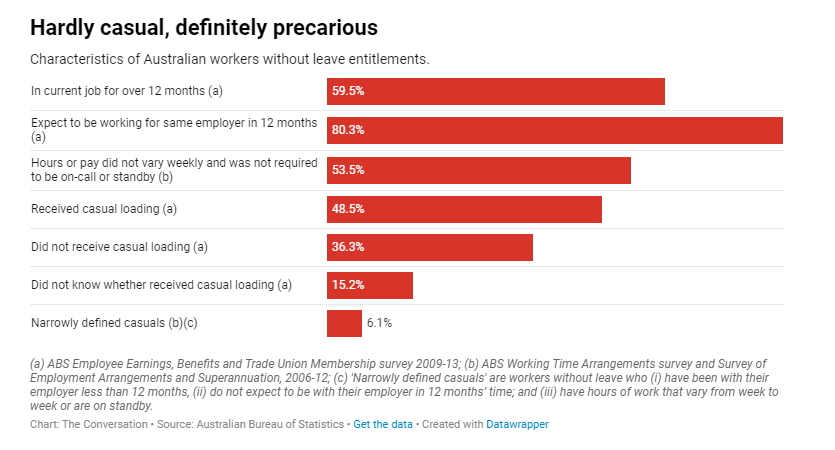
    This problem is that most “casual” workers aren’t really casual at all — as shown by analysis that I and colleague Robyn May did, using unpublished data from the Australian Bureau of Statistics (ABS).

    The premise for hiring them is that the work is intermittent, short-term and unpredictable. But, as you can see from the chart, the last time the ABS collected these data, a majority of “casuals” worked regular hours.

    Almost 60% of “casuals” had been in the job for more than a year. About 80% expected to still be there in a year’s time.

    Only 6% of “casuals” (1.5% of employees) worked varying hours (or were on standby), had been with their employer for a short time, and expected to be there for a short time.

    Even now, some “casuals” have been doing the same “casual” work for over 20 years.

    Permanent ‘casuals’

    All this has led to a class of “permanent casuals” – a nonsense term. They should more accurately be called “permanently insecure”.

    The one thing “casuals” have in common is they’re not entitled to sick leave or annual leave, and they are in a precarious employment situation. Their contract of employment only lasts till the end of their work day.

    That means they have much less power than other workers. So little power, in fact, that barely half of them even get the casual loading they are meant to be paid in compensation for not receiving other entitlements.

    On average, low-paid “casuals” get less pay than equivalent permanent workers, despite the loading.

    Changing legal definitions

    Not many “casuals” have been brave enough to challenge this exploitative relationship. But when they did a few years ago, Australia’s courts agreed permanent casual work was nonsensical.

    To be a “casual worker”, there had to be no promise of ongoing employment. A court would judge this not just by what was in the formal contract of employment but also by what the employer actually did. If they kept hiring you, week after week, on a predictable roster, you weren’t casual.

    In 2018, mine worker Paul Skene challenged his classification as a casual worker, arguing he had done pretty much the same work, with a few changes along the way, for five years.

    The Federal Court agreed he wasn’t a casual employee and should be back-paid annual leave. Another mine worker, Robert Rossato, had a similar victory in 2020.

    Employer organisations were “outraged” by the “billions” in back pay they could be forced to pay for having misclassified ongoing workers as casuals. They lobbied the Morrison government to amend the law, and challenged the rulings in the High Court.

    The Morrison government changed the law in early 2021, to give primacy to the written contract, ignore employer behaviour, and protect employers from back-pay claims.

    Later that year the High Court overturned the Federal Court decisions, ruling it was the written employment contract that mattered. If that was worded a certain way, you couldn’t test whether a worker was “casual” by whether the employer treated them that way afterwards.

    Labor promised to overturn these interpretations, and that’s what this proposal does.

    What will the legislation change?

    The details of the government’s plan is still not clear, but it is likely it will seek to amend the Fair Work Act to revert to something close to the pre-2020 definition of casual work, with a procedural twist.

    It will again be possible to judge whether an employee is “casual” based on employer behaviour. And an employee who repeatedly works a similar roster can, after six months, demand “permanency” – meaning rights to sick leave, annual leave, and better protection against arbitrary sacking.

    The twist: until they demanded “permanency” they won’t be entitled to any leave. So employers will be protected against claims for back pay.

    Theoretically this could affect hundreds of thousands of “casual” workers. In reality, it will likely help far fewer.

    Suppose you’re a “casual” labour hire worker in mining. You can tell what time you’ll start work on the first Friday next June. You go to your employer — the labour hire company — and say: “Make me permanent.” The labour hire company says: “We can’t. You might not have a job tomorrow.”

    And indeed, now that you’ve asked, maybe you won’t have a job. So would you really ask?

    It will depend critically on the protections offered to workers who ask to convert, and how credible they are to workers.

    Most people only expect a few people to make the demand. Workplace relations minister Tony Burke says he believes only a “very small proportion” of “casuals” working regular shifts will do so.

    Part of that reluctance will be fear of the consequences, and part of it will be that many casuals rely on their casual loading. About half of “casuals” are on the award minimum rate, compared with 15% of “permanent” full-time workers. Most cannot afford to “choose” to trade the money for holidays and other entitlements.

    If you’re not getting the casual loading, you’ve got nothing to lose — except your job. If the power imbalance means you don’t get the loading, you won’t fancy your chances.

    So, it will just work for a small number or workers – though it’s likely to be very important to them.

    More needs to be done

    In short, this is a good step but more needs to be done.

    In most other wealthy countries all workers – including temporary workers – are entitled to annual leave. That’s not the case in Australia, because of the “casual” ruse. These laws will not change that.

    There should be universal leave entitlements. Sure, there needs to be a loading where work is unpredictable, and hence so short-term that leave entitlements would not be practical.

    But everyone else should get annual and sick leave, and minimum award wages should be high enough that low-wage workers don’t have to rely on the casual loading to get by.

    The challenge should be about how we transition to that situation.


    You might also like

    “Permanent Casuals,” and Other Oxymorons

    by Jim Stanford

    Recent legal decisions are starting to challenge the right of employers to deploy workers in “casual” positions on an essentially permanent basis. For example, the Federal Court recently ruled that a labour-hire mine driver who worked regular shifts for years was still entitled to annual leave, even though he was supposedly hired as a “casual.” This decision has alarmed business lobbyists who reject any limit on their ability to deploy casual labour, while avoiding traditional entitlements (like sick pay, annual leave, severance rights, and more). For them, a “casual worker” is anyone who they deem to be casual; but that open door obviously violates the intent of Australia’s rules regarding casual loading.

  • Inflation is falling so let’s make sure we don’t let unemployment rise

    Originally published in The Guardian on July 27, 2023

    Inflation is coming down fast so we should now shift our attention to making sure unemployment does not rise

    The latest quarterly CPI figures showed that inflation is falling dramatically and in line with that of other major economies such as the USA and Canada. This, Chief Economist, Greg Jericho writes means we have a prime opportunity to lock in the current level of low unemployment.

    Through the past year of the Reserve Bank raising interest rates, the main justification has been that the economy needs to be slowed in order to bring down demand pressures on inflation.

    What the latest figures reinforce however is that the major pressures have come from the supply side. Australia’s inflation is essentially following the same path as other nations. This is because inflation is slowing largely due to reduced world prices of commodities rather than any response to increasing interest rates.

    Indeed the largest driver of inflation in the June quarter was rental prices, which will have been in part due to investors raising their prices to deal with higher mortgage payments.

    In the past year, unemployment has remained at 3.5% while inflation has gone from 6.7% up to 8.4% and now down to 5.4% (using the monthly measures). The belief that we needed to raise unemployment to 4.5% in order to stop inflation from accelerating is a cruel approach that treats inflation in the wrong way.

    Fortunately, in spite of the RBA’s best efforts, unemployment has not yet risen. This presents Australia with a genuine chance to lock in historically low unemployment as the norm.

    Rather than pursuing higher unemployment in order to reduce inflation the RBA and the government should be pursuing policies that keep unemployment low while also reducing inflationary pressure. This can mean a price cap on essential items such as rents and energy, introducing windfall-profits taxes, and increased public housing investment to reduce housing price surges.

    Interest rates are not the only way to tackle inflation and in an environment where profits are been driven by supply-side issues and profits they are one of the worst ways.

    Full employment needs to be the target, not a mythical “non-accelerating inflation rate of unemployment” that largely justifies higher unemployment and more ho0usyheold living in poverty.


    Related research

    You might also like