Category: Carmichael Centre

Research branch

  • Industry-Wide Bargaining Good for Efficiency, as Well as Equity

    Industry-Wide Bargaining Good for Efficiency, as Well as Equity

    by Anis Chowdhury

    In this commentary, Centre for Future Work Associate Dr. Anis Chowdhury discusses the economic benefits of industry-wide collective bargaining. In addition to supporting wage growth, industry-wide wage agreements generate significant efficiency benefits, by pressuring lagging firms to improve their innovation and productivity performance. The experience of other countries (such as Germany and Singapore) suggests that this system promotes greater efficiency, as well as equity — although other wealth-sharing policies are also needed.

    Dr. Chowdhury’s full comment is posted below.

    INDUSTRY-WIDE BARGAINING CAN BOOST EFFICIENCY AS WELL AS WAGES

    by Dr. Anis Chowdhury

    In an effort to reverse long-term wage stagnation, the ACTU is calling for an end to current industrial rules which effectively prohibit sector- or industry-wide wage bargaining. Predictably, the business community is opposed. Australian Industry Group chief executive, Innes Willox, said, “The ACTU’s latest proposals would destroy jobs and the competitiveness of Australian businesses…If the ACTU got its way, unions would be able to make unreasonable claims and cripple whole industries and supply chains until employers capitulated.”

    No doubt, the issue will be a hot topic in the upcoming Federal Elections. The Labor Party conference is debating the ACTU’s call. And the Liberal-National Coalition will surely accuse Labor of capitulating to the vested interest of the union movement.

    Mr. Willox’s claim that the sector-wide wage bargaining would destroy jobs and Australia’s competitiveness has no basis. A powerful example is provided by Germany, Europe’s strongest economy. In Germany, wages, hours, and other aspects of working conditions are decided by unions, work councils (organisations complementing unions by representing workers at the firm level in negotiations), and employers’ associations. Collective wage bargaining takes place not at the company or enterprise level but at the industry and regional levels, between unions and employers’ associations. If a company recognises the trade union, all of its workers are effectively covered by the union contract.

    Yet, Germany’s competitiveness did not decline. On the contrary, Germany experiences both strong productivity growth and strong wage growth. Despite ongoing real wage improvements, unit labour costs are stable or even declining – further enhancing Germany’s competitiveness.

    How is this possible? The answer was given by more than half a century ago by two leading Australian academics – WEG Salter and Eric Russel. By de-linking productivity-based wage increases at the enterprise level and adhering to the industry-wide average productivity-based wage increases, an industry bargaining system raises relative unit labour costs of firms with below-industry-average productivity, thereby forcing them to improve their productivity or else exit the industry. At the same time, firms with above-industry-average productivity enjoy lower unit labour costs, hence higher profit rates for reinvestment. Singapore also used this approach to restructure its industry in the 1980s towards higher value-added activities, with great success.

    Trying to compete on the basis of low wages is a recipe for failure. As a matter of fact, low-wage countries typically demonstrate lower productivity; and research by a leading French economist, Edmond Malinvaud, showed that a reduction in the wage rates has a depressing effect on capital intensity. Salter’s research implies that the availability of a growing pool of low paid workers makes firms complacent with regard to innovation and technological or skill upgrading. Other researchers show that under-paid labour provides a way for inefficient producers and obsolete technologies to survive. Firms become caught in a low-level productivity trap from which they have little incentive to escape – a form of Gresham’s Law’ whereby bad labour standards drive out good. The discipline imposed on all firms as a result of negotiated industry-wide wage increases forces all of them to innovate and become more efficient.

    So, sector-wide wage bargaining is good for the economy: favouring efficient firms, stimulating investment, and lifting wages. Of course, industry-wide bargaining alone cannot solve all the problems of wage inequity or wage stagnation. It must be part of a broader suite of policy measures, to provide all-round support for greater equality and inclusive prosperity.

    In particular, we must address the system that produces sky-rocketing executive pays at the expense of workers. A lower marginal tax rate is one of the incentives for the executives to pay themselves heftily, while tax cuts are not found to boost growth or employment. Share options for CEOs, which encourage job cuts and discourage re-investment, also must be reined in. If anything that is making the Australian economy vulnerable, is growing economic disparity between self-serving executive compensation and stagnant wages for the rest of the population.

    Reforms also need to address the macroeconomic policy paradigm, where fiscal policy is focused on creating needless budget surpluses by cutting social services and public infrastructure investment. Meanwhile, monetary policy is focused on a pre-determined inflation target regardless of the economic cycle. All of this stifles economic growth prospects and increases job insecurity – both of which are detrimental for wage recovery.


    You might also like

  • Are States Filling the Democratic Void?

    Originally published in New Matilda on December 2, 2018

    The recent Victorian election results showed Australian voters want governments to play a pro-active role delivering public services, infrastructure, improved labour standards, and sustainability. They showed that in a time of deep cynicism with federal politics, States (and Territories) can play an important role filling the democratic void left by dysfunction and policy paralysis at the Commonwealth level.

    This commentary from Alison Pennington, economist at the Centre for Future Work, explores what the energetic campaign in Victoria revealed about our unique system of dual governance and the potential for pro-active and progressive policy making. This commentary was originally published in New Matilda.

    The Victorian election: Are states filling the democratic void?

    A destructive and cynical politics is on the rise across the world with emergent right-wing populism a warning of what happens when people lose faith in political institutions.

    In Australia, the Coalition government has been characterised by ongoing austerity, the retrenchment of public resources and capability to the tune of billions of dollars, but complete paralysis on just about every other policy reform (most visibly including massive inconsistency on energy and climate policy). This has led to a democratic void in Australian society.

    Meanwhile, the recent victory of the Andrews Labor government on a bold social democratic platform of long-term investments in services, education and infrastructure projects (some with a 2050 completion date) gave Victorians a secure, positive vision of a more balanced, stable society – and voters endorsed that vision strongly.

    How is it that these two wildly different scenarios of political life can exist alongside each other?

    Many commentators have explained the Victorian election result as a mere by-product of the Coalition’s ongoing crisis (with subsequent warnings about the future of the federal Liberals). But this suggests Victorians were motivated by cynicism alone. In reality, Victorians rallied enthusiastically around a constructive, hopeful vision of State-level policy-making. Indeed, since federation, Australian communities and regions who have identified needs and desires unmet by the Commonwealth, have often turned to the state level of governance to get things done.

    The unique organisation of governance in Australia, featuring a Commonwealth composed of somewhat independent States and Territories, has preserved a realm of Australian democracy distinct from the national level of affairs. At a time of deep cynicism with federal politics, the Victorian election result shows that States can fill the democratic void left by dysfunction and tribal politics at the Commonwealth level, strengthening Australian democracy and saving it from the worst of cynical politics we see emerging elsewhere (such as Trumpism in the US).

    Where does the legitimacy of this State-based democracy come from? Despite losing (or handing over) many of their powers to the Commonwealth over time, States still retain power to administer the key public goods that Australians most value: like education, health care, civic services, and culture. These are the functions of government that people will energetically defend when they are undermined.

    While the Australian constitution allocates responsibility for big-ticket public programs like healthcare and education to the States, the Commonwealth retains powers to raise the bulk of the revenue needed to fund these expensive services. This means States operate in a contradictory financial bind: always dependent on the federal government to honour the financing of essential services that the States are constitutionally bound to provide. This gives enormous economic and political power to federal governments— a power play that has been repeated many times over Australia’s history.

    For example, a recent attempt by the Commonwealth to undermine the funding of public goods under the ‘spend within your means’ mantra was mounted in 2016, when Malcolm Turnbull and Scott Morrison tried to shift responsibility for raising revenue for public services to States. This was done without relinquishing any of the Commonwealth’s income and corporate taxation powers – all the while overseeing billions of dollars in cuts in healthcare and education in the federal Budget.

    But the constitutional and financial bind faced by State governments has gained particular significance in recent years, as decades of ‘small government’ policies wound back public services in favour of highly-subsidised private models have come to a head. Publicly-subsidised private markets in aged care, disability care, healthcare, education, VET and childcare have all been proven failures: both in the quality of services delivered, and in the standards of employment for those doing the work.

    Recent polling by the Australian Institute shows that 64 per cent of Australians want an increase in public spending funded by tax revenue from wealthy individuals and high-turnover businesses. Australians value government provision of public goods, even more than personal income tax cuts. The failure of federally-backed market experiments within spheres of life where Australians demand a proactive and productive government role, has left the political field wide open – and States are in prime strategic political terrain to fill that space.

    State action is applauded in the face of Commonwealth inaction. For instance, amidst recent turmoil in federal energy and climate policy, the Victorian, SA and ACT governments have proactively invested in renewable energy industries. And State governments in Victoria, SA, ACT and QLD have found innovative work-arounds to protect workers from new exploitative labour practices, despite the dominance of the Commonwealth in the jurisdiction of labour law: including labour hire licencing schemes, mandated minimum pay and safety conditions, and a new inquiry just launched into on-demand ‘gig’ work and its implications for the Victorian economy.

    The Victorian election results provide another clear insight into what Australians value and what they will tolerate. They confirm that Australians care about a fair society – underpinned by the public provision of healthcare and education (including a revamped TAFE sector), new infrastructure, action on renewable energy, and employment conditions that allow Australians to live a decent quality life.

    With the Andrews government’s pledges for sizeable investments in all of these endeavours ratified so strongly by voters, it shows that the failure of Commonwealth policy and politics can be mitigated by popular, publicly-minded campaigns at the State level.

    A future federal government could build on the example set by the Victorian election. It could use its much stronger policy and fiscal levers to charter a course that addresses the growing labour market power imbalances, restores the billions cut from hospitals, schools and housing, prepares our economy for a renewable energy future, and delivers a comprehensive program of tax reform.

    But until that decisive break with the failed austerity and cynicism of recent federal politics, the Victorian election results confirm that in the meantime, States can step firmly into the breach. They can and must continue to function as a key site for the expression of Australians’ demands for a more equal, inclusive, participatory society, with a proactive role for government in delivering public goods.


    You might also like

    Centre For Future Work to evolve into standalone entity

    The Centre for Future Work was established by the Australia Institute in 2016 to conduct and publish progressive economic research on work, employment, and labour markets. Supported by the Australian Union movement, the centre produced cutting edge research and led the national conversation on economic issues facing working people: including the future of jobs, wages

  • Go Home on Time Day 2018

    Go Home on Time Day 2018

    Share

    Wednesday 21 November is Australia’s official “Go Home On Time Day,” sponsored by the Centre for Future Work and the Australia Institute. This represents the 10th year of our initiative, to provide light-hearted encouragement to Australian workers to actually leave their jobs when they are supposed to. Instead of working late once again – and allowing your employer to “steal” even more of your time, without even paying for it – why not leave the job promptly. Spend a full evening with your family or friends, visit the gym, see a movie – do anything other than work.

    Please visit our special Go Home On Time Day website for more information, tips on how to get away from work on time, and free posters and shareables. There’s also an online calculator where you can estimate the value of the time theft you experience, through unpaid overtime in all its forms.

    In conjunction with Go Home On Time Day, The Centre for Future Work is releasing two new research reports on the time pressures facing Australian workers:

    Our annual update on attitudes toward working hours, the incidence of unpaid overtime and its aggregate value: Excessive Hours and Unpaid Overtime: 2018 Update, by Troy Henderson and Tom Swann. On the basis of a survey of 880 employed Australians, we estimate that the typical worker puts in 6.0 hours of unpaid overtime per week – ranging from going in early, staying late, working through lunch and tea breaks, taking work home in the evenings and weekends, responding to calls or emails out of hours, and more. That amounts to 3.25 billion hours of unpaid overtime across the whole labour market this year, worth a total of $106 billion.

    This year, our Go Home On Time Day survey also included a special section focusing on the forms, prevalence, impacts and implications of electronic and digital monitoring and surveillance in Australian workplaces. Our goal was to investigate a secondary dimension of the time pressure facing Australian workers. It is not just that work is being extended into greater portions of our days (through unpaid overtime, the use of mobile phones and computers to reach workers at any time, pressure to not fully utilise annual leave, and similar trends). In addition, even within the work day, time pressure is intensified with the expectation that every moment of work time must be used for productive purposes – an expectation that is increasingly reinforced through omnipresent systems of monitoring, performance measurement, and surveillance. The result of these twin forces is an overall inability for people to escape from the demands of work: neither at the workplace (even for short periods), nor away from it.

    Please see our companion report, Under the Employer’s Eye: Electronic Monitoring & Surveillance in Australian Workplaces, by Troy Henderson, Tom Swann and Jim Stanford.


    Related research

    You might also like

  • Infographic: The Shrinking Labour Share of GDP and Average Wages

    Infographic: The Shrinking Labour Share of GDP and Average Wages

    by Jim Stanford

    Share

    The Centre for Future Work recently published a symposium of research investigating the long-term decline in the share of Australian GDP paid to workers (including wages, salaries, and superannuation contributions). The four articles, published in a special issue of the Journal of Australian Political Economy, documented the erosion of workers’ share of national income, its causes, and consequences.

    This infographic summarises the bottom-line impact on average wage incomes for Australian workers.

    Labour Share Infographic

    In the March quarter of 2018, labour income (in wages, salaries, and superannuation contributions) accounted for 47.1% of total GDP. That is down over 11 percentage points from the peak labour share (over 58%) recorded in the same quarter of 1975. The loss of that share of GDP, given total output today, is equivalent to a redirection of some $210 billion in annual income – and the research symposium showed that almost all of that income was captured in the form of higher company profits (especially in the financial sector). If it were divided equally amongst all employed Australians, that lost income share translates into foregone income of close to $17,000 per worker.

    Many thanks to Anna Chang for her creative work on the infographic!

    The research symposium highlighted several factors that have caused the long-run shift in income distribution from workers to the business sector, and resulting growth in personal income inequality in Australia. Key factors included the erosion of union representation and collective bargaining, inadequate minimum wages, and the growing power of the financial sector.  For more details, see the articles by Jim Stanford, David Peetz, Margaret Mackenzie, Shaun Wilson, and Frances Flanagan.


    You might also like

    Denying Wages Crisis Won’t Make It Go Away

    by Jim Stanford

    As the great novelist Isaac Asimov wrote, “The easiest way to solve a problem is to deny it exists.” Business leaders and sympathetic commentators have adopted that advice with gusto, during current public debates over the unprecedented weakness of Australian wages.

  • Possibly Surprising Insights on the Future of Work

    Possibly Surprising Insights on the Future of Work

    by Jim Stanford

    Share

    Trade unionists are gathering this week at the ACTU’s triennial Congress in Brisbane.  Jim Stanford, Director of the Centre for Future Work, participated in a panel on the Future of Work (an apt title!) at the Congress.

    His presentation was “5 Possibly Surprising Insights on the Future of Work”.

    More detail on the issues raised in his presentation is provided in the Centre’s recent submission to the Senate Inquiry on the Future of Work and the Future of Workers.


    Related documents


    Presentation Slides


    Factsheet

    Related research

    You might also like

    Centre For Future Work to evolve into standalone entity

    The Centre for Future Work was established by the Australia Institute in 2016 to conduct and publish progressive economic research on work, employment, and labour markets. Supported by the Australian Union movement, the centre produced cutting edge research and led the national conversation on economic issues facing working people: including the future of jobs, wages

  • The Dimensions of Insecure Work in Australia

    The Dimensions of Insecure Work in Australia

    by Jim Stanford

    Share

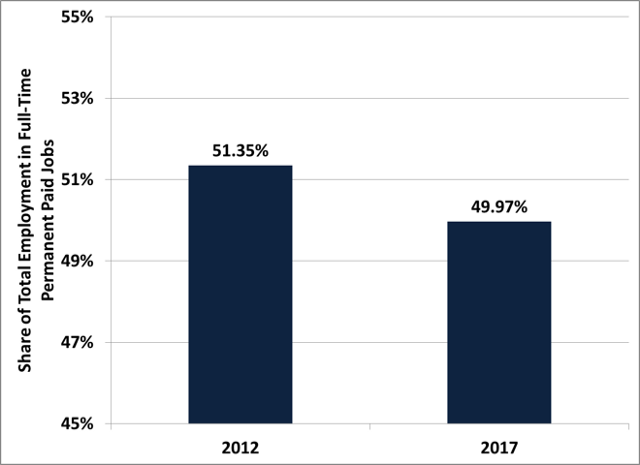
    Less than half of employed Australians now hold a “standard” job: that is, a permanent full-time paid job with leave entitlements. That’s the startling finding of a new report on the growing insecurity of work published by the Centre for Future Work.

    Share of Workers in Full-Time Paid Employment with Leave Entitlements. Source: Centre for Future Work calculations from ABS Catalogues 6291.0.55.003, EQ04 (2017), and 6333.0 Tables 2.3 and 9.1 (2012).

    The report, The Dimensions of Insecure Work: A Factbook, reviews eleven statistical indicators of the growth in employment insecurity over the last five years: including part-time work, short hours, underemployment, casual jobs, marginal self-employment, and jobs paid minimum wages under modern awards.

    All these indicators of job stability have declined since 2012, thanks to a combination of weak labour market conditions, aggressive profit strategies by employers, and passivity by labour regulators. Together, these trends have produced a situation where over 50 per cent of Australian workers now experience one or more of these dimensions of insecurity in their jobs - and less than half have access to “standard,” more secure employment.

    “Australians are rightly worried about the growing insecurity of work, especially for young people,” said Dr. Jim Stanford, one of the co-authors of the report. “Many young people are giving up hope of finding a permanent full-time job, and if these trends continue, many of them never will.”

    The report also documents the low and falling earnings received by workers in insecure jobs. While real wages for those in permanent full-time positions (the best-paid category) have grown, wages for casual workers have declined. And part-time workers in marginal self-employed positions (including so-called “gig” workers) have fared the worst: with real wages falling 26 percent in the last five years.

    “Given current labour market conditions and lax labour standards, employers are able to hire workers on a ‘just-in-time’ basis,” Dr. Stanford said. “They employ workers only when and where they are most needed, and then toss them aside. This precariousness imposes enormous risks and costs on workers, their families, and the whole economy.”

    Dr. Stanford called on policy-makers to address growing precarity with stronger rules to protect workers in insecure jobs (such as provisions for more stable schedules, and options to transition to permanent from casual work). He also stressed the need for economic policies that target the creation of permanent full-time jobs.


    Related research

    You might also like

    Centre For Future Work to evolve into standalone entity

    The Centre for Future Work was established by the Australia Institute in 2016 to conduct and publish progressive economic research on work, employment, and labour markets. Supported by the Australian Union movement, the centre produced cutting edge research and led the national conversation on economic issues facing working people: including the future of jobs, wages

  • Insecure work: The New Normal

    Insecure work: The New Normal

    by Jim Stanford

    Most Australians know in their guts that it’s pretty hard to find a traditional permanent job these days.  And now the statistics confirm it: less than half of employed Australians have one of those “standard” jobs.  And more than half experience one or more dimensions of insecurity: including part-time, irregular, casual, contractor, and marginally self-employed jobs.

    In this commentary article published originally by Ten Daily, Our Director Dr. Jim Stanford summarises the findings of the Centre’s recent report on “The Dimensions of Insecure Work.”

    If You Have A Stable Full-Time Job You’re An Endangered Species

    Ask any young job-seeker about their prospects of finding a permanent full-time job, and they won’t know whether to laugh or cry.  Sure, they might get a few hours of work here, a few hours there: piecing together disparate “gigs” in hopes of paying the rent.

    But landing a permanent full-time job with a regular salary and basic benefits (like paid holidays and superannuation)?  Dream on.

    It’s no surprise that young workers experience the insecurity of modern work most brutally: they don’t have experience, seniority, or connections to help them in their hunt.  But precarious work now affects Australians of any age, in all sectors of the economy, not just those trying to break in.  What was once considered a “standard” job – the kind where you know where and when you will work, and how much you will earn – now feels like the exception, not the rule.  And in fact, the hard numbers now confirm it: insecure work has indeed become the new normal.

    With co-author Dr. Tanya Carney, I recently assembled data on eleven different dimensions of job insecurity, based on official statistics from the Australian Bureau of Statistics and other government sources.  We considered many aspects of the problem: including the rise of part-time work, casual jobs, people working very short hours, temporary foreign workers, and workers in nominally “self-employed” positions.

    In every case, there has been a marked increase in insecurity in recent years.  A turning point was reached in 2012, as the mining investment boom (that underpinned several years of strong job conditions) turned down.  That boom, and associated macroeconomic expansion, had masked longer-run structural shifts in the nature of employment – but only for a while.  But now, since 2012, the sea-change in employment relationships is starkly visible.

    It was when we put all of these different indicators of insecurity together, that a startling conclusion became clear.  The standard “job” has been whittled away on all sides – by part-time work, by casual and temporary jobs, by shifting more tasks to supposedly independent contractors and self-employed gig workers.  And in 2017, for the first time since these statistics have been collected, the proportion of employed Australians filling a standard job fell below 50 percent.  Less than half of employed Australians now work in a permanent full-time paid position with basic entitlements (like sick pay and paid holidays).

    In other words, most employed Australians experience one or more dimensions of insecurity in their jobs.  Insecure work, once on the margins of the labour market, is now the norm.  In fact, many workers experience multiple aspects of this insecurity.

    For example, part-time marginally self-employed workers are among the most insecure of all.  They have no employees of their own; most aren’t even incorporated.  They get a tax number, and then scrabble from gig to gig – accepting outsourced work from large firms who once hired actual employees to perform these tasks.  Their incomes, low to start with, have declined a shocking 26 percent in real terms since 2012.  They now make, on average, barely one-third as much as a typical paid full-time permanent employee.

    Surprisingly, some defenders of the status quo in Australia’s labour market deny any problem with job security.  For example, Craig Laundy, Australia’s Minister for Small Business, claims insecure work is not actually more common, and defends casual work as “a completely appropriate way for many businesses and many employees to conduct their relationship.” Business lobbyists also deny work has become any less secure.

    But this flies in the face of both the official statistics, and the lived experience of millions of Australians struggling to find stable employment. And the increasing precarity of modern work in turn produces a spate of economic, social and political consequences.  Households can’t predict their future income; they also can’t make long-run financial commitments (like buying a home, supporting children through higher education, or saving for retirement).  Consumer spending and financial stability suffer, as does growth and job-creation.

    Politically, the frustration of millions of Australians about this chronic insecurity will inevitably bubble up at the polling booths.  Job insecurity has reached a tipping point, now that less than half of all employed workers fill standard permanent full-time jobs.  Sooner or later, a political tipping point will also be reached: as Australians react against the erosion of the ideal of a “fair go.”

    For this reason, hopeful politicians should be ready to present convincing ideas for restoring job stability and shared prosperity, in the lead-up to the next Commonwealth election.  Denying that there is even a problem, will not likely do the trick.

    Jim Stanford is Economist and Director of the Centre for Future Work at the Australia Institute. With Tanya Carney he is co-author of The Dimensions of Insecure Work: A Factbook.


    You might also like

    Centre For Future Work to evolve into standalone entity

    The Centre for Future Work was established by the Australia Institute in 2016 to conduct and publish progressive economic research on work, employment, and labour markets. Supported by the Australian Union movement, the centre produced cutting edge research and led the national conversation on economic issues facing working people: including the future of jobs, wages

  • A Comprehensive and Realistic Strategy for More and Better Jobs

    A Comprehensive and Realistic Strategy for More and Better Jobs

    by Jim Stanford

    Share

    The Australian Council of Trade Unions has released a major policy paper outlining an ambitious, multi-faceted program to address the chronic shortage of work, and the steady erosion of job quality, in Australia. The full paper, Jobs You Can Count On, is available on the ACTU’s website.  It contains specific proposals to stimulate much stronger job-creation, reduce unemployment and underemployment, improve job quality (including through repairs to Australia’s industrial relations system), and ensure that all communities (including traditionally marginalised populations like indigenous peoples, women, youth, and people with disability) have full access to the decent work opportunities that the plan would generate.

    Dr. Jim Stanford, Director of the Centre for Future Work, reviewed the ACTU’s paper in detail, and prepared an evaluation of its proposals and likely effects. Stanford endorsed the policy’s complementary set of expansionary macroeconomic measures, which would strengthen every major component of aggregate demand in the national economy: including government programs, capital investment, net exports, and consumer spending. He also emphasised the importance of the paper’s vision for a stronger labour market information and planning system, which will be essential to effectively match workers with jobs as the labour market tightens.

    Stanford estimated that the ACTU’s plan, if implemented consistently over a five-year period, would be capable of achieving the following outcomes:

    • Unemployment rate falling to 4 percent or lower.
    • Share of full-time work rebounding toward 75 percent of employment (since employers will be pressured by falling unemployment to create full-time jobs).
    • Underemployment rate falling to fall to 5 percent or lower.
    • Incidence of casual work declining below 20 percent.
    • Labour force participation rising by at least 2 percentage points, especially among young workers.
    • Nominal wage growth accelerating to traditional rates of 4 percent per year.

    Read the complete ACTU paper, Jobs You Can Count On.


    Related documents


    Report review

    You might also like

  • The Difference Between Trade and ‘Free Trade’

    Originally published in The Guardian on March 19, 2018

    U.S. President Donald Trump’s recent trade policies (including tariffs on steel and aluminium that could affect Australian exports) have raised fears of a worldwide slide into protectionism and trade conflict.  Trump’s approach has been widely and legitimately criticised.  But his argument that many U.S. workers have been hurt by the operation of current free trade agreements is legitimate; conventional economic claims that free trade benefits everyone who participates in it, have been discredited by the reality of large trade imbalances, deindustrialization, and displacement.

    Can progressives respond to the real harm being done by current trade rules, without endorsing Trump-like actions – which will almost certainly hurt U.S. workers more than they will help?  Centre for Future Work Director Jim Stanford has proposed several key principles to guide a progressive vision of international trade: one that would capture the potential benefits of greater trade in goods and services, while managing the downsides (instead of denying that there are any downsides).

    Dr. Stanford’s commentary was recently published in the Australian Guardian.  The column generated follow-up coverage and commentary in Australia and internationally.  For example, here is an interview with Phillip Adams on ABC Radio National’s Late Night Live.

    Here is an edited version of Dr. Stanford’s commentary:

    Progressives Alternatives to So-Called Free Trade Deals

    U.S. President Donald Trump’s bellicose policies, including new tariffs on steel and aluminium, have raised fears of a worldwide slide into protectionism and trade conflict.  Trump’s unilateral and xenophobic approach to trade policy is reprehensible and dangerous from any perspective.  But many progressives feel conflicted about Trump’s actions.  After all, he is challenging business-friendly trade deals (including the TPP and NAFTA) which labour, social and environmental advocates opposed for years.  And while his policies will clearly make life worse for working and poor people in the U.S., he is nevertheless speaking to their actual experience: unlike free trade defenders, who continue to pretend that the tide of globalisation has lifted all boats.

    But many progressives feel conflicted about Trump’s actions.  After all, he is challenging business-friendly trade deals (including the TPP and NAFTA) which labour, social and environmental advocates opposed for years.  And while his policies will clearly make life worse for working and poor people in the U.S., he is nevertheless speaking to their actual experience: unlike free trade defenders, who continue to pretend that the tide of globalisation has lifted all boats.

    Given Trump’s domination of the debate, progressives need to work quickly to distinguish our critique of globalisation from his.  In particular, we must flesh out a vision of trade policy reforms that would genuinely help those harmed by globalisation, while rejecting the nationalism and racism that underlies Trump’s appeal.

    Established policy elites still ridicule Trump’s belief that trade deals have contributed to the misery and inequality afflicting working class communities in America (and, for that matter, Australia).  For them, globalisation must produce winners but no losers.  And they trot out theoretical economic models (premised on assumptions of full employment and costless adjustment) to buttress their case.  They concede the gains from trade may not have been evenly shared.  But they deny that globalisation has anything to do with the erosion of living standards experienced in so many once-prosperous working communities.

    This patronising denial is precisely what got Trump elected in the first place.  It’s not that depressed industrial towns in Pennsylvania, Ohio, and Wisconsin (the states that put Trump over the top) didn’t “share in the benefits” of free trade.  It’s that their economic viability was destroyed by it.

    Acknowledging that globalisation produces losers as well as winners, allows us to imagine policies to moderate the downsides of trade – and purposefully share the upsides.  The next step is to make a crucial distinction between trade and ‘free trade.’  The former is the pragmatic day-to-day flow of goods and services between countries.  The latter is the set of specific, lopsided rules embodied in the plethora of trade and investment agreements enacted over the last generation.

    These ‘free trade’ rules often have very little to do with actual trade: describing tariff elimination, for example, usually takes up just a tiny part of the text of each trade deal.  The rest is devoted to a raft of provisions securing and protecting the rights of private companies to do business anywhere they want, on predictable and favourable terms.

    Proof of the dissonance between trade and ‘free trade’ is provided by Australia’s lacklustre trade performance over the last two decades.  Exports of actual goods and services constitute a smaller share of total GDP today, than at the turn of the century.  Sure, the volume of resource exports has surged – not surprisingly, since that’s what our trading partners wanted.  But resource prices have been shaky, and meanwhile our other value-added exports flagged badly. If the goal of all the free trade agreements signed since then (a dozen) was to boost Australia’s exports, they failed miserably.  But of course, that wasn’t the goal: the deals were actually intended to cement a business-friendly policy environment, even in sectors that have nothing to do with international trade.

    Progressives can endorse mutually beneficial international trade, and even international flows of direct investment, without accepting the lopsided, business-dominated vision of ‘free trade’ agreements.  In fact, a progressive approach to managing globalisation would actually boost real trade more effectively: by supporting purchasing power on all sides, and avoiding the contractionary race-to-the-bottom unleashed by current free trade rules.

    Here are several key principles central to a more hopeful and inclusive vision of globalisation:

    Preserve the power to regulate:  Free trade deals assume government intervention in markets (regulating prices, service standards, investment, and more) is inherently illegitimate and wasteful; they establish “ratchet” rules to limit regulation and public ownership, and lock-in deregulation over time.  The failure of market competition in so many areas – in Australia’s case, including electricity, vocational education, and employment services – reaffirms that trade deals must not inhibit governments from regulating businesses, no matter where they are owned.

    Eliminate investment preferences:  ‘Free trade’ deals proffer all kinds of preferences and rights for businesses and investors that have no necessary connection at all to actual trade.  Chief among these are the unique quasi-judicial rights and powers granted to corporations (such as investor-state dispute settlement panels); these are an affront to democracy.  Progressive trade policy would abolish these preferences, and subject corporations and their owners to the same laws and processes the rest of us face.  Similarly, progressive trade deals would aim to relax monopoly patent rights (for drug companies and others), rather than strengthening them.

    Manage capital and currencies:  Foreign direct investments in real businesses that produce actual goods and services can certainly benefit host communities, but only so long as those operations are subject to normal public interest and regulatory oversight.  Retaining the capacity to regulate foreign investment is essential to capturing maximum benefits from foreign investment.  On the other hand, volatile, speculative flows of financial capital and foreign exchange have less upside, and more downside.  In particular, rules should prevent the common practice of suppressing exchange rates to gain artificial advantage in international competition.

    Social clauses that mean something:  Most ‘free trade’ deals, the TPP included, feature token language about protecting labour and environmental standards.  These provisions are window-dressing: responding to fears that global competition will spark a downward spiral in social standards.  Typically these clauses simply commit signatories to follow their own laws – with no requirement that those laws are decent to start with.  Progressive trade deals would have safeguards that are enforceable, including requiring participating jurisdictions to respect universal standards or lose preferential trade rights.  Where trade partners have different standards (such as, for example, levying varying degrees of carbon pricing), border adjustments must be permitted so that trade competition does not undermine environmental and social progress.

    Balanced adjustment:  Trade and investment flows never automatically settle at a balanced position – even if a “level playing field” in labour and environmental standards was actually achieved.  That’s because competition always has uneven effects, producing both winners and losers.  Countries that experience loss of employment and production through global competition (a possibility denied by free trade theory, but commonplace in practice) must be supported with measures to safeguard domestic employment, facilitate adjustment, and boost exports.  Chronic surplus countries (like China and Germany) must recycle excess earnings into expanding their own imports, thus bearing a fair share of adjustment – rather than forcing deficit countries to do all the heavy lifting.

    Active, inclusive domestic policies:  Opposition to trade liberalisation is relatively mild in the highly trade-exposed social-democratic countries of Europe: like the Nordic countries, Germany, and Netherlands.  Their extensive networks of social protections provide average workers with reasonable confidence they won’t be economically tossed aside for any reason: whether trade competition, or some other disruption.  That’s why a key component of progressive trade policy must be a general commitment to social protection, inclusion, and job-creation. A general context of security and equity better facilitates adjustments of any kind, in response to any source of change.  Indeed, collecting healthy taxes from successful industries, and reinvesting them in priorities like infrastructure, training, and communities, is precisely how to harvest the much-trumpeted gains from trade – and pro-actively share them throughout society.  That’s much more feasible than hoping those benefits will somehow trickle down of their own accord.

    Claims by policy elites that international trade is the engine of all progress are vastly overblown.  Our well-being mostly depends on what we do with our skills, energies and innovation right here at home.  But real international trade and investment, properly managed, can certainly make a contribution to prosperity.  And progressives can advance a vision of a more balanced, inclusive globalisation that has nothing in common with Donald Trump.


    You might also like

  • Scare Tactics for Corporate Tax Cuts Do Not Stand Fact Checks

    Scare Tactics for Corporate Tax Cuts Do Not Stand Fact Checks

    by Anis Chowdhury

    Share

    In the wake of the Trump Administration’s success in pushing a major company tax cut through the U.S. Congress, the Australian Treasurer has stepped up his calls for reduced company taxes here. He claims Australia will bypass the growth-inducing benefits of these tax cuts, but Dr. Anis Chowdhury, Associate of the Centre for Future Work, has compiled the economic evidence.  The U.S. experience shows no statistical evidence of any “trickle-down” growth dividend from company tax cuts.

    “Trump tax cuts: Scott Morrison warns business will abandon Australia while we are at the beach” was the Sydney Morning Herald headline, reporting on the Coalition Government’s scare tactics to press through its tax cuts gift for business.  The Treasurer used the opportunity of the Trump tax cuts to issue this “dire” warning. However, his claim does not withstand some basic empirical scrutiny.

    Fact 1: Australia is not a high tax country

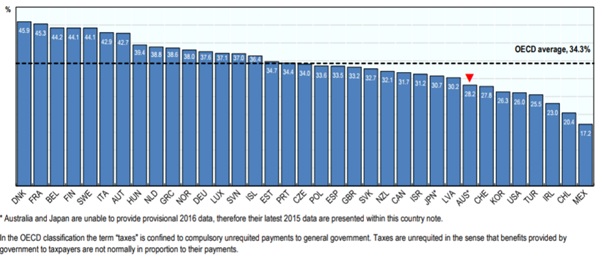
    Our overall tax take is one of the lowest among the 35 OECD countries. If Mr. Morrison was correct, then by now there should have been a tsunami of investment flowing here from 27 OECD countries with higher tax-GDP ratios than that of Australia’s 28.2% in 2016. Australia’s overall tax ratio is well below the OECD average of 34%, and also below neighbouring New Zealand’s tax take of 32.1% of GDP.

    Here are reported tax ratios for 27 OECD countries, 2016.

    OECD Tax Shares
    Source: Revenue Statistics 2017 – Australia; https://www.oecd.org/tax/revenue-statistics-australia.pdf

    Fact 2: Australia’s effective corporate tax is far below its statutory 30% rate

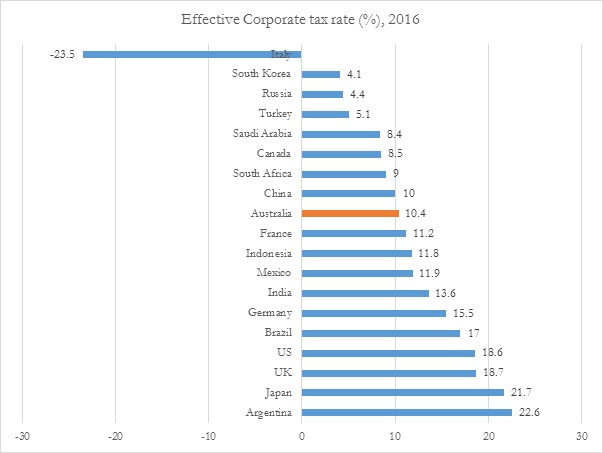
    Australian companies may seem to face a higher statutory corporate tax rate, but once they go through all their deductions and credits they don’t end up paying an unusually high amount compared to companies in other nations. The average effective rate (10.4%) is barely one-third the statutory rate. In fact, more than a third of large companies did not pay any corporate taxes in 2016 according to the recently released ATO data.

    Effective vs Statutory Tax Rates
    Source: National Public Radio, based on US Congressional Budget Office data; https://www.npr.org/2017/08/07/541797699/fact-check-does-the-u-s-have-the-highest-corporate-tax-rate-in-the-world

    Fact 3: Tax is low on companies’ lists of factors influencing investment location decision

    For example, the OECD noted, “it is not always clear that a tax reduction is required (or is able) to attract FDI. Where a higher corporate tax burden is matched by well-developed infrastructure, public services and other host country attributes attractive to business… tax competition from relatively low-tax countries not offering similar advantages may not seriously affect location choice. Indeed, a number of large OECD countries with relatively high effective tax rates are very successful in attracting FDI.”

    This is corroborated by the most recent World Bank survey of enterprises, which found that tax incentives are not high on the list of critical factors affecting inflows of foreign direct investment. The IMF’s recent research also reports that the net impact of corporate tax cuts to incentivise private investment is quite often negative on government revenues.  The pre-tax profitability of Australian businesses has also tended to exceed that in other countries, and this is surely more important in motivating investment flows.

    Fact 4: Rigorous studies of past US tax cuts did not find a positive link between tax cuts and economic or employment growth

    For example, the oft-cited examples of the Reagan or Bush tax cuts do not in fact demonstrate that tax cuts cause growth.  Admitted by President Reagan’s former chief economist, Martin Feldstein, the vast majority of growth during the Reagan era was due to expansionary monetary policy that slashed interest rates massively to help the economy bounce back from a severe recession in 1982.  Increased defence spending and an expanded labour force due to an influx of baby boomers also boosted the economy. In another study with Doug Elmendorf, the former Congressional Budget Office Director, Martin Feldstein found no evidence that the 1981 tax cuts increased employment.

    The 2001 and 2003 Bush tax cuts also failed to spur growth. Between 2001 and 2007 the economy grew at a lacklustre pace—real per-capita income rose by 1.5% annually, compared to 2.3% over the 1950-2001 period. Interestingly, the two sectors that grew most rapidly in this period were housing and finance, which were not affected by the 2001 and 2003 tax cuts.  Moreover, by 2006, prime-age males were working the same hours as in 2000 (before the tax cuts), and women were working less – both facts inconsistent with the view that lower tax rates raise labour supply.

    Fact 5: The most infamous case of tax cuts in the US State of Kansas was a colossal failure

    Governor Sam Brownback promised that a moderate tax cut for individuals and a big tax cut for businesses would be “like a shot of adrenaline into the heart of the Kansas economy.”  Unfortunately, however, despite his 2012 tax cuts, the Kansas economy remained moribund, while neighbouring states surged ahead. In the process, the Kansas state budget was left in tatters. No wonder that the Republican-led state legislature reversed most of Brownback’s tax cuts in the face of poor growth and pressing public spending needs.

    Therefore, if Mr. Morrison is serious about repairing the budget, or stimulating growth and employment, then he should be concentrating on raising more revenues (not less) and investing in the nation – instead of cutting basic services to fund his tax cuts for the rich. He should be looking at the facts, instead of resorting to scare tactics.


    You might also like

    Commonwealth Budget 2025-2026: Our analysis

    by Fiona Macdonald

    The Centre for Future Work’s research team has analysed the Commonwealth Government’s budget, focusing on key areas for workers, working lives, and labour markets. As expected with a Federal election looming, the budget is not a horror one of austerity. However, the 2025-2026 budget is characterised by the absence of any significant initiatives. There is

    Centre For Future Work to evolve into standalone entity

    The Centre for Future Work was established by the Australia Institute in 2016 to conduct and publish progressive economic research on work, employment, and labour markets. Supported by the Australian Union movement, the centre produced cutting edge research and led the national conversation on economic issues facing working people: including the future of jobs, wages