Author: Greg Jericho, David Peetz

  • The Continuing Irrelevance of Minimum Wages to Future Inflation

    The Continuing Irrelevance of Minimum Wages to Future Inflation

    Minimum and award wages should grow by 5 to 9 per cent this year
    by Greg Jericho

    Updated analysis by the by the Centre for Future Work at the Australia Institute reveals that a fair and appropriate increase to the minimum wage, and accompanying increases to award rates, would not have a significant effect on inflation. The analysis examines the correlation between minimum wage increases and inflation going back to 1990, and finds no consistent link between minimum wage increases and inflation. It also reveals that such an increase to award wages could be met with only a small reduction in profit margins.

    The report, authored by Greg Jericho, based on previous work by both he and Jim Stanford finds that an increase to the National Minimum Wage and award wages of between 5.8% and 9.2% in the Fair Work Commission’s Annual Wage Review, due in June, is required to restore the real buying power of low-paid workers to pre-pandemic trends. The report also finds that this would not significantly affect headline inflation.

    Key findings of the report include:

    • Last year’s decision, which lifted the minimum wage and award wages by 3.75 per cent, offset the inflation of the previous year but still left those on Modern Awards with real earnings below what they were in 2020.
    • By June this year, the real value of Modern Award wages will be almost 4 per cent below what they were in September 2020
    • Despite increases in the minimum wage over the past 2 years above inflation, inflation fell by a combined 4.5 percentage points.
    • There has been no significant correlation between rises in the minimum wage and inflation since 1990.
    • Raising wages by 5.8 to 9.2 per cent this year would offset both recent inflation and restore real wages for award-covered workers to the pre-pandemic trend.
    • Even if fully passed on by employers, higher award wages would have no significant impact on economy-wide prices.
    • A 9.2 per cent increase in award wages could be fully offset, with no impact on prices at all, by a 1.8 per cent reduction in corporate profits – still leaving profits far above historical levels

    “Australia’s lowest paid workers have been hardest hit by inflation over the past 3 years. The price rises of necessities always hurt those on low incomes harder than those on average and high incomes. This analysis shows there is no credible economic reason to deny them a decent pay raise above inflation.” Jericho said.

    “It’s vital the Fair Work Commission ensure that the minimum wage not only keeps up with inflation but also returns the value to the real trend of before the pandemic.”


    The Continuing Irrelevance of Minimum Wages to Future Inflation


    Factsheet
    The continuing irrelevance of minimum wages to future inflation

    Share

  • Real wages falls and interest rates rises signal tough times for households and the economy

    Originally published in The Guardian on May 25, 2023

    You can’t sustain household spending while real wages continue to fall, and households are starting to let everyone know

    The Australian economy – like all economies – is about people. And yet too often company profits are used as a judge of economic health. Throughout the pandemic and in the years since, company profits have soared while the real wages of workers has fallen. This situation is inherently unsustainable with an economy dependent upon household consumption. As policy director Greg Jericho writes in his Guardian Australia column, we are beginning to see households struggle to keep going.

    The Budget delivered this month by Treasurer Jim Chalmers revealed that the next financial year starting in little over a month is set to be one of the worst in the past 40 years. Household consumption is expected to rise just 1.5% – the 5th worst since 1985-86. Even worse if we account for an expected 1.7% rise in population this means in a per capita sense, real household spending is about to fall.

    And when household spending slows, so too does the entire economy.

    We have already see the beginnings of this with sharp slowing in the volume of retail spending being done, all while the amount of money we are spending rises. In effect we are paying more for less. This means the “nominal” figures in the retail trade data hides the weakness in the economy and the pain households are going through.

    With mortgage repayments rising nearly 80% in the past year, households are switching from spending in shops and on services that employ people, to paying off their loans – driving up the profits of banks ever more, but in doing so actually slowing the economy.

    The Reserve Bank is getting what it wanted – a slowing economy, less money being spent and rising unemployment.  But with conditions only seen in recessions expected in the next year, the risk that this slowing will lead to the economy stopping completely is rising, and the Reserve Bank must not raise rates any further and be extremely mindful of the pain they have already caused to households struggling from the fastest increase in loan repayments in over 30 years at the same time as real wage fall faster than they have on record.


    You might also like

  • Wages are growing solidly but real wages continue to plummet

    Originally published in The Guardian on May 18, 2023

    Wages are growing the best they have for 11 years, but real wages are now back at the level they were 14 years ago

    The good news of the strongest wages growth since 2012, writes policy director Greg Jericho, in his Guardian Australia column, is tempered by the fact that real wages have fallen back to levels last seen in early 2009.

    The 3.7% growth in the wage price index demonstrates that workers are finally seeing some return for the tighter labour market in which unemployment is at around 50-year lows. It also reflects that public servants are also becoming free of the wage caps over the past decade that had purposefully kept wages down.

    In the March quarter for the first time in more than a decade, public-sector wages grew by 0.9%. Private-sector wages have also grown above 0.75% for 4 straight quarters – the first time since September 2012.

    But even with this very good wage growth, workers are seeing their living standards fall. In real terms, wages fell 3.1% in the past year and are now 5.4% below where they were before the pandemic. This destruction of purchasing power will take many years to recover. And it highlights that wages should rise faster than inflation and with workers being the ones who have suffered the most from inflation, they should not be expected to suffer once inflation is back within normal ranges.


    You might also like

  • With interest rates set to rise another 3 times, no wonder consumers are feeling grim

    Originally published in The Guardian on February 16, 2023

    The Reserve Bank now forecasts real household incomes will take longer to recover than they did during the 1990s recession and is also projecting economic growth at historical lows. Australian consumers are right to feel worried about the future.

    Right now Australian consumers have less confidence than they did in April 2020 when the entire world was locked down and the pandemic was raging without any prospect of a vaccine.

    That might suggest that Australians are overly pessimistic, especially given unemployment is at generational lows of 3.5%, but when you look at the statements of the Reserve Bank and its projections for the next 2 years, it is little wonder Australians are worried.

    Last week the RBA not only lifted the cash rate for the 9th straight time, it signalled that there would be a plural number of rises to come. In response, the market now anticipates at least three more rate rises, with a slight chance of 4 more. That would be easily the fastest and largest raising of interest rates since the late 1980s. And Australians are well aware of what occurred after the 1980s rate rises.

    Indeed even the Reserve Bank is anticipating a sharp slowing of the economy. While not suggesting a recession is imminent, in its latest Statement on Monetary Policy the RBA forecast 2 straight years of GDP growth of less than 1.8%. That would equal the record length of less than 2% growth during the 1990s recession. In reality, anytime Australia’s economy has grown by less than 2% for just one year there has been either a recession or near recession conditions such as during the GFC.

    Australians are right to be wary especially as their standard of living has suffered a sharp decline in the past year as incomes fail to keep up with inflation.

    The Reserve Bank of course does need to be concerned about inflation but given the expectations of recessions of slight contractions in the UK, USA and Europe the risk of a recession should be weighed much higher than they currently are.


    You might also like

  • Inflation is soaring and real wages are plummeting

    Originally published in The Guardian on October 27, 2022

    On Wednesday the latest inflation figures showed that in the 12 months to September prices across Australia grew by 7.3% – the fastest rate since 1990.

    The biggest concerns about the figures are that inflation is rising fastest for items that are non-discretionary, which means people are unable to avoid paying them – things like food, energy bills, transport costs, and health costs. As Labour market and fiscal policy Director, Greg Jericho, notes in his Guardian Australia column low-middle income earners have to spend a greater share of their income on these items than the average, which means they are hurt hardest.

    The inflation figures also show that while house prices are still rising strongly, the rising interest rates are now starting to truly have an impact on rents. Rental prices across every capital city rose by more than 1% in the September quarter – the first time that has happened since 2007.

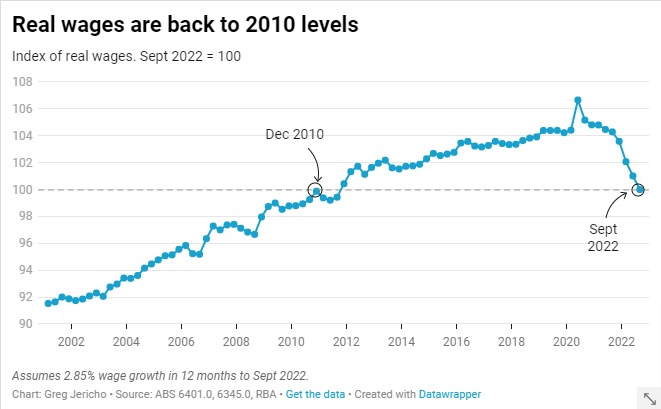
    But the real damage of inflation is seen in relation to wage growth. The Reserve Bank estimates that wages in the 12 months to September will have grown just 2.85%. This means people’s ability to buy things with their wages has fallen over 4% in the past year. This is a massive drop in real wages and unfortunately, it is expected to continue at least until the middle to end of next year.

    Right now real wages are back where they were 12 years ago. It is a damning indictment of the Industrial Relations system that has been designed to keep wages down. The Government today has introduced the Fair Work Legislation Amendment (Secure Jobs, Better Pay) Bill 2022 which seeks to provide workers with greater power to bargain for better wages. Given the latest figures, it is clear how urgently the changes are needed.


    You might also like

  • Inflation: A Primer

    Inflation: A Primer

    by Greg Jericho

    Over the past year, inflation has accelerated both in Australia and in most advanced economies, to rates much faster than have been observed for many years. Not unsurprisingly, this has caused much concern among people whose cost of living has risen abruptly. It has also created great challenges for policy makers: the risks of tackling higher inflation are high, given that the conventional response is to reduce aggregate demand, economic activity, and employment in order to “cool off” spending and thus reduce price pressures. This can mean that the “cure” can be worse than the “disease” – especially if, as occurred in the 1980s and 1990s, a recession follows efforts to constrain inflation.

    The Inflation Primer report investigates the history of Australian inflation and policy choices and provides a counter to the view that low inflation and the current inflation target is an unalloyed good. The period of inflation targeting has coincided with a strong shift of national income away from workers to company profits. It has also seen a tendency of the Reserve Bank to act decisively when inflation grows above the target and be much less active when, as we saw in the years prior to the pandemic, inflation slowed below the target range. The report also reveals that workers’ wages did not cause the current level of inflation  and yet workers are being urged to accept historic falls in real wages in order bring inflation back within the Reserve Bank target.

    Our review of the causes of current inflation points to some clear policy conclusions, that should be kept in mind by the government, the Reserve Bank, and other stakeholders as Australia continues to adjust to these new inflationary challenges:

    1. Inflation targeting in Australia since 1993 has not been “neutral”. Inflation missed the target from below, far more often than from above. Moreover, that period of inflation targeting (especially the sustained periods when inflation fell below the target) was associated with a massive transfer of income and economic power from workers to businesses. As the Commonwealth government undertakes its review of the RBA’s mandate and operations, these broad political-economic dimensions of monetary policy must be considered carefully. Monetary policy has not been a technocratic exercise, intended to maximise public welfare in a general sense. It clearly reflects and continues to reflect, value judgments and priorities placed on how the costs and benefits of inflation management are distributed across society.
    2. There is no evidence at all that a tight labour market, rising wages, or labour costs more generally have anything to do with the surge in inflation since the COVID pandemic. To the contrary, the evidence is clear that wages have had a dampening impact on inflation in this period. Recent inflation is clearly associated with a further expansion of business profits in Australia, to their highest share ever. Attacking inflation by aiming deliberately to increase unemployment and restrain wage growth even further, is a “blame-the-victim” policy that will only make workers pay even more for a problem they clearly did not create.
    3. The current surge of inflation reflects a “perfect storm” of unique factors (mostly global in nature) sparked by the COVID pandemic: which has been, after all, the most dramatic and painful event in the world economy since WWII. It should hardly be surprising that after-shocks from those events will be felt for some time, and the surge in global inflation is clearly one of them. Responding to this unique and unprecedented challenge by simply reciting a monetary playbook formulated in a fundamentally different era (the inflation of the 1970s) is not just inappropriate. It will, if pursued, lead to a painful and unnecessary global recession that will almost certainly engulf Australia, too.

    For all these reasons, the Reserve Bank and the Commonwealth government need to take a more careful, balanced look at the nature, causes, and consequences of the upsurge in inflation since the pandemic, before leaping to conclusions that are unjustified – and imposing policy responses that do more harm than good.


    Full report

    Share

  • Real wages plummet and will take years to recover

    Originally published in The Guardian on May 19, 2022

    The release of the March Wage Price Index confirms what a horror year it has been for workers. While inflation in the past 12 months rose 5.1%, wages grew just 2.4%. Even worse, in the past year the price of non-discretionary items rose 6.6%, meaning for those on low wages, who spend more of their incomes on essential items, real wages would have fallen even more than the 2.6% average fall.

    Labour market policy director, Greg Jericho notes in his Guardian Australia column that the fall in real wages has been the worst since the introduction of the GST and in the first 3 months of this year real wages fell 1.5%.

    So steep has been the fall that real wages are now back essentially to where they were at the time of the September 2013 election.

    The fall highlights that talk about Australia having recovered from the pandemic ignores the most basic aspect of the economy – the living standards of workers from their wages.

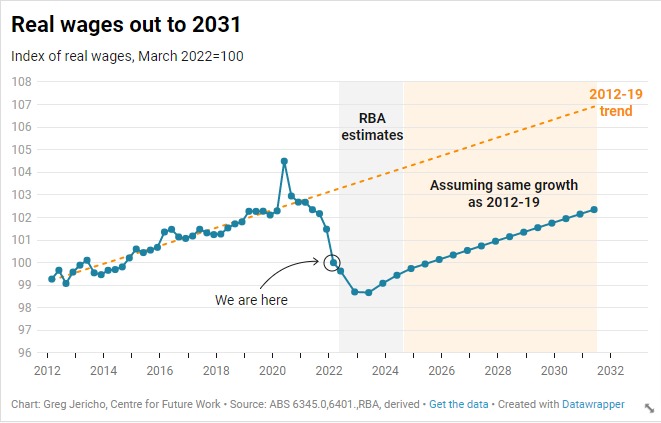
    The fall is such that even with the RBA’s estimates of solid wage growth recovery over the next two years, should Australia return to pre-pandemic trend real wages growth, it would take till 2031 to recover workers purchasing power back to the levels of 2020.

    That would we a lost decade of living standards.


    You might also like

  • High inflation means real wages have plummeted

    Originally published in The Guardian on April 28, 2022

    The March CPI figures showing that inflation rose 5.1% over the past 12 months is not just the highest level since the introduction of the GST it also signals the biggest fall in real wages since then as well.

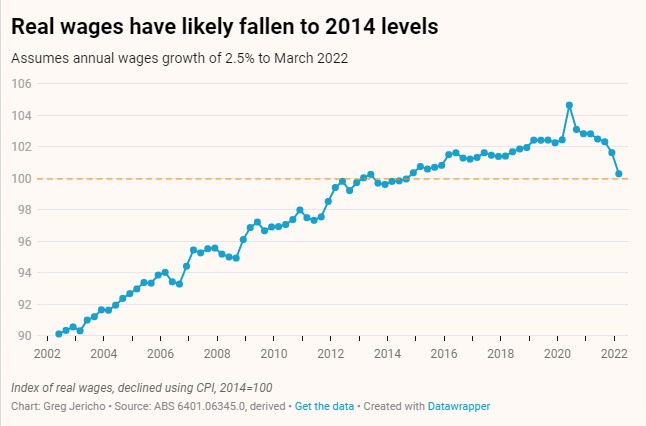
    Labour market policy director, Greg Jericho, notes in his column in Guardian Australia that even if wages have increased by 2.5% in the next release (up from 2.3% in the 12 months to December) real wages will have fallen 2.5% in the past 12 months.

    That would mean real wages would be back at 2014 levels and barely above where they were when the LNP took office in September 2013.

    Worse still for low-income earners, in the past 12 months the prices of non-discretionary items rose 6.6%. For those whose income goes more towards paying essential bills than does the average household, the pain of these price rises has been much higher. Their real wages have likely fallen by more than 3% in the past 12 months.

    This is why any gloating about a recovery from the pandemic must be tempered to consider the reality of workers’ lives. It is not enough to point to lower unemployment if real wages are falling faster than they ever have outside of the introduction of the GST – especially for lower income earners.

    That is not a recovery; that is a failure.

    With interest rate rises now very much on the way, without wage rises that account for inflation and properly reward for increases in productivity, workers standard of living is set to fall and see them back where they were nearly a decade ago.


    You might also like